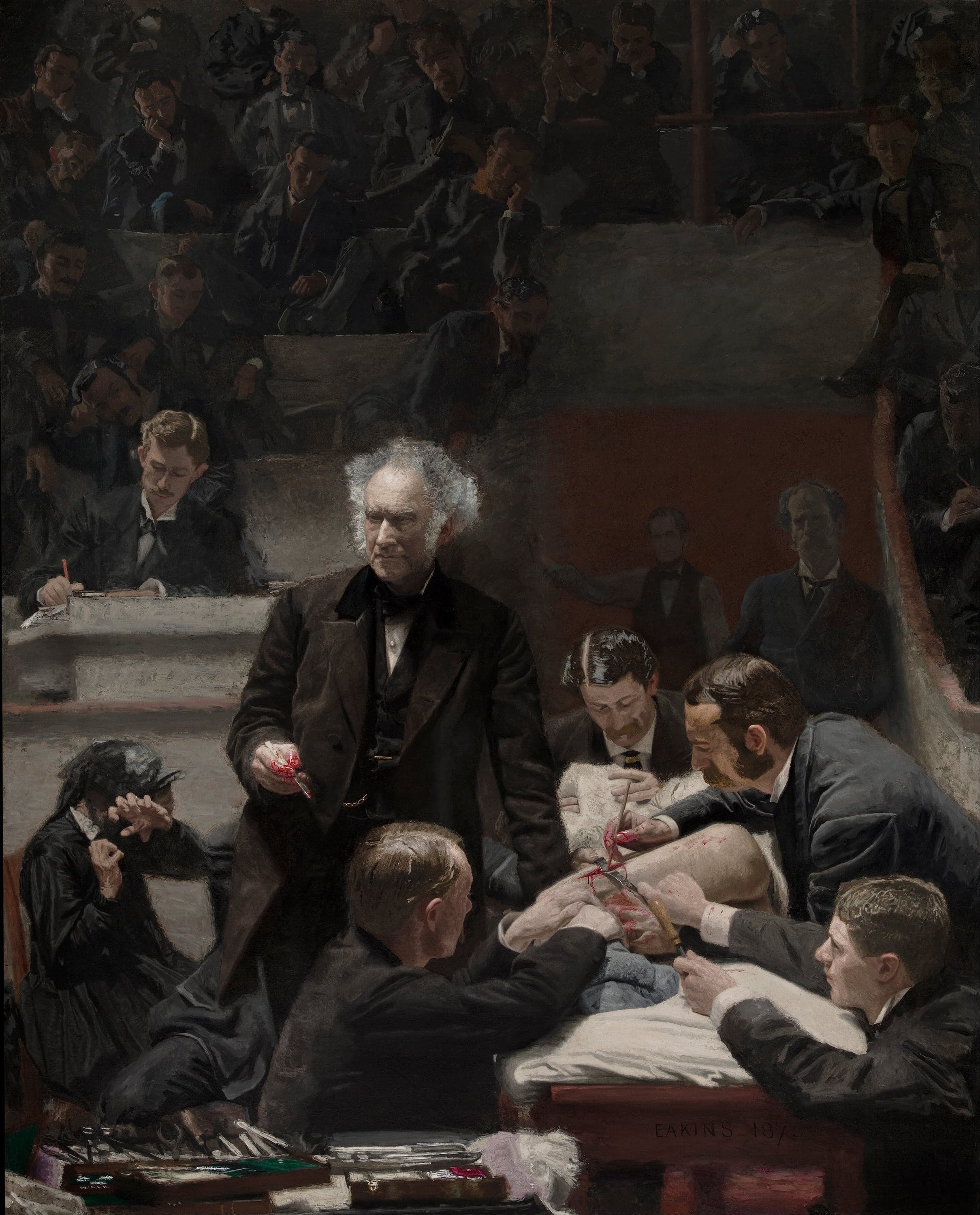
Portrait of Dr. Samuel D. Gross (The Gross Clinic)
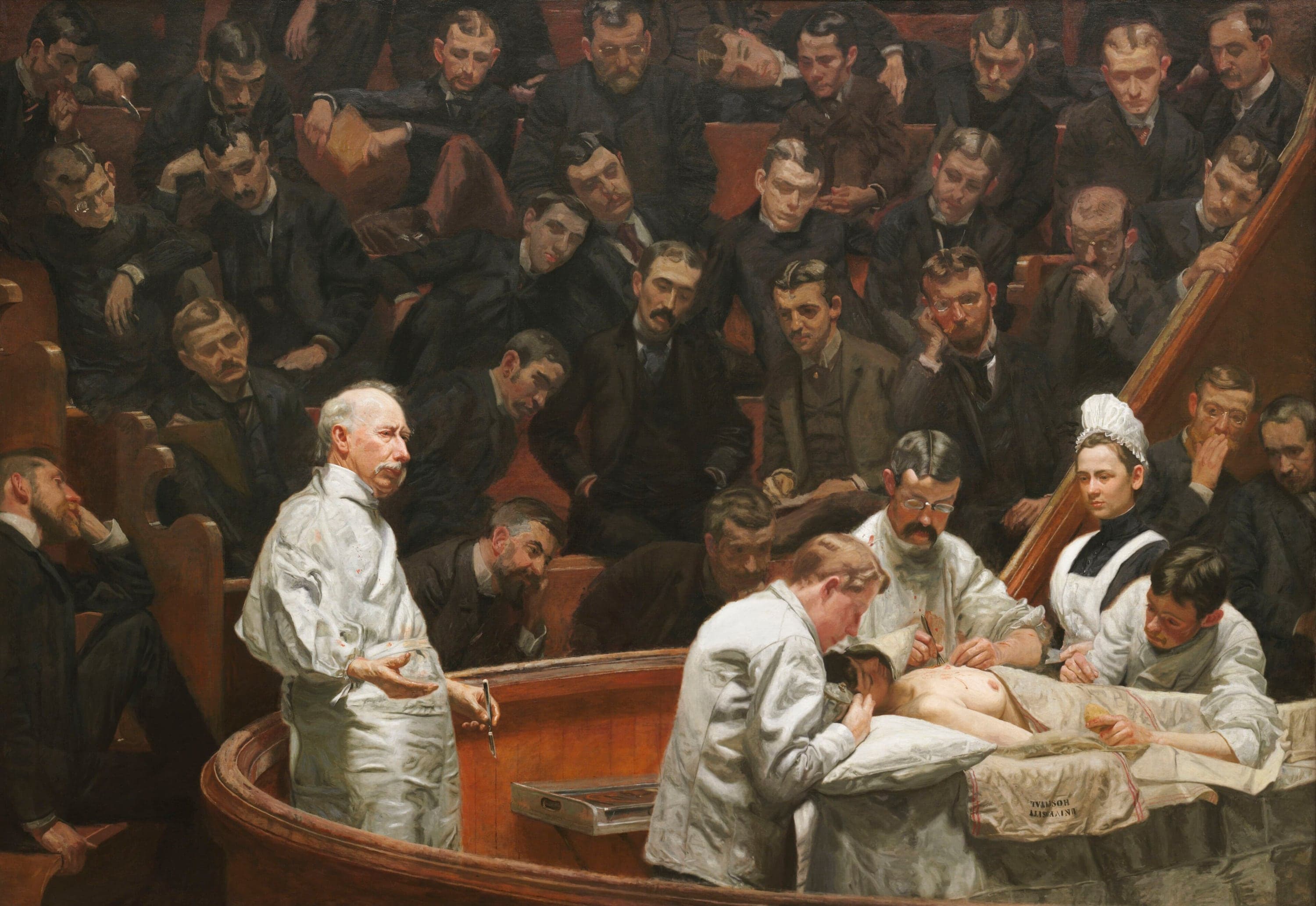
Samuel D. Gross, a seventy-year-old Philadelphia surgeon in a black frock coat, turns from an operation to lecture, a bloodied scalpel in his right hand. Thomas Eakins painted the scene in 1875 in the surgical amphitheatre of Jefferson Medical College, where he had studied anatomy a decade earlier. The Philadelphia Museum of Art and the Pennsylvania Academy of the Fine Arts bought the canvas together in 2007 and show it in turn.
- 1875
- Oil on canvas
- Philadelphia Museum of Art and Pennsylvania Academy of the Fine ArtsPhiladelphia, United States
About Thomas Eakins
What the painting shows
Samuel D. Gross stands at the centre of a surgical amphitheatre, lit from above so that his white hair and forehead are the brightest things in the picture. He wears a black frock coat and holds a scalpel in his right hand, the fingers red with blood. He is not looking at the wound. He has turned to speak to the students in the tiers behind him.
Four other doctors work at the table. One bends over the patient's head with a folded white cloth, the anaesthetic. Two lean in over the thigh with a probe and a retractor, and one holds the legs. The patient lies on his side with his left thigh laid open and his feet, in grey socks, pointing towards the viewer. Kathleen A. Foster, the Philadelphia Museum of Art's curator of American art, describes him as a little boy.
At the lower left a woman in black shrinks from the sight, one clawed hand thrown across her eyes. The museum records the tradition that she is the patient's mother. Behind Gross, at a desk on the left, a clerk with a pencil takes notes on the operation. Two men stand in the dark doorway of the tunnel at the right. At the very edge of the canvas Thomas Eakins sits sketching, a dark sleeve, a white cuff and a pencil showing beside the railing.
The rows of students above are painted in near darkness, with only a few faces catching the light. The canvas is 243.8 by 198.1 centimetres, eight feet by six and a half, and is signed and dated EAKINS 1875 on the front of the operating table.
The operation, and what Eakins brought to it
Gross is operating on a diseased thigh bone. The museum's label calls the procedure relatively new, one Gross had developed to treat bone infections. Foster puts the advance plainly: ten years earlier the boy would have lost the leg. Cleaning out the bone let it renew, and the patient could be sewn up and walking within a month.
Two things in the picture belong to 1875 rather than to modern surgery. The doctors operate in their street clothes, and Gross, in Foster's account, was still resisting the germ theory taught by Joseph Lister. The anaesthetic is a cloth soaked in ether or chloroform, moved closer to or further from the patient's nose as he breathed. The light comes from a skylight, so operations were done at noon.
Eakins knew the room. He had taken courses in anatomy and dissection at Jefferson Medical College in 1864 and 1865, and Foster says he had attended Gross's clinics. Between those years and the painting he spent 1866 to 1870 in Europe, most of it at the École des Beaux-Arts in Paris under Jean-Léon Gérôme, with further study in the studio of Léon Bonnat. Gérôme's tightly finished surfaces and Bonnat's insistence on anatomical exactness, which William Innes Homer's biography records, are both here, in the modelling of the surgeon's head and the drawing of the hands at the wound.
Foster reads the canvas as a showpiece made for the Centennial. Eakins, she says, wanted to make a giant poster advertising the excellence of Philadelphia's medical community, and picked Gross because he was an innovator in surgical technique.
The Centennial jury and the hospital ward
The art jury of the 1876 Centennial Exhibition in Philadelphia rejected the painting. The museum's label suggests the subject was judged too bloody and brutal for the art building; Foster says it was the blood on the hand. The canvas hung instead in a model United States Army post hospital on the exhibition grounds.
A critic in the Philadelphia Evening Telegraph of 16 June 1876 took the painting's side in print. There was nothing so fine in the American section of the art department, he wrote, and it was a great pity that the squeamishness of the selection committee had forced the artist into the United States Hospital building. Other viewers were repelled. The museum's label records that many found the realism ugly and inartistic, while some admired the command of composition, colour and detail.
The Alumni Association of Jefferson Medical College bought the painting and gave it to the college in 1878. It went on to the world's fairs at Chicago, Buffalo and St. Louis, and won a gold medal at St. Louis in 1904, according to the catalogue of the Metropolitan Museum of Art's memorial exhibition of 1917, to which the college lent it.
The sale of 2006 and the two owners
In November 2006 the trustees of Thomas Jefferson University agreed to sell the painting for $68 million to the National Gallery of Art in Washington and the Crystal Bridges Museum of American Art, then being built in Bentonville, Arkansas. Carol Vogel reported the deal in The New York Times on 11 November. The two Philadelphia institutions matched the price, and the museum's credit line records the purchase by the Pennsylvania Academy of the Fine Arts and the Philadelphia Museum of Art in 2007, with the support of more than 3,600 donors.
The two owners show the painting in turn. In August 2026 The Philadelphia Inquirer reported a five-year cycle, with the canvas at the Pennsylvania Academy until 2031. It hangs there in A Nation of Artists, the two museums' joint exhibition for the country's 250th anniversary, which runs at the Academy from 12 April 2026 to 5 September 2027. The Philadelphia Museum of Art's online record still lists it in Gallery 255, so a visitor should check with both before travelling.
The museum's conservators, led by Mark Tucker, planned a treatment in the autumn of 2009 to alleviate earlier damage to the surface and bring the picture closer to the way it looked when Eakins finished it. The painting returned to the galleries in 2010.
Close reading
Reading the work, detail by detail
Start with the lit head and the bloodied hand, then follow the operation down to the incision and out to the people who are not doctors: the woman hiding her eyes, the clerk, the two men in the tunnel and the painter at the edge.
1.The surgeon's head
Samuel D. Gross has turned away from the table to speak to the students. Light from a skylight above catches the top of his head and forehead, which Kathleen A. Foster of the Philadelphia Museum of Art describes as the painter's way of giving the surgeon a halo of hair.
2.The scalpel and the bloodied hand
The blood on Gross's fingers is the brightest red in the picture. Foster says it was this hand that got the painting excluded from the art exhibition of the 1876 Centennial. The watch chain and the stud in his shirt belong to a man who, in her words, has just walked in off the street.
3.The incision
Two assistants work at the wound while Gross lectures. The museum's label says the operation treated a bone infection with a procedure Gross had developed, and Foster explains that cleaning out the bone let it renew, where ten years earlier the leg would have been amputated.
4.The cloth over the patient's face
The patient's head is at the far end of the table, under the anaesthetist's cloth. Foster describes the anaesthesia of 1875 as a towel soaked in ether or chloroform, moved nearer or further from the patient's nose as he breathed.
5.The assistant holding the legs
A fourth assistant steadies the patient's legs at the foot of the table. Foster says the little boy lies on his side with his feet towards the viewer, so the thigh under the knife is what the audience sees first.
6.The woman hiding her eyes
The museum records the tradition that she is the patient's mother. Foster reads her as standing in for the viewer: horrified, not a professional, and set against the calm of the doctors around the table.
7.The clerk
A clerk records the operation from a desk behind Gross. The museum's label mentions the man recording the surgery among the figures a viewer's eye moves to after the surgeon.
8.The two men in the tunnel
Two figures stand in the tunnel that leads into the amphitheatre. They are painted in half-light, so that only their collars and faces come forward from the red-brown wall.
9.Eakins at the edge
The museum's label places Thomas Eakins seated to the right of the tunnel railing, sketching or writing. In the reproduction only the sleeve, cuff and pencil are clear; the face is lost in the dark at the edge.
10.The signature on the table
Eakins signed and dated the picture on the front edge of the table rather than in a corner. The Metropolitan Museum of Art's 1917 catalogue recorded the inscription as signed and dated near the bottom, EAKINS 1875.
Timeline
1864–65
Thomas Eakins takes courses in anatomy and dissection at Jefferson Medical College.
1866–70
Studies in Paris at the École des Beaux-Arts under Jean-Léon Gérôme and in the studio of Léon Bonnat, then returns to Philadelphia.
1875
Painted, and signed and dated EAKINS 1875 on the front of the operating table.
1876
Rejected by the art jury of the Centennial Exhibition and shown instead in the model army post hospital on the grounds. The Evening Telegraph defends it on 16 June.
1878
Given to Jefferson Medical College by its Alumni Association.
1904
Wins a gold medal at the St. Louis world's fair, after showings at Chicago and Buffalo.
1917
Number 9 in the Metropolitan Museum of Art's memorial loan exhibition, lent by Jefferson Medical College.
2006
Thomas Jefferson University agrees on 11 November to sell it for $68 million to the National Gallery of Art and Crystal Bridges.
2007
Bought by the Pennsylvania Academy of the Fine Arts and the Philadelphia Museum of Art with the support of more than 3,600 donors. Accessioned as 2007-1-1.
2009–10
Conserved at the Philadelphia Museum of Art under Mark Tucker and returned to the galleries in 2010.
2026
Shown at the Pennsylvania Academy in A Nation of Artists, 12 April 2026 to 5 September 2027.
Where to see it
Philadelphia Museum of Art and Pennsylvania Academy of the Fine Arts
Philadelphia, United States
A public viewing address has not yet been confirmed for this holding.
Owned jointly and shown in turn on a five-year cycle. At the Pennsylvania Academy of the Fine Arts, 118–128 North Broad Street, in A Nation of Artists until 5 September 2027, and there until 2031 according to The Philadelphia Inquirer. The Philadelphia Museum of Art's online record still lists Gallery 255, so check with both museums before travelling.
Frequently asked questions
Where is The Gross Clinic?
It belongs jointly to the Philadelphia Museum of Art and the Pennsylvania Academy of the Fine Arts, which show it in turn. In August 2026 The Philadelphia Inquirer reported it at the Academy, 118–128 North Broad Street, until 2031, in the exhibition A Nation of Artists, which runs there to 5 September 2027. The Philadelphia Museum of Art's online record still lists Gallery 255, so check with both museums before travelling.
What operation is shown in The Gross Clinic?
Samuel D. Gross is removing diseased bone from a boy's thigh. The museum's label calls it a relatively new procedure Gross had developed for bone infections. Kathleen A. Foster, the museum's curator, says that ten years earlier the leg would have been amputated; cleaning out the bone let it renew.
Who is the woman in The Gross Clinic?
The museum records the tradition that the woman at the lower left, hiding her eyes with a clawed hand, is the patient's mother. Foster reads her as standing in for the viewer: horrified, and unlike the doctors, not a professional who knows what is happening.
Why was The Gross Clinic rejected in 1876?
The art jury of the Centennial Exhibition in Philadelphia turned it down, according to the museum, perhaps because the subject was too bloody and brutal for the art building. Foster says it was the blood on the surgeon's hand. The painting hung instead in a model army post hospital on the grounds, where the Evening Telegraph's critic called it the finest thing in the American section.
Where is Thomas Eakins in The Gross Clinic?
At the right edge of the canvas, seated beside the tunnel railing and sketching or writing, according to the museum's label. In the reproduction only his dark sleeve, a white cuff and a pencil are clear.
How big is The Gross Clinic?
243.8 by 198.1 centimetres, about eight feet high by six and a half feet wide, in oil on canvas. The figures are close to life size.
How much did The Gross Clinic sell for?
In November 2006 Thomas Jefferson University agreed to sell it for $68 million to the National Gallery of Art and the Crystal Bridges Museum of American Art. The Pennsylvania Academy of the Fine Arts and the Philadelphia Museum of Art matched that price and bought it in 2007, with the support of more than 3,600 donors according to the museum's credit line.
More by Thomas Eakins
If you like Thomas Eakins
Explore painters from the same movements and circles.
Rosa Bonheur
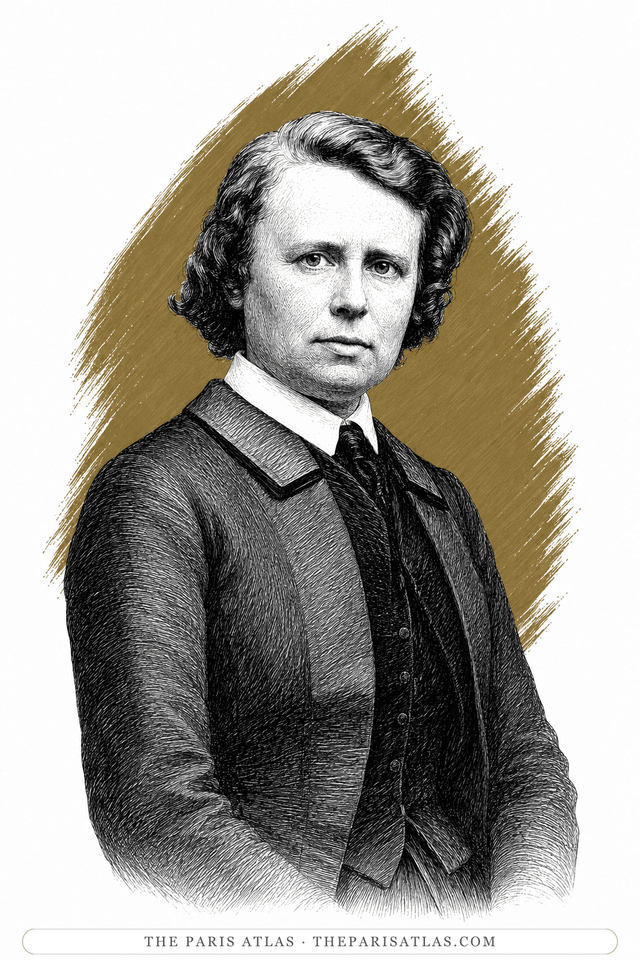
At the horse markets of Paris and in her studio beside the forest of Fontainebleau, Rosa Bonheur gave animals the presence of great portrait subjects. The success of The Horse Fair helped her build a life shaped by her work, financial independence, and the women she loved.
View artist
Henri Cartier-Bresson
French photographer who turned a pocket-sized 35mm camera into an instrument of split-second composition — the idea the world knows as 'the decisive moment'. He trained as a painter, was taken prisoner in 1940 and escaped on his third try, photographed the Liberation of Paris in August 1944, co-founded the photographer-owned agency Magnum Photos in 1947, gave up reporting for drawing in the 1970s, and left Paris a foundation in the Marais that deliberately hangs no permanent display of his own pictures.
View artist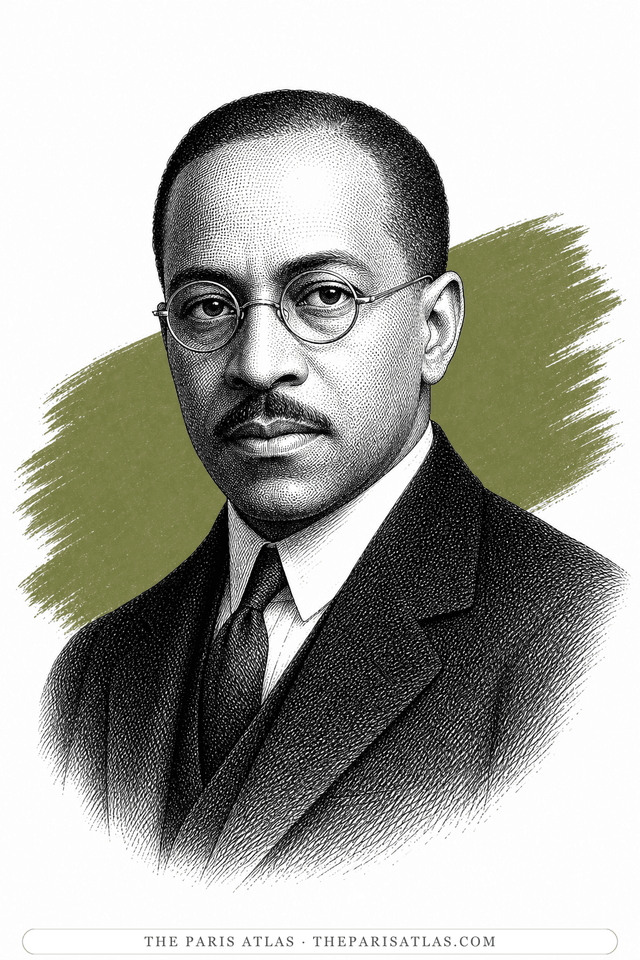
Aaron Douglas
The painter who gave the Harlem Renaissance — the flowering of Black American writing, music and art between the world wars — its look, in flat purple silhouettes in profile, ringed by bands of light. He moved to Harlem in 1925 with Paris as the eventual destination, got there in 1931, spent a year at the Académie Scandinave, a private art school in the city, and came home to paint the four murals that are still the centrepiece of the Schomburg Center, the New York Public Library's Harlem research library on Black history.
View artist
References
The sources below include collection records, catalogues, scholarly research, and primary materials that informed this page. They document Portrait of Dr. Samuel D. Gross (The Gross Clinic), its making, and its place in cultural history.


1Portrait of Dr. Samuel D. Gross (The Gross Clinic)
WebsitePhiladelphia Museum of ArtUsed forWeb source consulted for documented facts and historical context presented on the Portrait of Dr. Samuel D. Gross (The Gross Clinic) page.
2Thomas Eakins, The Gross Clinic and The Agnew Clinic
WebsiteSmarthistoryUsed forWeb source consulted for documented facts and historical context presented on the Portrait of Dr. Samuel D. Gross (The Gross Clinic) page.
3A Nation of Artists
WebsitePennsylvania Academy of the Fine Arts, 2026Used forWeb source consulted for documented facts and historical context presented on the Portrait of Dr. Samuel D. Gross (The Gross Clinic) page.

4Thomas Eakins' The Agnew Clinic and The Gross Clinic are on view at the expansive A Nation of Artists
PeriodicalThe Philadelphia Inquirer, 2026Used forContemporary reporting or criticism used to document the historical reception and context of Portrait of Dr. Samuel D. Gross (The Gross Clinic).
5Loan Exhibition of the Works of Thomas Eakins, November 5 to December 3, 1917
Exhibition catalogueThe Metropolitan Museum of Art, 1917Used forCatalogue scholarship used to verify attribution, provenance, chronology, and interpretive context for Portrait of Dr. Samuel D. Gross (The Gross Clinic).
6Eakins Masterwork Is to Be Sold to Museums
PeriodicalThe New York Times, 2006Used forContemporary reporting or criticism used to document the historical reception and context of Portrait of Dr. Samuel D. Gross (The Gross Clinic).
7Thomas Eakins's The Gross Clinic: the conservation project
WebsitePhiladelphia Museum of Art, 2009Used forWeb source consulted for documented facts and historical context presented on the Portrait of Dr. Samuel D. Gross (The Gross Clinic) page.
8Thomas Eakins: His Life and Art
BiographyAbbeville Press, 1992Used forBiographical evidence used to verify chronology, relationships, and historical context connected to Portrait of Dr. Samuel D. Gross (The Gross Clinic).
9Thomas Eakins
Exhibition cataloguePhiladelphia Museum of Art, 2001Used forCatalogue scholarship used to verify attribution, provenance, chronology, and interpretive context for Portrait of Dr. Samuel D. Gross (The Gross Clinic).
These references provide the documented foundation for this work's history and interpretation. Claim-level citations remain attached to the specific claims they support.
 Explore more resources