The rowing pictures and The Gross Clinic, 1870–1876
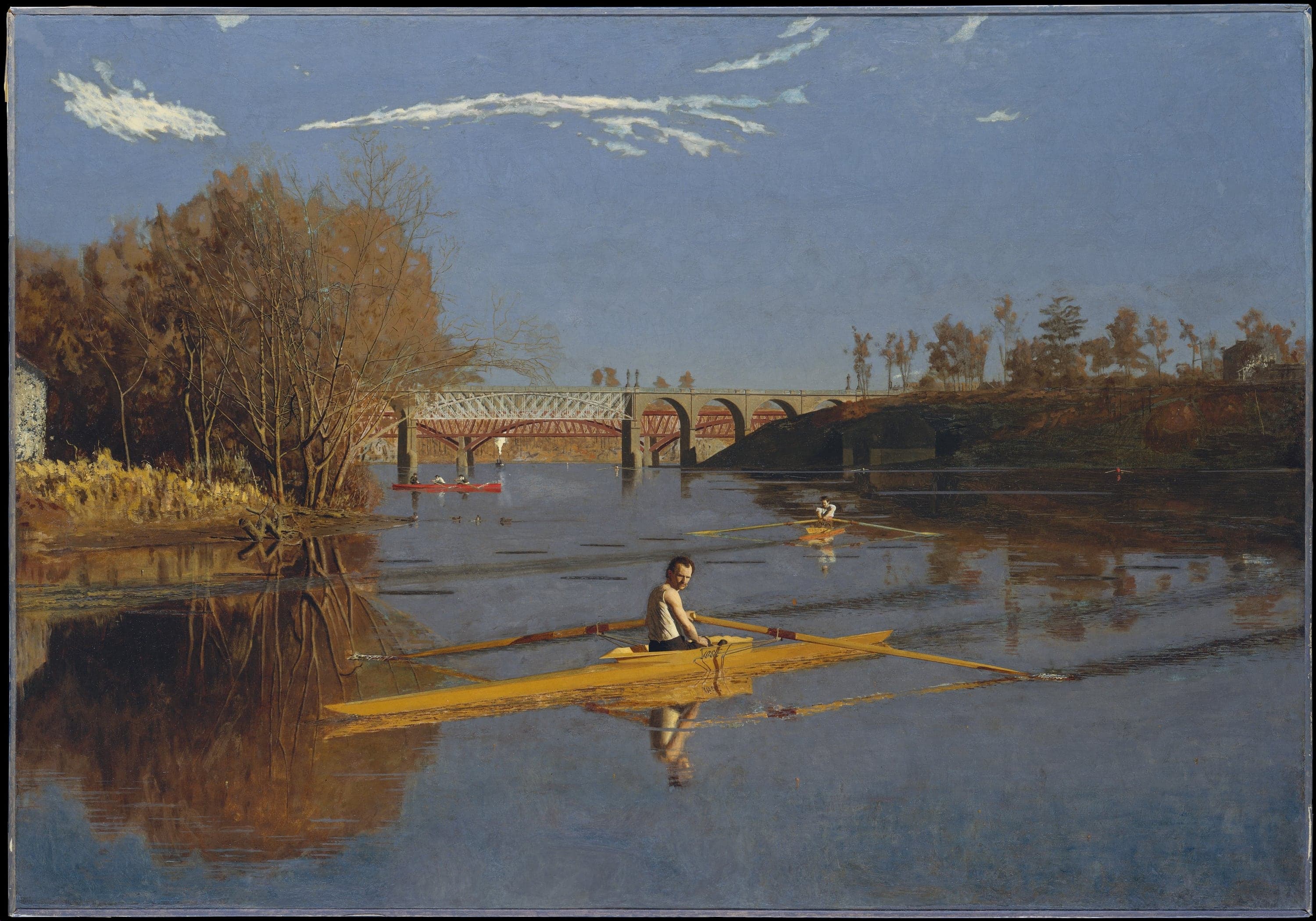
Back in Philadelphia, Eakins painted a group of rowing scenes, eleven oils and watercolours in all. The first and best known is Max Schmitt in a Single Scull (1871), also called The Champion Single Sculling. Choosing a contemporary sport was unusual enough in the city to draw comment on its own. Eakins put himself into the picture, rowing a scull behind Schmitt, with his own name written on the boat. His first known sale was a watercolour, The Sculler, in 1874.
He worked on domestic interiors at the same time, using his father, his sisters and his friends as sitters. Home Scene (1871), Elizabeth Crowell and her Dog (1874), Elizabeth at the Piano (1875) and The Chess Players (1876) are all dark in tone and plain in handling. In 1872 he painted his first large portrait, Kathrin, showing Kathrin Crowell in dim light playing with a kitten. Eakins and Crowell became engaged in 1874, and they were still engaged when she died of meningitis in 1879. In 1874 Benjamin Eakins added a fourth floor to the family house at 1729 Mount Vernon Street as a studio for his son.
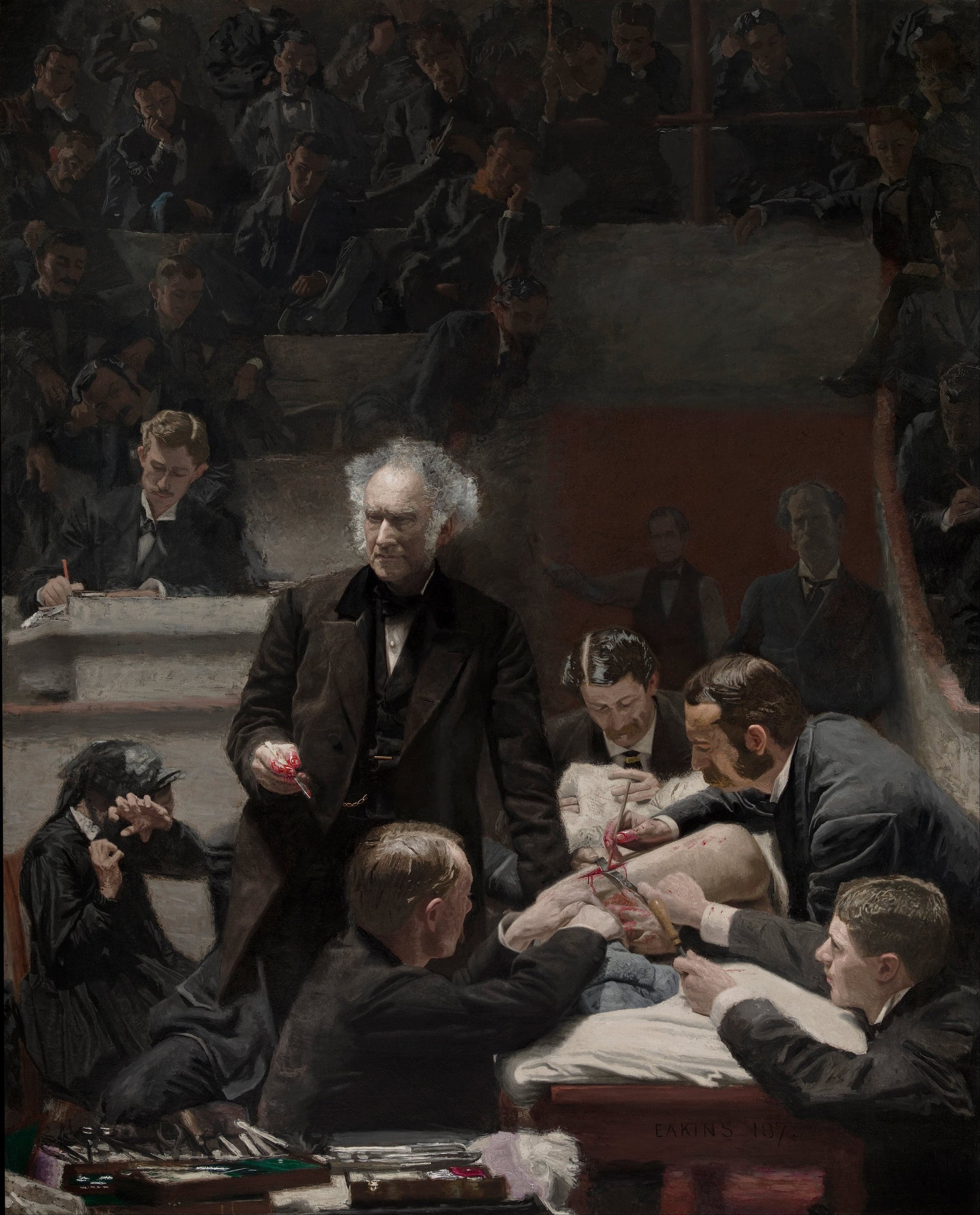
The Gross Clinic (1875) took Eakins nearly a year. It shows Samuel D. Gross, a leading Philadelphia surgeon, presiding over an operation to remove part of a diseased bone from a patient's thigh. Gross lectures to a crowded amphitheatre of students at Jefferson Medical College. At 96 by 78 inches the canvas is one of the largest Eakins made, and its subject, modern surgery, was a field in which Philadelphia led.
He may have painted it for the Centennial Exposition of 1876, but the exposition's art gallery rejected it. It hung instead on the centennial grounds, in an exhibit of a United States Army post hospital. Another Eakins submission, The Chess Players, was accepted by the committee and widely praised. Public reaction to the surgical incision and the blood was mixed at best, and Jefferson Medical College bought the painting for $200.
Eakins borrowed the picture back for later exhibitions, where it drew strong reactions. The New York Daily Tribune wrote that the more one praised it, the more one had to condemn its admission to a gallery where people of weak nerves would be made to look at it. No purpose was gained and no lesson taught by the display, the paper said. In 1876 Eakins painted a second surgeon, John Brinton of the Philadelphia Hospital, in a more informal setting, and The Art Journal called it a more favourable example of his abilities.
Teaching at the Pennsylvania Academy and the forced resignation, 1876–1886
Eakins returned to the Pennsylvania Academy of the Fine Arts as a volunteer teacher in 1876, when its new building by Frank Furness opened. He became a salaried professor in 1878 and director of the school in 1882. His methods broke with the usual training. Students did not draw from antique casts, and after a short charcoal study they were put straight on to paint, so that they met colour early.
The centre of the course was the human figure. Students took anatomy, dissected bodies, and made plaster casts from the dissections, copies of which were handed out for study. They also studied perspective, which involved a good deal of mathematics, and the anatomy of horses. Eakins encouraged them to use photography to understand anatomy and movement, and he refused to run prize competitions.
His students included Henry Ossawa Tanner, Thomas Pollock Anshutz, Alice Barber Stephens, Edward Willis Redfield, Colin Campbell Cooper, Frederick Judd Waugh, A. B. Frost and the Canadian painter George Agnew Reid. Eakins taught by example and said little. “A teacher can do very little for a pupil & should only be thankful if he don't hinder him,” he wrote, adding that the greater the master, mostly the less he can say.
He held that women should have the same professional training as men. Life classes and dissection were run separately for women, but women students did work from male models, who posed nude except for a loincloth. When the student Amelia Van Buren asked him about the movement of the pelvis, Eakins invited her to his studio and undressed. He wrote that he “gave her the explanation as I could not have done by words only.”
Episodes of that kind, together with the wish of younger colleagues to take the school over themselves, put Eakins at odds with the academy's board of directors. In 1886 the board forced him to resign, after he removed the loincloth from a male model in a class where women students were present. The dismissal split his family, and relatives on his wife's side took the other position in public. He spent years answering rumours and accusations about his conduct, had spells of poor health, and felt the humiliation for the rest of his life.
A drawing manual he had written and illustrated was left unfinished, and it went unpublished in his lifetime. Many students left the academy with him and set up the Art Students' League of Philadelphia, which ran from 1886 to 1893 and where Eakins taught. One of its students was the sculptor Samuel Murray, who became his closest companion in later life. He also lectured at the Art Students League of New York, the National Academy of Design, Cooper Union and the Art Students' Guild in Washington.
The Drexel Institute in Philadelphia dismissed him in March 1895, again for using a fully nude male model. The critic John Updike wrote that the dismissal followed complaints from a number of female sitters about what would now be called sexual harassment. Eakins withdrew from teaching altogether by 1898.
How Eakins painted: anatomy, perspective, and the camera
Eakins worked from life and from measurement. A painting usually began with close observation of the actual subject, then preparatory drawings of the figure and a perspective plan of the setting. The perspective drawings he made for another rowing painting, his Pair-Oared Shell, were exact enough that one researcher claimed to reconstruct distances inside the picture and to fix the position of the sun. On that basis the scene was dated to 7:20 p.m. on either 28 May or 27 July.
Anatomy underlay everything. He had dissected bodies at Jefferson Medical College as a student, went on dissecting as a teacher, and studied the anatomy of horses as closely as that of people. In 1891 the sculptor William Rudolf O'Donovan asked him to work on bronze equestrian reliefs of Abraham Lincoln and Ulysses S. Grant for the Soldiers' and Sailors' Arch in Grand Army Plaza, Brooklyn. Eakins also built wax figures and painted oil sketches before starting a large canvas.
He bought a camera in 1880, and has been credited with introducing the camera to the American art studio. Mending the Net (1881) and Arcadia (1883) were worked up at least in part from his own photographs. Some figures appear to be traced from the prints and then covered over in oil paint. Eakins used the photographs to fix the facts of a pose before the paint went on.
In the late 1870s he learned of Eadweard Muybridge's photographic motion studies, and in particular the sequences of horses. Eakins and the University of Pennsylvania trustee Fairman Rogers arranged a Muybridge lecture at the academy in 1883. A group of Philadelphians then brought Muybridge to the university, and in 1884 Eakins worked for a short time in Muybridge's studio at 36th and Pine Streets.
Their equipment differed. Muybridge fired a row of cameras to make a sequence of separate photographs, which he could also show on a projector. Eakins preferred one camera and a series of exposures laid over each other on a single negative. He wanted precise measurements from one image, so that he could translate a movement into paint. A May Morning in the Park depends on those studies for the gait of the four horses pulling Fairman Rogers's coach.
From 1883 he made what became known as the Naked Series, nude photographs of students and professional models taken from set angles to show real anatomy. They were hung and displayed for study at the school. Later photographs were less regimented, taken indoors and out, of men, women and children, including his wife. About eight hundred photographs are now attributed to Eakins and his circle, most of them figure studies and portraits.
Marriage, The Agnew Clinic, the late portraits, and death, 1884–1916
Susan Hannah Macdowell, the daughter of a Philadelphia engraver, met Eakins in 1875 at the Hazeltine Gallery, where The Gross Clinic was on show. She was twenty-five, and unlike most visitors she was impressed by the painting. She enrolled to study with Eakins at the academy, stayed six years, and won the Mary Smith Prize for the best painting by a woman student. They married in 1884, when Eakins was forty. The marriage produced no children.
Susan Macdowell Eakins painted only occasionally during the marriage. She spent most of her time supporting her husband's work, keeping the house open to students, and standing by him through the trouble at the academy. Some of her own relatives had taken the other side in that dispute. She shared his interest in photography, posed nude for many of his pictures, photographed him, and kept a studio of her own in the house. After his death she returned to painting and worked into the 1930s in a warmer, looser style. She died in 1938, and the Pennsylvania Academy gave her a solo exhibition in 1973.
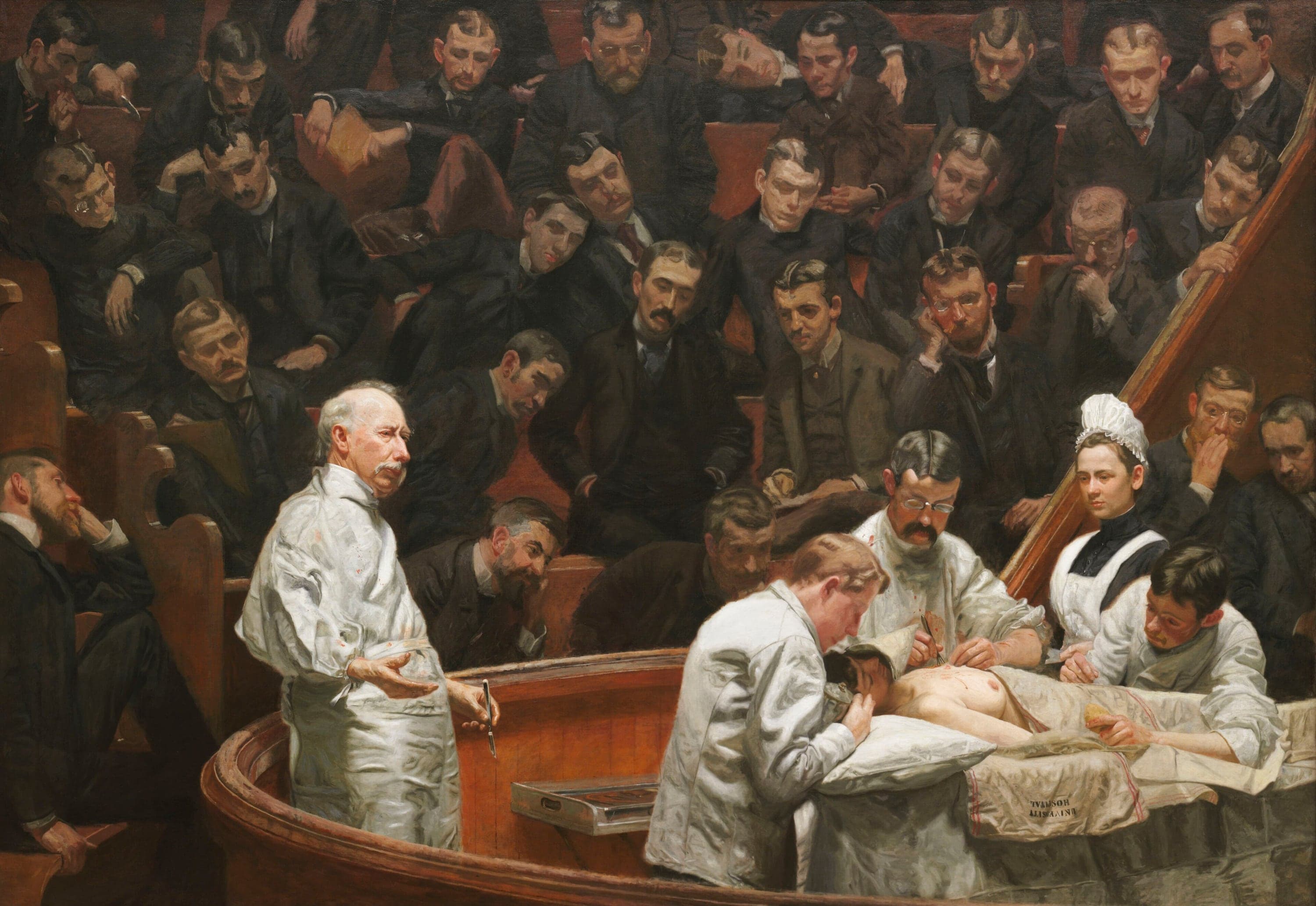
The Agnew Clinic (1889) was Eakins's largest painting and his most important commission. It shows David Hayes Agnew, another Philadelphia surgeon, performing a mastectomy in front of a class. After leaving the academy Eakins turned mainly to portraits, and painted about two hundred and fifty in all. Few of them were paid commissions.
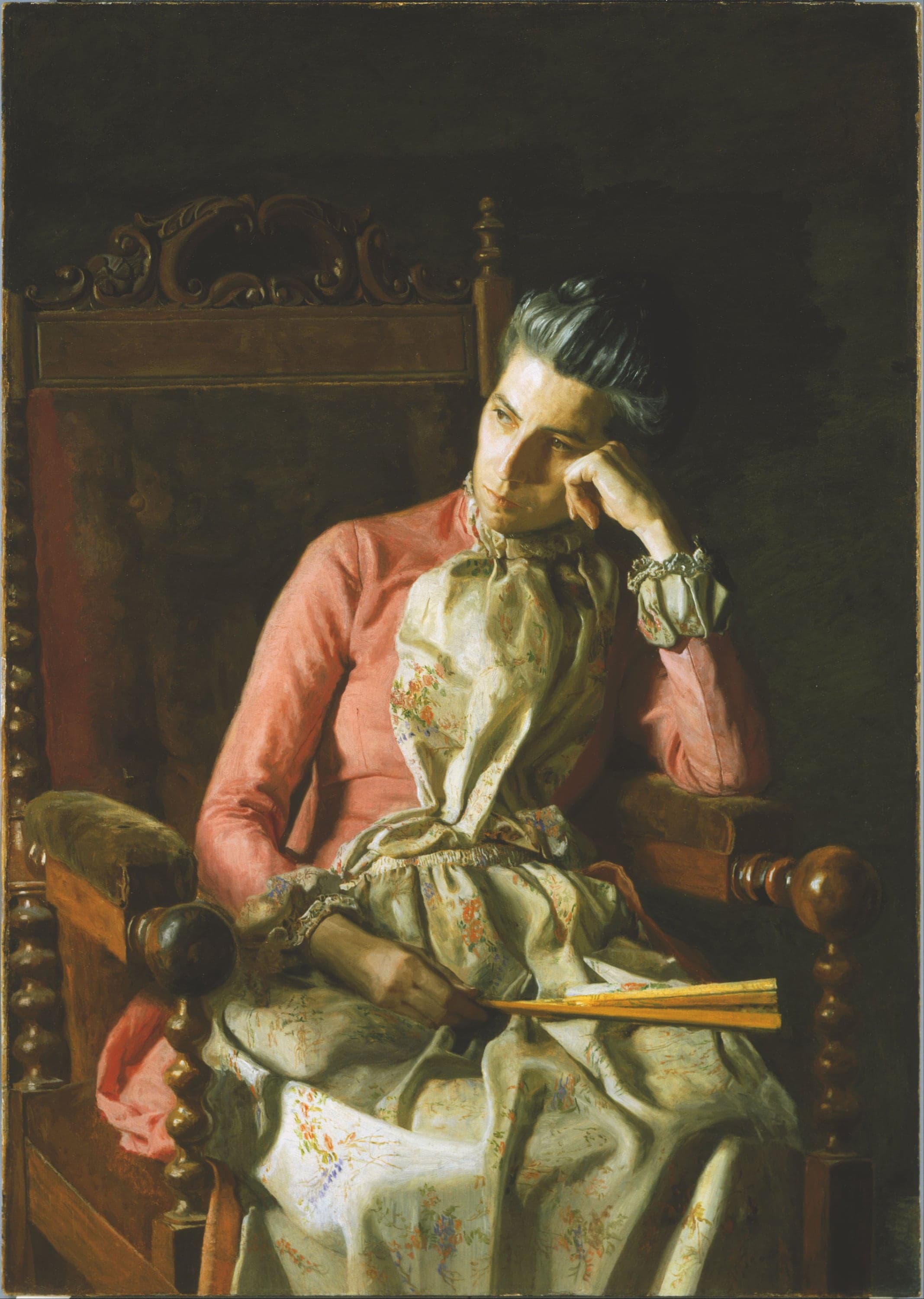
He usually asked people to sit rather than waiting to be hired, and gave them the finished picture. Miss Amelia Van Buren, painted about 1890, is a portrait of a friend and former pupil. For The Concert Singer (1890–1892) he asked Weda Cook to sing “O rest in the Lord,” so that he could study the muscles of her throat and mouth. He brought in an orchestral conductor to pose for the hand holding the baton at the lower left. His portrait of Walt Whitman, painted in 1887 and 1888, was the poet's own favourite.
Sitters and their families sometimes refused the portraits, which pushed Eakins further towards painting friends, students and relatives. A late group of pictures of Catholic clergy let him use the colour of the vestments: Sebastiano Cardinal Martinelli (1902), Archbishop William Henry Elder (1903) and Monsignor James P. Turner (about 1906). He kept painting the figure as well, in boxing subjects such as Salutat (1898) and Between Rounds (1899). For the second of those the boxer Billy Smith posed in his corner at the Philadelphia Arena, and models re-enacted a fight that had actually taken place.
Eakins was made a National Academician in 1902. In 1914 he sold a portrait study of Agnew to Albert C. Barnes, and rumours put the price at fifty thousand dollars. Barnes had paid four thousand. Eakins's health failed in his last years, about four decades after he began working as a painter. He died in Philadelphia on 25 June 1916, at the age of 71, and is buried at The Woodlands cemetery in West Philadelphia, near the University of Pennsylvania.
Reception and changing reputation, 1876 to the present
Eakins sold few pictures and received little public recognition while he was alive. His insistence on painting people as he found them looked coarse to an audience that expected art to be graceful. John Canaday of The New York Times wrote in 1964 that Eakins had seemed heavy and vulgar to that public, and that he had recorded his fellow Americans without idealising them.
The reversal began immediately after his death. The Metropolitan Museum of Art held a memorial retrospective in 1917, and the Pennsylvania Academy followed in 1917 and 1918. In an open letter to the Art Students League in October 1917, the painter Robert Henri called Eakins “the greatest portrait painter America has produced.” Susan Macdowell Eakins gave the Philadelphia Museum of Art more than fifty of her husband's oil paintings.
Much of the rest of the estate fared badly. After Susan Macdowell Eakins died in 1938, executors destroyed or damaged a large part of the remaining work, and a former Eakins student salvaged what was left of it late. Joseph Hirshhorn later bought a large group of the art and papers, now held by the Hirshhorn Museum.
His teaching carried furthest through his students. Thomas Anshutz taught Robert Henri, George Luks, John Sloan and Everett Shinn, who became members of the Ashcan School. Eakins's house in North Philadelphia was listed on the National Register of Historic Places in 1966, and Eakins Oval on the Benjamin Franklin Parkway is named for him. His painting The Biglin Brothers Racing (1872) appeared on a United States postage stamp in 1967.
Scholarship has shifted twice over. Lloyd Goodrich's two-volume biography of 1982 called Eakins the strongest American portrait painter since John Singleton Copley. The discovery of a large group of Eakins's personal papers in 1984 opened a reassessment of his life, and since the 1990s he has been a central figure in the study of sexuality in American art. Recent scholarship treats the school scandals as more than the prudery of his contemporaries, and connects them to his teaching, to the habits of his circle, and to his own behaviour.
In November 2006 the trustees of Thomas Jefferson University agreed to sell The Gross Clinic to the National Gallery of Art and the Crystal Bridges Museum of American Art for $68 million. That was the highest price paid for an Eakins, and a record for an American-made portrait. On 21 December 2006 a group of donors matched the sum to keep the painting in Philadelphia. It is now shown in turn at the Philadelphia Museum of Art and the Pennsylvania Academy of the Fine Arts.


 View source