Canyon
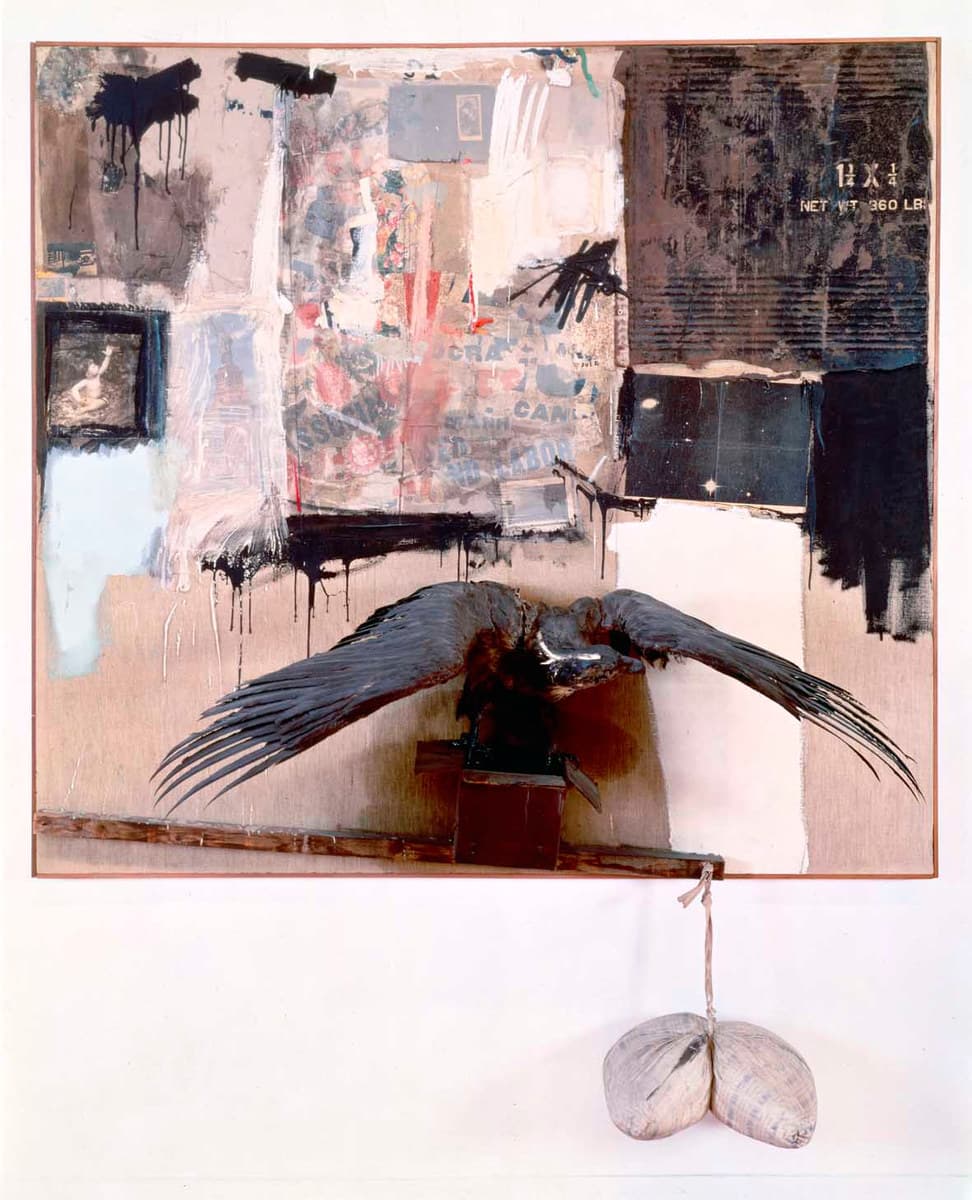
A taxidermied eagle, wings spread, stands on a wooden box projecting from a crowded collaged canvas, with a pillow hanging beneath it on a cord. Robert Rauschenberg made Canyon in 1959. Two federal statutes made it a crime to sell the bird, so the Combine could not legally be sold. That fact drove a long dispute with the Internal Revenue Service before the Museum of Modern Art received it in 2012.
- 1959
- Oil, pencil, paper, metal, photograph, fabric, wood, canvas, buttons, mirror, taxidermied eagle, cardboard, pillow, paint tube and other materials
- The Museum of Modern ArtNew York, United States
About Robert Rauschenberg
What the object shows
The canvas is upright in a thin reddish wooden frame, and the eagle projects from its lower half into the room. Its wings are spread almost the full width of the canvas, dark grey-brown, with the long primary feathers splayed at each tip. The body and head are dark and indistinct; the bird faces slightly to its right.
It stands on a dark brown box that is bolted to the canvas and sticks out from it. Beneath the box, a horizontal wooden batten runs across the picture. A knotted cord drops from it to a pillow tied at its middle, which hangs in two round lobes below the frame, clear of the canvas and against the wall.
The upper half is collage and paint. On the left, a black splash runs in drips from the top edge. Under it hangs a small dark panel holding a pale photographic image of a child with one arm raised, and below that a rectangle of pale blue paint.
The centre is a pale field of torn printed paper, washed over in pink and cream. Blue block capitals survive in fragments where the tearing stopped, including the runs OCRA and CAN. A red mark and a small orange arrow sit near the middle, with white cloth drips running down.
The right-hand third is dark. A large panel of printed board carries stencilled cream capitals reading, on one line, the fractions 1¼ X ¼, and beneath them NET WT 360 LB, the last character running off at the frame edge. Below that panel a dark blue-black rectangle is flecked with small white points, and a plain white painted rectangle sits beside it.
The Museum of Modern Art lists the materials as oil, pencil, paper, metal, photograph, fabric, wood, canvas, buttons, mirror, taxidermied eagle, cardboard, pillow, paint tube and other materials. The object is 207.6 by 177.8 by 61 centimetres.
The photograph is taken square on, so what projects from the canvas is foreshortened. The top of the eagle's back, the sides of the box and the underside of the pillow are not visible in it.
Where the eagle came from
The Museum of Modern Art's collection page used to carry an account of the bird. It described a stuffed bald eagle found in a pile of discarded belongings in the hallway of the Carnegie Hall studio building and given to Robert Rauschenberg by the artist Sari Dienes. That text was on the museum's page in captures from 2015 to June 2019 and had gone by October 2020.
The fuller version goes back to the curator Leah Dickerman's 2013 book on the work. In it, Sari Dienes had fished the bird out of the junk left by a recently dead neighbour, one of the last of Theodore Roosevelt's Rough Riders.
That neighbour is the reason the date of the bird's death matters, and it is what Robert Rauschenberg was later asked to attest to in writing.
Bald or golden: the sources disagree
The Robert Rauschenberg Foundation's catalogue entry now reads oil on taxidermied golden eagle. It did not always. Archived captures of the same page read bald eagle as late as 30 October 2020 and golden eagle by 28 November 2020, which dates the change to about that month. No conservation report, ornithological determination or published note giving a reason has been found.
The Museum of Modern Art names no species at all. Its catalogue entry says taxidermied eagle, in the online record and in its published collection dataset alike, and the curatorial text that once said bald eagle was removed around 2019 or 2020.
Almost everything else says bald. The museum's own blog said so in 2014, reporting Leah Dickerman. The art historian Jonathan Frederick Walz, writing in Panorama in 2024 and citing Leah Dickerman, calls it a taxidermized juvenile American bald eagle. A juvenile bald eagle is dark-bodied and has not yet grown the white head, which is consistent with the dark head in the photograph. Every contemporaneous account of the legal dispute says bald eagle.
The species is not settled here, and it is not a small point. Every legal analysis of the work rests on the bird being a bald eagle taken before 8 June 1940.
The two statutes
The first is the Bald and Golden Eagle Protection Act, passed on 8 June 1940 and codified at 16 U.S.C. sections 668 to 668d. Without a permit it is an offence to take, possess, sell, purchase, barter, offer to sell, transport, export or import a bald or golden eagle, alive or dead, or any part, nest or egg of one.
The Act did not cover golden eagles at first. They were added by Public Law 87-884 on 24 October 1962.
Section 668(a) carries two grandfather provisos, and they have different dates. Possession and transport are not prohibited for a bald eagle lawfully taken before 8 June 1940, nor for a golden eagle lawfully taken before the golden-eagle provisions were added, which the Law Revision Counsel's note fixes at 24 October 1962.
The second statute is the Migratory Bird Treaty Act, enacted on 3 July 1918 and codified at 16 U.S.C. sections 703 to 712. It prohibits taking, killing, possessing, selling, trading and transporting protected migratory birds without a permit from the Department of the Interior, and it carries no grandfather clause of the kind section 668(a) has.
The consequence for the work is narrow and severe. Robert Rauschenberg could keep the eagle he had been given; nobody could lawfully buy it from him.
The permit and the notarised statement
The dealer Ileana Sonnabend owned Canyon. In 1981 the Fish and Wildlife Service became aware of the bird and notified her gallery that ownership of the work was restricted by both statutes.
What followed is described differently by different sources. Her lawyer Ralph E. Lerner's account, given to Forbes in 2012, is that she applied for and received a permit to keep the work. The understanding was that she could lend it to museums at home and abroad, but could never sell it or export it for sale. The New York Times and the Center for Art Law both call the 1981 arrangement informal, a nod or a waiver rather than a permit.
In 1998 the question reopened. Her gallery applied for a permit to send Canyon to European museums with a Guggenheim retrospective, and the government replied that she should never have been allowed to keep it, because she was not a non-profit museum.
Robert Rauschenberg resolved it with a signature. On 27 May 1998 he provided a notarised statement attesting that the eagle had been killed before 1940. Ileana Sonnabend was then allowed to keep the work and lend it within the United States, but not to ship it abroad, and not to sell it.
A work worth nothing and taxed at sixty-five million
Ileana Sonnabend died in October 2007. Her heirs, Nina Sundell and Antonio Homem, had to value her estate for federal tax.
They valued Canyon at zero. Three appraisers, one of them Christie's, agreed, on the ground that selling the work would be a federal crime and a thing that cannot lawfully be sold has no fair market value.
The Internal Revenue Service disagreed twice. An unsigned draft report put the work at fifteen million dollars. The agency's Art Advisory Panel then valued it at sixty-five million. One panel member, Stephanie Barron of the Los Angeles County Museum of Art, told The New York Times that the ruling about the eagle was not something the panel considered. She added that the panel had cringed at the idea of saying the work had zero value.
A formal notice of deficiency followed in October 2011, demanding 29.2 million dollars in tax and an 11.7 million dollar penalty. The estate petitioned the United States Tax Court in January 2012.
The case never went to judgment. Under the settlement the Internal Revenue Service dropped the assessment, and in exchange the family had to give Canyon to a museum that would exhibit it publicly and claim no tax deduction for the gift. The closing agreement was signed on 7 May 2013.
How the Museum of Modern Art got it
Canyon had been on long-term loan to the Metropolitan Museum of Art since 2005, and both New York museums wanted it. The Museum of Modern Art won.
The museum accessioned the work on 27 November 2012 as number 1782.2012, with the credit line Gift of the family of Ileana Sonnabend, and put it on display that week. The donation preceded the formal settlement by about six months.
The terms explain the credit line's plainness. The family received nothing for the work and deducted nothing for it, which is an unusual way for a Combine of this standing to enter a collection.
Before any of that, it was an exhibition piece
Canyon was first shown at the Leo Castelli Gallery in New York from 29 March to 16 April 1960, with Broadcast, Gift for Apollo, Inlet and Winter Pool, all made the year before.
In 1961 William Seitz put it into The Art of Assemblage at the Museum of Modern Art, with Talisman of 1958. The exhibition ran from the fifteenth century to the present and drew on non-Western material as well; the Robert Rauschenberg Foundation's chronology calls it the first museum recognition of assemblage as an art form. It travelled on to the Dallas Museum for Contemporary Arts and the San Francisco Museum of Art.
Three years later Canyon hung in the United States Pavilion at the 32nd Venice Biennale, in Four Germinal Painters, with Bed and fifteen other works. Robert Rauschenberg took the International Grand Prize in Painting that year.
Close reading
Reading the work, detail by detail
Canyon is photographed square on against a white ground, with the pillow hanging free below the frame. Because the camera faces the work directly, the eagle's spread wings and the box it stands on are foreshortened, and the top of the bird, the sides of the box and the back of the pillow are outside the plate entirely.
1.The eagle stands out from the canvas
The bird is mounted with both wings spread almost the full width of the canvas, the body low and the head dark and turned slightly to its right. Seen square on, the wings read as a flat bar across the picture. Nothing of the back is visible.
2.The long feathers splay at the wing tip
At the left tip the long primaries separate into five or six splayed points, each bent slightly upward, dark grey-brown with paler edges. The feathers are the part of the bird the plate renders sharply; the head is the part it does not.
3.A box bolted through the canvas
The bird stands on a dark brown box that projects from the canvas and is held to it with metal fittings at the upper corners. It is structure, doing the work of a bracket, and it has not been disguised as anything else.
4.A batten runs under the whole thing
A rough horizontal batten runs across the lower canvas beneath the box, ending short of the frame at each side. The cord that carries the pillow is tied to it. It is the lowest fixed element inside the frame.
5.The pillow hangs below the picture
A pale pillow is tied at its middle with a knotted cord and hangs clear of the canvas, below the bottom edge of the frame, against the wall. It swings free of the picture entirely. The Museum of Modern Art lists a pillow among the materials.
6.The crate stencil, transcribed
Stencilled cream capitals survive on the dark board at the right. The upper line reads the fractions 1¼ X ¼; the line under it reads NET WT 360 LB, and the last character runs off where the frame crosses it. It is shipping marking, used as found.
7.Blue capitals torn off mid-word
In the pale centre, blue block capitals survive only where the tearing stopped. The longest legible runs are OCRA and CAN; the rest break off after two or three letters. Pink and cream washes have been dragged across them.
8.A small framed photograph at the left
A small dark panel is fixed to the left of the canvas, holding a pale photographic image of a child with one arm lifted above the head. It is the only clearly readable human figure in the work, and it is the smallest element in it.
9.Black thrown from the top edge
Black paint is thrown onto the top left and runs down in six or seven drips of uneven length. A second black mass sits along the top centre. Both were applied with the canvas upright, which is not true of everything else on the surface.
10.A dark rectangle flecked with white
Below the stencilled board, a dark blue-black rectangle carries small bright white points scattered across it. The flecks are irregular in size and spacing. A plain white painted rectangle sits directly beneath it, with nothing on it at all.
11.A patch of pale blue doing nothing
Under the framed photograph sits a rectangle of flat pale blue, brushed on and left. It carries no image, no collage and no drip. Passages like it are why the Combines resist being read as pictures of anything.
12.What the photograph cannot show
The Museum of Modern Art records the work as 61 centimetres deep. Photographed head on, that depth collapses: the eagle's spread reads as flat, the box has no visible sides, and how far the bird stands out from the wall cannot be judged from this plate.
Timeline
1959
Made in New York. The taxidermied eagle came to Robert Rauschenberg from the artist Sari Dienes, who had taken it from a dead neighbour's discarded belongings in the Carnegie Hall studio building.
1960
First exhibited at the Leo Castelli Gallery, 29 March to 16 April, with Broadcast, Gift for Apollo, Inlet and Winter Pool.
1961
Shown in The Art of Assemblage at the Museum of Modern Art, organised by William Seitz, which travels to the Dallas Museum for Contemporary Arts and the San Francisco Museum of Art.
1964
Hangs in the United States Pavilion at the 32nd Venice Biennale, 20 June to 18 October, in Four Germinal Painters.
1981
The Fish and Wildlife Service notifies the Sonnabend Gallery that ownership is restricted by the Bald and Golden Eagle Protection Act of 1940 and the Migratory Bird Treaty Act of 1918. Ileana Sonnabend may keep and lend the work but never sell it.
1998
A permit application to send the work to European museums is refused, and the government states that Ileana Sonnabend should never have been allowed to retain it. On 27 May Robert Rauschenberg signs a notarised statement that the eagle was killed before 1940.
2005
Goes on long-term loan to the Metropolitan Museum of Art in New York.
2007
Ileana Sonnabend dies in October, leaving the work to her heirs Nina Sundell and Antonio Homem.
2011
The estate's three appraisers value Canyon at zero. The Internal Revenue Service's Art Advisory Panel values it at sixty-five million dollars, and a notice of deficiency in October demands 29.2 million dollars in tax and an 11.7 million dollar penalty.
2012
The estate petitions the United States Tax Court in January. On 27 November the Museum of Modern Art accessions the work as 1782.2012, Gift of the family of Ileana Sonnabend, and puts it on view.
2013
The closing agreement is signed on 7 May. The Internal Revenue Service drops the assessment; the family claims no charitable deduction for the gift.
Where to see it
The Museum of Modern Art
11 West 53 Street, New York, NY 10019, United States
The museum's published collection data placed the work on Floor 4, gallery 408, in the David Geffen Wing when checked in September 2026.
Plan your visit on the museum’s official website (opens in a new tab)Frequently asked questions
Why could Canyon not be sold?
Because of the bird in it. The Bald and Golden Eagle Protection Act of 1940 and the Migratory Bird Treaty Act of 1918 make it an offence to sell an eagle or any part of one without a permit. The eagle is fixed into the work, so selling the Combine would have meant selling the bird.
Is the eagle in Canyon a bald eagle or a golden eagle?
The sources disagree. The Robert Rauschenberg Foundation's catalogue now says golden eagle, having said bald eagle until about November 2020. The Museum of Modern Art names no species. The Museum of Modern Art's own blog, the scholarship of Leah Dickerman and Jonathan Frederick Walz, and every account of the legal dispute say bald eagle, with Walz specifying a juvenile bird.
How much did the Internal Revenue Service say Canyon was worth?
Sixty-five million dollars, on the valuation of its Art Advisory Panel, after an earlier draft figure of fifteen million. The estate's three appraisers, including Christie's, had valued it at zero, because a work that cannot lawfully be sold has no market. The notice of deficiency demanded 29.2 million dollars in tax and an 11.7 million dollar penalty.
How did the tax dispute end?
By settlement rather than judgment. The Internal Revenue Service dropped its assessment, and in return the family of Ileana Sonnabend had to donate Canyon to a museum that would exhibit it publicly and claim no tax deduction for the gift. The Museum of Modern Art accessioned it on 27 November 2012, and the closing agreement was signed on 7 May 2013.
What is the pillow hanging under Canyon?
A pillow tied at its middle with a cord, so it hangs in two lobes below the bottom of the canvas. The Museum of Modern Art lists a pillow among the materials. It swings free of the picture, against the wall, and is the lowest part of the work.
What is printed on the dark panel at the right of Canyon?
Stencilled cream capitals on a panel of printed board. One line gives the fractions 1¼ X ¼; the line beneath reads NET WT 360 LB, with the last character running off at the frame edge. It is shipping-crate marking, used as it was found.
Where can you see Canyon?
At the Museum of Modern Art in New York, accession number 1782.2012. The museum's record placed it on Floor 4, gallery 408, in the David Geffen Wing when checked. It had been on long-term loan to the Metropolitan Museum of Art from 2005 until the donation in 2012.
More by Robert Rauschenberg
If you like Robert Rauschenberg
Explore painters from the same movements and circles.

Arman
French-American artist, lifelong friend of Yves Klein, and a founder of New Realism.
View artist
Jean Arp
Strasbourg-born sculptor and poet — Hans in German, Jean in French, both all his life — who co-founded Dada at the Cabaret Voltaire in 1916, composed collages by dropping torn paper 'according to the laws of chance', and settled at Meudon outside Paris in a house his wife Sophie Taeuber-Arp designed.
View artist
Rosa Bonheur
At the horse markets of Paris and in her studio beside the forest of Fontainebleau, Rosa Bonheur gave animals the presence of great portrait subjects. The success of The Horse Fair helped her build a life shaped by her work, financial independence, and the women she loved.
View artist
References
The sources below include collection records, catalogues, scholarly research, and primary materials that informed this page. They document Canyon, its making, and its place in cultural history.


1Robert Rauschenberg, Canyon, 1959
WebsiteThe Museum of Modern Art, New YorkUsed forThe holding museum's record: the materials line naming a taxidermied eagle without a species, the dimensions, the credit line, the accession number and the gallery location.

2The Museum of Modern Art collection dataset
Official recordThe Museum of Modern ArtUsed forThe museum's published collection data, the form in which the catalogue fields and the 27 November 2012 acquisition date were checked while moma.org was unreachable to scripted requests.
3Robert Rauschenberg, Canyon, 1959 (RRF 59.008)
WebsiteRobert Rauschenberg FoundationUsed forThe Foundation's catalogue entry, whose medium line now reads taxidermied golden eagle and read bald eagle until about November 2020.
4Diving into Rauschenberg's Canyon
WebsiteThe Museum of Modern Art, New York, 2014Used forThe museum's own account of the bird's origin, reporting Leah Dickerman: Sari Dienes, the Carnegie Hall studio building, and the Rough Rider neighbour.
5Canyon: Robert Rauschenberg's Declaration of Independence
PeriodicalPanorama: Journal of the Association of Historians of American Art, 2024Used forPeer-reviewed scholarship describing the bird as a juvenile American bald eagle, after Leah Dickerman's 2013 study of the work.
616 U.S.C. § 668 — Bald and golden eagles
Official recordOffice of the Law Revision Counsel, United States House of RepresentativesUsed forThe statute itself: the prohibited acts, the addition of golden eagles by Public Law 87-884 on 24 October 1962, and the two grandfather provisos with their different dates.
716 U.S.C. § 703 — Taking, killing, or possessing migratory birds unlawful
Official recordOffice of the Law Revision Counsel, United States House of RepresentativesUsed forThe Migratory Bird Treaty Act of 3 July 1918, the second statute the Fish and Wildlife Service invoked.
816 U.S. Code § 668 — Bald and golden eagles
Official recordLegal Information Institute, Cornell Law SchoolUsed forThe Legal Information Institute's text of the same section, used to cross-check the prohibitions and the provisos.
9Bald and Golden Eagle Protection Act
Official recordU.S. Fish and Wildlife ServiceUsed forThe enforcing agency's own summary of the Act, including the definition of take and the criminal penalties.
10Migratory Bird Treaty Act of 1918
Official recordU.S. Fish and Wildlife ServiceUsed forThe enforcing agency's summary of the Migratory Bird Treaty Act and the permits it requires.
11The Sonnabend Estate and Fair Market Valuation of Canyon
PeriodicalUniversity of Pennsylvania Law Review Online, 2015Used forThe legal account of the dispute: the 1998 notarised statement of 27 May, the appraisal documents, the Tax Court petition and the closing agreement of 7 May 2013.
12Even Rich Heirs Deserve A Fair Shake From The IRS
PeriodicalForbes, 2012Used forRalph E. Lerner's account of the 1981 permit and its conditions, and of the 1998 refusal.
13A Catch-22 of Art and Taxes, Starring a Stuffed Eagle
PeriodicalThe New York Times, 2012Used forThe valuations, the notice of deficiency, the penalty, and Stephanie Barron on what the Art Advisory Panel did and did not consider.
14MoMA Gains Treasure That Metropolitan Museum of Art Also Coveted
PeriodicalThe New York Times, 2012Used forThe settlement terms, the donation to the Museum of Modern Art and the competition with the Metropolitan Museum of Art.
15Chronology
WebsiteRobert Rauschenberg FoundationUsed forThe first showing at the Leo Castelli Gallery, The Art of Assemblage, and the 32nd Venice Biennale.
16Fair Use Policy
WebsiteRobert Rauschenberg FoundationUsed forThe rights holder's own position on fair use, and the basis on which the reproduction is shown.
These references provide the documented foundation for this work's history and interpretation. Claim-level citations remain attached to the specific claims they support.
 Explore more resources