Self-Portrait
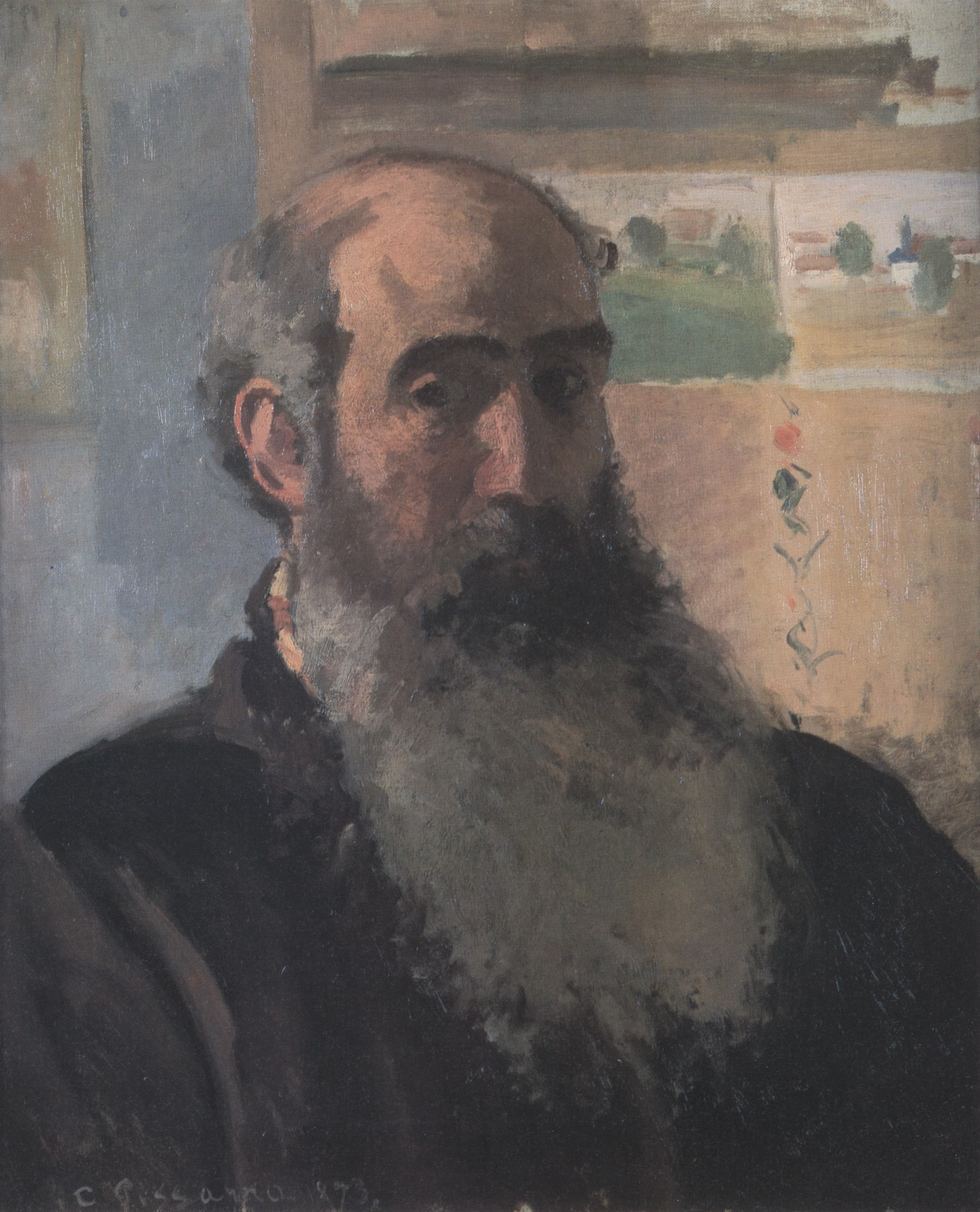
Camille Pissarro painted himself in 1873, the year he turned forty-three, bald and heavily bearded in a dark coat, against a wall hung with pictures. His son gave it to the French state in 1930 and it is at the Musée d'Orsay.
- 1873
- Oil on canvas
About Camille Pissarro
What the painting shows
Head and shoulders, turned slightly to one side, eyes on the viewer. The crown of the head is bald and catches the light; the hair at the sides and the eyebrows are grey. The beard is the largest thing in the picture, brown at the jaw and grey-white where it spreads down over the chest, and it is painted in loose separate strokes rather than combed into detail.
He wears a dark coat that is almost a single mass of brown-black, with a collar and one lapel indicated and nothing else. Nothing about the clothes or the pose says painter: no palette, no brushes, no smock.
The wall behind him carries the only colour. On the left it is grey-blue. Behind his shoulder on the right hangs a picture of a green field with pale roofs and a few trees, and below it a lighter panel with a thin flowering stem. The museum's record does not identify either of them. The canvas measures 55.5 by 46 centimetres and is signed and dated at the lower left: C. Pissarro 1873.
The year it was painted
Pissarro was born on 10 July 1830, so he turned forty-three during 1873. The Musée d'Orsay does not record the month the portrait was painted, and it does not record where. Pontoise is often assumed, because the family was living there, but the museum's record does not say so.
1873 is the year Pissarro and Claude Monet set up the Société anonyme des artistes peintres, sculpteurs, graveurs, the company that put on the exhibition of April 1874 now known as the first Impressionist exhibition. He painted himself here just before the group had a name, and he had thirty more years of work ahead of him.
It stayed in the family for fifty-seven years
There is no early ownership history. The painting was still with the artist's son Paul-Émile Pissarro in 1930, when he gave it to the French state under a donation with reserved usufruct: the donor makes the gift but keeps the use of the object for his lifetime. The committee approved it on 3 April 1930 and the council on 7 April.
That arrangement is why accounts saying the picture was simply donated in 1930 are imprecise. It did not physically reach the galerie du Jeu de Paume until 1947. It was assigned to the Musée d'Orsay in 1986, and its accession number is RF 2837. Some databases record a private owner between 1947 and 1986, which contradicts the museum's own record.
Nobody saw it for decades
The exhibition history recorded by the Musée d'Orsay begins in 1920, seventeen years after Pissarro's death, with a Pissarro exhibition in London where it was number 56. It was in the centenary exhibition of his birth at the Orangerie in Paris in 1930, and then in a run of portrait shows: a hundred years of French portraits at Bernheim-Jeune in 1934, French portraits from 1400 to 1900 at the Galerie Seligmann in 1936, and Agnew's in London in 1937.
Later it travelled to Lisbon in 1965, Leningrad in 1970 and Madrid in 1971. It is catalogued as number 200 in the 1939 catalogue raisonné by Ludovic-Rodo Pissarro and Lionello Venturi. At the last check of the museum's record it was not on display.
Close reading
Reading the work, detail by detail
Pissarro presents himself without studio spectacle: a close head, a direct look, and a dark field. Enlargement shows how beard, brow, and restrained color construct a working painter's alert, unsentimental presence.
1.The gaze is direct without becoming theatrical
The eyes meet the viewer while the brow and asymmetry of the face keep the expression active. Pissarro avoids both polite ease and heroic intensity; attention itself becomes the sitter's defining quality.
2.The beard is built from directional strokes
Short strokes change direction around mouth, chin, and jaw. The beard supplies texture and structure at once, letting the face emerge through paint rather than polished contour.
3.The ground withholds biography
No palette, easel, room, or landscape identifies his profession. The plain background concentrates the portrait on a face already marked by age and work, leaving status outside the frame.
4.A small area of light gives the forehead volume
The face is modeled with restrained shifts rather than polished blending. A lighter forehead stands out against hair and background, making the head feel solid without erasing the brushwork.
5.The dark collar keeps attention on the face
Clothing is summarized in broad dark shapes instead of descriptive detail. That economy supports the head and beard while refusing the props of a formal professional portrait.
6.The ear and cheek are built from warm and cool edges
Small red, brown, and gray touches meet without a single hard outline. The face holds together because neighboring colors define one another.
Timeline
1830
Camille Pissarro is born on 10 July on Saint Thomas, then a Danish colony in the Caribbean.
1873
Paints this portrait of himself; signed and dated at the lower left, C. Pissarro 1873. He and Claude Monet set up the artists' company that will hold the first Impressionist exhibition the following April.
1920
First recorded showing, at a Pissarro exhibition in London, as number 56.
1930
Given to the French state by the artist's son Paul-Émile Pissarro under a donation with reserved usufruct; approved by committee on 3 April and by council on 7 April.
1930
Shown in the centenary exhibition of Pissarro's birth at the Orangerie, Paris.
1936
Included in French Portraits from 1400 to 1900 at the Galerie Seligmann, as number 138.
1947
Physically enters the Louvre's galerie du Jeu de Paume.
1986
Assigned to the Musée d'Orsay. Accession number RF 2837.
Where to see it
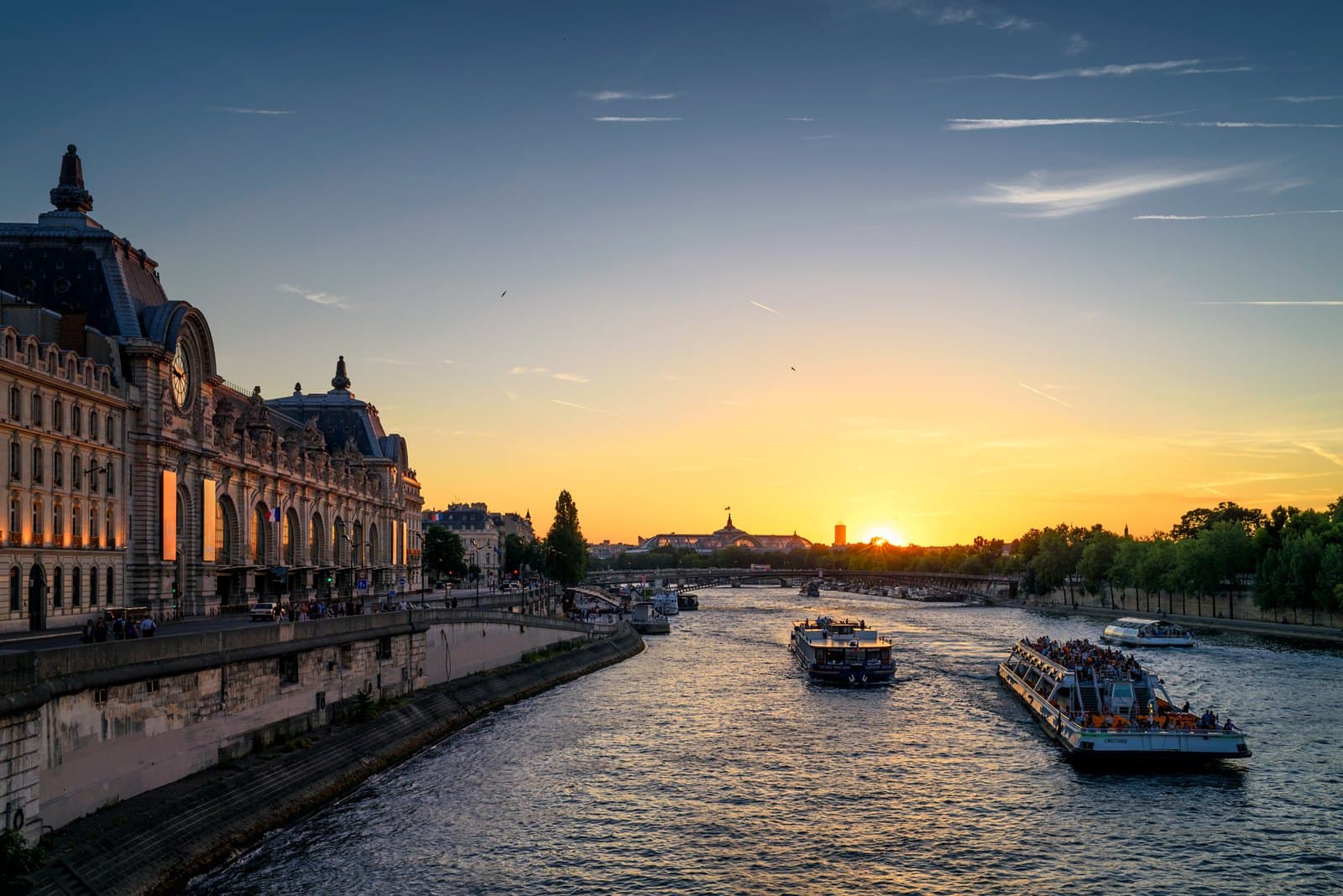
Musée d'Orsay, Paris
Esplanade Valéry Giscard d’Estaing, 75007 Paris, France
Displays and loans can change. Check whether this work is on view before making a special trip.
Plan your visitFrequently asked questions
What does Pissarro's 1873 Self-Portrait show?
Camille Pissarro himself, head and shoulders, bald on top with grey hair at the sides and a full beard spreading over his chest, in a dark coat against a wall on which two pictures hang. There is no palette, brush or smock: nothing in it announces that the sitter is a painter.
How old was Pissarro in this portrait?
He turned forty-three in 1873. He was born on 10 July 1830, and the Musée d'Orsay does not record the month the picture was painted, so he was either forty-two or forty-three when he sat for it. The white beard he is remembered by was already there.
Where can I see the Self-Portrait?
It belongs to the Musée d'Orsay in Paris, accession number RF 2837, and at the last check of the museum's record it was not on display. It has been in the French national collections since 1930 and physically in Paris museums since 1947.
Where was it painted?
The museum does not say. Pissarro was living at Pontoise in 1873 and the location is often given as his house there, but the Musée d'Orsay's record names no place, so anything more specific is an assumption.
How did the museum get it?
From the artist's son. Paul-Émile Pissarro gave it to the French state in 1930 under a donation with reserved usufruct, which let him keep the painting for the rest of his life. That is why it did not reach the Jeu de Paume until 1947, and why accounts that describe it as donated and delivered in 1930 are wrong about the second half.
What are the pictures hanging behind him?
The museum does not identify them. One shows a green field with pale roofs and trees; the other is a lighter panel with a thin flowering stem. They are the only strong colour in an otherwise brown and grey painting.
What is the painting called in French?
Portrait de l'artiste. The Musée d'Orsay gives no English title for it, so Self-Portrait is the common English form rather than the museum's own.
More by Camille Pissarro
If you like Camille Pissarro
Explore painters from the same movements and circles.
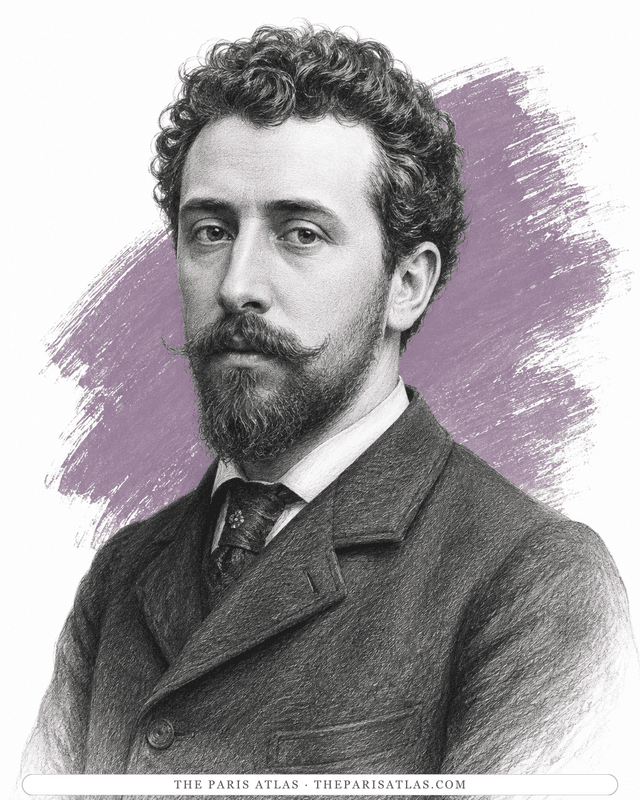
Georges Seurat
Parisian painter who built pictures from small dots of pure colour on optical principle, co-founded the Salon des Indépendants, and detonated the last Impressionist exhibition of 1886 with A Sunday on La Grande Jatte. He died at thirty-one.
View artist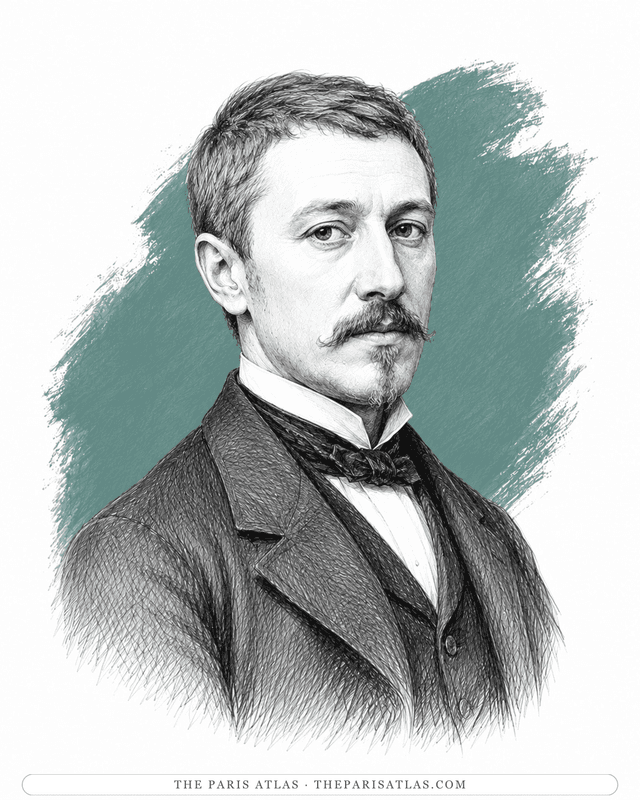
Gustave Caillebotte
Painter of Haussmann's geometry and the group's organizer-financier; his bequest of Impressionist paintings forced the French state to take the movement in.
View artist
Mary Cassatt
Mary Cassatt was an American painter and printmaker known for her depictions of women and children. Based in France for the last fifty-two years of her life, she was the only American to exhibit with the original French Impressionist group, participating in four of its eight exhibitions. Edgar Degas invited her to exhibit with the group in 1877 after the Salon jury rejected her submissions.
View artist
References
The sources below include collection records, catalogues, scholarly research, and primary materials that informed this page. They document Self-Portrait, its making, and its place in cultural history.


1musee-orsay.fr
WebsiteUsed forWeb source consulted for documented facts and historical context presented on the Self-Portrait page.
2Camille Pissarro: Biography and Chronology
WebsiteKunstmuseum BaselUsed forWeb source consulted for documented facts and historical context presented on the Self-Portrait page.
3Camille Pissarro — artist record
WebsiteMusée d'OrsayUsed forThe Musée d'Orsay artist record provides authoritative institutional context for Pissarro and the museum's holdings.
4Camille Pissarro — artist biography
WebsiteMuseo Nacional Thyssen-BornemiszaUsed forThe Museo Thyssen-Bornemisza biography supplies an independent account of Pissarro's life and early Impressionist period.

5Portrait de l'artiste (Self-Portrait), 1873
Official recordMusée d'OrsayUsed forOfficial record used to verify names, dates, institutional details, or other factual information on this page.
These references provide the documented foundation for this work's history and interpretation. Claim-level citations remain attached to the specific claims they support.
 Explore more resources