Two Young Peasant Women
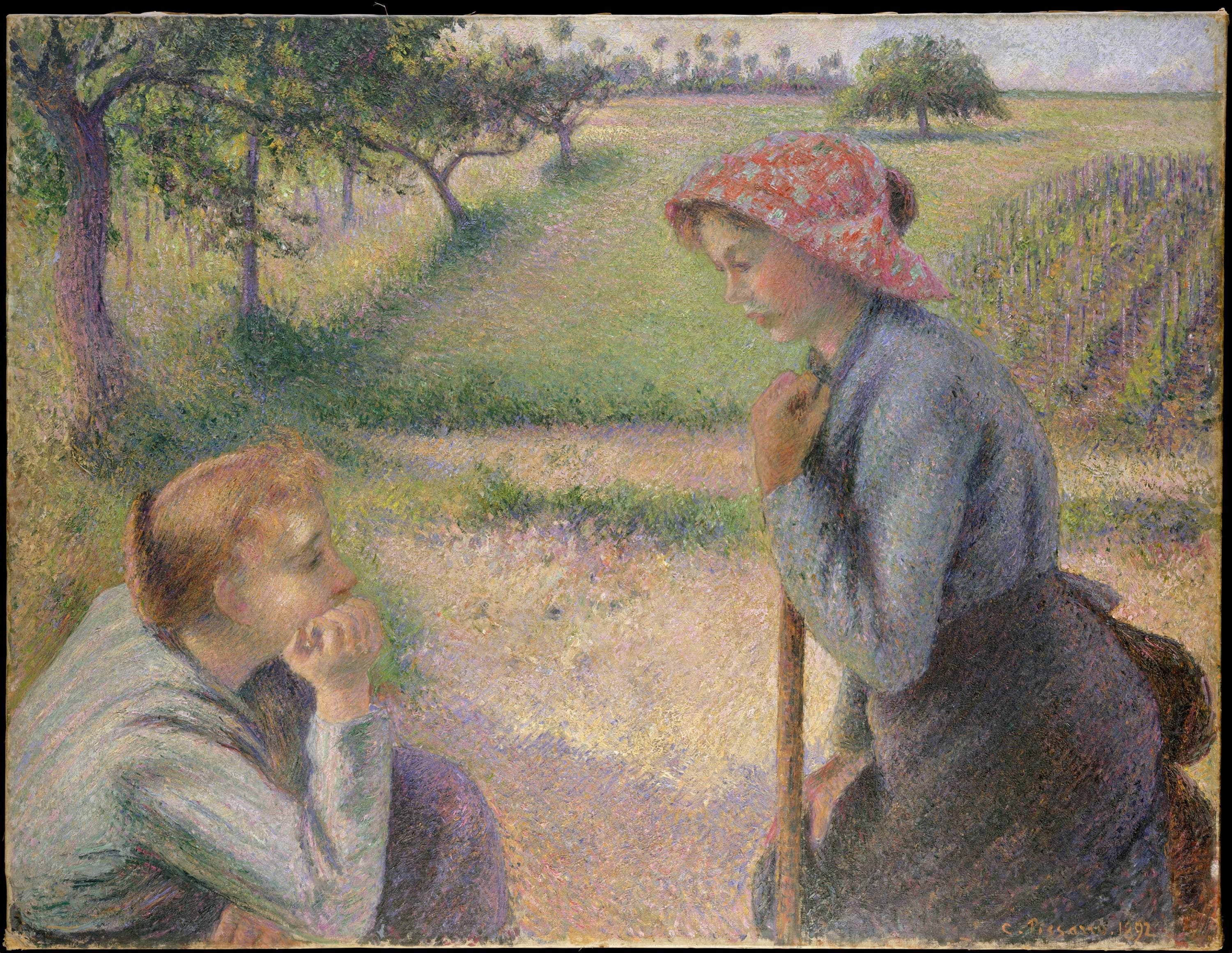
The largest canvas Camille Pissarro ever painted: two women resting at the edge of a field near his house at Éragny, begun in the summer of 1891 and finished in January 1892. It did not sell, and he gave it to his wife, Julie Vellay.
- 1891–92
- Oil on canvas
About Camille Pissarro
What the painting shows
Two women are at the very front of the picture, close enough that the lower edge of the canvas cuts them off. The one on the left has settled on the ground with her elbow propped and her chin on her fist, in a blue-grey blouse and a plum-coloured skirt, her hair pulled back off her face. The one on the right kneels facing her, both hands folded over the handle of a stick, in a red and white printed headscarf and a heavy dark blue skirt. They are looking at each other, and neither looks out at the viewer.
Behind them the ground rises into sunlight. A mown path crosses the middle distance, apple trees stand along the left, and the slope on the right is planted in rows of stakes. There is no sky in the picture except a little light coming through the branches at the top. Nothing is happening beyond the two of them.
The surface is built from short separate strokes of unmixed colour laid side by side, so that the grass is made of green, pink, blue and yellow marks rather than of green paint. The figures are close to life size. Camille Pissarro had painted farm workers for most of his career, usually small figures inside a landscape; here two of them fill the canvas at the scale a portrait would use.
The largest canvas he ever painted
The canvas measures 89.5 by 116.5 centimetres. Pissarro began it in the summer of 1891, in an open field near his house at Éragny, the village north-west of Paris where he lived from 1884, and finished it in mid-January 1892, a month before a large exhibition of his work opened at the Durand-Ruel gallery in Paris. Joseph Durand-Ruel organised the show, which held around fifty paintings.
Many of them sold. This one did not. The Metropolitan Museum of Art, which has owned it since 1973, records that he never produced a larger canvas afterwards.
Two woodcuts and a drawing
The poses did not come from watching the two women. Everett Fahy first noticed that both derive from Jean-François Millet, the painter of French farm labour a generation earlier: the seated figure follows his Seated Shepherdess, the kneeling one his Man with a Spade. Pissarro knew the compositions from woodcuts, prints made by cutting the design into a block of wood, which Millet's son-in-law gave him in 1884. Impressions of both are in the Metropolitan Museum's own collection.
The trees at the left come from a third source, a single drawing in black chalk made out of doors and now in the Ashmolean Museum in Oxford. A painting that reads as an afternoon in a field was assembled from prints and a drawing.
Colour after Seurat
Through the second half of the 1880s Pissarro had worked in the manner of Georges Seurat, laying small separate dots of unmixed colour in a controlled system so that the eye would combine them at a distance. That method is usually called pointillism, and by 1891 he was leaving it behind.
The Metropolitan Museum describes this canvas as showing "the variety of marks and intuited approaches to color division that he had developed as an alternative to Seurat's much more controlled method". In his letters Pissarro said he was after sensation, which the museum glosses as an optical vibrancy. The dots are still there in places, but the size and direction of the marks now change from the grass to the headscarf to the skin.
Peasants, politics, and the museum's caveat
Pissarro was an anarchist, which in his case meant opposition to government intrusion into ordinary life rather than anything to do with violence. The Metropolitan Museum ties the subject directly to that position: as an anarchist he "wanted to preserve the ancient values of France's agrarian society, threatened by rapid industrialization".
The same catalogue entry then turns on the picture. The goal of Millet's art and of Pissarro's at this date was, the museum writes, "to romanticize peasant life for urban sophisticates, since the reality was inevitably harsher and much more unattractive than their depictions". It is unusual for a museum to publish that about a painting in its own galleries.
How it was received
The reception was thin. The Metropolitan Museum states that although the picture was noteworthy at its first exhibition because of its large scale, it "did not receive much press". The critic Félix Fénéon singled it out, then gave more attention to other works in the same show.
Pissarro had hung it with two other large peasant canvases, Peasant Women Planting Pea-sticks and Seated Peasant Woman, Sunset. The grouping went unremarked as well. He and the critic Georges Lecomte treated these big canvases as the strongest statements of what he was then attempting, and the exhibition did not take them that way.
Julie Vellay's picture
After the exhibition Pissarro gave the unsold canvas to his wife, Julie Vellay, who came from a Burgundy wine-growing family. The art historian T. J. Clark suggested in 1999 that the gift and the subject were connected, Vellay being the child of peasants. The Metropolitan Museum records the suggestion as speculation.
She kept it until her death in 1928. At her sale at the Galerie Georges Petit in Paris on 3 December that year it was lot 25, catalogued as La causette, the chat, and went to the dealer Paul Rosenberg for 173,000 francs. It passed through a private collection and then to baron Maurice de Rothschild, who lent it to the exhibition Seurat et ses amis in Paris in 1933. Rothschild sold it in 1952 through Rosenberg & Stiebel in New York to Mr. and Mrs. Charles Wrightsman, who gave it to the Metropolitan Museum in 1973.
One condition of that acquisition is recorded on the museum's own object page: the painting may not be lent.
Close reading
Reading the work, detail by detail
Pissarro brings two rural workers close enough to command the canvas while resisting the polish of formal portraiture. Details of posture, hands, and painted fabric show how presence and ordinary labor share the same weight.
1.The women share space without becoming a pair of types
Their heads occupy the same shallow field, but different angles and expressions keep each person distinct. Neither performs for the viewer; their attention remains grounded in the moment they share.
2.Hands return the portrait to work
The hands are large enough to matter compositionally and quiet enough to avoid anecdote. Their weight and placement suggest a pause in labor rather than leisure staged for display.
3.Clothing is built from the same strokes as the setting
Aprons, sleeves, and surrounding ground share visible, broken marks. Pissarro integrates the figures with their environment without allowing either woman to disappear into it.
4.The bench makes proximity practical rather than sentimental
The women sit close because they share a simple support, not because the painter forces an embrace. The bench grounds their relationship in an ordinary place of rest.
5.Different gazes preserve two separate inner lives
Their heads do not turn toward one another or toward a single event. Pissarro keeps them socially connected while allowing each figure her own attention.
6.Garden foliage makes the setting as immediate as the figures
Leaves are painted with the same broken touch used for faces and clothing. The shared handling prevents the sitters from appearing cut out and placed against a generic rural background.
Timeline
1884
Millet's son-in-law gives Pissarro woodcuts after Jean-François Millet. Two of them supply the poses of the figures in this painting.
Summer 1891
Begun in an open field near the artist's house at Éragny.
January 1892
Finished in mid-January, a month before the Durand-Ruel exhibition opened.
1892
Shown at Durand-Ruel, Paris, 23 January to 20 February, as number 50, under the title Deux jeunes paysannes. It did not sell.
1892
Pissarro gives the canvas to his wife, Julie Vellay.
1904
Shown at Durand-Ruel as number 84, now titled La Causette.
1928
Julie Vellay dies. At her sale at the Galerie Georges Petit, Paris, on 3 December, lot 25 goes to Paul Rosenberg for 173,000 francs.
1933–34
Lent by baron Maurice de Rothschild to Seurat et ses amis at the Galerie Beaux-Arts, Paris, as number 49.
1952
Sold through Rosenberg & Stiebel, New York, to Mr. and Mrs. Charles Wrightsman.
1973
Given to the Metropolitan Museum of Art, accession 1973.311.5. The acquisition carries a condition that the painting may not be lent.
Where to see it
The Metropolitan Museum of Art
1000 Fifth Avenue, New York, NY 10028, United States
Displays and loans can change. Check whether this work is on view before making a special trip.
Plan your visit on the museum’s official website (opens in a new tab)Frequently asked questions
Who are the two women in Two Young Peasant Women?
They are not securely identified. Camille Pissarro painted them in a field near his house at Éragny in 1891 and 1892, and the poses were taken from woodcuts after Jean-François Millet rather than from the sitters. One later identification, made in a private letter of 1999 by the dealer Richard Nathanson, names the left-hand figure as Eugénie Estruc, called Nini, a niece of the painter's wife; the Art Institute of Chicago gives the same woman's surname as Astruc. No study is known for the right-hand figure.
Is Two Young Peasant Women Pissarro's largest painting?
It is the largest canvas Camille Pissarro ever painted, at 89.5 by 116.5 centimetres. The Metropolitan Museum of Art records that he never produced a larger one after it.
Why did Pissarro give the painting to his wife?
Because it did not sell. Camille Pissarro finished it a month before a large exhibition at the Durand-Ruel gallery in Paris in 1892, where many of the fifty or so paintings on show found buyers and this one did not. He then gave it to Julie Vellay. The art historian T. J. Clark suggested in 1999 that the gift was connected to the subject, since Vellay was the child of peasants; the Metropolitan Museum presents that as speculation.
Is Two Young Peasant Women a pointillist painting?
Not quite. Camille Pissarro had worked in Georges Seurat's pointillist manner, which lays small separate dots of unmixed colour in a controlled system, but by 1891 he was moving away from it. The Metropolitan Museum describes the canvas as showing the alternative he developed instead: a wider variety of marks and a looser, judged approach to dividing colour.
Was the painting a success when it was first exhibited?
No. The Metropolitan Museum states plainly that the picture was noteworthy at its first showing because of its scale but "did not receive much press". The critic Félix Fénéon mentioned it and paid more attention to other works in the exhibition, and the fact that Pissarro had hung it with two other large peasant canvases went unremarked.
Where is Two Young Peasant Women now?
The Metropolitan Museum of Art in New York, accession number 1973.311.5, given by Mr. and Mrs. Charles Wrightsman in 1973. The acquisition came with a condition that the painting may not be lent, so it is not seen in travelling exhibitions.
What does the title La Causette mean?
"The chat." It is the title the painting carried at the Durand-Ruel exhibition of 1904 and at Julie Vellay's estate sale in 1928, and it describes what the two women are doing. Camille Pissarro exhibited it in 1892 under the plainer title Deux jeunes paysannes, two young peasant women.
More by Camille Pissarro
If you like Camille Pissarro
Explore painters from the same movements and circles.
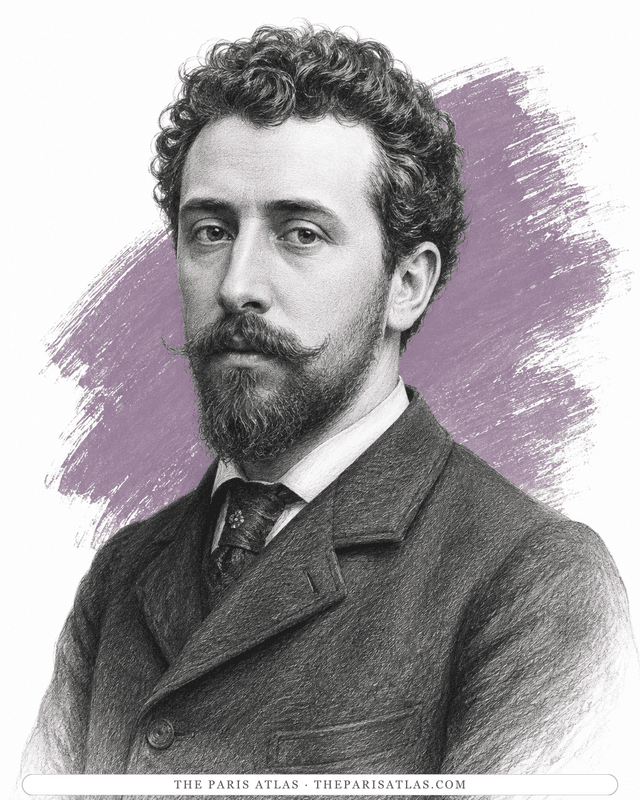
Georges Seurat
Parisian painter who built pictures from small dots of pure colour on optical principle, co-founded the Salon des Indépendants, and detonated the last Impressionist exhibition of 1886 with A Sunday on La Grande Jatte. He died at thirty-one.
View artist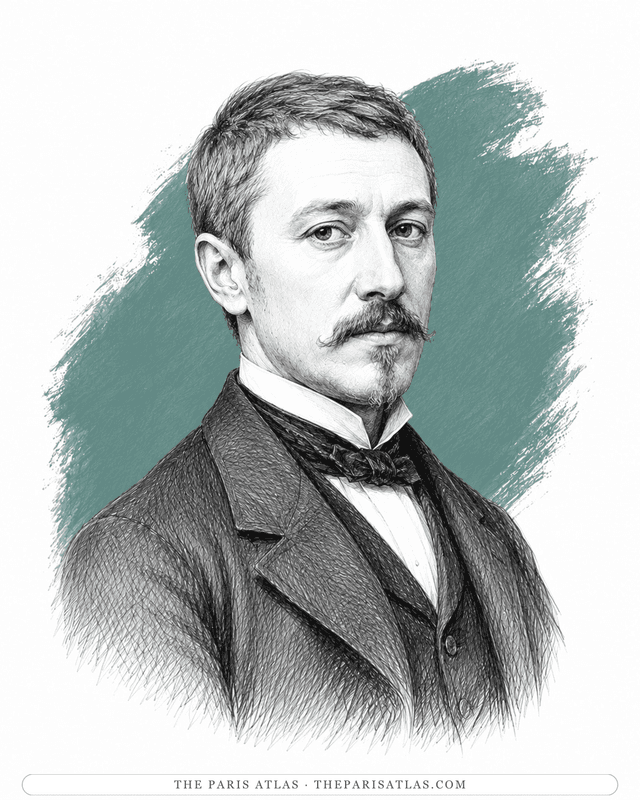
Gustave Caillebotte
Painter of Haussmann's geometry and the group's organizer-financier; his bequest of Impressionist paintings forced the French state to take the movement in.
View artist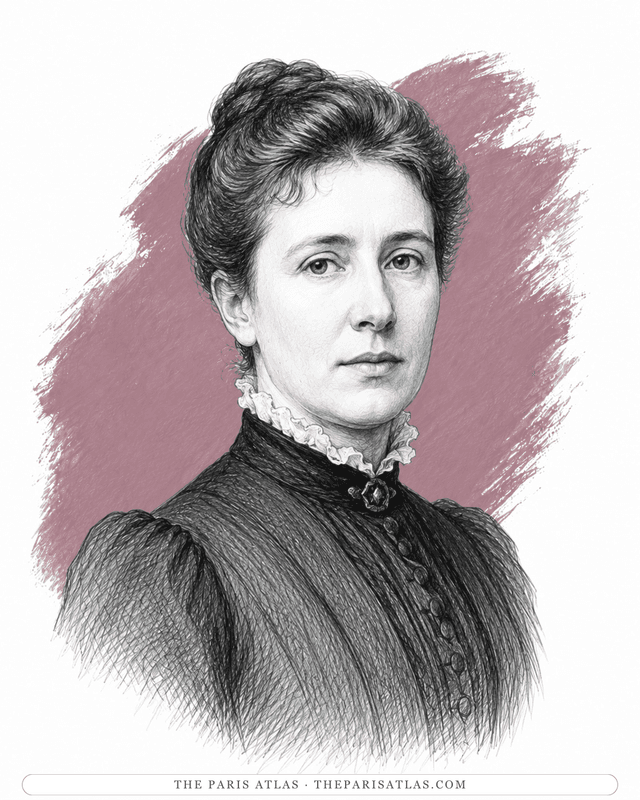
Mary Cassatt
Mary Cassatt was an American painter and printmaker known for her depictions of women and children. Based in France for the last fifty-two years of her life, she was the only American to exhibit with the original French Impressionist group, participating in four of its eight exhibitions. Edgar Degas invited her to exhibit with the group in 1877 after the Salon jury rejected her submissions.
View artist
References
The sources below include collection records, catalogues, scholarly research, and primary materials that informed this page. They document Two Young Peasant Women, its making, and its place in cultural history.


1Two Young Peasant Women, 1891–92
WebsiteThe Metropolitan Museum of ArtUsed forWeb source consulted for documented facts and historical context presented on the Two Young Peasant Women page.
2Camille Pissarro — artist record
WebsiteMusée d'OrsayUsed forUsed to place Two Young Peasant Women within Camille Pissarro's documented oeuvre and verify its period, medium, or institutional context.
3Camille Pissarro — artist biography
WebsiteMuseo Nacional Thyssen-BornemiszaUsed forUsed to cross-check artist chronology and the work's relationship to Camille Pissarro's wider practice.
4Camille Pissarro: Biography and Chronology
WebsiteKunstmuseum BaselUsed forUsed for an additional museum or scholarly perspective on Two Young Peasant Women's history and interpretation.
These references provide the documented foundation for this work's history and interpretation. Claim-level citations remain attached to the specific claims they support.
 Explore more resources