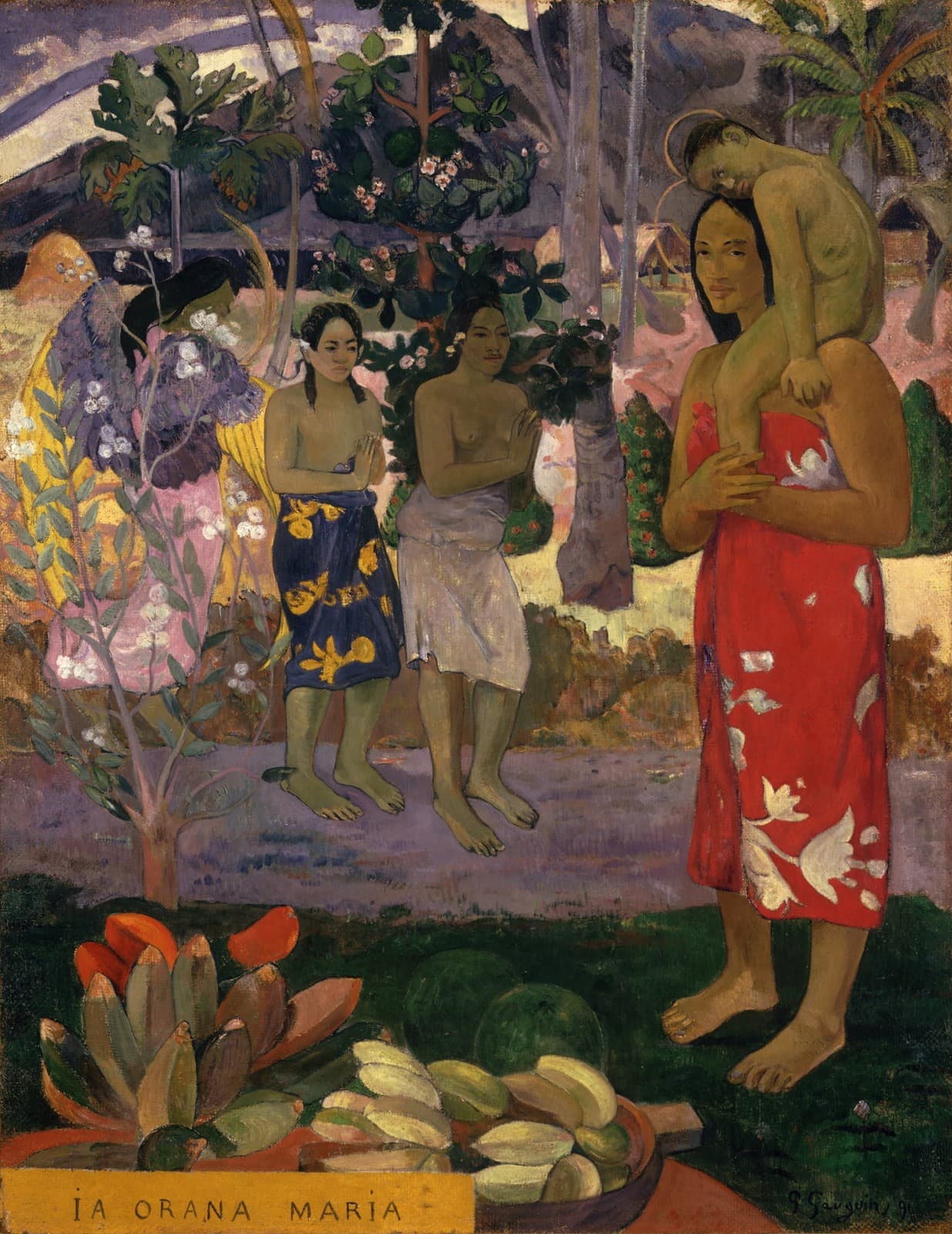
Ia Orana Maria (Hail Mary)
by Paul Gauguin
The first major canvas Paul Gauguin painted in Tahiti, in 1891: a Tahitian Madonna and Child greeted by two women and a yellow-winged angel, the title Tahitian for the Annunciation's 'Hail Mary.' The worshippers' pose comes from a photograph of the Borobudur temple reliefs he carried with him. It hangs at the Metropolitan Museum of Art.
- 1891
- Oil on canvas
About Paul Gauguin
What the painting shows
A Tahitian woman in a red pareu carries a child on her shoulder; both have gold halos. Two women in the middle ground press their palms together in greeting, and behind a flowering bush a yellow-winged angel watches. The setting is dense tropical growth, with a still life of bananas and fruit on a low table in the foreground. The Tahitian words of the title are inscribed at the lower left: Ia Orana Maria — Hail Mary.[1]
It is the Annunciation and the Madonna and Child at once, restaged in Polynesia with Tahitian figures throughout.[1]
A Christian scene in an invented Eden
Gauguin arrived in Tahiti in 1891 expecting an untouched pagan paradise; he found a French colony with sixty years of missionary Christianity. The painting records both truths without meaning to. Its subject is Christian because Tahiti's was; its treatment insists on paradise anyway, with fruit, flowers, and gold light. The Met identifies it as the first important canvas of the Tahitian years, and Gauguin himself thought well enough of it to describe it in detail in a letter the following spring.[1]
The sources are the pattern of everything he painted there. The two worshipping women take their pose from a photograph of the relief sculpture at Borobudur, the Buddhist temple in Java, that Gauguin carried in his luggage. A Christian subject, Javanese poses, Tahitian models, French paint: the Tahiti of his pictures was a deliberate hybrid, assembled from what he brought as much as from what he saw.[1]
Reading the picture, detail by detail
The first major Tahitian canvas rewards slow looking — nearly every passage carries one of Gauguin's imported sources wearing Tahitian dress.
The Madonna looks straight out of the picture — level, unstartled, entirely in possession of the scene — while the child rides her shoulder with his cheek laid against her hair. Their halos are two thin gold lines, worn as lightly as the flowers in their hair. European painting spent centuries making divinity heavy; here it weighs about as much as jewelry.
The two women greet mother and child with pressed palms — a gesture that never belonged to Tahiti. Gauguin lifted the pose directly from a photograph of the Borobudur temple reliefs in Java that he carried in his luggage. The devotion reads as genuine; the vocabulary is imported. That mixture is the method of the whole Tahitian decade, visible here at its first full strength.[1]
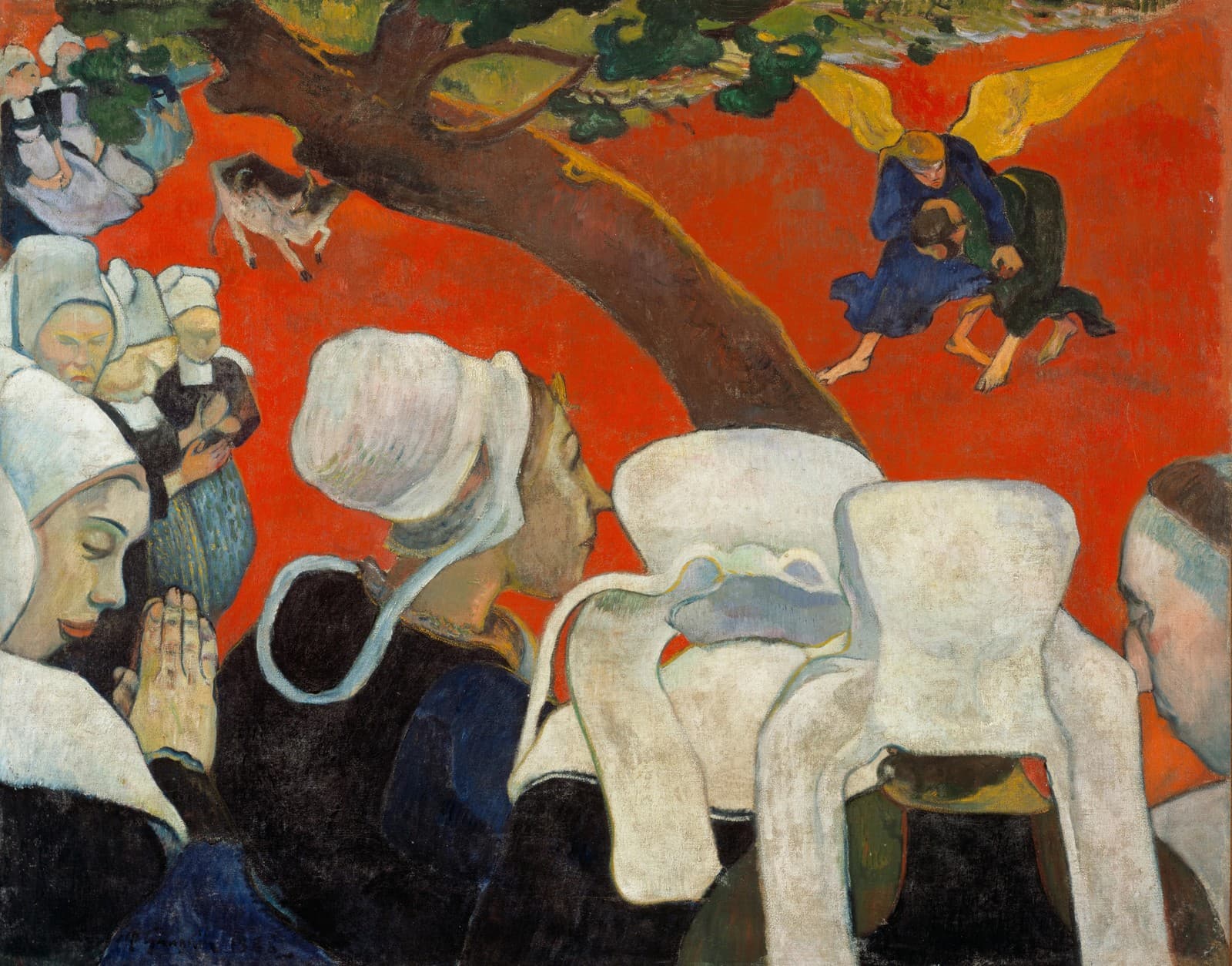
The angel barely attends its own Annunciation: purple-and-gold wings behind the flowering bush, face in profile among the leaves, one gesture directing the women's attention. Gauguin gives the supernatural messenger the smallest part in the scene — the vision belongs to the people having it, an idea he had been working since the Breton pictures.
At the Madonna's bare feet, the altar: a red bowl heaped with bananas on the pink path, signed P Gauguin 91 alongside. The offering in this Eden is lunch, presented with the same seriousness as the halos. Sacred and edible share one table, which is as good a summary of Gauguin's imagined Tahiti as the painting offers.
More details
5.The white flowers keep the dress flat
White flowers spread across the red garment with little change in brightness from one fold to the next. A dark contour establishes the body underneath, while the floral pattern continues to face the viewer. The dress lets Gauguin combine a solid standing figure with a broad area of ornament.
6.The trees divide the depth behind the figures
Pale trunks descend through the dark leaves in narrow, nearly vertical strips. Some pass behind branches and others stand sharply in front of them. These overlaps make the grove feel dense without describing every leaf, and their upright rhythm steadies the unequal heights of the figures below.
How it is painted
The color is keyed higher than anything in his Brittany work — saturated reds and yellows against deep greens, the whole surface patterned like a textile. Contours stay heavy and depth stays shallow in the Synthetist manner, but the paint itself is denser and warmer, worked for the tropical light he had come to find.
The halos are gold leaf-flat, borrowed from the medieval and popular religious images he admired; the composition stacks its planes like a processional frieze. Decoration and devotion are given the same weight, which is the picture's real subject.
What it led to
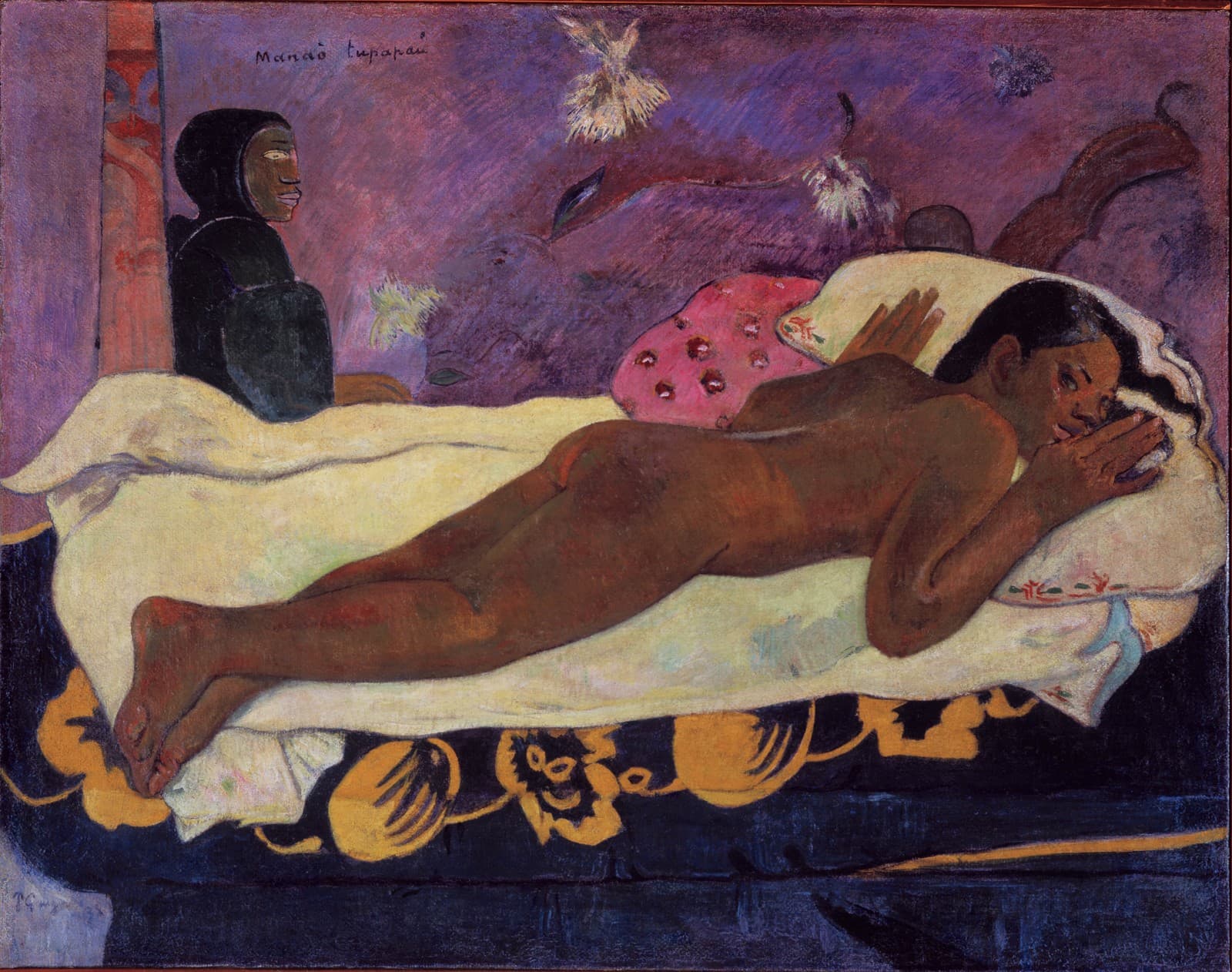
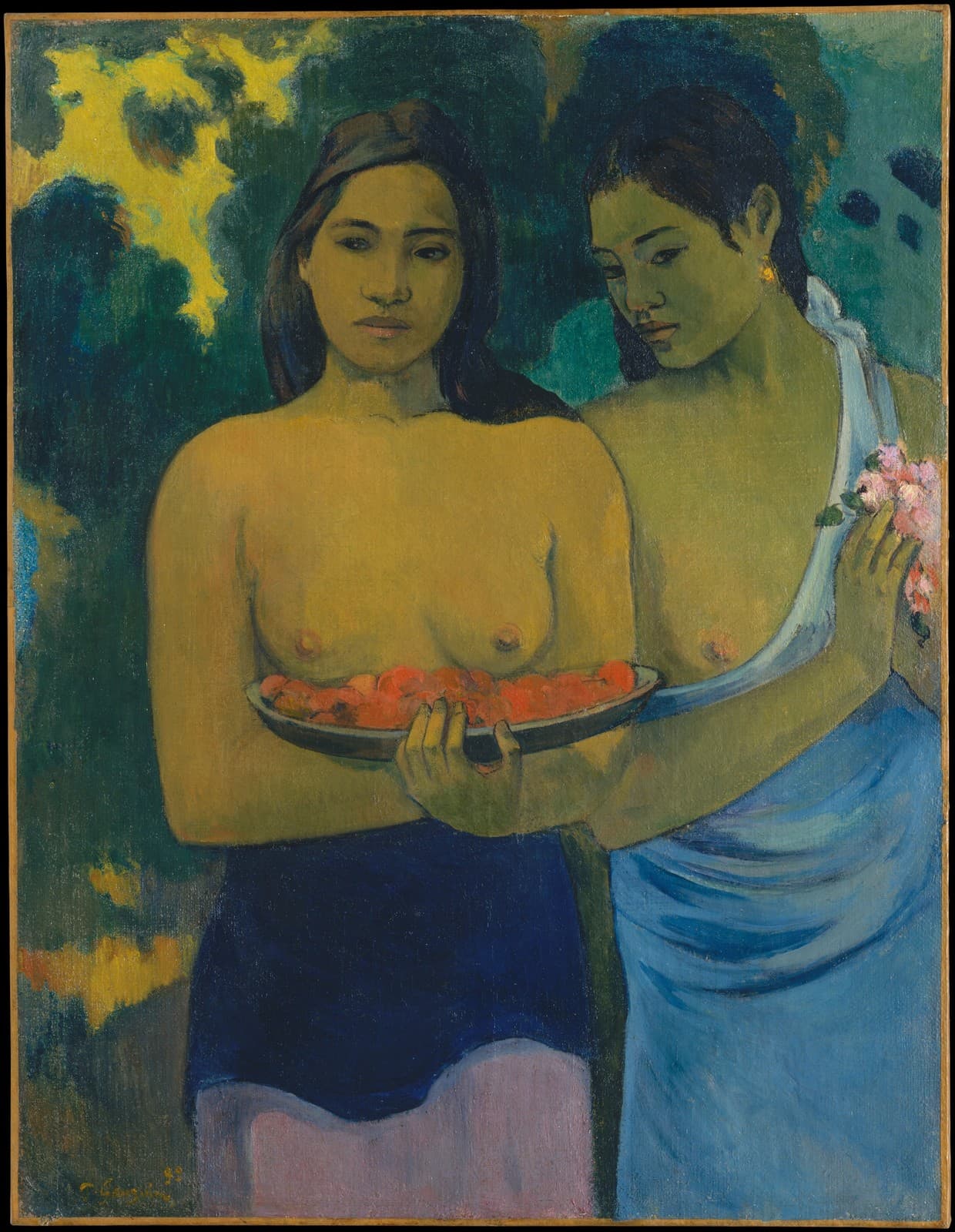
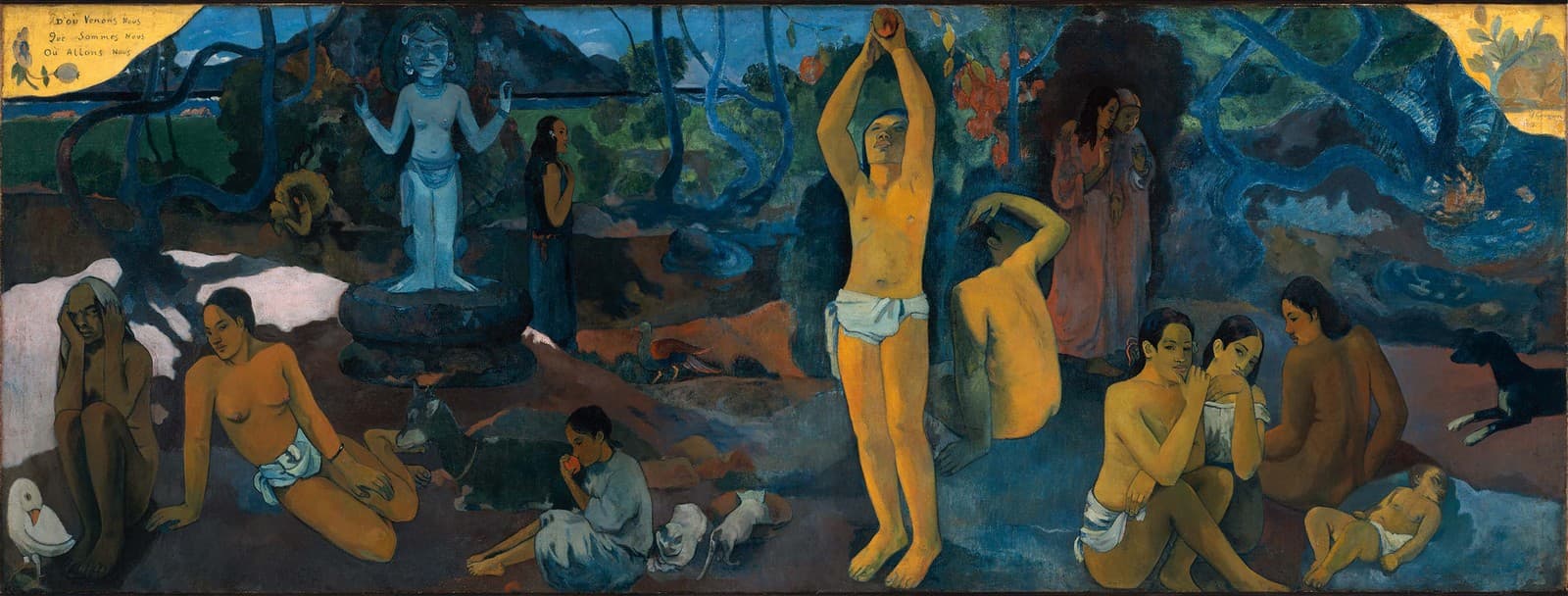
Ia Orana Maria set the template for the Tahitian decade: sacred subject matter — Christian or invented-Polynesian — carried by flat pattern and non-natural color, with figures assembled from the photographic file he traveled with. The canvases that followed it, from Manao tupapau to Where Do We Come From, elaborate the machinery first assembled here.
It entered the Metropolitan Museum with the bequest of Sam A. Lewisohn in 1951 and remains the museum's cornerstone Gauguin.[1]
Timeline
1891
Gauguin arrives at Papeete in June and settles at Mataiea; Ia Orana Maria is the first major canvas of the stay.
1892
Describes the painting in a letter to Daniel de Monfreid, singling it out among the new work.
1893
Returns to France with the Tahitian canvases for the Durand-Ruel exhibition.
1951
Enters the Metropolitan Museum of Art with the bequest of Sam A. Lewisohn.
Where to see it
The Metropolitan Museum of Art, New York
1000 Fifth Avenue, New York, NY 10028, United States
Displays and loans can change. Check whether this work is on view before making a special trip.
Plan your visit on the museum’s official website (opens in a new tab)Frequently asked questions
What does Ia Orana Maria mean?
'Hail Mary' in Tahitian — the Angel Gabriel's greeting to the Virgin at the Annunciation. Gauguin inscribed the words on the canvas at the lower left. The painting restages the Madonna and Child with Tahitian figures: a mother in a red pareu with the Child on her shoulder, both haloed.
Where is Ia Orana Maria?
The Metropolitan Museum of Art in New York, which received it in 1951 as a bequest of Sam A. Lewisohn.
Why did Gauguin paint a Christian subject in Tahiti?
Because the Tahiti he found in 1891 was a French colony with decades of missionary Christianity, not the pagan paradise he had imagined. The painting holds both facts: a Christian scene, insisted into an Edenic tropical setting. It is the first major canvas of his Tahitian years.
What is the Borobudur connection?
The two worshipping women take their pose directly from a photograph of the relief sculpture at Borobudur, the Buddhist temple in Java, which Gauguin carried with him to Tahiti. He assembled his Polynesian scenes from such sources — Javanese reliefs, Western art, photographs — as much as from observation.
Is the painting an accurate picture of Tahitian life?
No. Like nearly all of Gauguin's Tahitian work it is a constructed hybrid — Tahitian models and setting, Christian subject, poses from Javanese sculpture, halos from European religious art. Its value is as invention, not as ethnography.
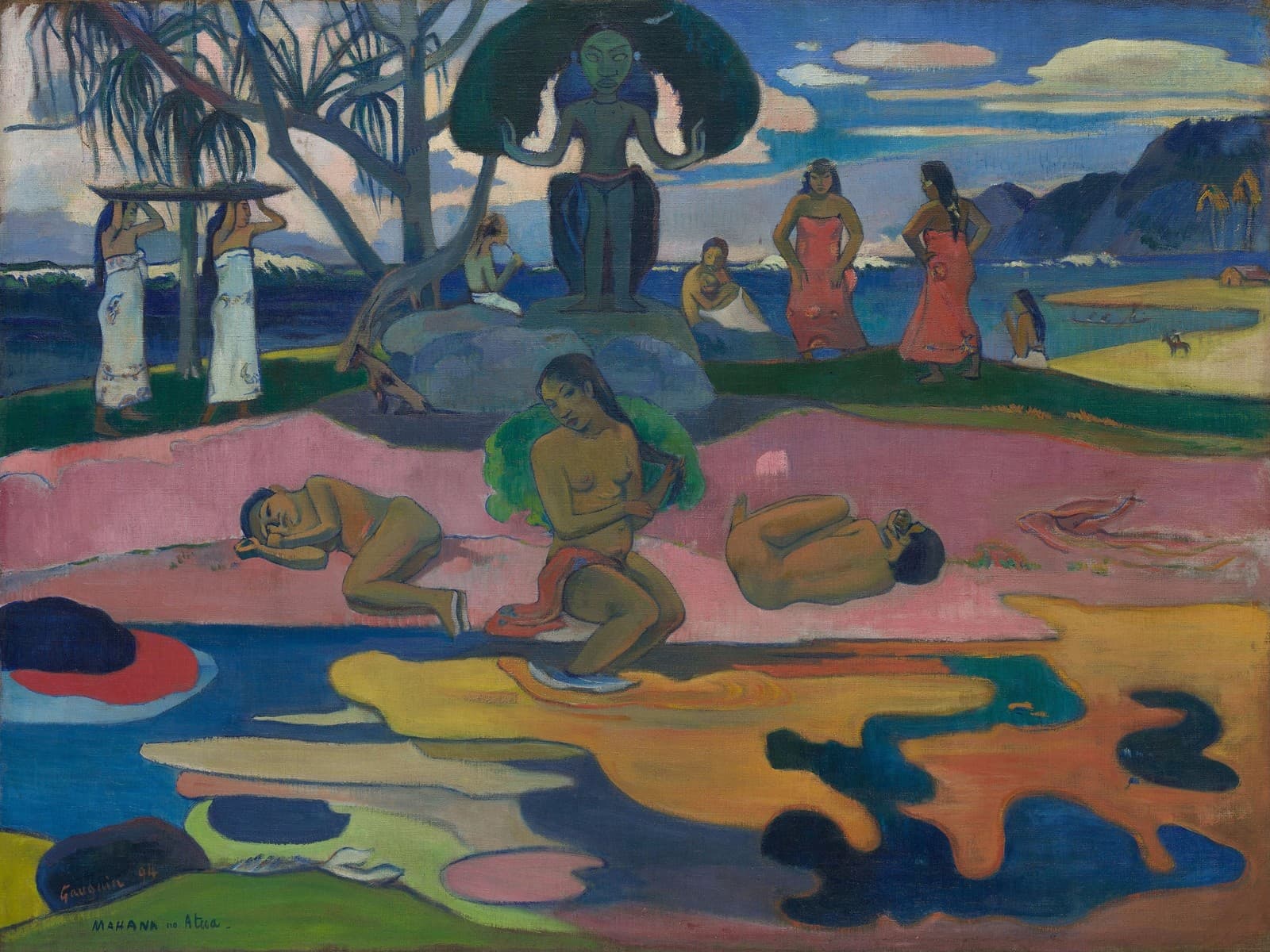
More by Paul Gauguin
If you like Paul Gauguin
Explore painters from the same movements and circles.
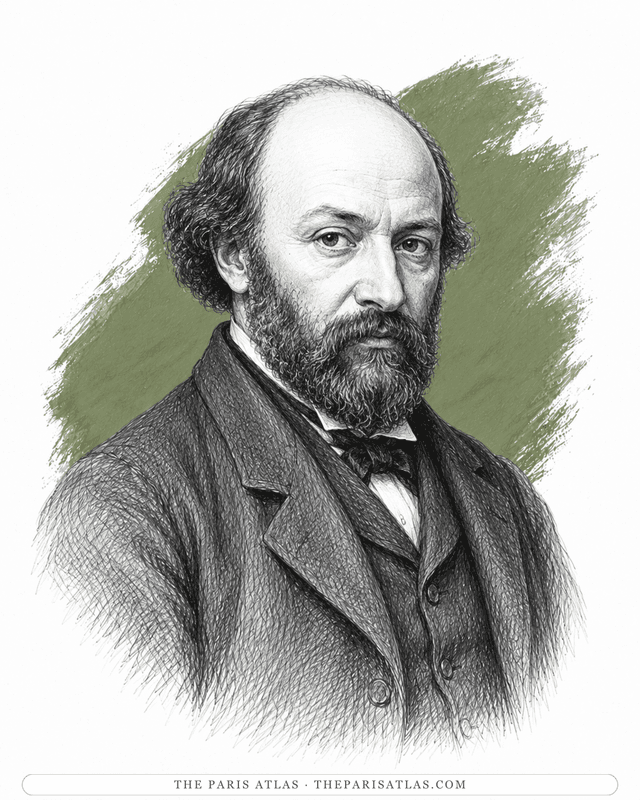
Paul Cézanne
Painter between Impressionism and everything after — shown in the independents' exhibitions, emulated by the Cubists, and present at the Orangerie through 15 works in the Walter-Guillaume collection.
View artist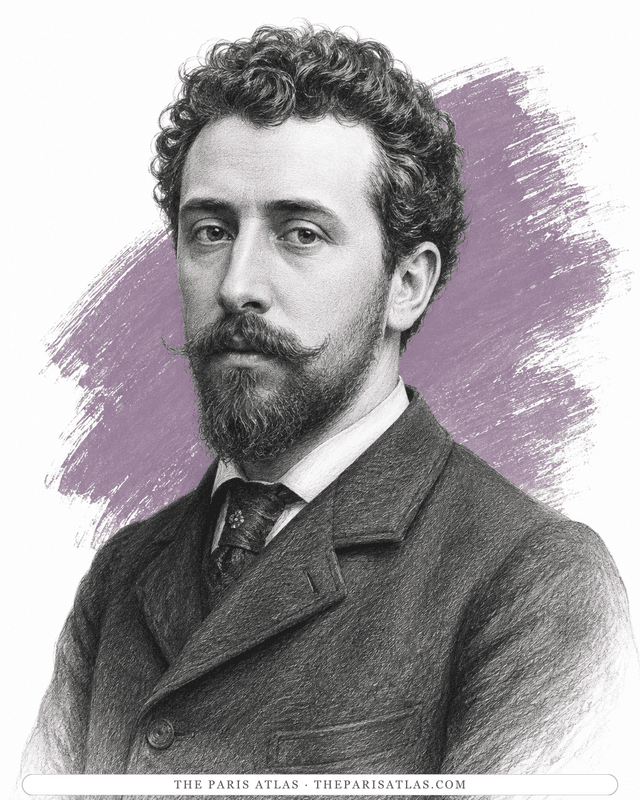
Georges Seurat
Parisian painter who built pictures from small dots of pure colour on optical principle, co-founded the Salon des Indépendants, and detonated the last Impressionist exhibition of 1886 with A Sunday on La Grande Jatte. He died at thirty-one.
View artist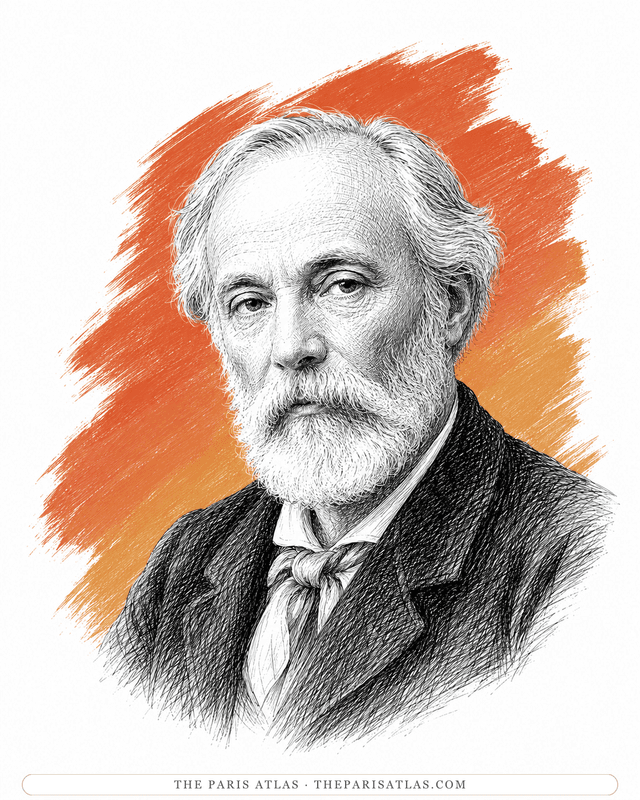
Pierre-Auguste Renoir
Porcelain painter turned co-founder of Impressionism — the painter of the Moulin de la Galette dance and the Luncheon of the Boating Party, whose later classical turn reached Picasso and Matisse.
View artist
In images
References
The sources below include collection records, catalogues, scholarly research, and primary materials that informed this page. They document Ia Orana Maria (Hail Mary), its making, and its place in cultural history.

2Paul Gauguin (1848–1903)
WebsiteThe Metropolitan Museum of ArtUsed forWeb source consulted for documented facts and historical context presented on the Ia Orana Maria (Hail Mary) page.
3Paul Gauguin (1848–1903)
WebsiteNational Gallery, LondonUsed forThe National Gallery's artist profile supplies independent biographical and stylistic context for Gauguin's Tahitian period.
4Gauguin – Tahiti, The Workshop of the Tropics
WebsiteMusée d'OrsayUsed forThe Musée d'Orsay resource documents Gauguin's Tahitian studio practice and the cultural setting of these religious images.
These references provide the documented foundation for this work's history and interpretation. Claim-level citations remain attached to the specific claims they support.
 Explore more resources