The Siesta
by Paul Gauguin
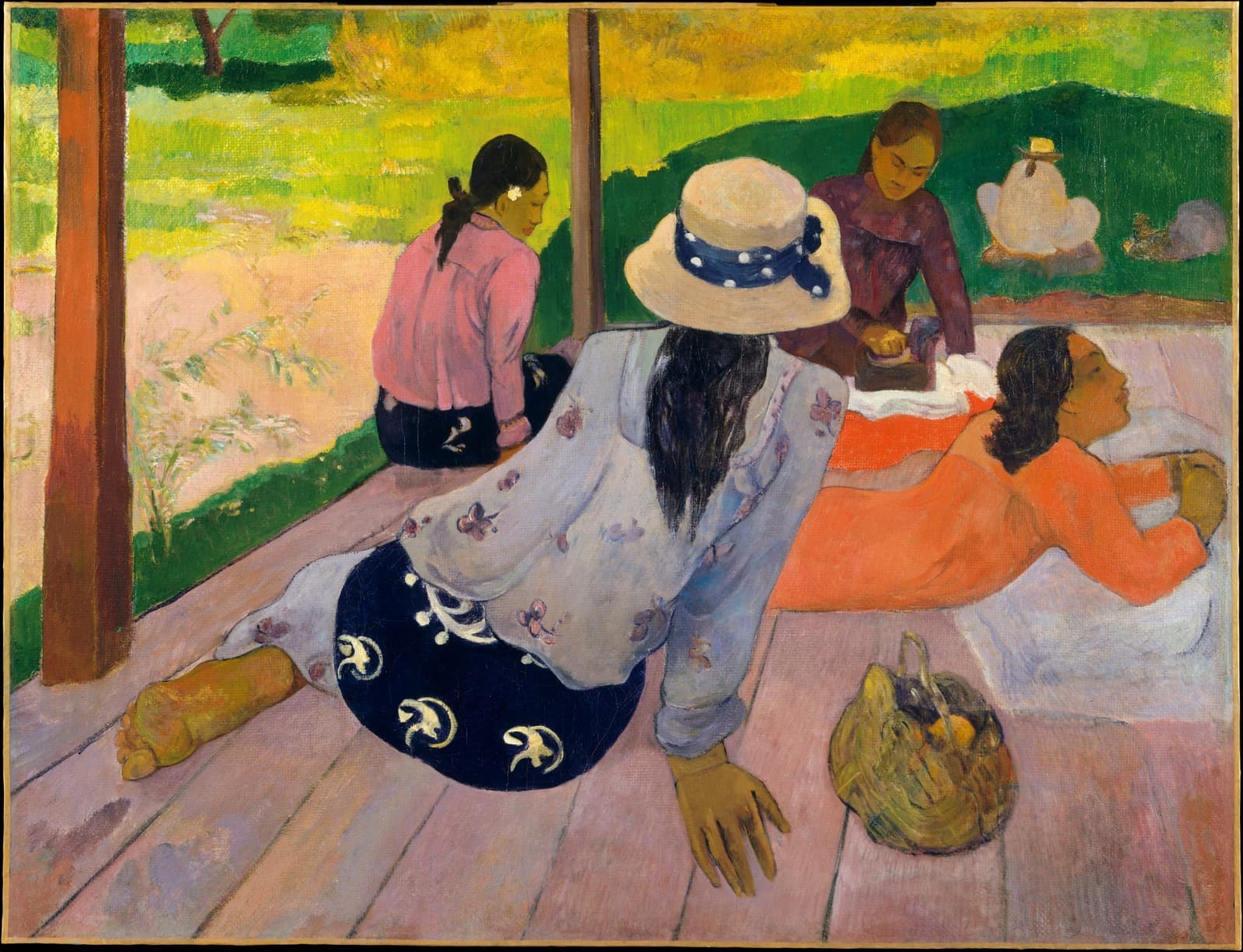
Four Tahitian women pass a hot afternoon on a wooden porch — one ironing, the others resting — in a canvas Gauguin worked on across several years, around 1892–94. No idol, no myth, no Tahitian title: the plainest picture of his first Tahitian period, and one of the best loved. The Metropolitan Museum of Art holds it in the Annenberg Collection.
- c. 1892–1894
- Oil on canvas
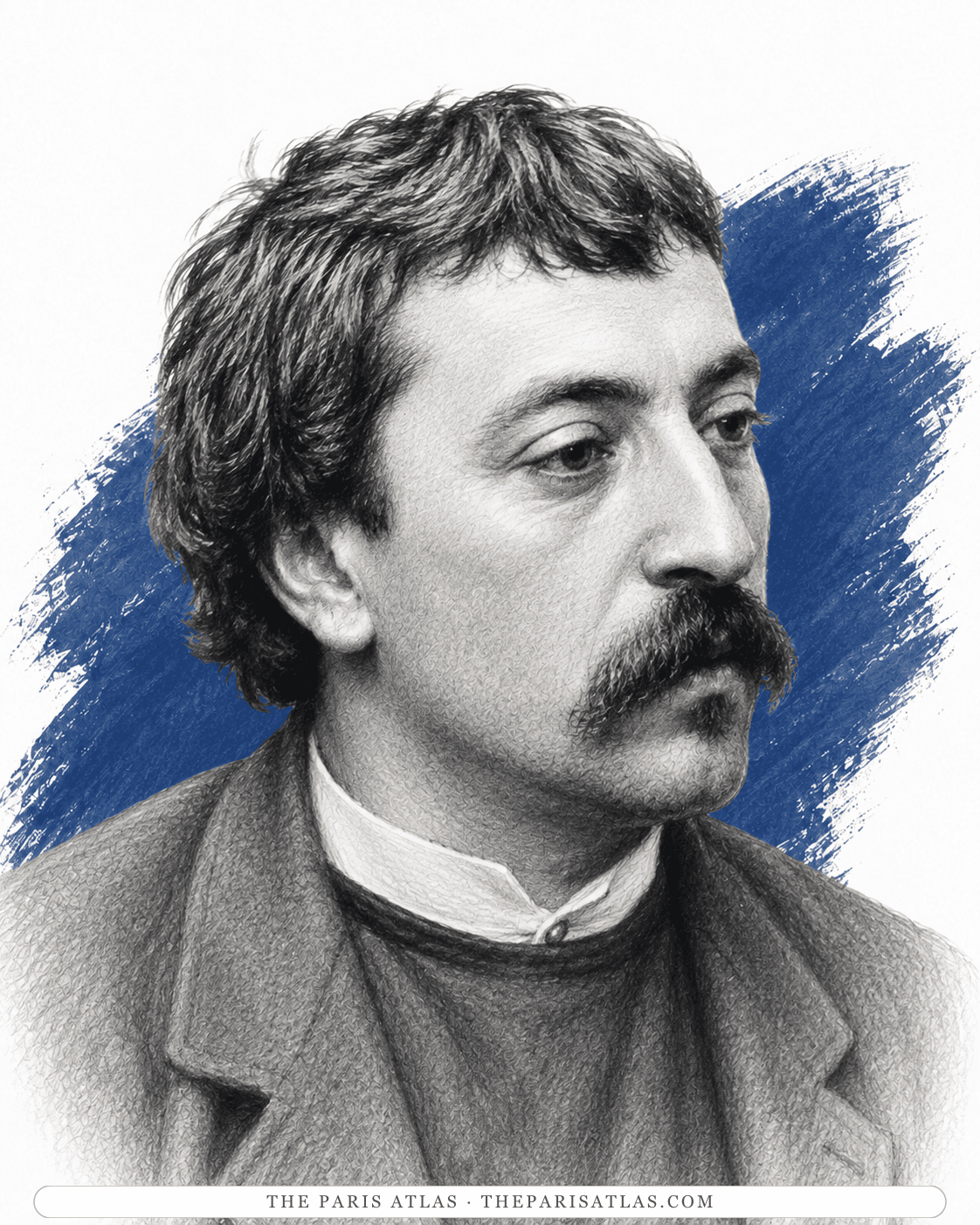
About Paul Gauguin
What the painting shows
A wooden porch in full afternoon heat, seen from its own floorboards. A woman in a pink jacket sits on the edge with her back to us, looking out at a pink dirt road; a woman in a straw hat with a polka-dot ribbon watches a third, in a dark red dress, press white cloth with a flat iron; a fourth, in orange, reclines along the deck. Beyond the porch, green lawns climb to a dark hill, and a figure in mission white crosses the grass. A basket of oranges stands on the boards.[1]
The Met's account records how long Gauguin worked at the arrangement: the foreground skirt was originally a brighter red, a dog once occupied the spot where the basket now sits, and the woman at the porch edge was moved bodily from her first position. The ease was composed, and recomposed.[1]
An afternoon without gods
Nothing in the picture is invented mythology — no idol, no spirit, no imitation script, not even a Tahitian title. After the loaded canvases of 1892, The Siesta simply watches four women pass the heat of the day, one of them working. That restraint is why the picture now reads as one of the most honest of the Tahitian decade: the colonial island as it looked on an ordinary afternoon, French fashion and flat irons included.
The colony is present in the details rather than the argument. The straw hat with its polka-dot ribbon, the high-necked white dress crossing the lawn, the ironing itself — European laundry discipline in the tropics — record the Tahiti the missions and the administration had made, without comment. Gauguin usually painted the island he wanted; here, unusually, he painted the one in front of him.
Reading the picture, detail by detail
The picture's honesty lives in its particulars. Five details, enlarged from the canvas.
The woman in pink faces away from everyone, out at the empty road. She is the picture's quiet plot: within a group scene of rest and work, one person looking at the exit. Gauguin moved her from her original position as he reworked the canvas — the Met's imaging shows the change — so the away-turned pose was a decision he made twice.[1]
The iron is the detail the title jokes with. One woman works through the siesta, pressing white cloth with a flat iron, eyes down, while a figure in mission white crosses the lawn behind her. European laundry standards came to Tahiti with everything else, and somebody had to meet them in the heat.
The straw hat with the blue polka-dot ribbon could have walked out of a Paris park. Worn over a flowered blouse on a Tahitian porch, it does the quiet work that mission dresses do in the 1892 canvases — recording the colony — but here without any opposing 'ancient' Tahiti to argue with. The afternoon absorbs it.
The bare foot, tucked under the printed pareu with its sole turned up and painted a frank yellow, is the late Gauguin's kind of truth — unposed, physical, closely seen. No symbol attaches to it. It is simply how a foot sits when its owner has been on the boards a while.
The basket of oranges stands where a dog once did — the Met's examination found the animal painted out beneath — and beside it a hand rests flat on the warm boards, doing nothing at all. In a career spent inventing gods, this may be the most convincing sacred object Gauguin painted: an afternoon with nowhere to be.[1]
More details
6.The orange dress carries the eye across the veranda
The orange garment stretches horizontally across the veranda, then turns upward with the bent arm. Its large, relatively unbroken area of color stands out against the white fabric and pink floorboards. The turn of the woman's head adds a second direction to a body otherwise defined by rest.
How it is painted
The colors are the first Tahitian period's — the pink of the boards against saturated greens, the orange dress burning at the center — but the drawing is looser and warmer than in the mythological canvases, the diagonal recession of the porch giving the picture a depth Gauguin usually flattened away. The floorboards lead the eye in like a dock into water.[1]
The long reworking shows as ease. Nothing is emphatic; the composition settles the four figures into an order that reads as accident and took, by the physical evidence, years of adjustment.[1]
Where it stands
The Siesta entered the Metropolitan Museum with the Walter H. and Leonore Annenberg Collection, and it has become one of the most reproduced canvases of the first Tahitian stay precisely because it needs no apparatus — no glossary of invented gods, no colonial mythology to unpick. Later painters of ordinary leisure, from the Nabis' interiors onward, work ground The Siesta helped clear.[1]
Within Gauguin's own shelf it is the counterweight: proof that when he set the mythology down, the island he could actually see was subject enough.
Timeline
c. 1892–1894
Painted and repeatedly reworked during and after the first Tahitian stay — the skirt's red softened, a dog painted out in favor of the basket, a figure repositioned.
1993
Enters the Metropolitan Museum of Art as part of the Walter H. and Leonore Annenberg gift.
2002
Confirmed to the Met by the bequest of Walter H. Annenberg.
Where to see it
The Metropolitan Museum of Art, New York
1000 Fifth Avenue, New York, NY 10028, United States
Displays and loans can change. Check whether this work is on view before making a special trip.
Plan your visit on the museum’s official website (opens in a new tab)Frequently asked questions
Where is Gauguin's The Siesta?
The Metropolitan Museum of Art in New York, in the Walter H. and Leonore Annenberg Collection — given in 1993 and confirmed by Annenberg's bequest in 2002.
What does The Siesta show?
Four Tahitian women passing a hot afternoon on a wooden porch — one pressing cloth with a flat iron, one watching in a straw hat, one seated at the edge looking out at the road, one reclining — painted by Paul Gauguin around 1892–94, during and after his first Tahitian stay.
Why is The Siesta different from Gauguin's other Tahitian paintings?
It has no mythology. No idol, no spirit, no invented script, not even a Tahitian title — just an ordinary colonial afternoon, French straw hat and flat iron included. After the loaded canvases of 1892 it reads as the plainest and most documentary picture of the period, which is much of why it is loved.
Did Gauguin change the painting while working on it?
Substantially. The Metropolitan Museum's examination records that the foreground skirt was originally a brighter red, that a dog once occupied the place where the basket of oranges now sits, and that the woman at the porch edge was moved from her first position. He worked at the canvas across several years.
When did Gauguin paint The Siesta?
Around 1892 to 1894 — begun during the first Tahitian stay and reworked over an extended period, by the Met's dating, which is why the picture carries both the period's saturated color and an unusual, settled ease.
More by Paul Gauguin
If you like Paul Gauguin
Explore painters from the same movements and circles.
Paul Cézanne
Painter between Impressionism and everything after — shown in the independents' exhibitions, emulated by the Cubists, and present at the Orangerie through 15 works in the Walter-Guillaume collection.
View artist
Georges Seurat
Parisian painter who built pictures from small dots of pure colour on optical principle, co-founded the Salon des Indépendants, and detonated the last Impressionist exhibition of 1886 with A Sunday on La Grande Jatte. He died at thirty-one.
View artist
Pierre-Auguste Renoir
Porcelain painter turned co-founder of Impressionism — the painter of the Moulin de la Galette dance and the Luncheon of the Boating Party, whose later classical turn reached Picasso and Matisse.
View artist
In images
References
The sources below include collection records, catalogues, scholarly research, and primary materials that informed this page. They document The Siesta, its making, and its place in cultural history.


2Paul Gauguin (1848–1903)
WebsiteThe Metropolitan Museum of ArtUsed forWeb source consulted for documented facts and historical context presented on the The Siesta page.
3Paul Gauguin (1848–1903)
WebsiteNational Gallery, LondonUsed forThe National Gallery's artist profile supplies independent biographical and stylistic context for Gauguin's Tahitian period.
4Gauguin – Tahiti, The Workshop of the Tropics
WebsiteMusée d'OrsayUsed forThe Musée d'Orsay resource documents Gauguin's Tahitian workshop and the everyday imagery of his island paintings.
These references provide the documented foundation for this work's history and interpretation. Claim-level citations remain attached to the specific claims they support.
 Explore more resources