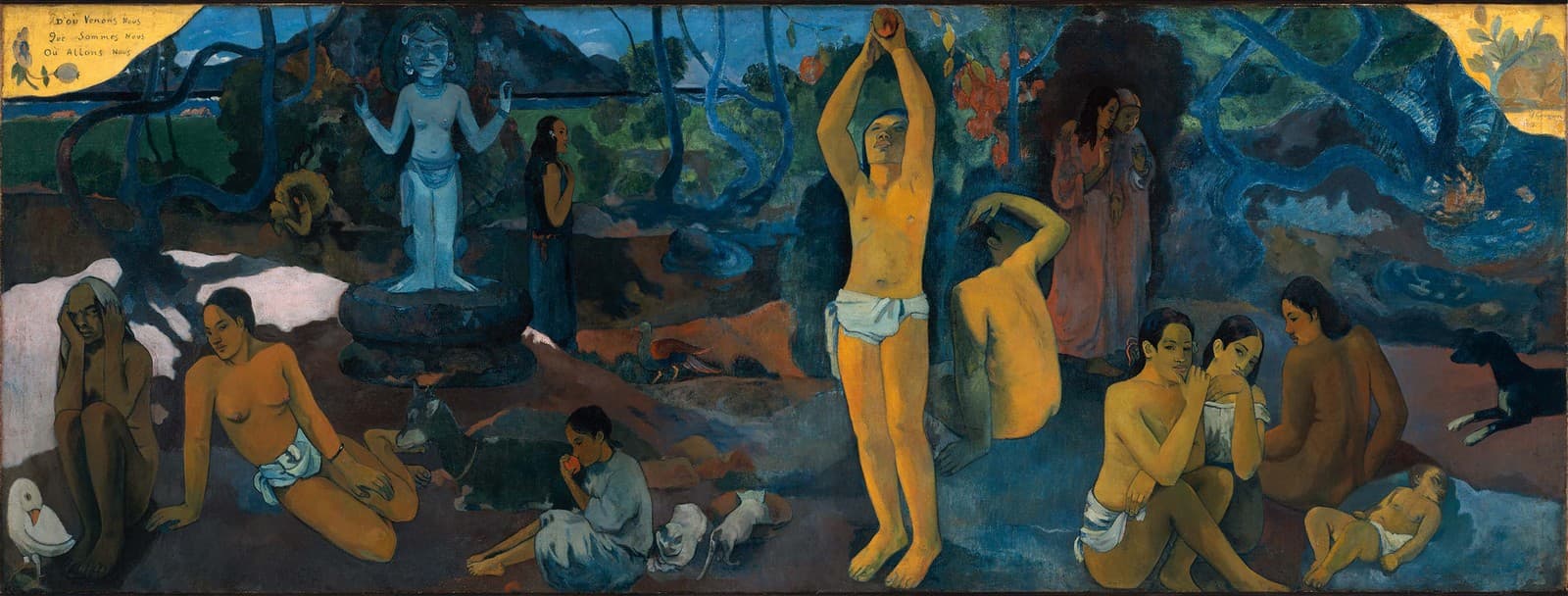
Where Do We Come From? What Are We? Where Are We Going?
by Paul Gauguin
The largest and most ambitious canvas of Paul Gauguin's career, painted in Tahiti in 1897–98 after the death of his daughter Aline: human figures cross the span of existence from infancy to old age, read from right to left at the painter's instruction, beneath a blue idol. The Museum of Fine Arts, Boston has owned it since 1936.
- 1897–1898
- Oil on canvas
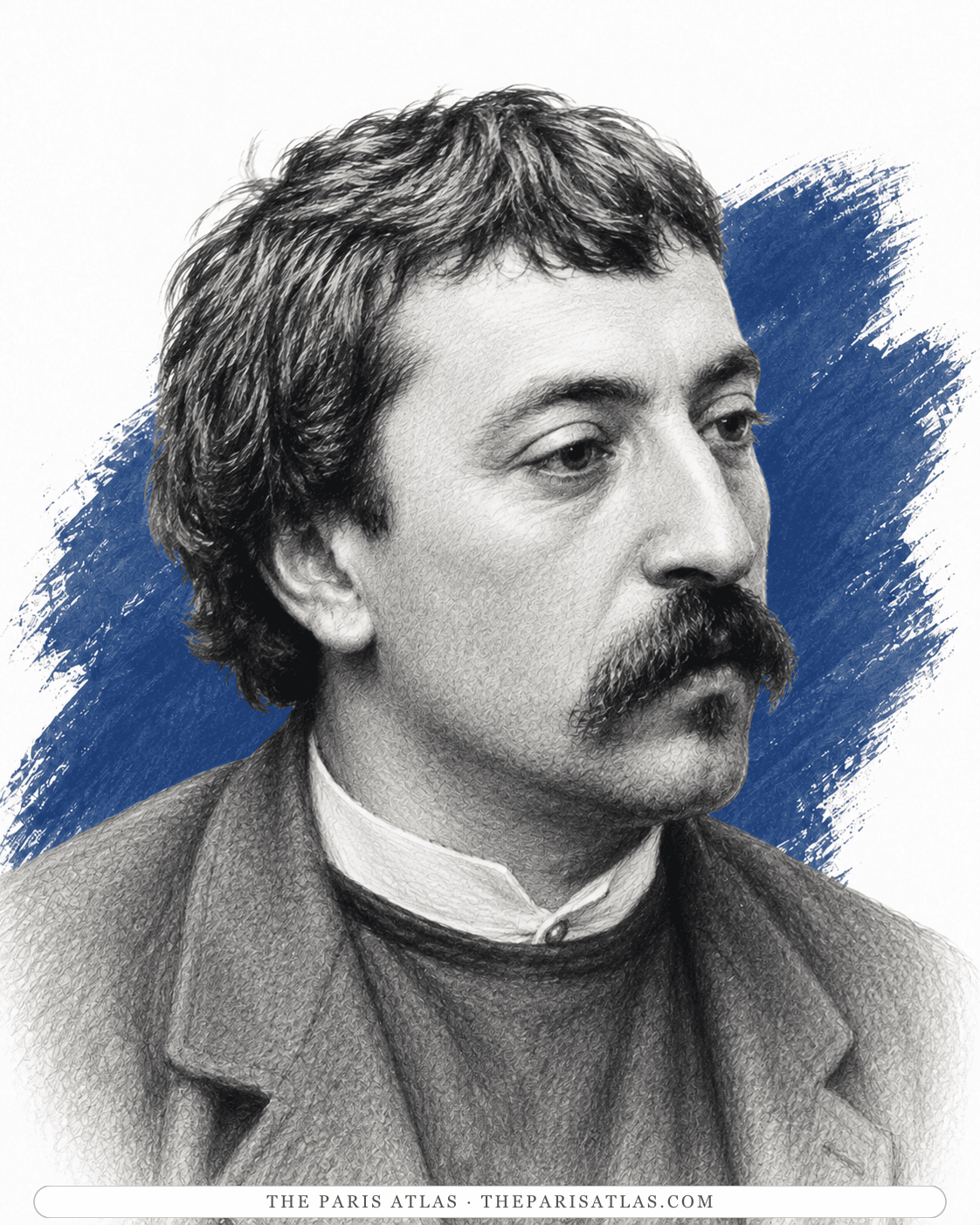
About Paul Gauguin
What the painting shows
Across nearly four meters of canvas, figures occupy a Tahitian landscape from shore to mountain. Gauguin instructed that the picture be read from right to left: a sleeping infant and three seated women at the right; in the center a standing figure reaching up to pick fruit; groups of women, children, animals, and a walking pair through the middle ground; at the left an old woman crouched with her head in her hands, near death, with a strange white bird at her feet. Behind them all stands a blue idol with raised arms.[1]
In the upper left corner, on a yellow field, Gauguin painted the three questions of the title in French. He signed and dated it in the opposite corner.
A summation painted in crisis
The canvas came out of the worst year of Gauguin's life. In 1897, on Tahiti, he learned that his daughter Aline — the child he was most attached to — had died in Copenhagen at nineteen; his health was failing and his money nearly gone. He painted the enormous canvas in response, at speed, and wrote to his friend Daniel de Monfreid that he had intended it as his final statement — by his own account he attempted to end his life after finishing it, and survived.[2]
The title's questions are the subject, and the picture declines to answer them. The Museum of Fine Arts, Boston describes it as a meditation on the fundamental questions of existence, and its refusal to resolve them is the meaning: life runs right to left from infancy to death under an unexplained god, and the fruit-picker at the center reaches upward without telling us what for. Gauguin wanted pictures that provoked meditation rather than delivered messages, and this is that principle at mural scale.[3]
Reading the picture, detail by detail
Four meters of canvas hold more private life than any reproduction shows. Six details, enlarged from the painting itself and set in Gauguin's own right-to-left reading order.
Where do we come from: the infant, asleep on a blue-white cloth at the right edge. The three figures beside it attend to their own thoughts — one looks out of the canvas entirely — and a black dog settles on the pink ground. Life begins here watched over and slightly ignored, which is its own kind of honesty about households.
Almost no one in the painting acknowledges being watched. The exception is here: a crouched figure, knuckles at her chin, meeting the viewer's eyes with a directness that stops the whole frieze. Behind her a bather turns his back and two robed figures pass through the shadow in conversation — thought happening at every depth of the picture at once.
What are we: the center of the canvas is a person taking fruit, arms at full stretch, face turned up into shadow, feet braced against the ground. Eden echoes without being quoted — the reach is neither innocent nor guilty, just human appetite at full extension. Two white kittens at the bottom edge go on being kittens.
The idol presides without belonging to any documented cult — Gauguin assembled his 'ancient' Polynesia from books and photographs. Painted a moon-glow blue with both palms lifted, it is the one figure in the picture that faces forward entirely, and the gloom around it holds a cloaked figure raising a hand to its head, startled by something the viewer never sees.
Where are we going: the old woman at the left edge, crouched with her hands pressed to her temples, white hair over her face like a hood. The young woman beside her — painted in the warmest flesh tones on the canvas — looks down and past her, not at her. And the white bird stands close, the one Gauguin told a correspondent represents the futility of vain words. At the end of the questions, the painting puts a creature that cannot speak.
The title is painted into the picture, handwritten on the chrome-yellow corner in plain schoolroom French — and without question marks. Gauguin wrote the questions as statements, on a corner made to look like a fragment of ancient fresco, as if they had always been there and would not be answered now.
How it is painted
The format is a frieze, and Gauguin underlined it: the two upper corners are painted yellow like a fresco's damaged gold ground, as if the canvas were a fragment of an ancient wall. The palette runs deep blues and greens shot with the orange-golds of the figures, keyed to twilight; contours stay heavy and the space stacks in bands, the whole surface organized as pattern before depth.[4]
The figures assemble his lifelong sources — poses from Borobudur and Western art, the invented idol, the Tahitian models — into a procession. It is the mature manner at its most complete: memory, borrowing, and observation fused into one designed surface.
What it led to
The canvas went back to France in 1898 and became the anchor of Gauguin's posthumous reputation — the work that convinced the twentieth century he had been painting philosophy, not travel pictures. Its scale and ambition stand behind the great synthetic murals of early modernism, and its questions became the standard frame for reading everything else he made.[5]
The Museum of Fine Arts, Boston acquired it in 1936, and it remains the destination Gauguin in an American collection.[3]
Timeline
1897
Gauguin learns of the death of his daughter Aline in Copenhagen; his health and finances collapse.
1897–1898
Paints the canvas at Punaauia, Tahiti, intending it as his final statement; by his own account he attempts suicide after finishing it, and survives.
1898
The canvas is shipped to France and exhibited in Paris.
1936
Acquired by the Museum of Fine Arts, Boston, through the Tompkins Collection.
Where to see it
Museum of Fine Arts, Boston
465 Huntington Avenue, Boston, MA 02115, United States
Displays and loans can change. Check whether this work is on view before making a special trip.
Plan your visit on the museum’s official website (opens in a new tab)Frequently asked questions
Where is Where Do We Come From? What Are We? Where Are We Going?
The Museum of Fine Arts, Boston, which acquired it in 1936. At 139.1 by 374.6 centimeters it is the largest canvas Gauguin ever painted.
How is the painting meant to be read?
From right to left, at Gauguin's own instruction: the sleeping infant at the right, the figure picking fruit at the center, and the old woman crouched near death at the left, with the blue idol presiding behind. The progression runs from birth toward death across the full width of the canvas.
Why did Gauguin paint it?
In the crisis year after his daughter Aline died in Copenhagen in 1897, with his health and money failing, Gauguin painted the canvas as a deliberate final statement — he wrote to Daniel de Monfreid that he had meant it as his testament, and by his own account attempted suicide after completing it. He survived, and lived five more years.
What do the three questions mean?
They are the painting's whole subject, written in French on the upper left corner, and the picture deliberately refuses to answer them. Gauguin wanted a meditation on existence — birth, life, death, and whatever the idol stands for — rather than an allegory with a key. The refusal is the point.
Why are the corners yellow?
Gauguin painted the two upper corners yellow like the damaged gold ground of an old fresco, so the canvas reads as a fragment of an ancient wall — a frieze surviving from some imagined civilization. It is part of the painting's claim to timelessness.
More by Paul Gauguin
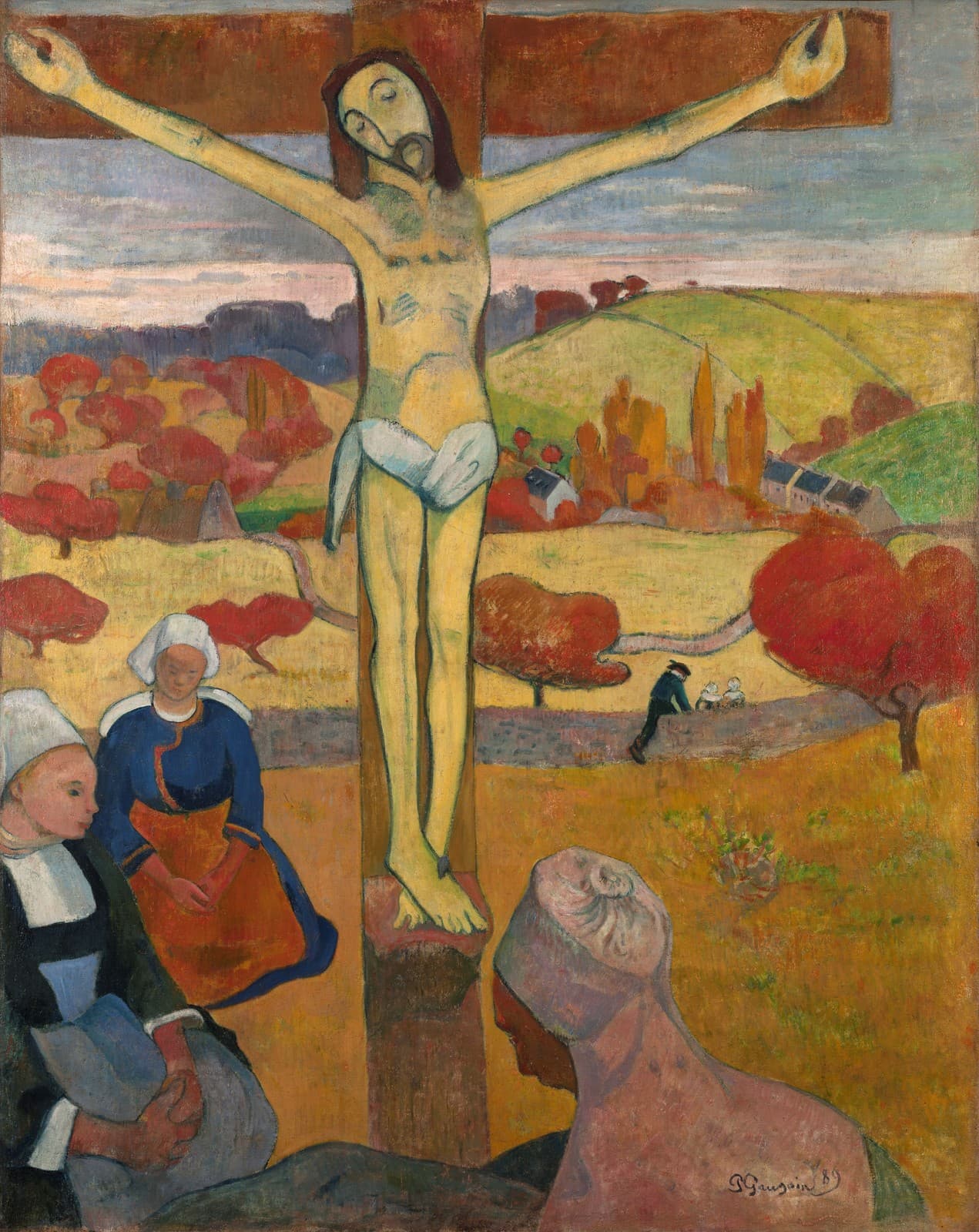
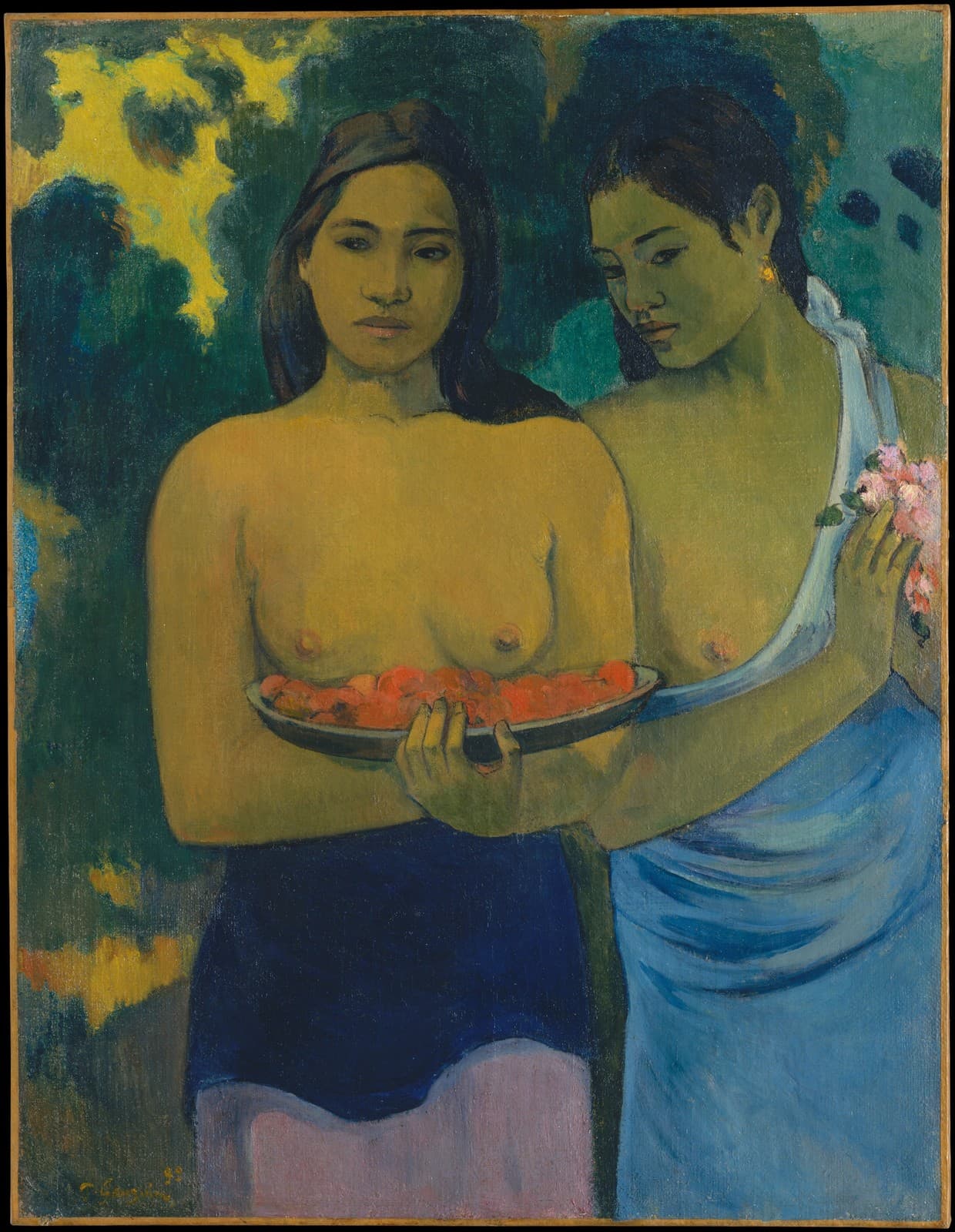
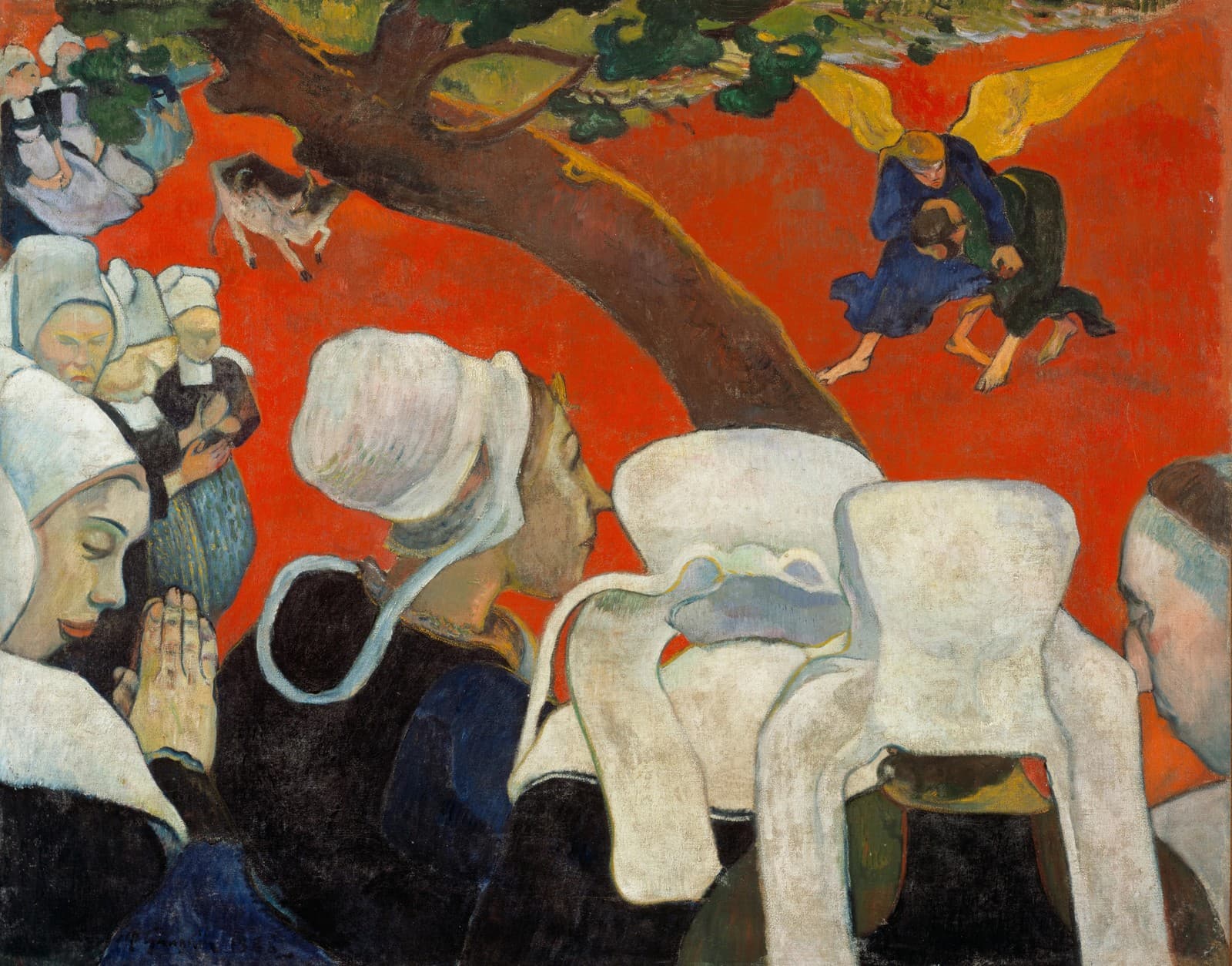
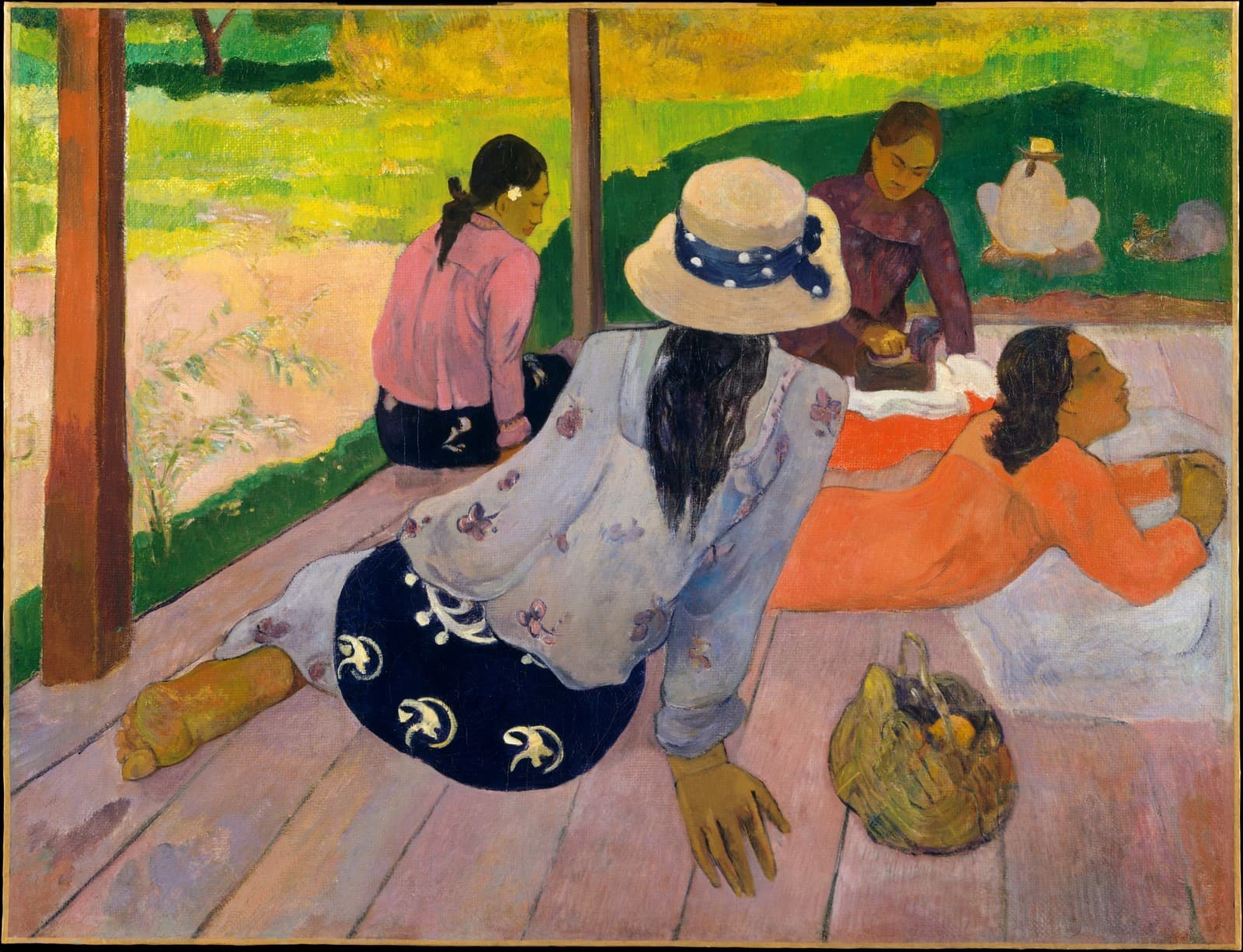
If you like Paul Gauguin
Explore painters from the same movements and circles.
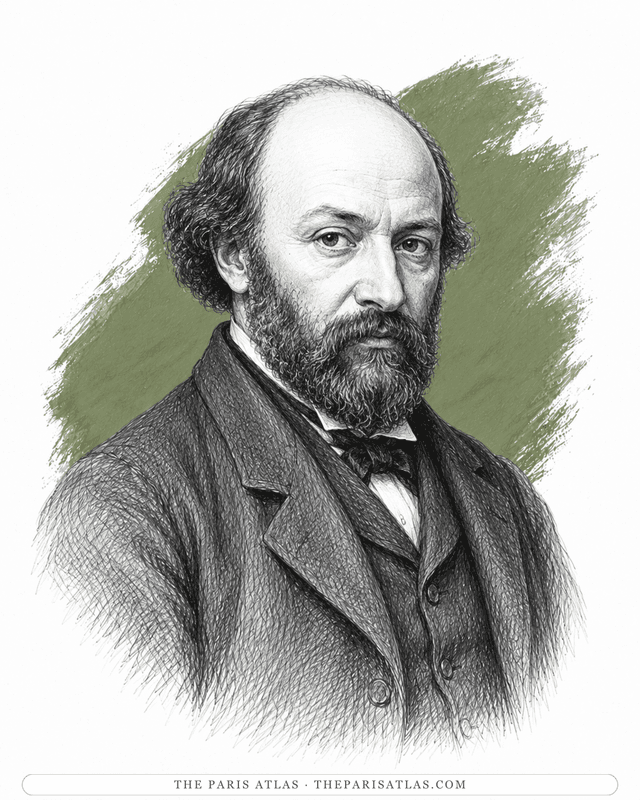
Paul Cézanne
Painter between Impressionism and everything after — shown in the independents' exhibitions, emulated by the Cubists, and present at the Orangerie through 15 works in the Walter-Guillaume collection.
View artist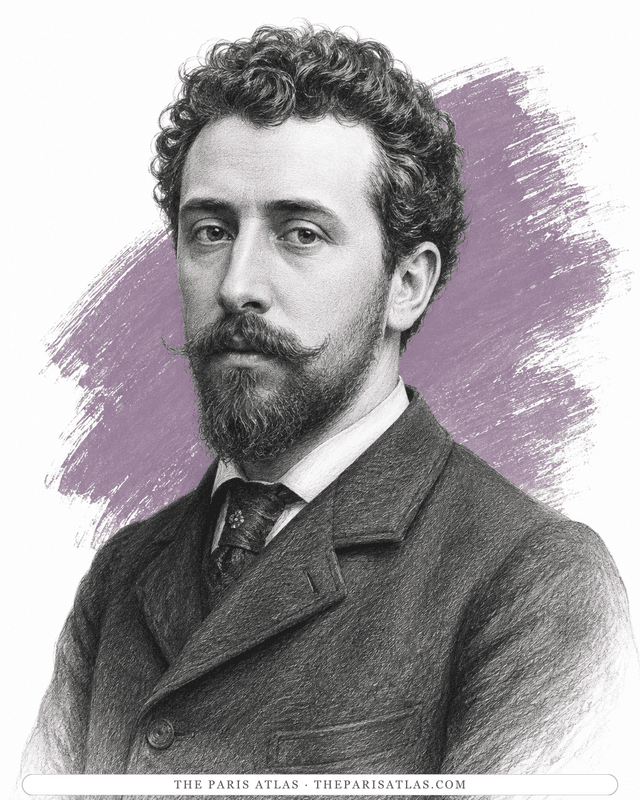
Georges Seurat
Parisian painter who built pictures from small dots of pure colour on optical principle, co-founded the Salon des Indépendants, and detonated the last Impressionist exhibition of 1886 with A Sunday on La Grande Jatte. He died at thirty-one.
View artist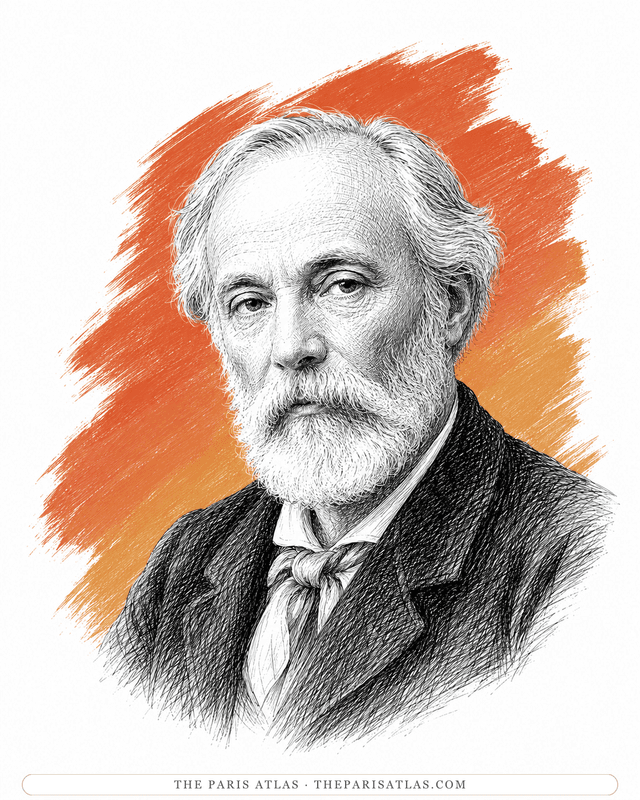
Pierre-Auguste Renoir
Porcelain painter turned co-founder of Impressionism — the painter of the Moulin de la Galette dance and the Luncheon of the Boating Party, whose later classical turn reached Picasso and Matisse.
View artist
In images
References
The sources below include collection records, catalogues, scholarly research, and primary materials that informed this page. They document Where Do We Come From? What Are We? Where Are We Going?, its making, and its place in cultural history.


1↑Where Do We Come From? What Are We? Where Are We Going?, 1897–98
Official recordMuseum of Fine Arts, BostonUsed forOfficial record used to verify names, dates, institutional details, or other factual information on this page.

2↑Where Do We Come From? What Are We? Where Are We Going? (1897–98), Paul Gauguin
WebsiteMuseum of Fine Arts, BostonUsed forWeb source consulted for documented facts and historical context presented on the Where Do We Come From? What Are We? Where Are We Going? page.
4↑Paul Gauguin (1848–1903)
WebsiteNational Gallery, LondonUsed forThe National Gallery's artist profile supplies independent biographical and stylistic context for Gauguin's late Tahitian work.
5↑Gauguin – Tahiti, The Workshop of the Tropics
WebsiteMusée d'OrsayUsed forThe Musée d'Orsay resource documents the Tahitian studio environment and cultural circumstances behind Gauguin's large compositions.
These references provide the documented foundation for this work's history and interpretation. Claim-level citations remain attached to the specific claims they support.
 Explore more resources