Mural
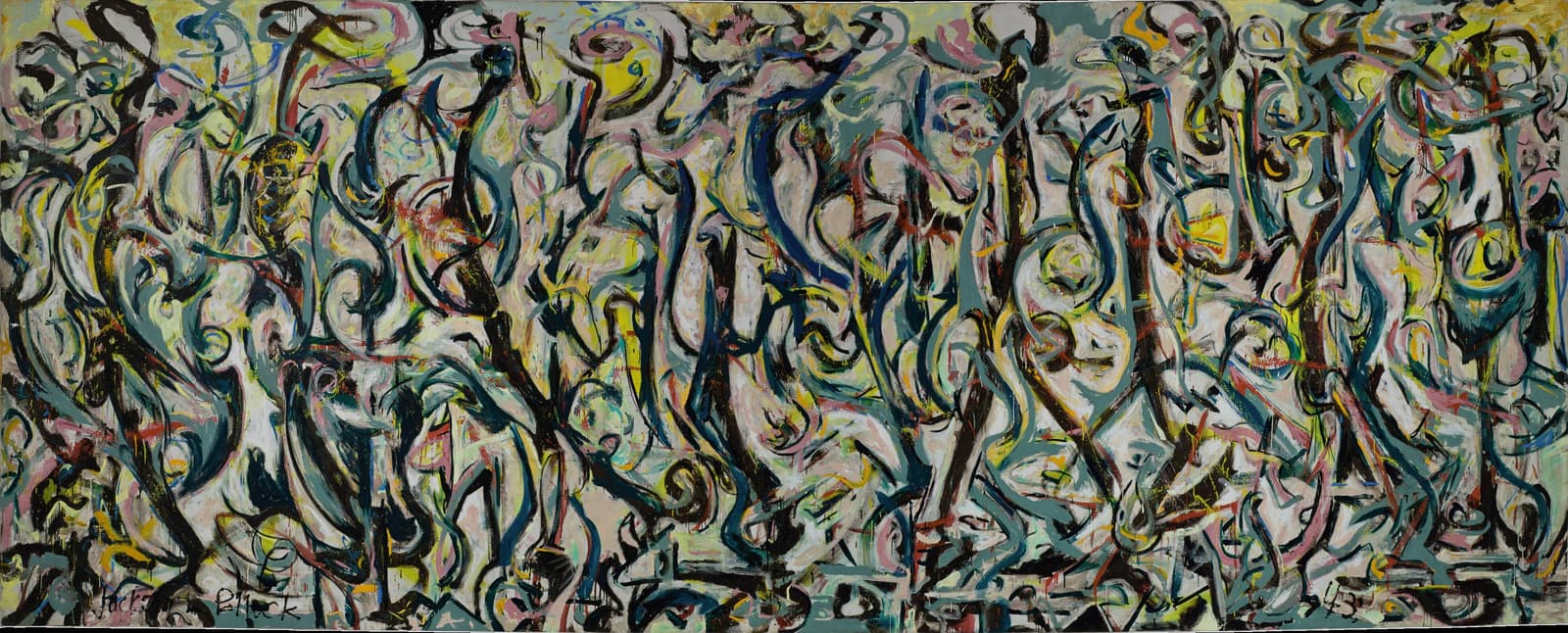
A canvas six metres wide, painted for the entrance hall of Peggy Guggenheim's New York townhouse. Jackson Pollock worked it upright, and the paint ran downward in long drips that are still visible along the bottom edge. The Getty Conservation Institute studied and treated it between 2012 and 2014, and established that the bright lemon yellow went on before the dark verticals rather than after them. It has belonged to the University of Iowa since 1951 and was accessioned in 1959.
- 1943
- Oil and casein on canvas
- University of Iowa Stanley Museum of ArtIowa City, United States
About Jackson Pollock
What the canvas shows
The picture is a band of vertical marks almost six metres long and two and a half metres high. Loops and hooks of dark brown-black run from top to bottom, roughly evenly spaced, each one shadowed by a slower curve in slate teal. Between them the ground is cream, pale yellow and rose pink, brushed thin enough in places to show the canvas weave.
Nothing is repeated exactly and nothing is symmetrical. The verticals lean at different angles, some doubling back on themselves, and the colour between them changes from a warm cream at the centre to a cooler grey-green at the right end. A pale blue-grey band runs along the top edge, and a dark horizontal band of brown-black runs along the bottom.
The Stanley Museum of Art gives the size as 242.25 by 603.89 centimetres, with a depth of 6.35 centimetres. It is the largest painting Jackson Pollock made.
Peggy Guggenheim's hallway
Peggy Guggenheim commissioned the painting in 1943 for the entrance of her New York townhouse. Her assistant Howard Putzel had pressed her to give Jackson Pollock a project large enough to use the force he saw in the smaller easel pictures. Pollock signed a gallery contract with her in July 1943 at $150 a month, with a settlement at the end of the year if his paintings sold.
Marcel Duchamp advised that it be painted on canvas rather than directly on the wall, so that it could be moved. Pollock wrote that the commission came with no strings as to what or how he painted it. He also wrote that he had torn out the partition between the front and middle rooms of his apartment to get the stretched canvas up.
The University of Iowa Museum of Art records that he stared at the blank canvas for weeks, told friends he was blocked, and then painted it in a single burst around New Year's Day of 1944. The canvas is dated 1943. The Getty's technical study later found that account cannot be right, and discredited the idea of one feverish night.
What the Getty found in the paint
Mural travelled from Iowa to the Getty in 2012 for technical study, conservation and cleaning, and was shown at the Getty Center from 11 March to 1 June 2014. Alan Phenix and Tom Learner established that the painting is virtually all artists' oil colour — thirteen different shades, used pure or mixed — on a stretched and primed canvas.
One material is not artists' paint. Pollock also used a cheap water-based casein house paint of the kind sold for walls, bought, Alan Phenix suggests, from the hardware store below his studio. He used it at several stages, possibly three or four times, to block in the light reserves between the darker forms.
The single largest surprise concerned the order of the layers. Thomas Hart Benton had taught that a long horizontal composition should begin with imaginary vertical poles acting as a skeleton, and it had always been assumed that Pollock laid those dark verticals down first. The analysis showed he began instead with bright lemon yellow, a strong colour that broke up the blank canvas without committing him to a dark start.
Painted standing up
Mural was made before Jackson Pollock began laying canvas on the floor, and the surface proves it. Drips run vertically from dozens of the dark strokes, long and straight, and gather in a dense fringe below the horizontal band at the bottom edge. Gravity pulled every one of them in the same direction, which only happens when the canvas is upright.
The marks themselves are brushed rather than poured. Bristle tracks are visible inside the wide black curves, the paint is dragged and scrubbed in the pale passages, and the edges of the teal strokes are combed rather than rounded. The later poured paintings have none of that.
The varnish and the sag
Two problems brought the painting to the Getty. It had been varnished in 1973 to protect it, but Jackson Pollock never varnished it, and the coating flattened the alternation of matte and gloss that the composition depends on. It had also sagged, apparently as early as 1947, because the original stretcher was not strong enough for the span.
Yvonne Szafran records that the cracked stretcher was replaced and the canvas lined, meaning a second fabric was glued to the back for strength. Lining locked the existing sag into the canvas. When it went back onto a rectangular stretcher, parts of the original tacking edges ended up exposed on the front, in the lower and right corners and in the upper centre.
Greenberg, and the road to Iowa
Clement Greenberg had written encouraging but qualified reviews of Jackson Pollock before he saw the painting installed. The University of Iowa Museum of Art records his account of the change: he took one look at it and thought that was great art, and knew Pollock was the greatest painter the country had produced. He advocated for Pollock through the rest of the 1940s.
Peggy Guggenheim closed her gallery in 1947 and returned to Europe with no room for a six-metre canvas in Venice. She wrote to Lester Longman, head of the University of Iowa's School of Art and Art History, on 3 October 1948, reminding him of her offer to give the painting if the university paid the freight from Yale. It was shipped to Iowa in October 1951 and accessioned in 1959.
Close reading
Reading the work, detail by detail
Mural was painted standing up, on a stretched canvas six metres wide, four years before Jackson Pollock began working on the floor. Close view shows what that means in practice: brush hairs inside the black curves, drips falling straight down from them, and a lemon yellow that the Getty's analysis found beneath the dark verticals rather than above them.
1.The lemon yellow went down first
A bright lemon yellow fills the ground here, with a pale blue-grey band along the top edge above it. The Getty Conservation Institute's analysis found this yellow among the earliest paint on the canvas, laid down before the dark verticals. It had always been assumed the black armature went on first.
2.Every drip falls straight down
Thin runs of black and red-brown hang below the brushed hooks, straight and parallel. Gravity pulled all of them the same way, which happens only when a canvas is upright. Mural was painted on a wall, not on the floor.
3.A dark band along the bottom, fringed with runs
A broad brown-black band crosses the lower canvas horizontally, the only sustained horizontal in the picture. Dozens of thin runs hang beneath it in a fringe. Below that sit teal-blue curves and a band of rose pink.
4.The signature sits on the bottom edge
Jackson Pollock signed in black script along the bottom left, and later strokes run across the letters. A narrow strip of unpainted canvas shows below the signature at the picture's edge. Cadmium-yellow slashes and cobalt-blue dashes cross the area above.
5.Slate teal shadows every black curve
A second colour follows the black almost everywhere: a slate teal, greyer and greener than the black, laid in broad curves beside it. The pairing gives the verticals a doubled edge. Rose pink and a darker red-brown run through the gaps.
6.One cobalt blue band cuts across the verticals
A broad cobalt blue runs diagonally through the centre, against the general upward-downward grain of the picture. It is the only colour used at that width, and it crosses several verticals rather than following them. Red-brown marks sit where it meets them.
7.A lemon oval near the right end
A lemon-yellow oval sits near the right end with a black loop drawn inside it, roughly the size of a head. It is the most enclosed shape in a picture otherwise made of open curves. Rose pink and slate teal wrap round it.
8.Bristle tracks inside the strokes
Parallel tracks run along the inside of the wide curves, left by the bristles of a loaded brush. The edges are combed rather than rounded. A poured line has none of that, which is the plainest difference between Mural and the paintings of 1947 onwards.
9.The canvas weave shows through
In the pale passages the paint is scrubbed on thinly enough for the weave of the canvas to read through. The Stanley Museum of Art gives the medium as oil and casein on canvas, and the casein is a thin water-based house paint used to block in the light areas.
10.An ochre disc caught between two curves
A small ochre disc is caught between two curves, darker and warmer than the lemon yellow elsewhere. Jackson Pollock varied yellow across the canvas rather than repeating one. Alan Phenix identified thirteen shades of artists' oil colour in the painting, used pure or mixed.
11.The rhythm keeps going off the left edge
At the left edge the strokes run off rather than turning back. Nothing closes the composition at either end. Peggy Guggenheim commissioned the painting for a hallway, where it would be met from the side and walked past rather than faced.
12.A cool grey-blue strip runs along the top
A pale grey-blue band runs along the top edge for most of the painting's length, cooler than anything below it. Rose-pink hooks and a dark blue-black blob sit against it. The black drips that fall from the blob cross the band on their way down.
Timeline
1943
Peggy Guggenheim commissions the painting for her New York townhouse hallway; Marcel Duchamp advises painting on canvas rather than the wall. Pollock signs her gallery contract in July at $150 a month.
1943–44
Painted and dated 1943; the University of Iowa Museum of Art records that Pollock finished it around New Year's Day 1944.
1947
The canvas has already sagged on its original stretcher.
1948
Peggy Guggenheim writes to Lester Longman on 3 October offering the painting to the University of Iowa if it pays the freight from Yale.
1951
Shipped to Iowa City in October.
1959
Accessioned by the University of Iowa Museum of Art as 1959.6, Gift of Peggy Guggenheim.
1973
Varnished, a coating Pollock had never applied.
2012
Travels to the Getty for technical study, conservation and cleaning.
2014
Shown at the Getty Center from 11 March to 1 June, with Jackson Pollock's Mural: The Transitional Moment published alongside it.
Where to see it
University of Iowa Stanley Museum of Art
Iowa City, United States
A public viewing address has not yet been confirmed for this holding.
Given to the University of Iowa by Peggy Guggenheim and accessioned in 1959. Gallery displays change, so check the museum's own object record before making a special visit.
Frequently asked questions
Who commissioned Jackson Pollock's Mural?
Peggy Guggenheim, in 1943, for the entrance hall of her New York townhouse. Her assistant Howard Putzel had urged her to give him a project big enough to use what he saw in the smaller paintings. Marcel Duchamp advised painting it on canvas rather than the wall so it could be moved.
Did Jackson Pollock paint Mural in one night?
No. The story comes from Pollock himself and the University of Iowa Museum of Art repeats it, but the Getty's technical study of 2012 to 2014 found distinct campaigns of paint laid over dried earlier layers. The Getty states plainly that the work discredits the myth of one feverish night.
What is Mural painted with?
The Stanley Museum of Art and the Getty both give the medium as oil and casein on canvas. Alan Phenix identified thirteen shades of artists' oil colour, plus a cheap water-based casein house paint used to block in the light areas. There is no commercial enamel in it, unlike the later poured paintings.
How big is Mural?
242.25 by 603.89 centimetres, about eight feet by nearly twenty, on a stretcher 6.35 centimetres deep. It is the largest painting Jackson Pollock made. Earlier University of Iowa records gave 247 by 605 centimetres; the museum's current figures follow the Getty's re-examination.
Was Mural painted on the floor?
No. It was painted upright, four years before Jackson Pollock began laying canvas on the ground. Long straight drips run downward from the dark strokes and gather below the horizontal band at the bottom edge, which only happens when a canvas is vertical.
Where is Mural now?
At the University of Iowa Stanley Museum of Art in Iowa City, accession number 1959.6, given by Peggy Guggenheim. Gallery displays change, so check the museum's own object record before travelling to see it.
More by Jackson Pollock
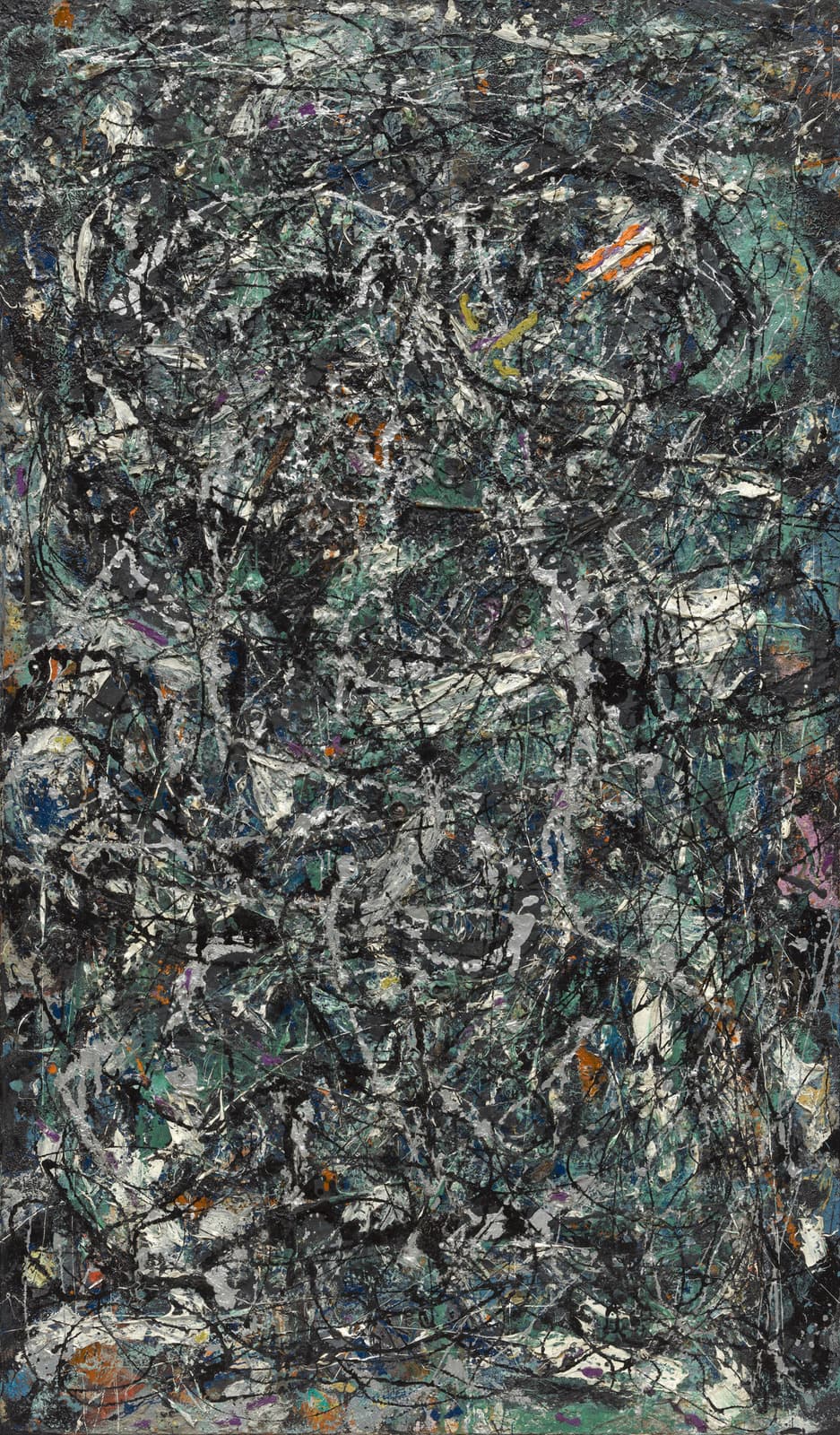
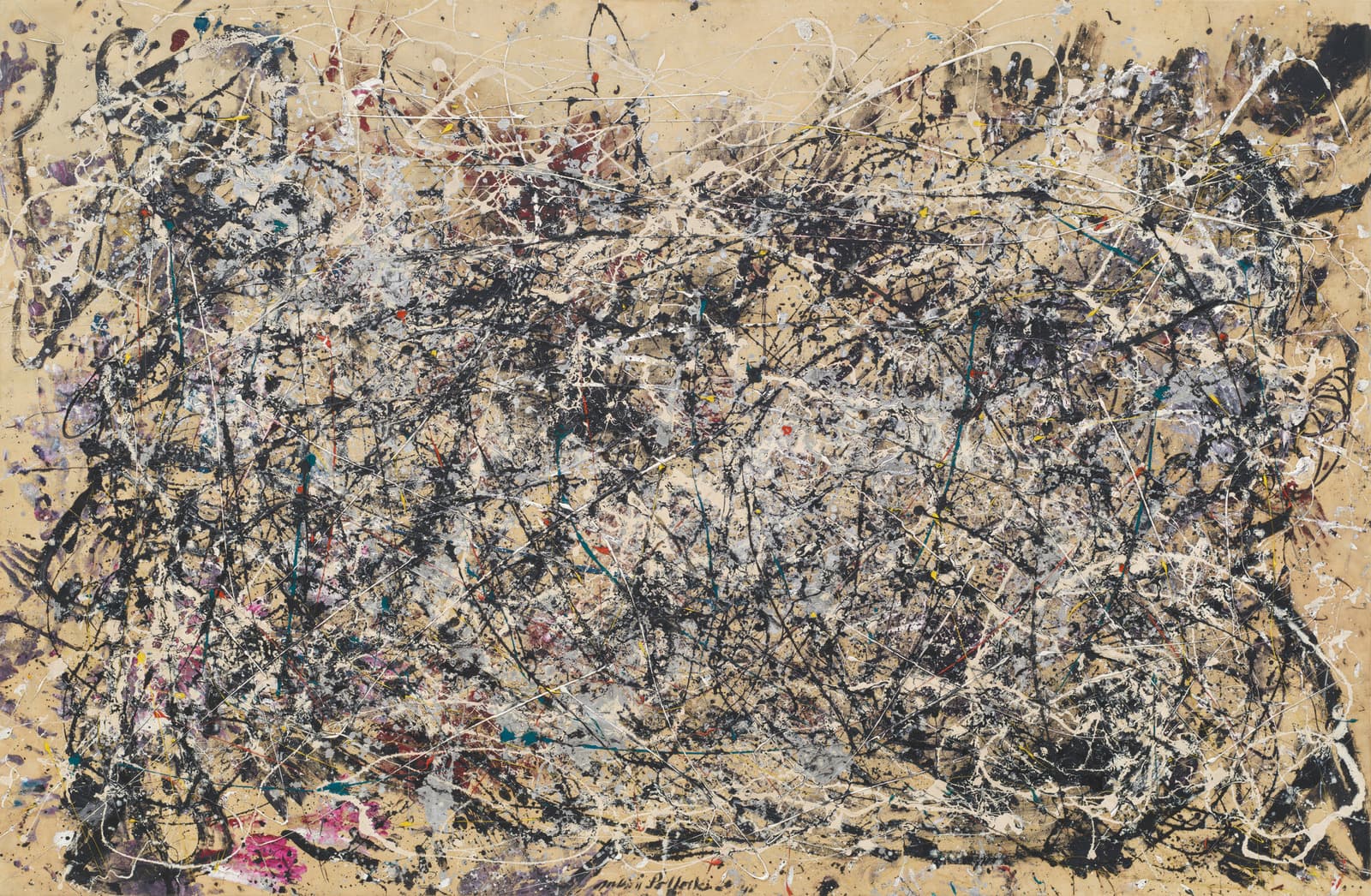
If you like Jackson Pollock
Explore painters from the same movements and circles.
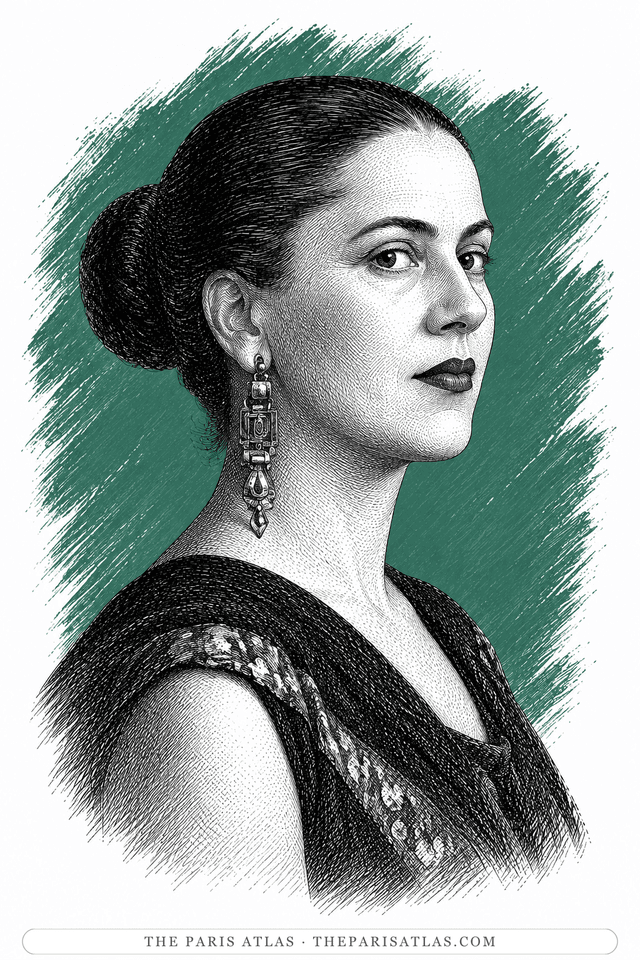
Tarsila do Amaral
Brazilian painter who spent the 1920s moving between São Paulo and Paris, studied Cubism under André Lhote, Albert Gleizes and Fernand Léger, and used what she learned to paint Brazilian towns, railways, plants and bodies. Her 1928 painting Abaporu prompted the manifesto that gave the Anthropophagic movement its name.
View artist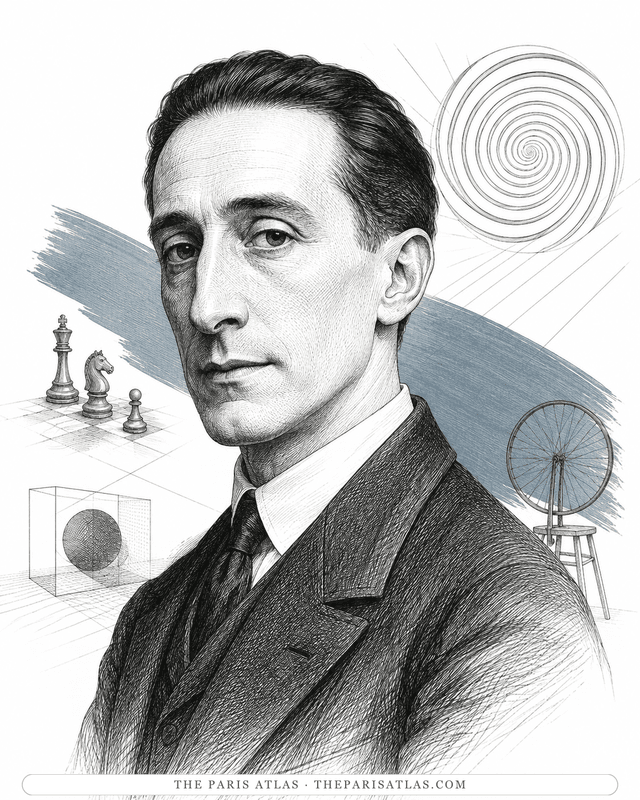
Marcel Duchamp
The century's quietest revolutionary — readymades, the abandonment of painting, chess on a Paris rooftop in Entr'acte, and one anemic film of spinning puns signed Rrose Sélavy.
View artist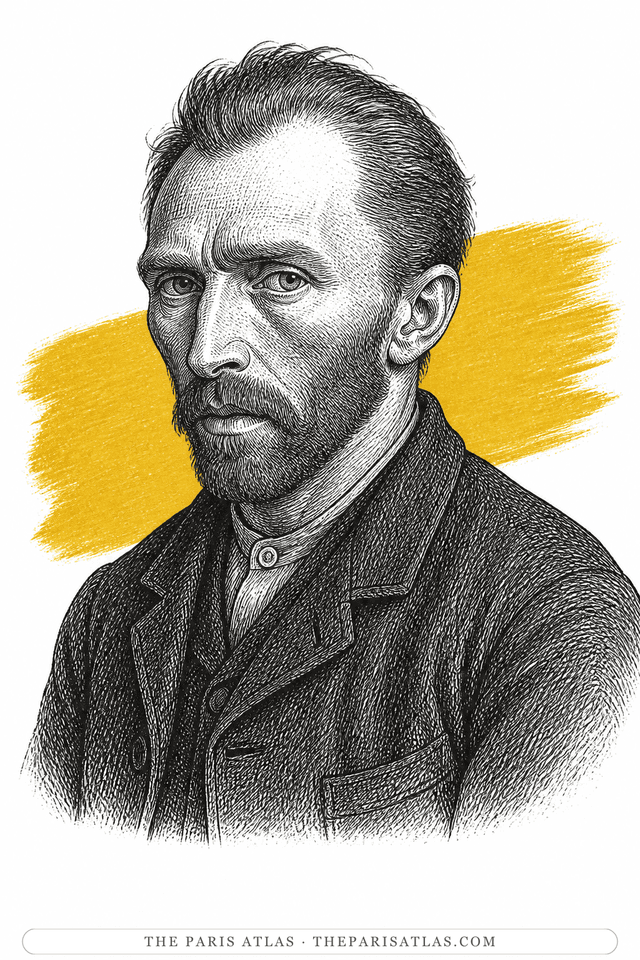
Vincent van Gogh
Dutch painter who lived in Montmartre with his brother Theo from March 1886 to February 1888 — the two years in which his dark Dutch palette turned into colour. He painted more than 200 pictures in Paris and died at Auvers-sur-Oise, north of the city, in 1890.
View artist
References
The sources below include collection records, catalogues, scholarly research, and primary materials that informed this page. They document Mural, its making, and its place in cultural history.


1Jackson Pollock, Mural
WebsiteStanley Museum of Art, University of IowaUsed forWeb source consulted for documented facts and historical context presented on the Mural page.
2Jackson Pollock's Mural
WebsiteGettyUsed forWeb source consulted for documented facts and historical context presented on the Mural page.
3Art + Ideas: Jackson Pollock's Mural, Part One
WebsiteGettyUsed forWeb source consulted for documented facts and historical context presented on the Mural page.
4Art + Ideas: Jackson Pollock's Mural, Part Two
WebsiteGettyUsed forWeb source consulted for documented facts and historical context presented on the Mural page.

5Jackson Pollock's Mural: The Transitional Moment
Exhibition catalogueGetty Publications, 2014Used forCatalogue scholarship used to verify attribution, provenance, chronology, and interpretive context for Mural.
6Mural — collection feature, archived 11 July 2015
WebsiteUniversity of Iowa Museum of Art, via the Internet ArchiveUsed forWeb source consulted for documented facts and historical context presented on the Mural page.
7Jackson Pollock
WebsitePollock-Krasner House and Study CenterUsed forWeb source consulted for documented facts and historical context presented on the Mural page.
These references provide the documented foundation for this work's history and interpretation. Claim-level citations remain attached to the specific claims they support.
 Explore more resources