The Paris AtlasCharting the artists, works, and places worth returning to.
  • Painter
· American · 1912–1956

Jackson Pollock

American painter who from 1947 laid his canvas on the floor and directed liquid paint across it with sticks and hardened brushes, making a poured line the substance of a picture rather than the outline of an object. He was a central figure in Abstract Expressionism, and died at forty-four when he crashed his car while drunk, killing a passenger.

Details

Lived
1912–1956
Born
28 January 1912
Birthplace
Cody, Wyoming, United States
Birth name
Paul Jackson Pollock
Died
11 August 1956 · aged 44
Place of death
Springs, New York, United States
Nationality
American
Profession
Painter
Major works
The Moon Woman, The She-Wolf, Mural, Full Fathom Five, Alchemy, Number 1A 1948, Number 1, 1950 (Lavender Mist), Autumn Rhythm: Number 30, 1950, One: Number 31, 1950, Blue Poles, The Deep
Roles
Painter
Also known as
Paul Jackson Pollock · Jack the Dripper

About Jackson Pollock

American painter who laid canvas on the floor and made poured line the substance of a picture

Jackson Pollock (1912–1956) was an American painter, born Paul Jackson Pollock in Cody, Wyoming. He is best known for the paintings he made from 1947 by pouring, dripping and directing liquid paint across canvas laid on the floor.[1] His achievement was not only an unusual technique. He built a way of painting in which movement, overlapping marks, and the relationship between painted and bare canvas carried the force that recognizable subjects had carried before.[2]

His career was not a straight line from pictures to abstraction. He began with landscapes and figures, worked through a dense imagery of animals and mythic beings, made the poured paintings of 1947 to 1950, and then returned to more open suggestions of bodies and faces.[3] The work sits inside a wider exchange between American painting, Mexican muralism, European modernism, Indigenous artistic traditions, and ideas about the unconscious.[4]

Overview

A central figure in Abstract Expressionism, Pollock developed a pictorial language in which line no longer had to describe the edge of anything. His paintings were made on the floor, approached from every side, and built up from paint that travelled, fell and pooled. He worked for the WPA Federal Art Project through the Depression, was taken up by the collector Peggy Guggenheim in 1943, and reached a national audience through a Life magazine profile in 1949. He stopped painting in 1955 and died the following year.[1][5]

Early life and artistic education

Pollock was the youngest of five brothers. His family left Wyoming during his infancy, and he grew up in Arizona and California. His mother encouraged artistic interests within the household, and his brothers Charles and Sanford also became artists. The distances and open terrain of the American Southwest formed part of his early experience, although his later paintings should not be understood simply as disguised representations of western landscapes.[2]

In Los Angeles, Pollock attended Manual Arts High School, where his interest in art became more serious. His education was unsettled, including expulsions, and he did not follow a conventional academic path. In 1930, at eighteen, he moved to New York to join Charles and enrolled at the Art Students League, studying with Thomas Hart Benton.[2]

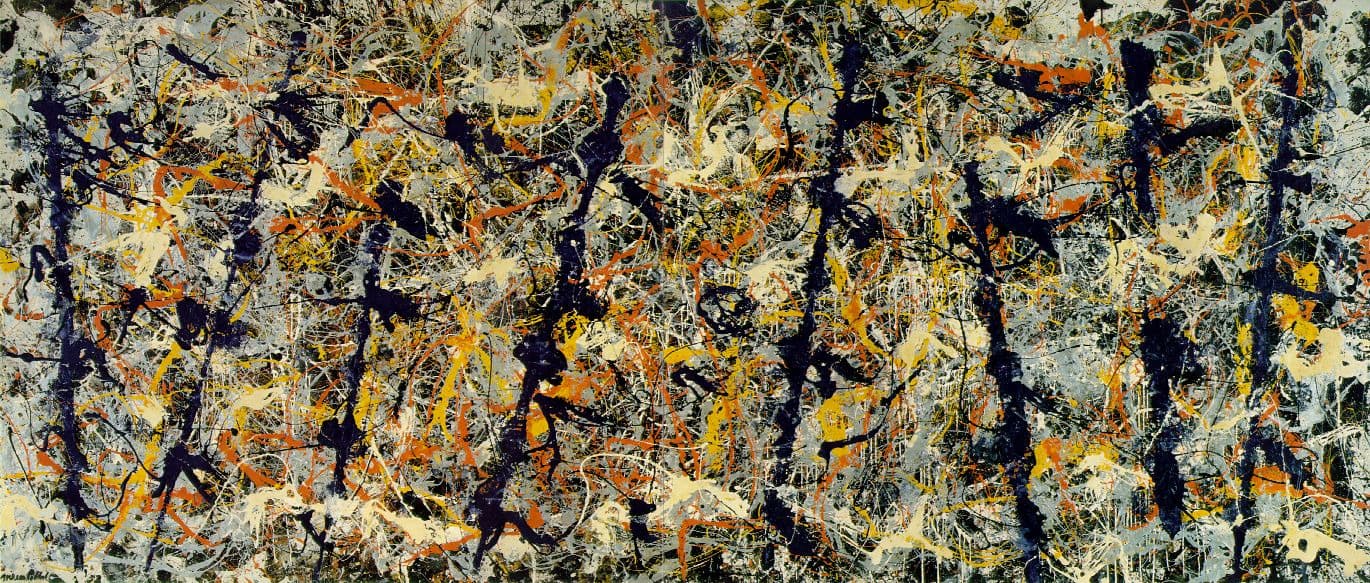
Benton was a leading Regionalist painter, known for scenes of American life organized through muscular figures, sweeping curves, and strong rhythmic structures. His example was important even after Pollock abandoned recognizable American subjects. Benton's teaching treated composition as a system of interlocking forces rather than a passive arrangement of objects. The tension between curving movement and vertical supports would remain visible in Pollock's mature work, particularly in Mural and Blue Poles.[6]

The 1930s: work, experimentation, and influences

During the Depression, government employment gave Pollock the opportunity to continue developing as an artist. He worked for the WPA Federal Art Project from 1935 to 1942. This support was crucial to a generation of American artists who had little access to a dependable commercial market. Pollock's surviving work from the period shows an artist absorbing different approaches rather than moving immediately toward a single recognizable style.[6]

Among his strongest early influences were the Mexican muralists José Clemente Orozco, Diego Rivera, and David Alfaro Siqueiros. Their work demonstrated that modern painting could operate on an architectural scale and address intense human experience through distorted bodies, compressed space, and powerful movement. Orozco's dramatic imagery was especially important to Pollock's early development.[7]

In 1936, Pollock participated in Siqueiros's experimental workshop in New York. There he encountered commercial paints and unconventional methods of applying them, including pouring and flinging. The workshop did not produce his mature style overnight, but it provided an important technical precedent: paint could be manipulated as a flowing material rather than applied exclusively through traditional brushwork.[5]

Pablo Picasso offered Pollock a model for breaking apart the human figure without abandoning its emotional intensity. Joan Miró suggested how signs, biomorphic shapes, and apparently spontaneous marks could create a world that was neither straightforward representation nor purely geometric abstraction. Pollock's early paintings often occupy this intermediate territory: faces and bodies remain present, but they are fragmented, overlaid, or difficult to separate from their surroundings.[8]

Surrealism supplied another important principle: the unconscious could be a source of artistic invention. Rather than beginning with a fully planned image, an artist could allow drawing and material experiments to generate unexpected forms. Pollock encountered these ideas within a New York art world increasingly connected to European émigrés. His development belonged to this international environment, not to an isolated, exclusively American tradition.[3]

Pollock's struggles with alcohol and emotional distress led him into treatment. Beginning in 1939, he worked with the Jungian analyst Joseph Henderson, using drawings as part of the therapeutic exchange; he later underwent analysis with Violet Staub de Laszlo. Jungian ideas about recurring symbols and the unconscious provided a framework for his interest in mythic figures, animals, and ambiguous human forms. They do not, however, supply a reliable dictionary for decoding every painting.[9]

He also studied Native American art, including the sand-painting demonstrations associated with MoMA's 1941 exhibition, Indian Art of the United States. The practice of working around an image on the ground offered a meaningful precedent for his later approach. These influences came from particular cultural traditions, including Navajo sand painting, rather than from a generalized category of supposedly instinctive creativity.[9]

Pollock did not invent the act of pouring paint. Besides Siqueiros's experiments, Janet Sobel had developed remarkably intricate poured and marbled compositions before Pollock's celebrated drip period. Her Milky Way of 1945, for example, uses enamel to build an animated surface without a conventional central subject. Recognizing such precedents makes Pollock's achievement more precise: his originality lay in the sustained pictorial possibilities he developed from flowing paint, not in being the first person to let it fall onto a surface.[10]

Lee Krasner and the formation of an artistic partnership

Pollock's partnership with Lee Krasner began in 1941 and 1942, around preparations for French and American Painting, an exhibition organized by the artist and intellectual John Graham. Krasner, already familiar with New York's experimental painters, was surprised to encounter an unfamiliar name among the participating Americans. She visited Pollock's studio and recognized an exceptional talent.[11]

Krasner was an accomplished artist with substantial training, including study with Hans Hofmann, and an established engagement with abstraction. Her importance to Pollock was both intellectual and practical: she brought a highly developed critical eye, introduced him to colleagues, and helped others understand his work. Their exchange also affected her painting, encouraging a freer relationship to the Cubist structures she had previously explored. She was not merely his assistant or a painter who began working only after his death.[12]

They married in October 1945 and moved to Springs, near East Hampton on Long Island. Their relationship combined genuine artistic understanding with increasingly difficult personal circumstances. Krasner continued to pursue her own work throughout the marriage, even as Pollock's needs and growing reputation placed considerable demands on their shared life.[12]

Peggy Guggenheim and the breakthrough of 1943

The collector and dealer Peggy Guggenheim gave Pollock the support that allowed him to become a full-time painter. Her New York gallery, Art of This Century, brought together European Surrealism and emerging American abstraction. Pollock's advocates within this environment included the curator James Johnson Sweeney and Piet Mondrian, who recognized promise in work that differed dramatically from his own geometric painting.[13]

In 1943, Guggenheim offered Pollock a contract providing a monthly allowance and presented his first solo exhibition. She also commissioned an enormous painting for the entrance hall of her Manhattan townhouse. These arrangements gave him financial breathing room, an audience, and an opportunity to work at a scale he had previously been unable to attempt.[13]

The Moon Woman, now in the Peggy Guggenheim Collection in Venice, belongs to the period immediately preceding this breakthrough. Its figure is organized through emphatic contours, shifting viewpoints, and areas of contrasting color rather than naturalistic anatomy. Picasso's influence is evident, but the painting's atmosphere is more ritualistic and psychologically uncertain than descriptive. The subject also belongs to Pollock's broader interest in mythic female figures. Connections have been proposed with Charles Baudelaire and French Symbolism, but the painting should not be treated as a confirmed illustration of a particular poem.[8]

In The She-Wolf, a heavy animal form stretches across a field of marks and partially legible signs. Thick contours establish its body, but additional lines and patches of color disturb the distinction between the animal and its surroundings. Pollock combined oil, gouache, and plaster, producing a surface that is physically assertive as well as visually complicated. The subject has often been associated with the wolf that nursed Romulus and Remus, although Pollock resisted fixing its meaning. Exhibited in his first solo show, it became the first Pollock acquired by the Museum of Modern Art, in 1944.[14]

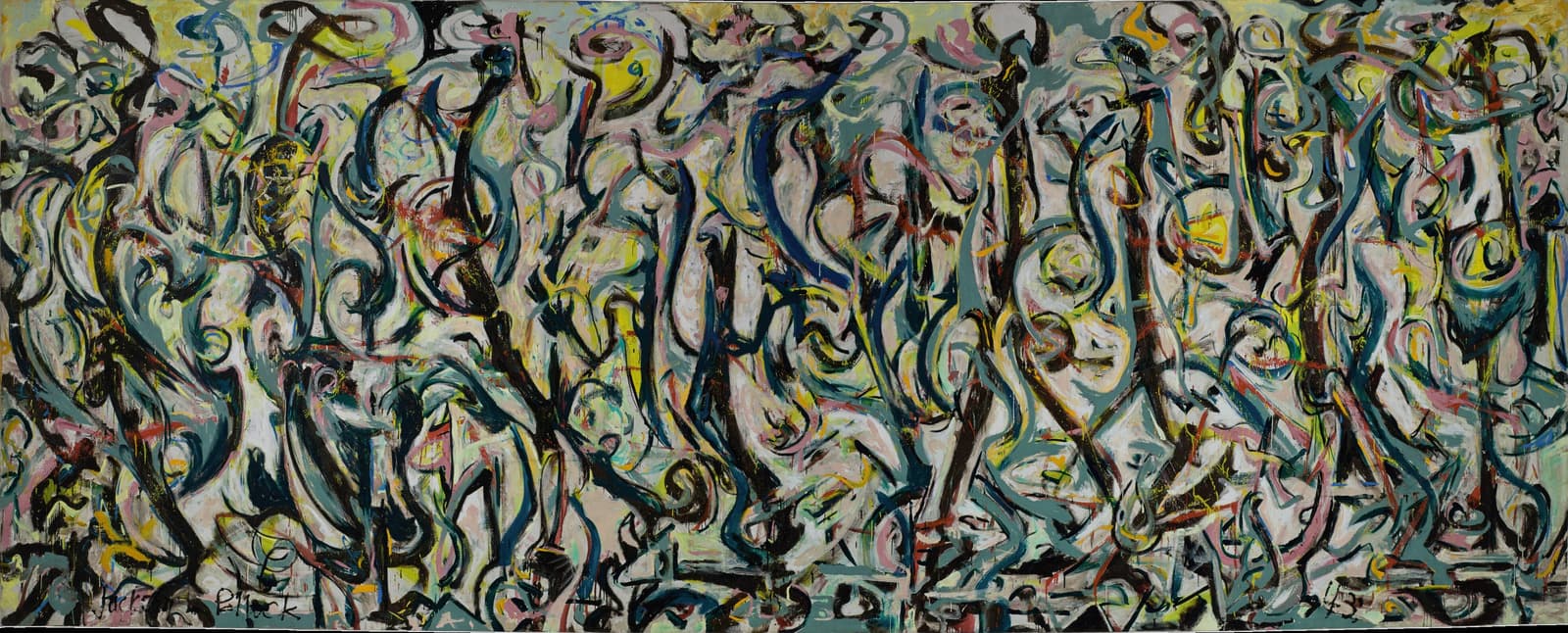
Guggenheim's commission resulted in Mural, approximately twenty feet wide and now in the University of Iowa Stanley Museum of Art. Its dark, upright forms and sweeping curves establish a procession-like rhythm across the canvas. Yellow, pink, green, and other colors repeatedly interrupt and reconnect this underlying structure. Although largely abstract, the work retains suggestions of bodies moving through a continuous field.[15]

Mural was a decisive encounter with monumental scale. Instead of enlarging a small, centralized composition, Pollock developed a structure that unfolds across the viewer's field of vision. The painting is primarily brushed, using artists' oils alongside casein paint, and should not be confused with the fully developed poured paintings that followed several years later.[16]

A famous story claims that Pollock completed the entire canvas in one extraordinary night. Getty conservation research has challenged that account, identifying distinct stages of work, revisions, and a more complicated sequence of paint application. A rapid initial campaign may underlie the legend, but the completed painting records sustained development rather than a single uninterrupted eruption.[17]

Springs and the development of the poured paintings

The move to Long Island gave Pollock and Krasner a different working environment. Their modest house stood in a rural community, away from the immediate pressures of Manhattan. Pollock eventually used a converted barn as his principal studio. The property became the setting for the paintings that established his international reputation.[5]

By 1947, pouring and dripping had become central to his practice. He spread canvas on the floor, approached it from different directions, and directed streams of paint across it. The change was not merely ergonomic. It altered the relationship between the artist's body, the material, and the image: a painted line could now record a movement made above the surface rather than the pressure of a brush dragged along it.[18]

Pollock used sticks, brushes, containers, and other implements to control the delivery of liquid paint. The width and character of a mark depended on several interacting factors: the paint's consistency, the amount released, the movement of his hand and arm, and the distance above the canvas. A continuous thread, a thick loop, and a scattered cluster of droplets were materially different events, not interchangeable decorations.[19]

His materials were more varied than the popular phrase “house-paint paintings” suggests. He used commercial enamels and metallic paints, but also traditional artists' oils. Conservation analysis has identified brushed passages beneath poured layers, additions of other materials, and different combinations of paints within a single work. His methods changed from painting to painting.[20]

The resulting compositions are often described as all-over. Instead of arranging a principal object against a subordinate background, Pollock distributed visual activity throughout the surface. This does not mean that every area is identical. Dense knots, thinner passages, abrupt changes of direction, and exposed canvas create differences that the eye continually negotiates. The composition can seem to extend beyond its edges without literally becoming an endless, uniform pattern.[10]

Nor was the process simply random. Pollock worked with the unpredictable behavior of liquid paint while making decisions about placement, density, color, and when to stop. His declaration, “I deny the accident,” expresses his resistance to the idea that the paintings happened without artistic control. Chance contributed to particular effects; it did not replace judgment.[21]

Around this period, he also began numbering many paintings rather than assigning descriptive titles. Krasner explained that numbers discouraged viewers from looking immediately for an illustrated subject. Titles such as Lavender Mist and Autumn Rhythm can be evocative, but they should not obscure the paintings' relationships of color, line, scale, and surface.[22]

Major works of the poured-painting period

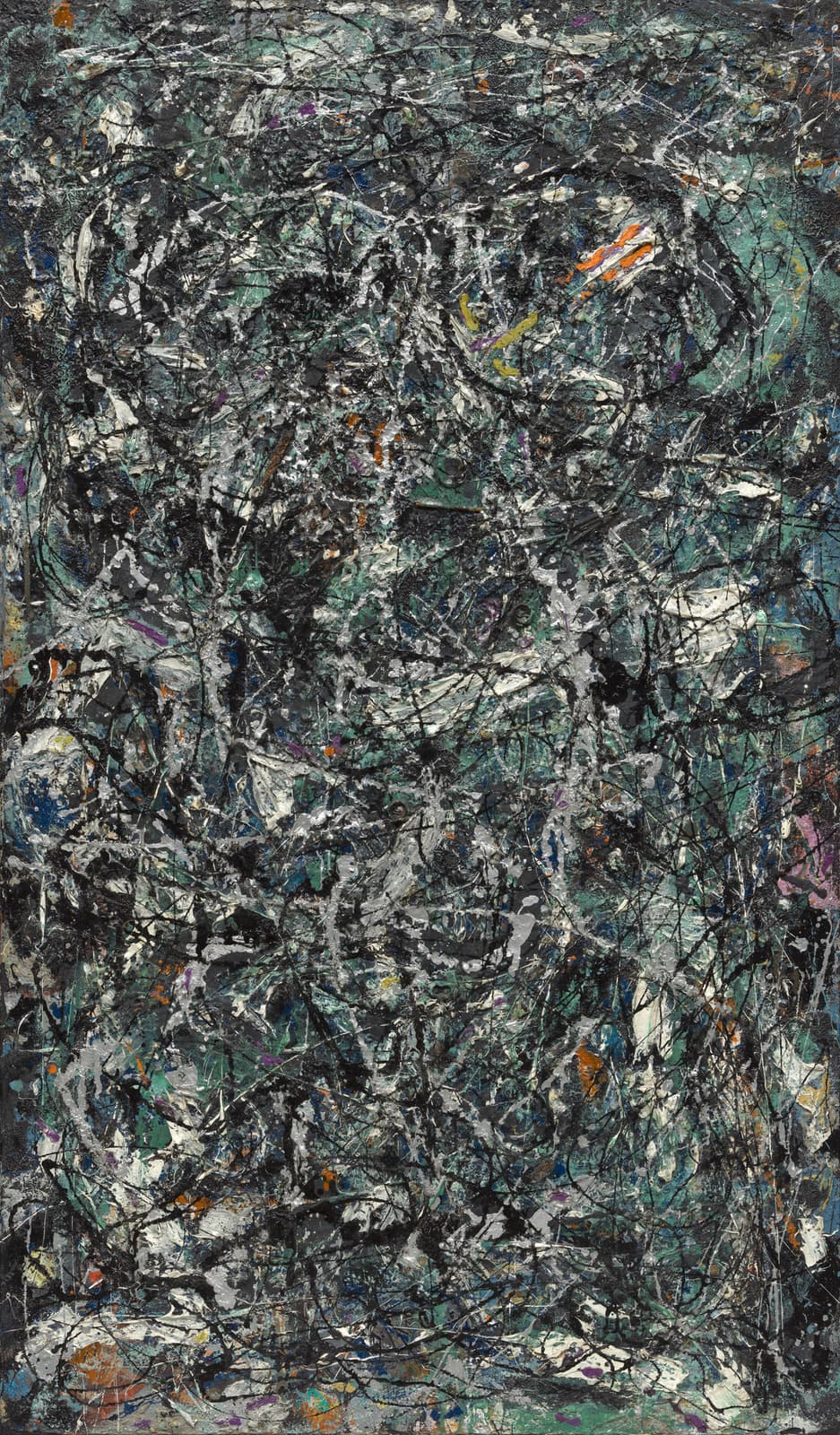
Full Fathom Five, in the Museum of Modern Art, shows that Pollock's new method grew out of a more complicated studio practice than a single act of dripping. The painting includes a worked surface containing such objects as nails, buttons, coins, matches, and cigarettes, over which poured lines establish further layers. Its densely accumulated material gives the painting a physical weight quite different from the apparently weightless movement of its uppermost marks. Some lines seem suspended above the ground, while others disappear into it.[23]

Alchemy, in the Peggy Guggenheim Collection in Venice, transforms the surface into an intricate accumulation of crossing lines, raised paint, and incorporated matter. Its materials include oil and enamel paints, aluminum paint, sand, pebbles, fibers, and fragments of wood on commercially printed fabric. The painting's importance lies in the independence of its lines: they no longer need to describe the boundary of a recognizable object. The title, supplied by Pollock's neighbors Ralph Manheim and his wife, is suggestive, but it is not proof that Pollock intended a specific alchemical program.[18]

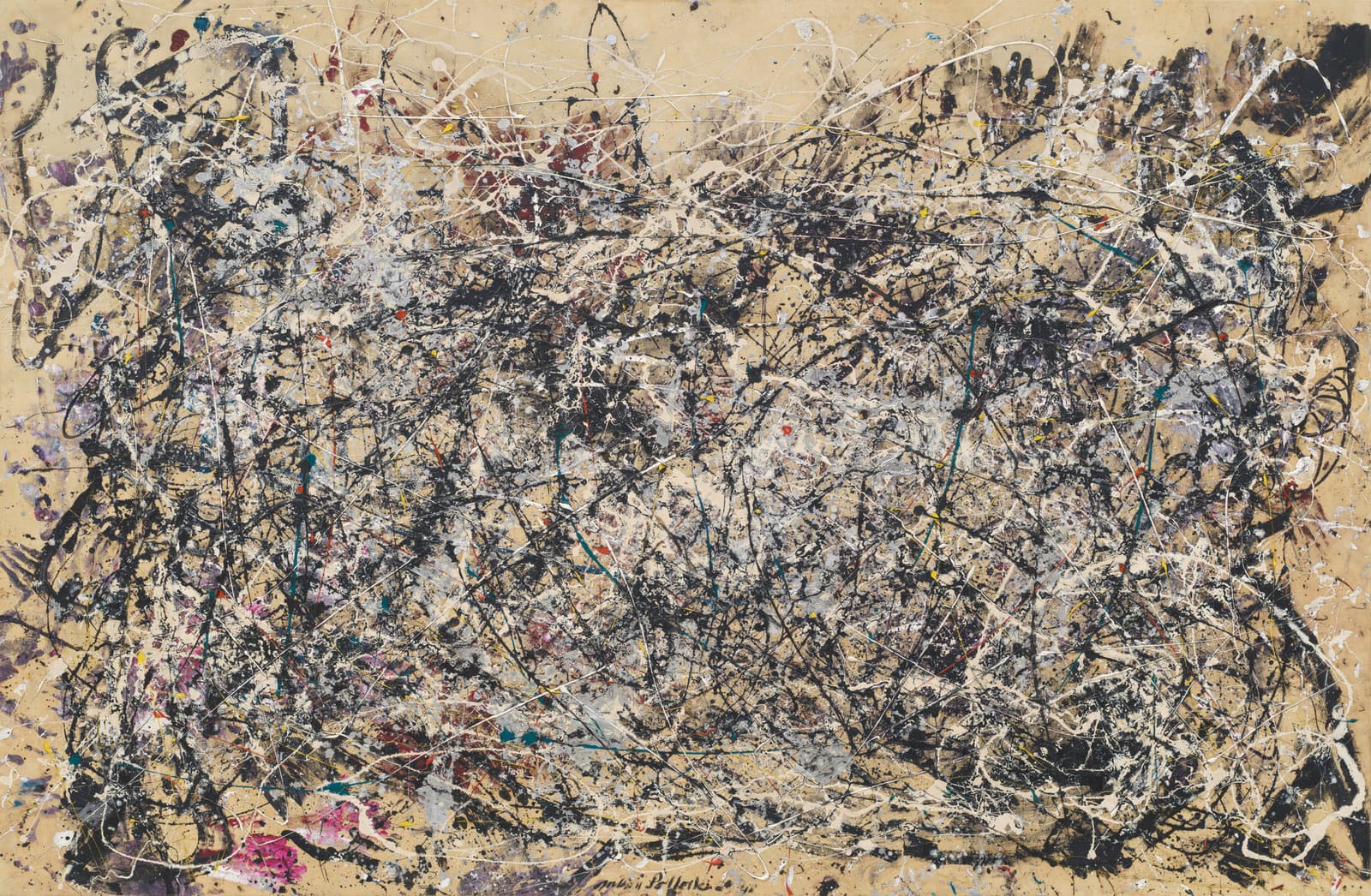
Number 1A, 1948, also at MoMA, combines an expansive network of lines with a strikingly direct indication of the artist's presence: handprints near the upper-right edge. Whereas the poured marks record movement indirectly, the handprints preserve physical contact. The juxtaposition complicates the idea that Pollock eliminated the artist's traditional touch. He was changing its forms. The painting also illustrates the uncertain reception of his work: it initially remained unsold when exhibited, despite the significance later attached to it.[22]

Number 1, 1950 (Lavender Mist), at the National Gallery of Art in Washington, demonstrates how Pollock could create an atmospheric effect without depicting weather or landscape. Its interacting threads and patches of black, white, silver, and other colors produce an overall softness that differs markedly from the sharpness of individual marks. There is no lavender pigment in the painting. Clement Greenberg suggested its familiar title in response to the optical effect created by the combination of colors.[21]

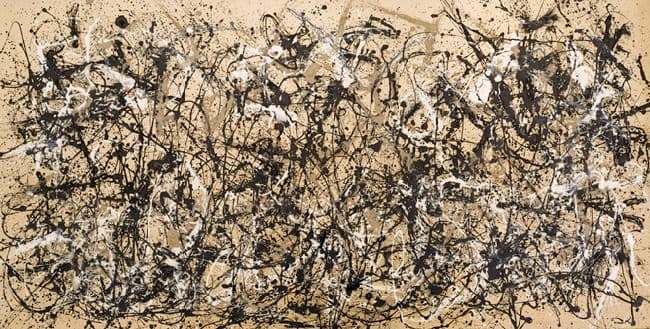
One: Number 31, 1950 is among Pollock's most imposing achievements of that year. Across its more-than-five-metre width, interwoven dark and pale marks produce a composition that is simultaneously dense and permeable. Unpainted intervals prevent the field from closing into an opaque mass. Its coherence comes neither from a central figure nor from mechanical repetition. Many different kinds of marks remain active within a single, encompassing structure.[19]
Fame, critics, and the New York art world

Pollock's public visibility increased sharply after Life magazine's profile of 8 August 1949, which asked whether he was the greatest living painter in the United States. Martha Holmes's photographs helped establish the image of the artist in work clothes before his enormous paintings. The article brought experimental painting into a mass-circulation setting, but it also encouraged a personality-centered understanding of his achievement.[24]

Hans Namuth's photographs and films of 1950 further shaped this image. They made the movements of Pollock's working body visible to people who had never entered his studio. Published and circulated afterward, these records became inseparable from public understanding of his art. They are valuable evidence, but the spectacle of making should not replace attention to the completed paintings.[20]

Despite his reputation for isolation, Pollock belonged to a closely connected artistic community. Willem de Kooning, Robert Motherwell, William Baziotes, Franz Kline, and Krasner were among the artists with whom his development intersected. They shared concerns without sharing a uniform style: Pollock's poured fields were not interchangeable with de Kooning's repeatedly revised figures or Rothko's broad areas of color.[11]

The artist and collector Alfonso Ossorio became an important friend and patron. Pollock also developed a friendship with Tony Smith, with whom he discussed a proposed architectural collaboration involving a church; the project was never realized. Such relationships reveal interests extending beyond the image of a solitary painter working only for himself.[9]

Commercially, he moved from Guggenheim's gallery to Betty Parsons after Art of This Century closed in 1947, and then to Sidney Janis in 1952. His work increasingly circulated internationally, including a solo exhibition in Venice in 1950 and exhibitions in Paris. Pollock himself never travelled outside the United States: his international influence was carried by paintings, publications, dealers, and exhibitions rather than personal travel.[1]

Later work: black paintings and renewed figuration

In 1951, Pollock changed direction. He made a group of predominantly black paintings on unprimed canvas in which suggestions of faces, animals, and bodies became more apparent. These works are sometimes treated as evidence that he had lost confidence in abstraction. A more useful interpretation recognizes their continuity with his earlier interests: recognizable imagery had repeatedly been present beneath, or within, his marks. The black paintings brought that tension forward again.[25]

Their restricted palette made differences of pressure, saturation, and line particularly important. In Echo: Number 25, 1951, now at MoMA, conservation research indicates that Pollock used a turkey baster with its tip touching the canvas in some passages. The process could therefore resemble drawing as much as pouring from above. Even the label “black pourings” can conceal how various his methods remained.[20]

Originally exhibited as Number 11, 1952, Blue Poles combines a vividly colored network with eight dark, tilted vertical forms. These poles interrupt the surrounding activity without standing entirely apart from it. Further streams of paint pass across them, integrating the strong uprights into the larger field. The composition recalls Benton's concern with vertical supports and circling movement, now transformed through Pollock's mature methods. Acquired for Australia's national collection in 1973, it became both a major museum possession and a focus of public debate about modern art.[26]

The Deep, at the Centre Pompidou in Paris, differs dramatically from the continuous networks of 1950. A dark, elongated opening runs through a predominantly pale field. White passages gather around it, suggesting a fissure, an aperture, or a space that cannot be measured. The distinction between a central form and its surroundings returns, although the image remains abstract. The painting is often read in psychological terms, but no single interpretation is definitive. Pollock was still testing other ways to organize a picture rather than repeating his best-known formula.[27]

Final years and death

Pollock's struggles with alcohol intensified during his final years, while his productivity diminished. It is important not to confuse this history with the claim that intoxication generated his greatest paintings: his exceptionally productive period of 1948 to 1950 coincided with sustained sobriety. By 1955, he had stopped painting.[5]

His marriage was under severe strain. In the summer of 1956, Krasner travelled to Europe, while Pollock remained in Springs and was involved with Ruth Kligman. On 11 August 1956, he crashed his car while driving drunk. Pollock, aged forty-four, and passenger Edith Metzger were killed; Kligman survived with injuries. Krasner returned from Europe after learning of his death.[5]

Legacy and historical significance

MoMA opened a memorial exhibition in December 1956, only months after Pollock's death. Later exhibitions, scholarship, and conservation research greatly expanded understanding of his work, moving beyond the narrow emphasis on the famous drip paintings to examine his early development and later experiments.[28]

His influence extended beyond painters who adopted flowing or gestural marks. Allan Kaprow's 1958 essay, “The Legacy of Jackson Pollock,” considered implications for an art moving beyond the traditional picture. The Japanese Gutai group also recognized the importance of Pollock's treatment of materials. His work could be understood both as a culmination of painting and as an opening toward practices centered on physical action, process, and the surrounding environment.[28]

Krasner played an essential role in preserving his work and supporting its study, while continuing an important career of her own. Her bequest made possible the Pollock-Krasner Foundation, established in 1985 to support working artists. Their names are therefore associated not only with the history of Abstract Expressionism but also with continuing assistance to artistic practice.[29]

Pollock's lasting achievement cannot be described as splashing paint. His paintings changed what a line could do, how a composition could be organized, and how scale could affect a viewer. They remain difficult to classify neatly: controlled yet open to material surprise, emphatically physical yet capable of atmospheric delicacy, and abstract without being empty of associations. Their variety is as important as their recognizability.[21]

Life events

  1. 1912

    Born Paul Jackson Pollock in Cody, Wyoming, on 28 January, and raised in Arizona and California.

  2. 1928

    Begins studying painting at Manual Arts High School in Los Angeles.

  3. 1930

    Moves to New York at eighteen and studies with Thomas Hart Benton at the Art Students League.

  4. 1935

    Joins the WPA Federal Art Project, which employs him until 1942.

  5. 1936

    Takes part in David Alfaro Siqueiros's experimental workshop in New York, where paint is poured and flung rather than brushed.

  6. 1939

    Begins analysis with the Jungian analyst Joseph Henderson, using drawings as part of the sessions.

  7. 1942

    Paints The Moon Woman. His partnership with Lee Krasner begins around John Graham's exhibition of French and American painting.

  8. 1943

    Peggy Guggenheim gives him a contract and his first solo exhibition, and commissions Mural for her townhouse. He paints The She-Wolf the same year.

  9. 1944

    The Museum of Modern Art acquires The She-Wolf, the first Pollock to enter the collection.

  10. 1945

    Marries Lee Krasner in October and moves to Springs, near East Hampton on Long Island.

  11. 1947

    Pouring becomes central to his practice. He paints Full Fathom Five and Alchemy, and moves to the Betty Parsons gallery after Art of This Century closes.

  12. 1948

    Paints Number 1A, 1948, which carries his handprints near the upper-right edge.

  13. 1949

    A Life magazine profile of 8 August asks whether he is the greatest living painter in the United States.

  14. 1950

    Paints Number 1, 1950 (Lavender Mist), Autumn Rhythm: Number 30, 1950, and One: Number 31, 1950. Hans Namuth photographs and films him at work.

  15. 1951

    Makes the black paintings on unprimed canvas, among them Echo: Number 25, 1951.

  16. 1952

    Paints Blue Poles, first exhibited as Number 11, 1952, and begins showing with Sidney Janis.

  17. 1953

    Paints The Deep.

  18. 1955

    Stops painting.

  19. 1956

    Dies on 11 August when he crashes his car while drunk at Springs, aged forty-four. His passenger Edith Metzger is also killed. MoMA opens a memorial exhibition in December.

  20. 1973

    The National Gallery of Australia acquires Blue Poles, prompting national debate about modern art.

  21. 1985

    The Pollock-Krasner Foundation is established through Lee Krasner's bequest, to support working artists.

Selected works

Cataloged from the holding institutions' records. Reproductions appear only where the rights are verified.

Paintings

Autumn Rhythm: a wide field of poured black, white and tan lines looping and crossing over bare unprimed canvas, dense in places and open in others, with no central figure.

Artwork reproduction

Painting · Modern Art

Autumn Rhythm: Number 30, 1950

1950 · Oil-modified alkyd resin on canvas

Jackson Pollock made Autumn Rhythm: Number 30, 1950 by pouring paint onto canvas laid on the floor of his Long Island studio. It is more than five metres wide, worked in a narrow range of colours, with large areas of bare canvas left open between the black lines. The Metropolitan Museum of Art bought it in 1957, the year after Pollock's death.

The Metropolitan Museum of Art

Jackson Pollock, Autumn Rhythm: Number 30, 1950, 1950. The Metropolitan Museum of Art. Image © the rights holder, shown under fair use.

Movements

The artistic and literary currents this life ran through.

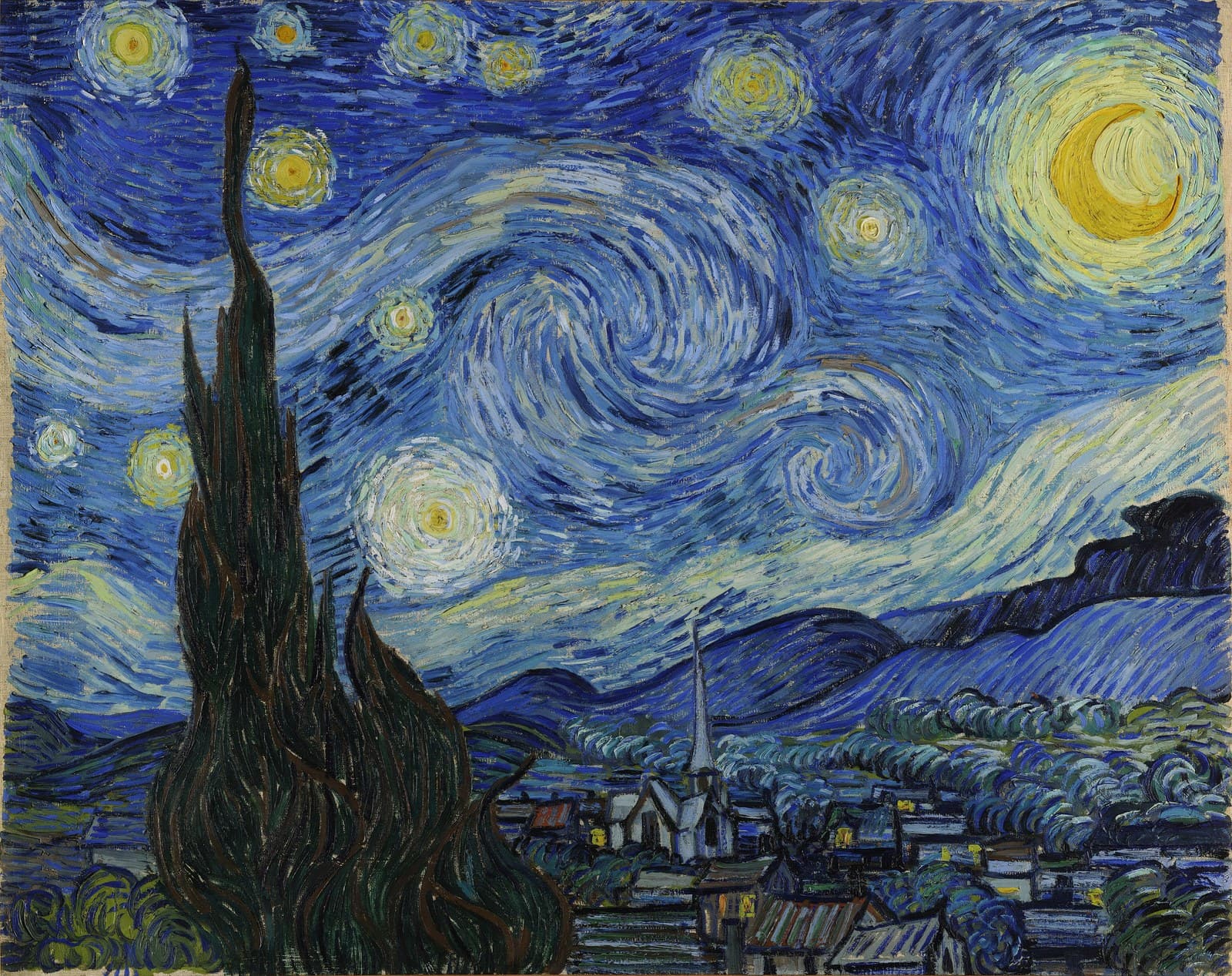
Vincent van Gogh's The Starry Night: a night sky of swirling blue and yellow currents above a sleeping village, with a dark flame-shaped cypress rising at the left and a church spire below

Historical period and art category · circa 1860s–1970s

Modern Art

From 1947 Jackson Pollock laid canvas on the floor and directed poured paint across it, distributing the activity of a picture across its whole surface instead of arranging a subject against a background. He was a central figure in Abstract Expressionism, and Autumn Rhythm: Number 30, 1950 entered the Metropolitan Museum of Art in 1957, the year after his death.

Abstract Expressionism; Jackson Pollock, Autumn Rhythm (Number 30) — collection record

Questions about Jackson Pollock

Who was Jackson Pollock?

Jackson Pollock (1912–1956) was an American painter and a central figure in Abstract Expressionism. From 1947 he laid canvas on the floor and poured, dripped and directed liquid paint across it, making the painted line a record of movement rather than the outline of an object.

How did Jackson Pollock make his paintings?

He spread unstretched canvas on the floor of a converted barn at Springs, Long Island, walked around it, and delivered paint with sticks, hardened brushes and containers. The character of a mark depended on the paint's consistency, how much he released, how his arm moved, and how far above the canvas he held the tool. He used commercial enamels and metallic paints alongside traditional artists' oils, and conservation has found brushed passages beneath poured layers.

Was Jackson Pollock's painting random?

No. He worked with the unpredictable behaviour of liquid paint, but chose placement, density, colour and the moment to stop. His own statement was blunt: “I deny the accident.” Chance produced particular effects within the work; it did not replace his judgement.

Did Jackson Pollock invent drip painting?

No. He encountered pouring and flinging in David Alfaro Siqueiros's New York workshop in 1936, and Janet Sobel had made intricate poured compositions before his own drip period, among them Milky Way of 1945. What was his own was the sustained pictorial language he built from flowing paint, not the act of letting paint fall.

How did Jackson Pollock die?

He died on 11 August 1956 near his home at Springs, on Long Island, when he crashed his car while driving drunk. He was forty-four. A passenger, Edith Metzger, was killed with him; Ruth Kligman survived with injuries. He had stopped painting the previous year, and his drinking had intensified as his productivity fell.

Where can you see Jackson Pollock's paintings?

They are spread across several collections. The Museum of Modern Art in New York holds five: The She-Wolf, Full Fathom Five, Number 1A, 1948, One: Number 31, 1950 and Echo: Number 25, 1951. Autumn Rhythm is at the Metropolitan Museum of Art. Lavender Mist is at the National Gallery of Art in Washington. Alchemy and The Moon Woman are in Venice, at the Peggy Guggenheim Collection. Mural is at the University of Iowa, Blue Poles at the National Gallery of Australia, and The Deep at the Centre Pompidou in Paris.

Connections and Sources

Jackson Pollock’s connections to people, places, and works, with the sources behind each one.

Associated with · 1947

Modern Art

From 1947 Jackson Pollock laid canvas on the floor and directed poured paint across it, distributing the activity of a picture across its whole surface instead of arranging a subject against a background. He was a central figure in Abstract Expressionism, and Autumn Rhythm: Number 30, 1950 entered the Metropolitan Museum of Art in 1957, the year after his death.

Abstract Expressionism; Jackson Pollock, Autumn Rhythm (Number 30) — collection record

References

References

The sources below include biographies, scholarly essays, interviews, and primary materials that informed this page. They reflect both the historical record and ongoing critical conversations about Jackson Pollock and their work.

  1. 1abcJackson Pollock: The Artist

    Website
    National Gallery of Australia, Action Reaction
    Used for

    Web source consulted for documented facts and historical context presented on the Jackson Pollock page.

    View source
  2. 2abcJackson Pollock

    Website
    National Gallery of Art
    Used for

    Web source consulted for documented facts and historical context presented on the Jackson Pollock page.

    View source
  3. 3abJackson Pollock: The Early Years (1934–1947)

    Website
    Musée national Picasso-Paris
    Used for

    Web source consulted for documented facts and historical context presented on the Jackson Pollock page.

    View source
  4. 4Abstract Expressionism

    Website
    The Metropolitan Museum of Art
    Used for

    Web source consulted for documented facts and historical context presented on the Jackson Pollock page.

    View source
  5. 5abcdeJackson Pollock

    Website
    Pollock-Krasner House and Study Center
    Used for

    Web source consulted for documented facts and historical context presented on the Jackson Pollock page.

    View source
  6. 6abJackson Pollock

    Website
    Peggy Guggenheim Collection
    Used for

    Web source consulted for documented facts and historical context presented on the Jackson Pollock page.

    View source
  7. 7Vida Americana: Mexican Muralists Remake American Art, 1925–1945

    Website
    Whitney Museum of American Art
    Used for

    Web source consulted for documented facts and historical context presented on the Jackson Pollock page.

    View source
  8. 8abThe Moon Woman

    Website
    Peggy Guggenheim Collection
    Used for

    Web source consulted for documented facts and historical context presented on the Jackson Pollock page.

    View source
  9. 9abcJackson Pollock Chronology: Life and Art

    Website
    National Gallery of Australia, Action Reaction
    Used for

    Web source consulted for documented facts and historical context presented on the Jackson Pollock page.

    View source
  10. 10abJanet Sobel, Milky Way, 1945

    Website
    The Museum of Modern Art
    Used for

    Web source consulted for documented facts and historical context presented on the Jackson Pollock page.

    View source
  11. 11abPollock and Friends: The Abstract Expressionists

    Website
    National Gallery of Australia, Action Reaction
    Used for

    Web source consulted for documented facts and historical context presented on the Jackson Pollock page.

    View source
  12. 12abLee Krasner

    Website
    Pollock-Krasner House and Study Center
    Used for

    Web source consulted for documented facts and historical context presented on the Jackson Pollock page.

    View source
  13. 13abArt + Ideas: Jackson Pollock's Mural, Part One

    Website
    Getty
    Used for

    Web source consulted for documented facts and historical context presented on the Jackson Pollock page.

    View source
  14. 14Jackson Pollock, The She-Wolf, 1943

    Website
    The Museum of Modern Art
    Used for

    Web source consulted for documented facts and historical context presented on the Jackson Pollock page.

    View source
  15. 15Jackson Pollock, Mural

    Website
    Stanley Museum of Art, University of Iowa
    Used for

    Web source consulted for documented facts and historical context presented on the Jackson Pollock page.

    View source
  1. 16Jackson Pollock's Mural

    Website
    Getty
    Used for

    Web source consulted for documented facts and historical context presented on the Jackson Pollock page.

    View source
  2. 17Art + Ideas: Jackson Pollock's Mural, Part Two

    Website
    Getty
    Used for

    Web source consulted for documented facts and historical context presented on the Jackson Pollock page.

    View source
  3. 18abAlchemy

    Website
    Peggy Guggenheim Collection
    Used for

    Web source consulted for documented facts and historical context presented on the Jackson Pollock page.

    View source
  4. 19abJackson Pollock, One: Number 31, 1950

    Website
    The Museum of Modern Art
    Used for

    Web source consulted for documented facts and historical context presented on the Jackson Pollock page.

    View source
  5. 20abcMoMA's Jackson Pollock Conservation Project: Insight into the Artist's Process

    Website
    The Museum of Modern Art
    Used for

    Web source consulted for documented facts and historical context presented on the Jackson Pollock page.

    View source
  6. 21abcNumber 1, 1950 (Lavender Mist)

    Website
    National Gallery of Art
    Used for

    Web source consulted for documented facts and historical context presented on the Jackson Pollock page.

    View source
  7. 22abJackson Pollock, Number 1A, 1948

    Website
    The Museum of Modern Art
    Used for

    Web source consulted for documented facts and historical context presented on the Jackson Pollock page.

    View source
  8. 23Jackson Pollock, Full Fathom Five, 1947

    Website
    The Museum of Modern Art
    Used for

    Web source consulted for documented facts and historical context presented on the Jackson Pollock page.

    View source
  9. 24Jackson Pollock: Early Photos of the Action Painter at Work

    Website
    TIME
    Used for

    Web source consulted for documented facts and historical context presented on the Jackson Pollock page.

    View source
  10. 25Jackson Pollock, Echo: Number 25, 1951

    Website
    The Museum of Modern Art
    Used for

    Web source consulted for documented facts and historical context presented on the Jackson Pollock page.

    View source
  11. 26Blue Poles: The Work of Art

    Website
    National Gallery of Australia, Action Reaction
    Used for

    Web source consulted for documented facts and historical context presented on the Jackson Pollock page.

    View source
  12. 27The Deep (La Profondeur)

    Website
    Centre Pompidou
    Used for

    Web source consulted for documented facts and historical context presented on the Jackson Pollock page.

    View source
  13. 28abJackson Pollock

    Website
    The Museum of Modern Art
    Used for

    Web source consulted for documented facts and historical context presented on the Jackson Pollock page.

    View source
  14. 29Foundation Overview

    Website
    Pollock-Krasner Foundation
    Used for

    Web source consulted for documented facts and historical context presented on the Jackson Pollock page.

    View source
  15. 30Jackson Pollock, Autumn Rhythm (Number 30) — collection record

    Website
    The Metropolitan Museum of Art
    Used for

    Web source consulted for documented facts and historical context presented on the Jackson Pollock page.

    View source
i
Why these sources are here

These references anchor the page in the documented record and in the scholarly conversations around Jackson Pollock. Every claim on this page traces back to one or more of the works listed here.

Explore more resources