Essays: First Series
Ralph Waldo Emerson
Essays: First Series
The essays of 1841, including "Self-Reliance", put the ideas of Nature to work in everyday life.
Read our takeNature
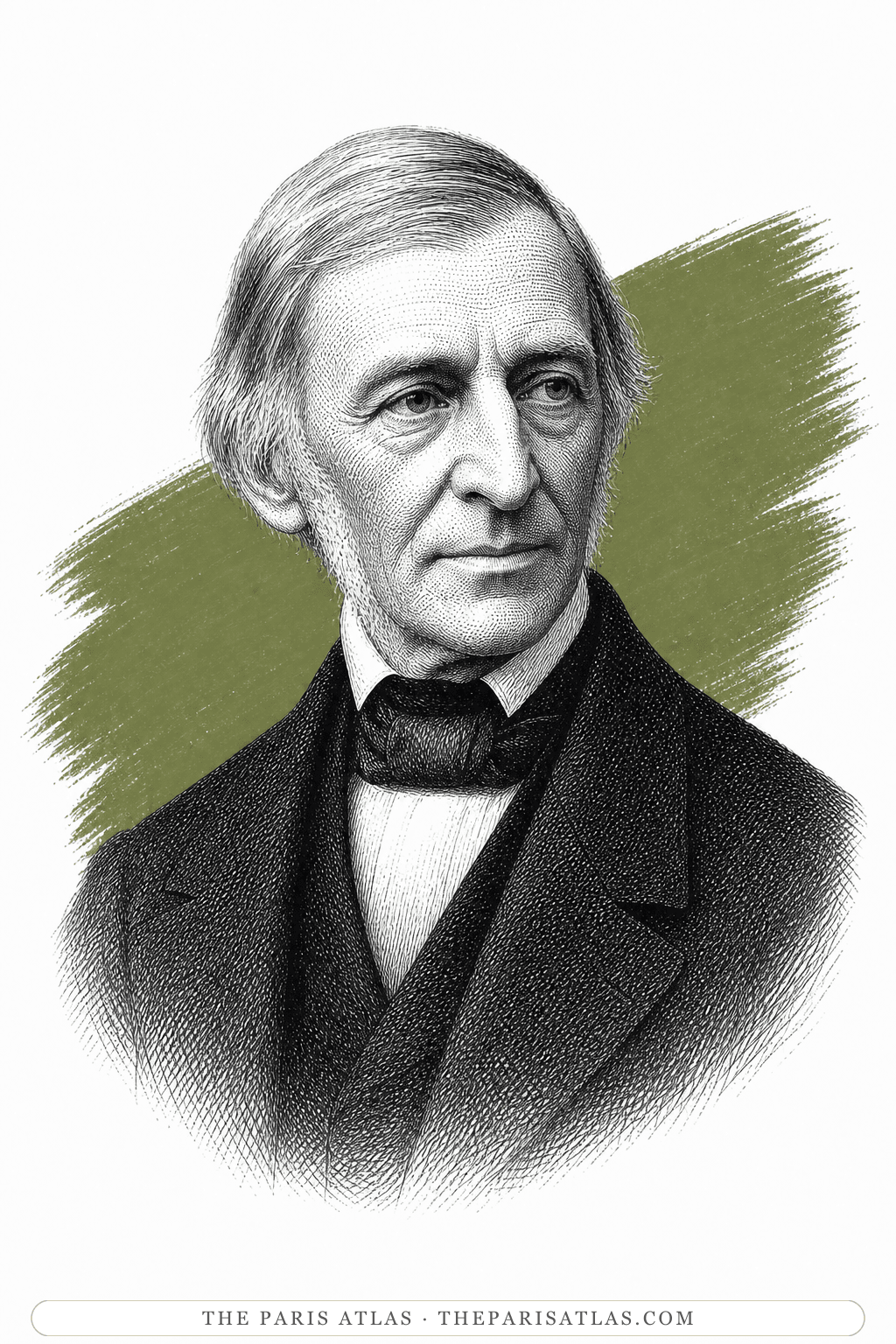
Ralph Waldo Emerson
Emerson's first book, 95 pages long and unsigned: the woods of Concord, a transparent eyeball, and an idea he found in a Paris museum.
Nature is Ralph Waldo Emerson's first book, a long essay published in Boston in September 1836 by James Munroe and Company. The title page carries no author's name.[1][2] In an introduction and eight short chapters, Emerson asks what the natural world is for. He answers that it feeds us, delights us, gives us language and teaches us. In the end, he says, it points to the spirit behind it. The book contains his most famous image, of standing on bare ground and becoming "a transparent eye-ball".[1] The idea behind the book first appears in his journal three years earlier, in the natural history rooms at the Jardin des Plantes in Paris.[3]
Emerson was writing the book in the first half of 1836. On 28 June he told his brother William: "My little book is nearly done. Its title is 'Nature.'" He meant to follow it with a second essay, called "Spirit", so that the two would make a decent volume. He corrected proofs late in August, and the book came out in September.[2]
The first edition is a small book of 95 pages. Its motto on the title page comes from the ancient philosopher Plotinus: "Nature is but an image or imitation of wisdom, the last thing of the soul."[1] The book sold slowly. Oliver Wendell Holmes, citing Thomas Wentworth Higginson, wrote in 1884 that it took twelve years to sell five hundred copies.[4]
In 1849 Munroe brought out a new edition under the name R. W. Emerson. The Plotinus motto was replaced by six lines of Emerson's own verse, beginning "A subtle chain of countless rings".[5] Emerson also changed some wording. The 1849 text is the one Project Gutenberg reproduces.[5][1]
The Introduction complains that the age looks backward. "Why should not we also enjoy an original relation to the universe?" Emerson asks. He then sets the question the book will answer: to what end is nature?[1]
Chapter I, Nature, is about being outdoors. Crossing a bare common at twilight, Emerson feels "a perfect exhilaration" for no particular reason. In the woods he stands on the bare ground and becomes "a transparent eye-ball". Chapter II, Commodity, covers the practical uses of nature: food, shelter, the wind and the steam engine.[1]
Chapter III, Beauty, argues that the eye and light make the world beautiful, and that beauty is sought for its own sake. Chapter IV, Language, says that words come from natural things. Right first meant straight, he notes, and spirit first meant wind. Chapter V, Discipline, treats nature as a school for the mind and for the conscience.[1]
Chapter VI, Idealism, raises the doubt of whether nature exists outside the mind at all. Chapter VII, Spirit, says nature always points to the spirit behind it. Chapter VIII, Prospects, criticises science that measures without asking what things mean. The book closes with the words of an unnamed poet, and the command "Build, therefore, your own world."[1]
On 13 July 1833, Emerson walked into the Cabinet of Natural History at the Jardin des Plantes in Paris. He was thirty, had given up his church in Boston the year before, and was travelling with no plan. He got in with a ticket from David Bailie Warden, an American living in Paris. His journal records what he saw that day in detail.
The bird rooms came first. He wrote down the names of parrots, hummingbirds and birds of paradise, and a vulture that looked like an executioner. In the mineral rooms he saw amber with perfect mosquitoes inside it, and gold in threads and plates. Then he wrote the lines whose wording comes back in Nature.
Not a form so grotesque, so savage, nor so beautiful but is an expression of some property inherent in man the observer, — an occult relation between the very scorpions and man. I feel the centipede in me, — cayman, carp, eagle, and fox. I am moved by strange sympathies; I say continually "I will be a naturalist."
Occult here means hidden. Three years later the same phrase opens a paragraph in Nature: "The greatest delight which the fields and woods minister, is the suggestion of an occult relation between man and the vegetable." In the last chapter Emerson names the room itself. "In a cabinet of natural history," he writes, "we become sensible of a certain occult recognition and sympathy in regard to the most bizarre forms of beast, fish, and insect."
The cabinet sentence reads differently in the 1849 edition. There the forms are "the most unwieldly and eccentric", not "the most bizarre". Project Gutenberg's text has the later wording.
Outside, Emerson noticed that the garden beds were planted by botanical classification. Past the flower garden were the animals: lions, two elephants, a giraffe and a rhinoceros, open to everyone, French or English, without payment. The garden still belongs to the Muséum national d'Histoire naturelle, France's national natural history museum.
The best-known passage in the book is on page 13. Emerson says that in the woods a man casts off his years, as a snake sheds its skin. Then he describes standing on bare ground with his head in the open air.
Standing on the bare ground, — my head bathed by the blithe air, and uplifted into infinite space, — all mean egotism vanishes. I become a transparent eye-ball. I am nothing. I see all.
The next sentence goes further: "The currents of the Universal Being circulate through me; I am part or particle of God." In the 1849 edition the three short sentences are joined by semicolons: "I become a transparent eye-ball; I am nothing; I see all."
I become a transparent eye-ball. I am nothing. I see all.
Why should not we also enjoy an original relation to the universe?
The greatest delight which the fields and woods minister, is the suggestion of an occult relation between man and the vegetable.
His first book sets out the ideas behind the essays that followed, "Self-Reliance" among them.
One of the most quoted passages in American writing is on page 13, and it takes a minute to read.
The book's central idea began in the natural history rooms at the Jardin des Plantes on 13 July 1833, and one sentence names the room.
Ninety-five pages in the first edition, which is free to read in a scan on the Internet Archive.
1833
On 13 July, in the natural history rooms at the Jardin des Plantes in Paris, Emerson writes in his journal: "I will be a naturalist."
1836
On 28 June he tells his brother William that his little book, called Nature, is nearly done.
1836
James Munroe and Company publishes Nature in Boston in September, without the author's name.
1849
Munroe issues a new edition under Emerson's name, with a verse motto of his own and some revised wording.
1884
Oliver Wendell Holmes writes that the book took twelve years to sell five hundred copies.
1985
Beacon Press publishes a facsimile of the first edition, introduced by Jaroslav Pelikan.


Essays: First Series
Ralph Waldo Emerson
The essays of 1841, including "Self-Reliance", put the ideas of Nature to work in everyday life.
Read our takeThe American Scholar
Ralph Waldo Emerson
The speech Emerson gave at Harvard a year later. Nature is the first of the scholar's three teachers.
Read our takePoems
Ralph Waldo Emerson
His first book of verse, in which the woods and fields of Concord come back as poems.
Read our takeRepresentative Men
Ralph Waldo Emerson
His lectures on six great men, published in 1850. The Montaigne lecture recalls another day in Paris in July 1833.
Read our takeThe book asks what the natural world is for. Emerson answers that nature serves us, delights us, gives us language and teaches us, and that in the end it points to the spirit behind it. James Elliot Cabot, Emerson's literary executor, wrote that the Transcendentalists' vision "found expression in Nature".
An image from the first chapter. Standing on bare ground in the woods, Emerson writes, "I become a transparent eye-ball. I am nothing. I see all." He means that his sense of self disappears and he simply sees.
In September 1836, in Boston, by James Munroe and Company. The first edition did not carry Emerson's name. A revised edition followed in 1849.
The first edition has 95 small pages: an introduction and eight chapters called Nature, Commodity, Beauty, Language, Discipline, Idealism, Spirit and Prospects.
The book's central idea came to Emerson in Paris. On 13 July 1833, in the natural history rooms at the Jardin des Plantes, he wrote of "an occult relation" between people and every living form. The same phrase appears in Nature, which also mentions "a cabinet of natural history".
Emerson revised the text for the 1849 edition, and Project Gutenberg's free text follows the later version. For example, the 1836 "most bizarre forms" became "the most unwieldly and eccentric forms".
The Internet Archive has a scan of the 1836 first edition. Project Gutenberg has the 1849 text as ebook 29433.
Explore authors with a similar voice, perspective, and influence.
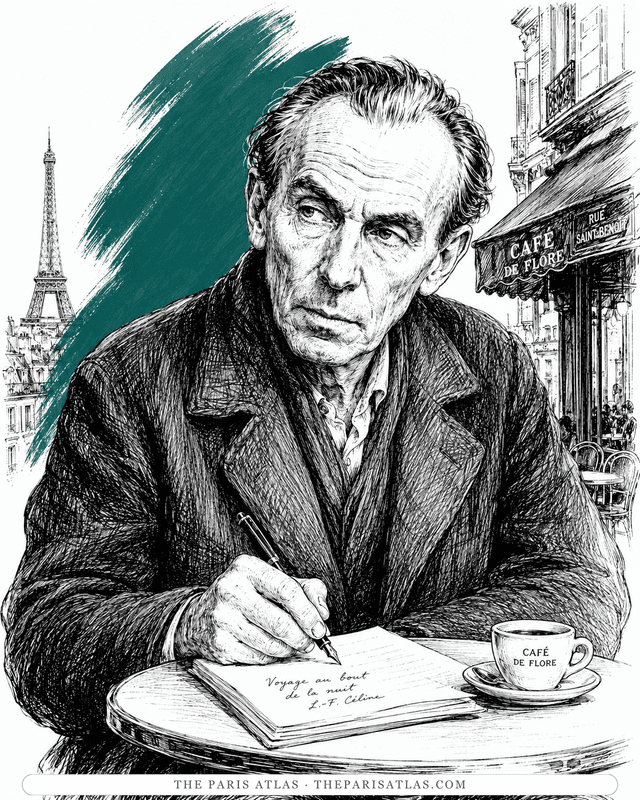
The doctor of the Paris slums who wrote the century's blackest, funniest novel — and changed the sound of French prose.
View author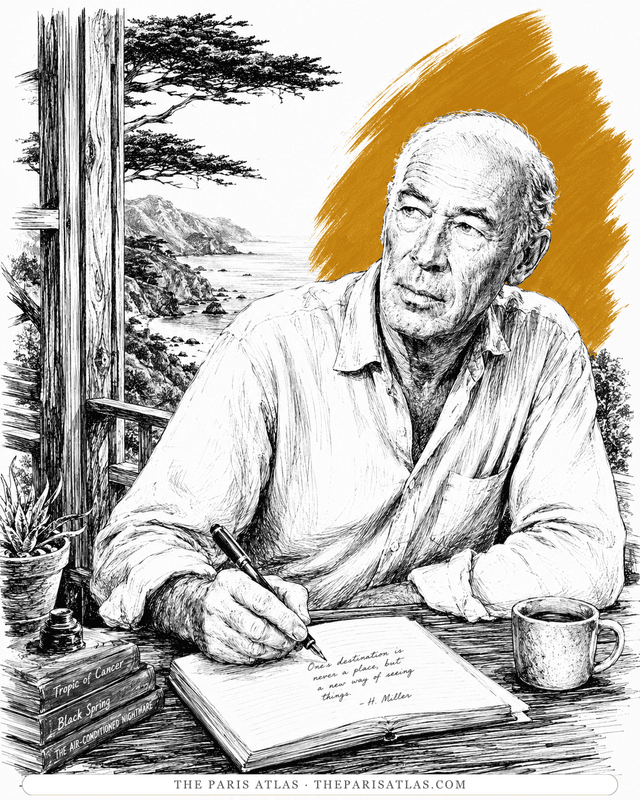
The Brooklyn dropout who arrived in Paris broke at thirty-eight and wrote the exuberant, banned books that ended American censorship.
View author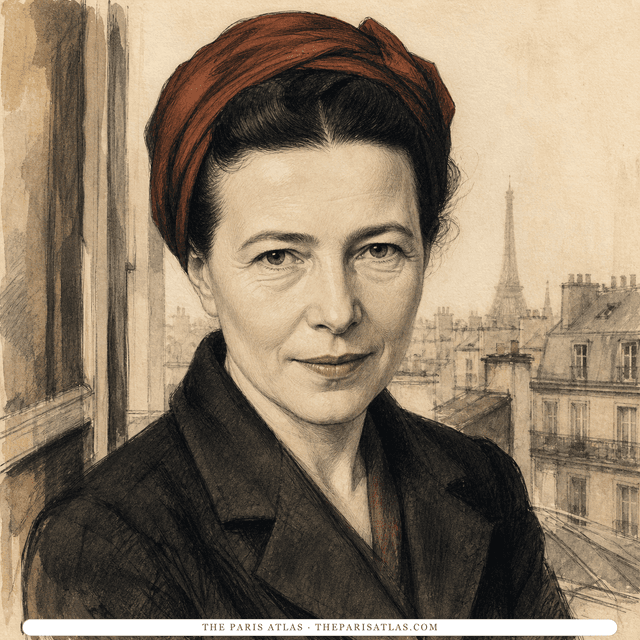
French writer and philosopher whose novels, memoirs, and social analysis examined freedom, gender, responsibility, aging, and the material conditions that shape a life.
View authorThe sources below include the primary text, editions, scholarship, archival materials, and other records that informed this page. They document Nature, its publication, and its place in literary history.

Emerson's own journal entry from the Jardin des Plantes.
Oliver Wendell Holmes on the book's slow sale.
The Muséum national d'Histoire naturelle on the garden today.
Catalogue records for the Beacon facsimile, the Penguin paperback and other editions.
The Penguin Classics selection: ISBN, contents and page count.
The primary text is the baseline reference for every book page. Additional references document publication history, interpretation, and historical context where that evidence is available.
 Explore more resources