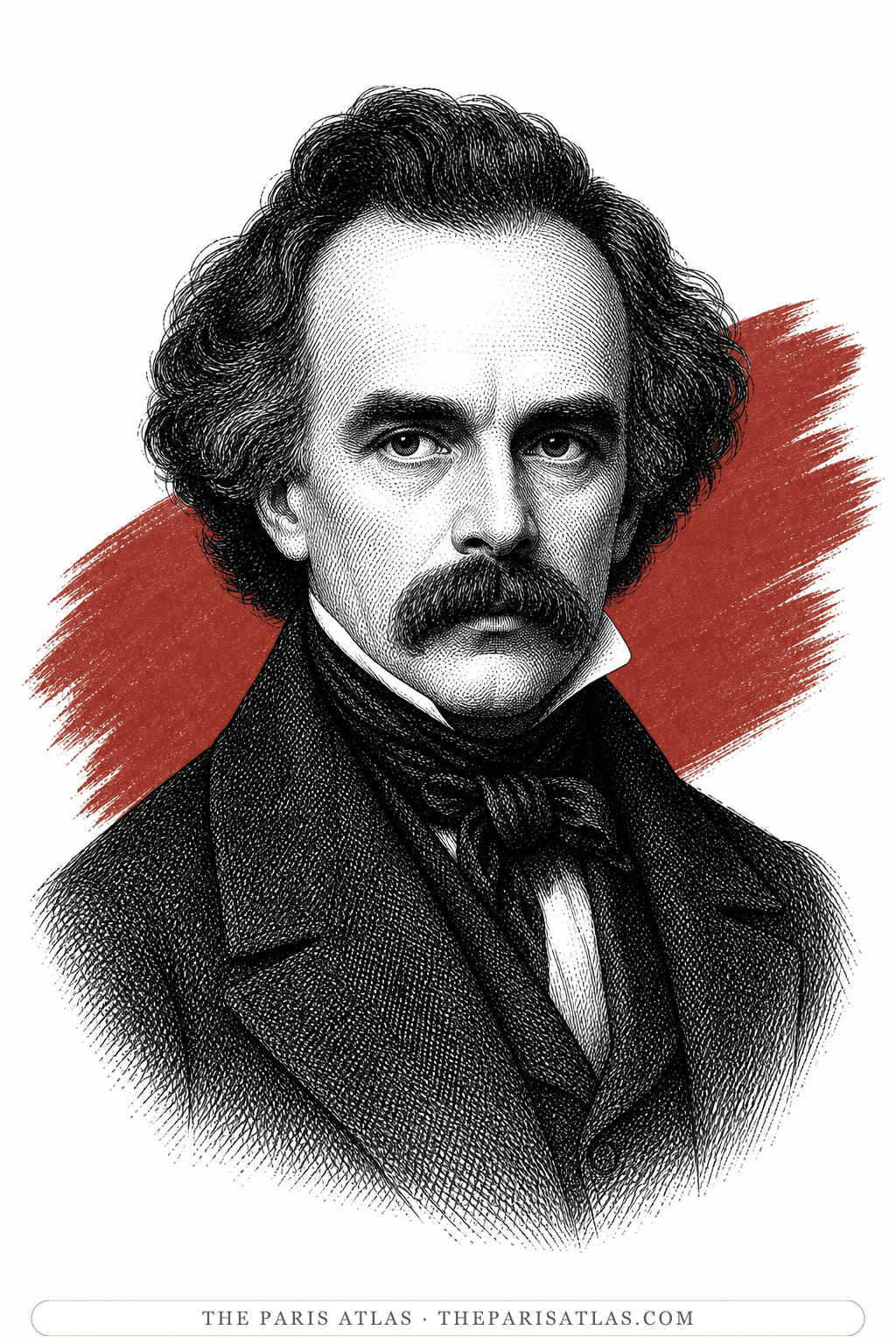
American essayist and lecturer who spent four weeks in Paris in the summer of 1833, walked into the natural history museum at the Jardin des Plantes on 13 July, and wrote in his journal that day: "I will be a naturalist." The idea he took home from that room became Nature (1836), the founding book of American Transcendentalism.
5 books on our shelves
Details
Lived
1803–1882
Born
1803
Birthplace
Boston, Massachusetts
Died
1882
Place of death
Concord, Massachusetts
Nationality
American
Profession
Essayist, lecturer and poet
Major works
Nature, Self-Reliance, The American Scholar, Essays: First and Second Series
Married
Ellen Louisa Tucker · 1829–1831Lidian Jackson · 1835–1882
Roles
AuthorPhilosopherPoet
About Ralph Waldo Emerson
Ralph Waldo Emerson was a Boston minister who resigned his pulpit at twenty-nine because he could no longer serve communion, sailed for Europe with no plan, and came back a writer. The turn happened in a museum in Paris. On 13 July 1833 he used a stranger's ticket to get into the Cabinet of Natural History at the Jardin des Plantes — the botanical garden and zoological museum on the Left Bank that is still France's national natural history museum — and walked through room after room of birds, shells, minerals and skeletons laid out not by beauty or country but by relation, each form set beside the forms it was kin to. Standing in it he wrote: "I am moved by strange sympathies; I say continually 'I will be a naturalist.'"[1]
He never became a naturalist in the professional sense. What he took from those rooms was the arrangement itself — the conviction that everything alive is connected to everything else and, crucially, to the person looking. Three years later he published Nature (1836), a small anonymous book that opens American Transcendentalism, the New England movement holding that spiritual truth is available directly to any individual through nature and intuition rather than through churches. In it he wrote of "an occult relation between man and the vegetable," and, in a sentence that carries Paris in it whole: "In a cabinet of natural history, we become sensible of a certain occult recognition and sympathy in regard to the most unwieldly and eccentric forms of beast, fish, and insect."[2] He spent the rest of his life in Concord, Massachusetts, lecturing, writing the essays — Self-Reliance above all — that made him the most quoted American of his century, and giving Henry David Thoreau the land at Walden Pond.
The minister who could not serve communion
Emerson was born in Boston on 25 May 1803, the son of a Unitarian minister — Unitarianism being the liberal wing of New England Protestantism, which rejected the Trinity and read the Bible as moral instruction rather than miracle. His father died in May 1811, days before Waldo's eighth birthday, leaving the family poor; he went to Harvard on scholarship, taught school, studied divinity, and in 1829 was ordained at the Second Church in Boston. That September he married Ellen Louisa Tucker, who was seventeen and already ill with tuberculosis.[3]
She died on 8 February 1831, and Emerson recorded it in his journal in five flat words and a clock reading: "Ellen Tucker Emerson died, 8th February, Tuesday morning, 9 o'clock." On 29 March 1832 he wrote one sentence and nothing else: "I visited Ellen's tomb and opened the coffin." That summer he told his congregation he could no longer administer the Lord's Supper — the communion rite of bread and wine — as a sacrament instituted for all ages; he proposed dropping the bread and wine and keeping the service as remembrance. A church committee expressed complete confidence in him and declined to change anything. He went to the White Mountains for a week to think, came back, and resigned. He never held a settled pulpit again.[4]
On Christmas Day 1832 he sailed from Boston in the brig Jasper, a 236-ton trading vessel bound for the Mediterranean, and landed at Malta on 2 February. He had no itinerary and no assignment. He went up through Sicily, Naples, Rome and Florence, over the Simplon Pass into Switzerland, and on to France.[1]
"A loud, modern New York of a place"
He reached Paris at noon on Thursday 20 June 1833 and disliked it on sight. The carriage crossed the Seine by the Pont Neuf, and he was pleased to see the bronze equestrian statue of Henri IV on its bridge until he noticed that the politics of the moment had jammed a tricolour flag into the king's bronze fist "as into a doll's" — an indignity he blamed on Louis-Philippe, the citizen-king installed by the revolution of 1830. He took a room at the Hôtel Montmorency on the Boulevard Montmartre, walked out, got dust in his eyes near the gardens of the Louvre, turned back before he reached the Champs-Élysées and refused to go further. Leaving Italy, he wrote, he had left "forever that air of antiquity and history which her towns possess, and in coming hither had come to a loud, modern New York of a place."[1]
Then the city won him over on its own terms, which were the terms of an open door. "It were very ungrateful in a stranger to be discontented with Paris," he decided, "for it is the most hospitable of cities. The foreigner has only to present his passport at any public institution and the doors are thrown wide to him." He used the privilege hard. At the Sorbonne, the ancient university of Paris, France's leading scientists lectured daily for free to anyone who walked in; he heard the philosopher Théodore Jouffroy and the chemists Louis-Jacques Thénard and Joseph Louis Gay-Lussac. He went to the Musée du Louvre and found more Leonardos than in any gallery he knew, and discovered the Spanish painter Murillo almost for the first time. He read the world's newspapers at Galignani's, the English-language bookshop and reading room, and at the English Reading Room in the Rue Neuve Augustine, which advertised four hundred journals in all languages. He moved from the hotel to a boarding house at the corner of the Rue Neuve Vivienne, directly over the entrance to the Passage des Panoramas — the first of the city's glass-roofed shopping arcades, built, he noted with satisfaction, by an American.[1]
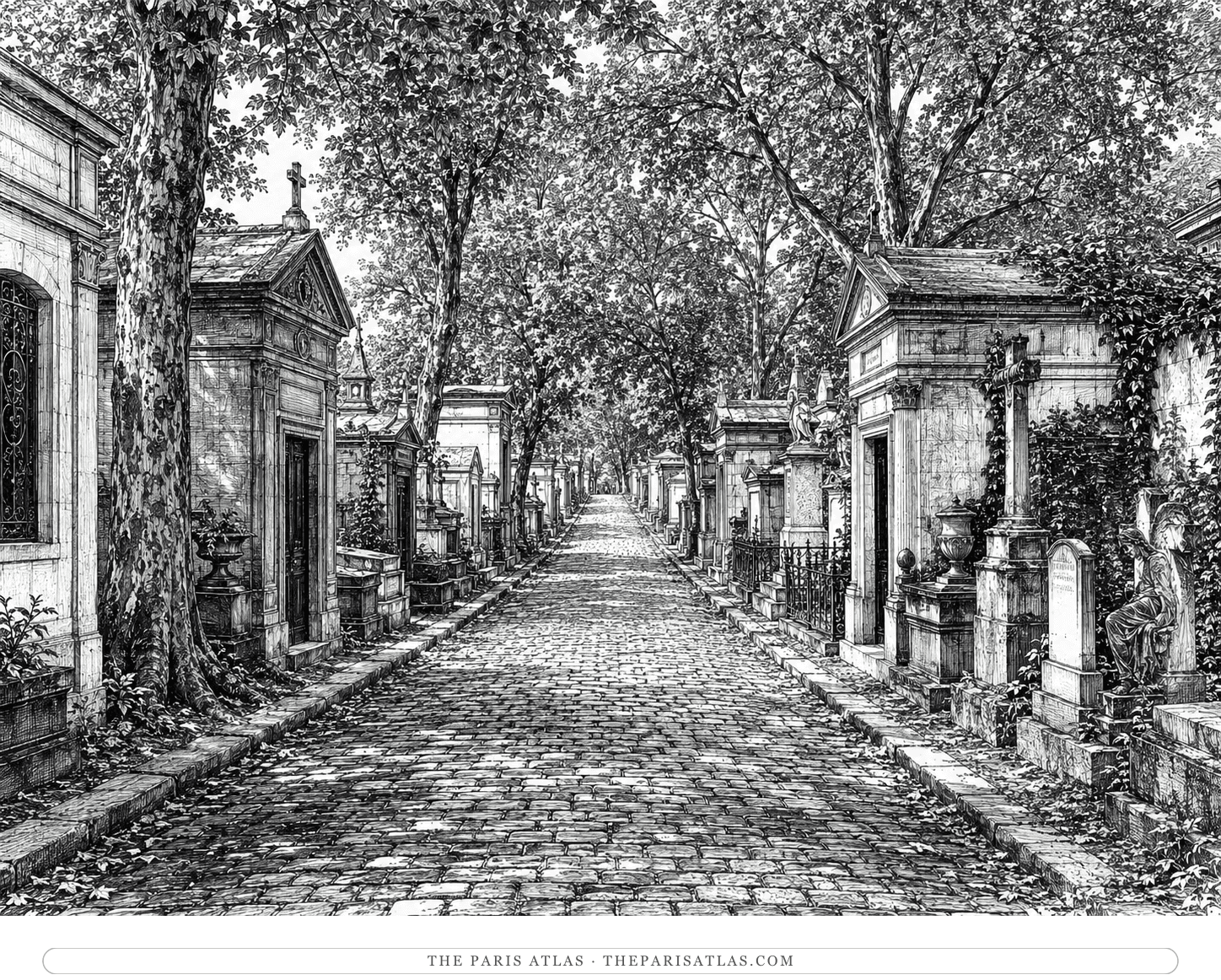
He also catalogued the boulevard the way a naturalist catalogues a shoreline: the man with live snakes crawling on him selling soap, the books lying on the ground, the tubs of goldfish, the silhouette-cutter offering to take yours, the bird-shop with twenty parrots and four swans, the boy with four legs. On 15 July he walked out to Père Lachaise, the great garden cemetery on the eastern hill, decided the French were a vain nation whose tombstones read like advertisements, and then copied down one epitaph in full — that of Auguste Charles Collignon, who had led a sweet and happy life by following, as far as he could, the morals and lessons of Montaigne's Essays and La Fontaine's Fables. He looked in at Frascati's, the most famous gambling house in Paris, on the Rue Richelieu, watched the little piles of gold napoleons change hands in complete silence, tipped the servant a franc for his hat and left. Of Notre-Dame he wrote that it was a fine church outside "but the interior quite naked and beggarly."[1]
13 July 1833: the Cabinet of Natural History
The Jardin des Plantes is the capital's first botanical garden, on the Left Bank near the river, and it is not only a garden: it is the seat of the Muséum national d'Histoire naturelle, France's national natural history museum, with galleries, a menagerie and a school of botany where thousands of species are planted according to their classification. In 1833 its collections were shown in what was called the Cabinet of Natural History. Admission needed an introduction, and Emerson got his ticket from David Bailie Warden, an American in Paris who opened scientific doors for visiting countrymen.[5][1]
What struck him first was curatorial: "How much finer things are in composition than alone. 'T is wise in man to make cabinets." In the ornithological chambers — the bird rooms — he wished he had come nowhere else, and started writing down names like a man in love: a parrot from New Holland that "deserves as special mention as a picture of Raphael in a gallery," hummingbirds smaller than beetles he had seen, one with "such a neck of gold and silver and fire," the birds of paradise, a vulture so like an executioner "that to meet in the wilderness would make your flesh quiver." In the mineral rooms he found amber holding perfect mosquitoes and native gold crystallised into threads and plates. "Ah! said I, this is philanthropy, wisdom, taste, to form a cabinet of natural history."[1]
Not a form so grotesque, so savage, nor so beautiful but is an expression of some property inherent in man the observer, — an occult relation between the very scorpions and man. I feel the centipede in me, — cayman, carp, eagle, and fox. I am moved by strange sympathies; I say continually "I will be a naturalist."[1]
That is the sentence. It is worth being exact about what it is and is not: it is a private journal entry, written the same day, in a museum, by a thirty-year-old ex-minister with no profession — not a public vow and not a career plan. He never trained in science. But the idea in it is the idea he built everything else on, and he did not have to change a word of it. Walking out through the garden he noticed the plants set out in the classification system of the botanist Antoine-Laurent de Jussieu, and a placard on the gate announcing that Jussieu would lead a free public botanising walk into the country the following Sunday, all comers welcome. Beyond the flower beds were the animals: lions, two elephants out in the open day, a giraffe seventeen feet high, the bison and the rhinoceros, "where all people, French and English, may come and see without money."[1]
He left Paris three days later, on 18 July, riding all night in the diligence — the long-distance stagecoach — to Boulogne, and crossed to London on the 19th. In England he sought out the writers he had read: Samuel Taylor Coleridge, William Wordsworth, and, at a remote farmhouse in Scotland, the essayist Thomas Carlyle, then unknown, who became his lifelong correspondent.[1] Then he went home.
Nature, and the sentence Paris left in it
Emerson settled in Concord, a village some twenty miles from Boston where his family had been ministers for generations, married Lidian Jackson in 1835, bought a house on the edge of the village and lived in it for the rest of his life. In September 1836 he published Nature, anonymously, at his own risk. It argues that the natural world is not scenery but language: that every fact of nature answers to a fact of mind, and that a person standing in a field has as direct an access to the divine as any priest or any book. It sold a few hundred copies and waited twelve years for a second edition.[3]
Two of its sentences come straight out of the Cabinet of Natural History. "The greatest delight which the fields and woods minister," he writes, "is the suggestion of an occult relation between man and the vegetable" — the same phrase, occult relation, that he had reached for in Paris in front of the scorpions. And later, arguing that science without humanity is only bookkeeping: "In a cabinet of natural history, we become sensible of a certain occult recognition and sympathy in regard to the most unwieldly and eccentric forms of beast, fish, and insect." He is describing a specific room. He had stood in it on 13 July 1833 and written the same thought in the same words.[2][1]
The month the book appeared, at the celebration of Harvard's second centennial, Emerson fell into conversation with the minister George Ripley and the theologian Frederic Henry Hedge about how unsatisfactory current thinking in theology and philosophy had become. They agreed to gather a few like-minded people the following week. That informal group — later called the Transcendental Club — is where American Transcendentalism starts. On 15 July 1838 Emerson returned to Harvard to give what became known as the Divinity School Address, telling the graduating ministers, in the chapel, that historical Christianity had gone wrong and that each of them must preach from his own soul rather than from tradition. His former colleague Henry Ware Jr., by then a professor there, praised the lofty ideas and beautiful images and then wrote the next day to say that some of the statements seemed to him more than doubtful, and that if they prevailed they would tend to overthrow the authority and influence of Christianity.[3] The Boston newspapers and the Unitarians' own Christian Examiner went after him. Harvard came round eventually — an honorary doctorate in 1866, election as an overseer, and the Phi Beta Kappa oration in 1867 — but by then he was the foremost man of letters in New England and no longer needed it.
Concord, Thoreau, and the long afterlife
In the spring of 1841 Emerson invited a young Concord man named Henry David Thoreau to come and live in his house for a year in exchange for work — "an indefatigable and a very skilful labourer," he told his brother, "a scholar and a poet, and as full of buds of promise as a young apple-tree." Emerson owned the ground: he had bought up land on the shore of Walden Pond until he was, as he put it, "landlord and water-lord of fourteen acres, more or less, on the shore of Walden," and it was there that Thoreau built his cabin. The same year Emerson published Essays: First Series, containing Self-Reliance, the most consequential short piece of American prose of its century — "Whoso would be a man, must be a nonconformist"[6] — and by the 1850s he was the country's most sought-after lecturer, travelling the new railways to speak in halls from Boston to the Mississippi.
Concord filled up around him. Nathaniel Hawthorne rented the Old Manse — the parsonage Emerson's grandfather built, where Emerson himself had written much of Nature — and became a neighbour who met him on the wood-paths and described him as carrying "that pure intellectual gleam diffused about his presence, like the garment of a shining one." Emerson's early years had been an argument with a church; his later ones were an argument with a country. He came late but hard to the anti-slavery cause, attacked the Fugitive Slave Act from the platform, and lived to see the war settle it.
A cold caught in the spring of 1882 turned to pneumonia, and he died on Thursday 27 April, a few weeks short of his seventy-ninth birthday. He was buried on 30 April at Sleepy Hollow Cemetery in Concord — the burial ground he had himself dedicated with an address in 1855 — at the foot of a tall pine on the highest ridge, not far from the graves of Hawthorne and Thoreau.[3] He had been in Paris for four weeks, forty-nine years earlier, and had come out of one of its museums with the sentence that started everything.
Life events
1803
Born in Boston on 25 May, son of a Unitarian minister.
— James Elliot Cabot, A Memoir of Ralph Waldo Emerson, in two volumes (1887)
1829
Ordained at the Second Church in Boston; marries Ellen Louisa Tucker in September.
— James Elliot Cabot, A Memoir of Ralph Waldo Emerson, in two volumes (1887)
1831
Ellen dies on 8 February. His journal records it in a line: "Ellen Tucker Emerson died, 8th February, Tuesday morning, 9 o'clock."
— Ralph Waldo Emerson, Journals of Ralph Waldo Emerson, 1820–1872, Volume II (1824–1832), edited by Edward Waldo Emerson and Waldo Emerson Forbes (1909)
1832
Proposes in June that the Second Church drop the bread and wine from communion; the committee declines, and he resigns his pulpit. On 25 December he sails from Boston for the Mediterranean in the brig Jasper.
— James Elliot Cabot, A Memoir of Ralph Waldo Emerson, in two volumes (1887); Ralph Waldo Emerson, Journals of Ralph Waldo Emerson, 1820–1872, Volume II (1824–1832), edited by Edward Waldo Emerson and Waldo Emerson Forbes (1909)
1833
Reaches Paris at noon on 20 June and calls it "a loud, modern New York of a place"; lodges at the Hôtel Montmorency on the Boulevard Montmartre.
— Ralph Waldo Emerson, Journals of Ralph Waldo Emerson, 1820–1872, Volume III (1833–1835), edited by Edward Waldo Emerson and Waldo Emerson Forbes (1909)
1833
13 July: enters the Cabinet of Natural History at the Jardin des Plantes on a ticket from David Bailie Warden and writes, "I am moved by strange sympathies; I say continually 'I will be a naturalist.'"
— Ralph Waldo Emerson, Journals of Ralph Waldo Emerson, 1820–1872, Volume III (1833–1835), edited by Edward Waldo Emerson and Waldo Emerson Forbes (1909)
1833
15 July: walks out to Père Lachaise and copies down an epitaph. On 18 July he leaves Paris by diligence for Boulogne, and crosses to London the next day.
— Ralph Waldo Emerson, Journals of Ralph Waldo Emerson, 1820–1872, Volume III (1833–1835), edited by Edward Waldo Emerson and Waldo Emerson Forbes (1909)
1836
Publishes Nature anonymously in September — a few hundred copies sold, and twelve years before a second edition. It carries the Paris phrase: "an occult relation between man and the vegetable."
— Ralph Waldo Emerson, Nature (Project Gutenberg etext of the 1836 essay) (1836); James Elliot Cabot, A Memoir of Ralph Waldo Emerson, in two volumes (1887)
1836
At Harvard's second centennial he agrees with George Ripley and Frederic Henry Hedge to gather like-minded people — the meetings that became the Transcendental Club.
— James Elliot Cabot, A Memoir of Ralph Waldo Emerson, in two volumes (1887)
1838
Delivers the Divinity School Address in the chapel at Harvard on 15 July; the Boston press and the Unitarians' own Christian Examiner turn on him.
— James Elliot Cabot, A Memoir of Ralph Waldo Emerson, in two volumes (1887)
1841
Invites Henry David Thoreau to live and work at his house in Concord; publishes Essays: First Series, containing Self-Reliance.
— James Elliot Cabot, A Memoir of Ralph Waldo Emerson, in two volumes (1887); Ralph Waldo Emerson, Essays — First Series (Project Gutenberg etext), including Self-Reliance (1841)
1882
Dies of pneumonia at Concord on 27 April and is buried on 30 April at Sleepy Hollow Cemetery, near the graves of Hawthorne and Thoreau.
— James Elliot Cabot, A Memoir of Ralph Waldo Emerson, in two volumes (1887)
People Ralph Waldo Emerson Knew
Relationships with other people, with sources for each connection.
Neighbours at Concord from 1842, when the newly married Hawthornes took the Old Manse — the parsonage built by Emerson's grandfather, where Emerson had written much of Nature. Hawthorne was no Transcendentalist and said so, but left one of the best descriptions of Emerson anyone wrote. Both are buried at Sleepy Hollow Cemetery in Concord.
— Henry James, Hawthorne (English Men of Letters series) (1879), Chapter IV, Brook Farm and Concord; James Elliot Cabot, A Memoir of Ralph Waldo Emerson, in two volumes (1887)
Emerson's first book of verse opens with a riddling Sphinx and ends with "the shot heard round the world". Near the end is his lament for his five-year-old son.
Did Ralph Waldo Emerson really say "I will be a naturalist" in Paris?
Yes, and the date and place are precise. On 13 July 1833, in the Cabinet of Natural History at the Jardin des Plantes in Paris, he wrote in his journal: "I am moved by strange sympathies; I say continually 'I will be a naturalist.'" The sentence comes at the end of a long entry cataloguing the birds, minerals and skeletons he had just walked through, and directly after the thought it depends on — that no form of life, however grotesque, is unrelated to the person looking at it: "an occult relation between the very scorpions and man." He never trained as a scientist. What he kept was the idea.
What is the Jardin des Plantes, and why did it matter to Emerson?
It is Paris's first botanical garden, on the Left Bank, and the seat of the Muséum national d'Histoire naturelle — France's national natural history museum, with galleries, a menagerie and a school of botany where species are planted according to their scientific classification. In 1833 its collections were displayed as the Cabinet of Natural History. What moved Emerson was not any single specimen but the arrangement: things placed beside the things they were related to. "How much finer things are in composition than alone," he wrote that day. "'T is wise in man to make cabinets." Three years later Nature argued that the same relatedness runs through the whole world and includes the observer.
How long was Emerson in Paris, and what did he think of it?
Four weeks — he arrived at noon on 20 June 1833 and left on 18 July. His first verdict was hostile: after Italy, Paris struck him as "a loud, modern New York of a place," and he turned back from his first walk in disgust at the dust. He came round because the city let him in everywhere. "It is the most hospitable of cities," he wrote. "The foreigner has only to present his passport at any public institution and the doors are thrown wide to him." He used that access at the Sorbonne, the Louvre, the Institute, the reading rooms and, decisively, the Jardin des Plantes.
Why did Emerson leave the ministry?
Over communion. Ordained at the Second Church in Boston in 1829, he came to believe that the Lord's Supper — the rite of bread and wine — had not been instituted by Christ as a permanent sacrament, and that he could not administer it honestly. In June 1832 he proposed keeping the service as an act of remembrance and dropping the elements. The church's committee said it had complete confidence in him and declined to change anything. He spent a week in the White Mountains deciding, then resigned. He was twenty-nine, recently widowed, and had no other profession; six months later he sailed for Europe.
What is Transcendentalism, in plain terms?
A New England movement of the 1830s and 1840s holding that every person has direct access to spiritual truth through nature, conscience and intuition — without the mediation of a church, a creed or an authority. Emerson's Nature (1836) is its founding statement; the informal Transcendental Club, which began meeting the same month the book appeared, is its address book. Its practical consequences were large: self-reliance as a moral programme, Thoreau's cabin at Walden, and a strong strain in American abolitionism.
What was Emerson's relationship with Henry David Thoreau?
Emerson was the older neighbour who made Thoreau's life possible. In the spring of 1841 he invited the young man to live in his Concord house for a year, working in the garden in exchange for board — "a scholar and a poet, and as full of buds of promise as a young apple-tree," Emerson wrote of him. It was Emerson's land at Walden Pond that Thoreau later used to build his cabin on. The friendship was close, uneven and much argued over afterwards; they are buried in the same Concord cemetery.
What should I read first by Emerson?
Self-Reliance (1841), the essay everyone quotes without knowing it — "Whoso would be a man, must be a nonconformist," "A foolish consistency is the hobgoblin of little minds." Then Nature (1836), which is short, strange and where the whole system starts, including the sentence about a cabinet of natural history that he brought home from Paris. The journals, published in ten volumes after his death, are the best of him for readers who like watching a mind work in private.
Connections and Sources
Ralph Waldo Emerson’s connections to people, places, and works, with the sources behind each one.
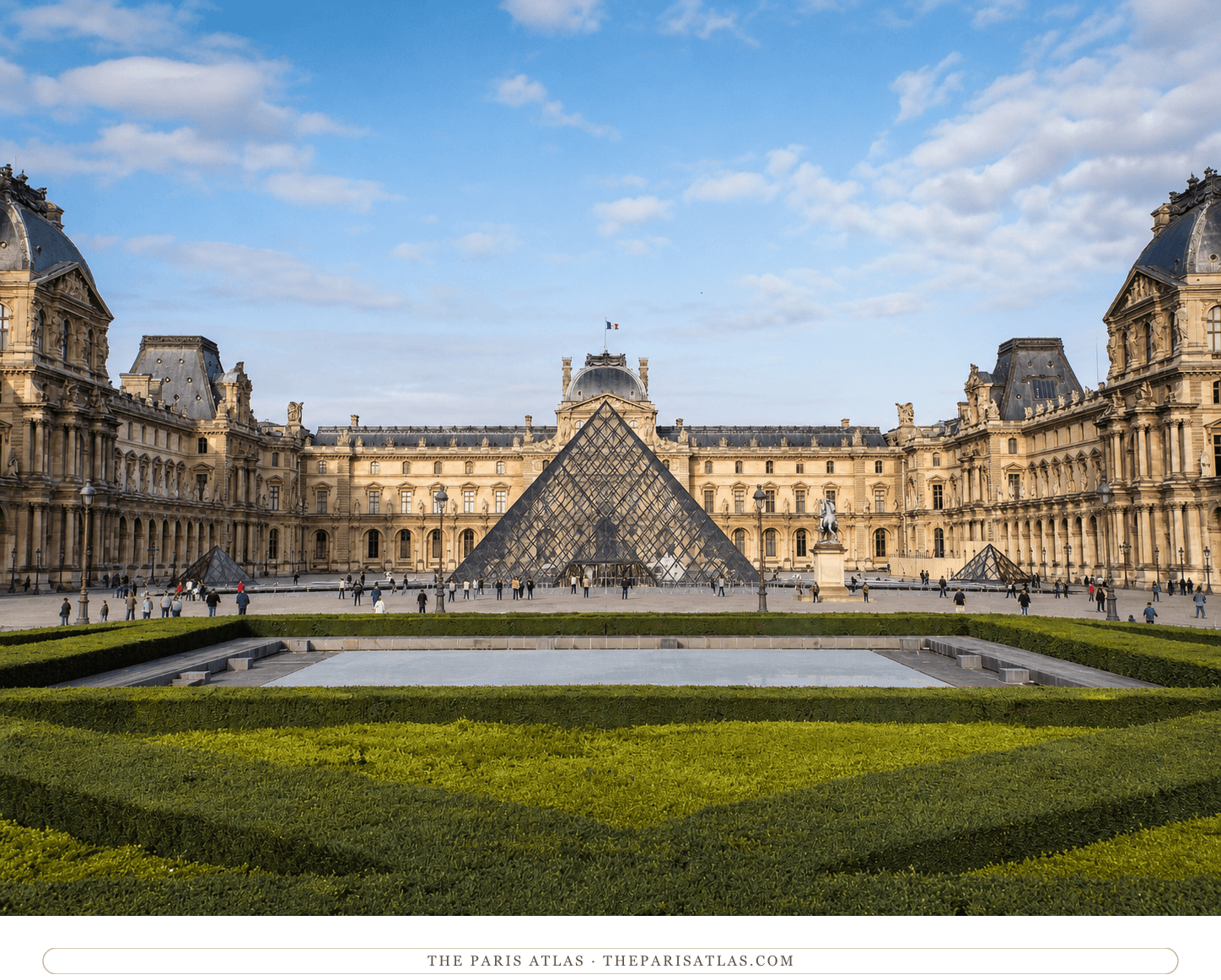
One of the free public institutions Emerson used during his four Paris weeks in 1833. He went for the pictures, found more Leonardos than in any gallery he knew, and discovered Murillo.
— Ralph Waldo Emerson, Journals of Ralph Waldo Emerson, 1820–1872, Volume III (1833–1835), edited by Edward Waldo Emerson and Waldo Emerson Forbes (1909), Paris, June–July 1833
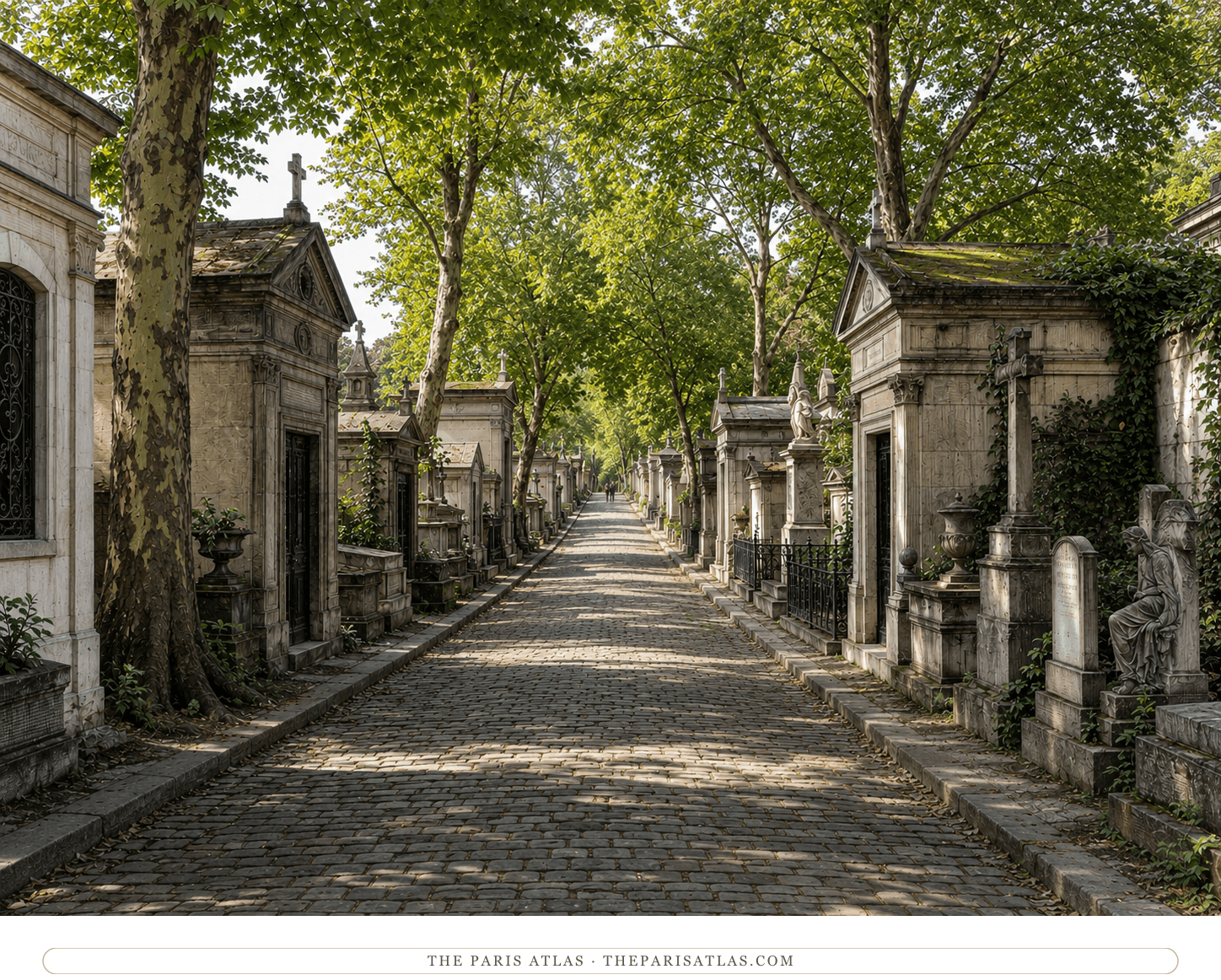
15 July 1833. He judged the tombstones vain and advertisement-like, then copied out in full the epitaph of Auguste Charles Collignon, who had lived by the morals of Montaigne's Essays and La Fontaine's Fables.
— Ralph Waldo Emerson, Journals of Ralph Waldo Emerson, 1820–1872, Volume III (1833–1835), edited by Edward Waldo Emerson and Waldo Emerson Forbes (1909), Journal, 15 July 1833
Neighbours at Concord from 1842, when the newly married Hawthornes took the Old Manse — the parsonage built by Emerson's grandfather, where Emerson had written much of Nature. Hawthorne was no Transcendentalist and said so, but left one of the best descriptions of Emerson anyone wrote. Both are buried at Sleepy Hollow Cemetery in Concord.
— Henry James, Hawthorne (English Men of Letters series) (1879), Chapter IV, Brook Farm and Concord; James Elliot Cabot, A Memoir of Ralph Waldo Emerson, in two volumes (1887)
References
References
The sources below include biographies, scholarly essays, interviews, and primary materials that informed this page. They reflect both the historical record and ongoing critical conversations about Ralph Waldo Emerson and their work.
1abcdefghijkJournals of Ralph Waldo Emerson, 1820–1872, Volume III (1833–1835), edited by Edward Waldo Emerson and Waldo Emerson Forbes
Memoir
Houghton Mifflin / The Riverside Press, Cambridge, 1909
Used for
The primary text: Emerson's own journal of the 1833 European journey, including the Paris weeks and the 13 July entry.
These references anchor the page in the documented record and in the scholarly conversations around Ralph Waldo Emerson. Every claim on this page traces back to one or more of the works listed here.




 View source