Bathers at Asnières
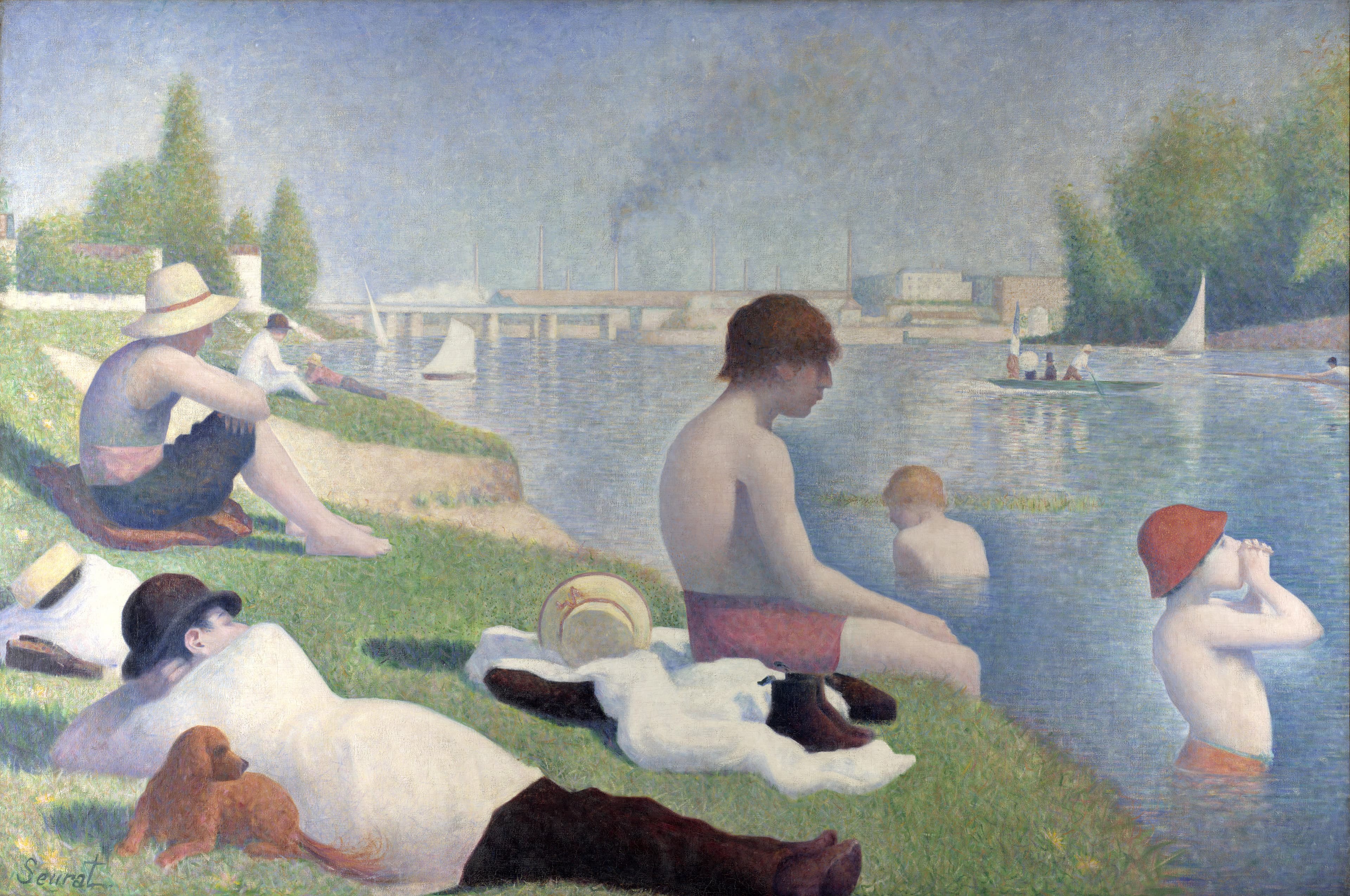
Georges Seurat gives working men and boys resting beside the Seine the scale and stillness of a monumental history painting. Made before his mature pointillist technique was fully established, the canvas shows how careful drawing, modern subject matter, and experiments with separated color came together in his first major composition.
- 1884; reworked circa 1886–1887
- Oil on canvas
About Georges Seurat
What the painting shows
Men and boys rest beside the Seine between Asnières and Courbevoie, northwest of central Paris. One lies fully dressed beside a dog, another sits at the water's edge with his work clothes spread on the grass, and two figures stand in the river. At the far right, a boy in an orange hat cups his hands around his mouth as if calling across the water.
The distant view is industrial rather than rural. Bridges cross the river, a train sends up steam, and factories and the Clichy gasworks rise beyond the boats. A well-dressed couple passes in a boat under a parasol while the much larger figures on the bank remain apart from one another, each absorbed in his own pause.
Modern workers painted on a monumental scale
The National Gallery describes the clothes and bearing of the bathers as working-class or lower-middle-class. Seurat did not show them laboring, competing, or performing heroic deeds. He made their leisure the subject of a canvas two meters high and three meters wide—a scale conventionally associated with history painting and public ambition.
That contrast is central to the picture without proving a single political message. The workers occupy the foreground and the bourgeois passengers remain small in the distance, but Seurat does not turn either group into a simple moral lesson. His figures are unusually still and separate. The picture asks the viewer to notice class, work, and access to leisure while withholding a tidy story about them.
How Seurat built the composition
Bathers at Asnières was not painted as a quick record of one afternoon. Seurat worked in the studio after sustained preparation: the National Gallery records about thirteen surviving oil sketches and ten drawings connected with the painting. The simplified bodies, side-on poses, and orderly intervals make the group read almost like a carved frieze.
His academic training remained visible in that structure. The boy calling from the water recalls the sea god Triton blowing a shell, while the large, quiet figures have been compared with classical and Renaissance art. Yet the location, clothes, bridges, factories, and haze belong unmistakably to the industrial edge of modern Paris.
A bridge from broad brushwork to Pointillism
This is an essential Pointillist work, but it was not originally covered in the even field of dots associated with Seurat's later paintings. Broad strokes remain especially visible in the water, and the first version predates the fully developed method he used for A Sunday on La Grande Jatte.
Seurat returned to selected passages after developing his divided-color practice. The orange hat of the boy in the water, for example, carries later touches of yellow and blue. Those additions make the canvas a record of change: the earlier painting was not erased, and the newer color experiment sits visibly on top of it.
Rejected by the Salon, then preserved by Fénéon
Seurat intended the painting to announce him at the official Salon of 1884, but the jury rejected it. He then showed it at the newly formed independent exhibition that year. The rejection matters because the alternative exhibition network gave ambitious young artists a way to show work without the Salon's approval.
After Seurat's death, the painting remained with his family before the critic Félix Fénéon acquired it around 1900. The National Gallery bought it through the Courtauld Fund in 1924. It is now in the National Gallery's main collection under inventory number NG3908; the museum's live object page should be checked before a visit because gallery displays can change.
Close reading
Reading the work, detail by detail
Seurat gives an ordinary riverside pause the scale and stillness of a public monument. These six details move from individual bathers to boats, factories, and the sharply different kinds of leisure that share this stretch of the Seine.
1.A fully dressed worker rests at the edge
The man has not changed for swimming: boots, trousers, jacket, and bowler hat keep him tied to the working city behind the riverbank. Seurat gives his rest weight by placing this clothed body across the immediate foreground.
2.The central bather is posed like a monument
He sits in profile with his shoulders lowered and legs entering the water, but the clean outline and calm pose feel closer to a classical figure than a fleeting holiday snapshot. His discarded clothes identify modern labor while the composition grants him unusual permanence.
3.The calling boy supplies the picture's loudest gesture
The boy's open mouth and cupped hands imply a call that the silent canvas cannot deliver. Small blue and yellow touches on his orange hat belong to Seurat's later reworking, so this lively figure also preserves the transition toward divided color.
4.Boats divide work from recreation
Sails, oars, and a narrow racing shell activate the river behind the motionless men. Seurat keeps that traffic small, making the bathers' stillness more conspicuous while showing that the Seine carries several kinds of activity at once.
5.Factories prevent the scene from becoming pastoral
The railway, road bridge, gasworks, and Clichy factories identify the setting as the industrial edge of Paris. Their pale haze does not remove them; it makes work the distant condition surrounding the men's temporary rest.
6.A parasol marks another class of leisure
The well-dressed passengers are tiny beside the anonymous men on the bank, and their oarsman is the only figure visibly at work. The contrast makes class legible without assigning the painting one simple political verdict.
Timeline
1883–1884
Seurat studies the riverside site and individual figures in oil sketches and Conté-crayon drawings, then completes his first major composition in the studio.
1884
The official Salon rejects Bathers at Asnières; Seurat exhibits it independently later that year.
Circa 1886–1887
After developing divided color in the course of La Grande Jatte, Seurat revisits selected passages of Bathers with small contrasting touches.
Circa 1900
The critic Félix Fénéon acquires the painting from Seurat's family and keeps it for more than two decades.
1924
The National Gallery acquires the painting through the Courtauld Fund; it is now inventory number NG3908.
Where to see it
The National Gallery, London
Trafalgar Square, London WC2N 5DN, United Kingdom
Collection locations and gallery displays can change. Check the official object record before making a special visit.
Plan your visit on the museum’s official website (opens in a new tab)Frequently asked questions
Where is Bathers at Asnières?
Bathers at Asnières is in the National Gallery, London, inventory number NG3908. The museum's object page lists its current gallery status, which is worth checking before a visit.
Is Bathers at Asnières a Pointillist painting?
It is a precursor to Seurat's mature Pointillism rather than a canvas originally made entirely from dots. He used varied, often broader brushwork in 1884 and later added small divided-color touches to selected areas, including the orange hat.
Who are the people in Bathers at Asnières?
They are unidentified men and boys whose clothes and setting suggest working-class or lower-middle-class life on the industrial edge of Paris. The painting does not supply individual names or a single narrative linking them.
Why was Bathers at Asnières rejected by the Salon?
The surviving record establishes that the Salon rejected it in 1884, but it does not give us a definitive jury explanation. Its enormous scale, modern working-class subject, simplified figures, and unconventional handling all departed from what a successful Salon debut normally looked like.
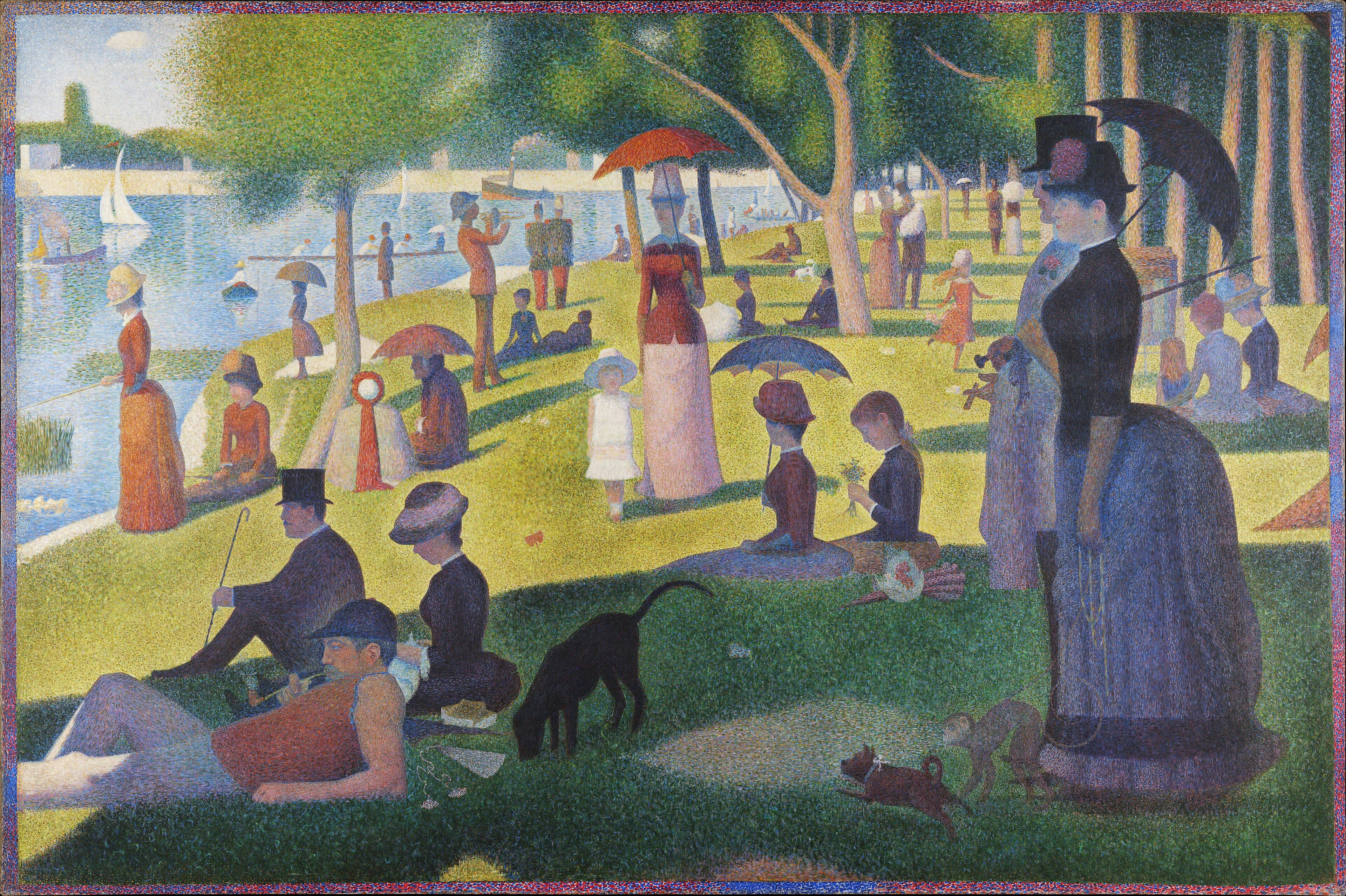
How is Bathers at Asnières connected to A Sunday on La Grande Jatte?
The two paintings show the same stretch of the Seine from opposite sides. Bathers foregrounds workers at Asnières, while La Grande Jatte presents the leisure crowd on the island across the water; Seurat also carried lessons from the later canvas back into selected parts of Bathers.
How large is Bathers at Asnières?
The painting measures 201 by 300 centimeters—roughly two meters high and three meters wide. Its monumental size is part of the work's meaning because Seurat applied the scale of an ambitious public painting to anonymous modern bathers.
More by Georges Seurat
If you like Georges Seurat
Explore painters from the same movements and circles.
Paul Cézanne
Painter between Impressionism and everything after — shown in the independents' exhibitions, emulated by the Cubists, and present at the Orangerie through 15 works in the Walter-Guillaume collection.
View artist
Paul Gauguin
Stockbroker turned painter who came into art through Camille Pissarro, showed with the Impressionists, and left Europe for Polynesia.
View artist
Camille Pissarro
The eldest of the Impressionists and the only painter to show in all eight of the group's exhibitions, 1874 to 1886.
View artist
References
The sources below include collection records, catalogues, scholarly research, and primary materials that informed this page. They document Bathers at Asnières, its making, and its place in cultural history.


1Bathers at Asnières — Georges Seurat
WebsiteThe National Gallery, LondonUsed forWeb source consulted for documented facts and historical context presented on the Bathers at Asnières page.
2Georges Seurat
WebsiteThe National Gallery, LondonUsed forWeb source consulted for documented facts and historical context presented on the Bathers at Asnières page.
3Seurat's Painting Practice: Theory, Development and Technology
WebsiteThe National Gallery, London, 2003Used forWeb source consulted for documented facts and historical context presented on the Bathers at Asnières page.
4Georges Seurat (1859–1891) and Neo-Impressionism
WebsiteThe Metropolitan Museum of ArtUsed forWeb source consulted for documented facts and historical context presented on the Bathers at Asnières page.

5Seurat: Paintings and Drawings — exhibition catalogue
Exhibition catalogueThe Art Institute of Chicago / The Museum of Modern Art, 1958Used forCatalogue scholarship used to verify attribution, provenance, chronology, and interpretive context for Bathers at Asnières.
These references provide the documented foundation for this work's history and interpretation. Claim-level citations remain attached to the specific claims they support.
 Explore more resources