Models (Poseuses)
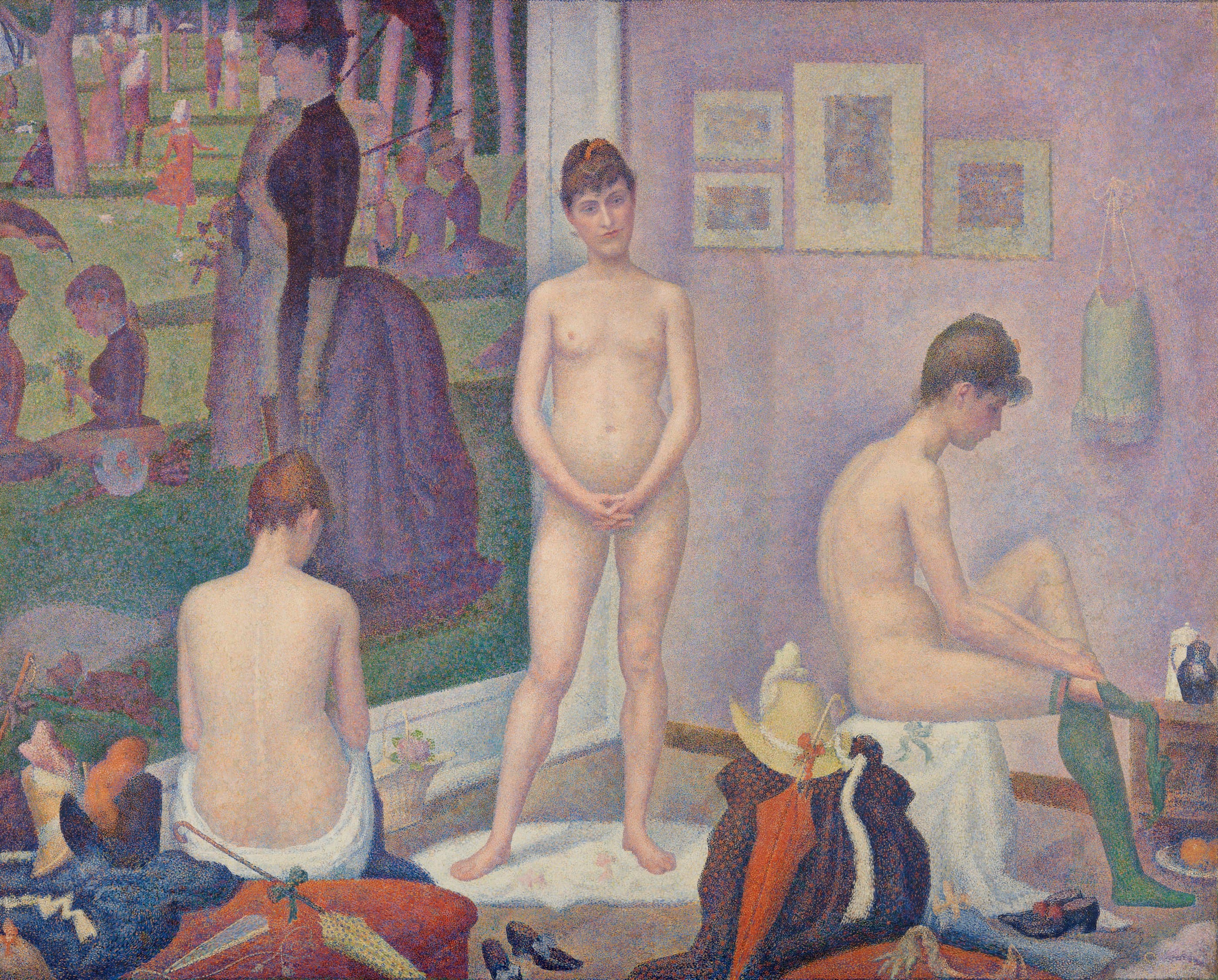
Three young women undress, pose and dress again in a corner of Georges Seurat's studio in Paris. Behind them hangs part of his huge painting A Sunday on La Grande Jatte. Georges Seurat painted Models between 1886 and 1888, in tiny dots of colour, to show that his method could paint the nude. The Barnes Foundation in Philadelphia owns it.
- 1886–1888
- Oil on canvas
- Barnes FoundationPhiladelphia, United States
About Georges Seurat
What the painting shows
Three young women are in a corner of a painter's studio. On the left, one sits with her back to us, a white cloth round her hips. In the middle, one stands facing us with her hands folded in front of her. On the right, one sits sideways on a white-draped seat and pulls on a green stocking.
Their clothes lie everywhere. A yellow straw hat, a red parasol, a dark coat, a blue skirt, a cane and a pair of shoes are heaped on the floor. A pale green garment hangs on the lilac wall beside four framed pictures, and a plate of oranges sits on a small table.
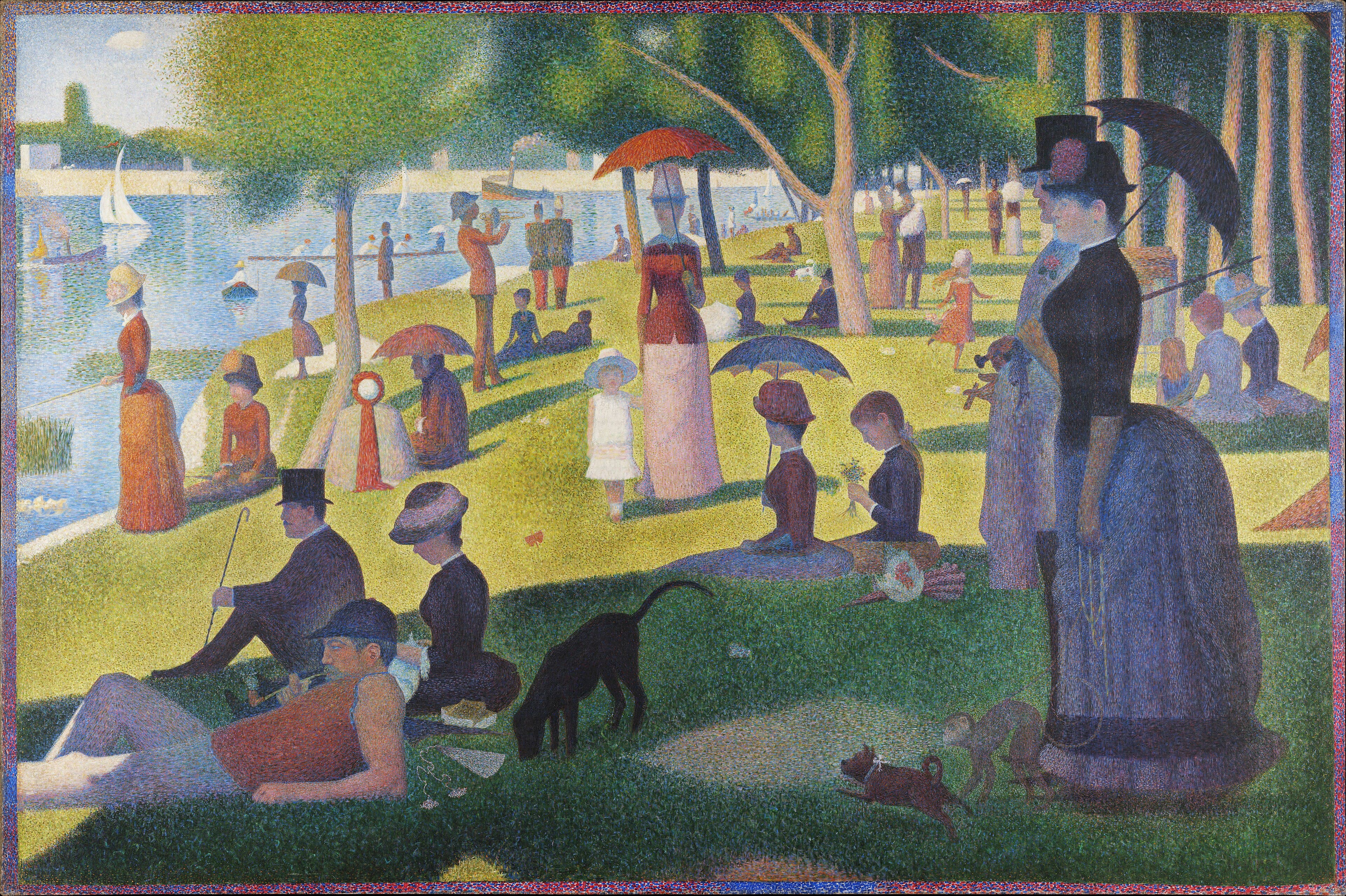
Most of the left side is filled by another painting: part of A Sunday on La Grande Jatte, the big park scene Georges Seurat had finished in 1886. The whole canvas is two metres high and two and a half metres wide, and the women are life-size.
An answer to the critics
Georges Seurat painted in small separate touches of pure colour, which the viewer's eye mixes from a distance. When he showed the Grande Jatte in 1886, some critics said the method was too cold and too mechanical. The method might suit a landscape, they said, but never a noble subject like the nude.
Models was his reply, according to the Barnes Foundation. Georges Seurat called his most provocative pictures toiles de lutte, battle canvases. Here he painted three life-size nudes in the same dots, from the front, the side and the back.
Few critics changed their minds. One, quoted by the critic Sebastian Smee, saw only pathetic, rachitic skeletons smeared with all the colours of the rainbow. Camille Pissarro, who saw the picture while Georges Seurat was still working on it, admired it.
A painting inside the painting
Putting the Grande Jatte on the studio wall was a deliberate move. The Barnes Foundation says the quotation ties Models to the argument of 1886. The painting on the wall also lets us compare the two pictures: clothed figures and nude ones, a park and a room, a finished painting and the work of posing.
The painted park is copied down to small details. A girl in an orange-red dress runs across the grass, and a woman in a dark jacket and a purple skirt stands at its edge. The models' heads and shoulders overlap the painted figures, so the real room and the painted park run together.
Old poses, modern women
The Barnes Foundation points out how many famous pictures lie behind the three models. Three women together recall the Three Graces of ancient art and Raphael's painting of them. Georges Seurat keeps his three apart, quiet and turned inward, instead of dancing hand in hand.
The woman on the right recalls the Spinario, an ancient bronze of a boy pulling a thorn from his foot. The back view recalls a bathing woman by Jean-Auguste-Dominique Ingres that the Louvre acquired in 1879. The whole idea also echoes Édouard Manet's Luncheon on the Grass of 1863.
The clothes on the floor pull the old poses into the present. The hats, parasols and stockings were the fashions of 1880s Paris. The Barnes Foundation reads the scene as models perhaps auditioning for work, a quick business deal rather than a myth.
Made in Paris
By June 1886 Georges Seurat had a studio at 128 bis boulevard de Clichy, according to the local historian Odile Mercier. His family lived on the boulevard de Magenta, and he died there, at his mother's home, on 29 March 1891. Models belongs to the studio years in between.
He prepared the big canvas with small studies. Little oil sketches of the models on wooden panels are now at the Musée d'Orsay in Paris; the critic Félix Fénéon owned them until they were sold in Paris in 1947. The Metropolitan Museum of Art holds a Conté-crayon drawing for the picture.
Shown, sold and sent to Philadelphia
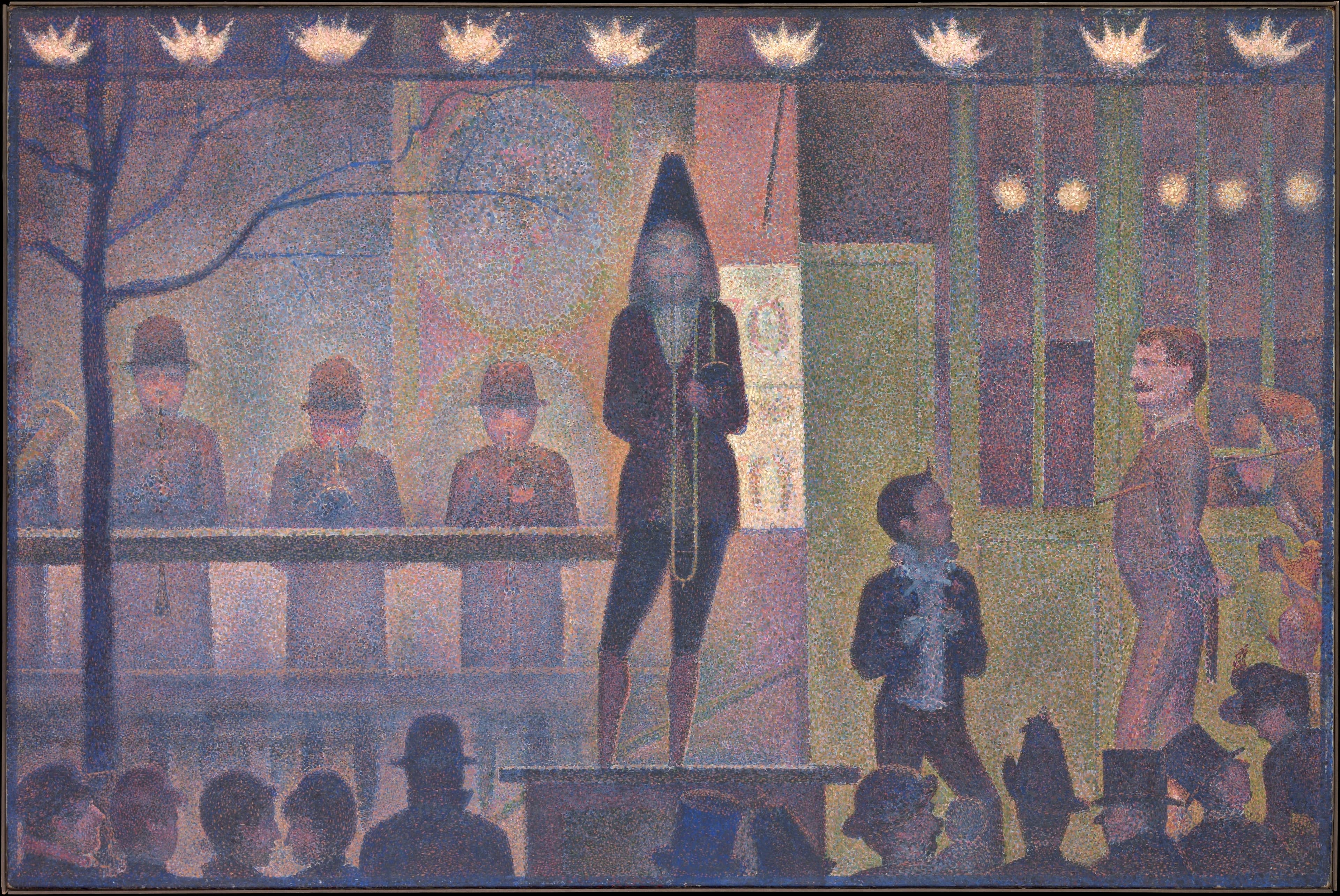
Georges Seurat first showed Models at the Salon des Indépendants in Paris in spring 1888, catalogue number 613. Circus Sideshow, his first night scene, hung in the same show. Models went to Brussels for the exhibition of the artists' group Les XX in 1889, and again in 1892, after his death.
The German collector Count Harry Kessler bought the painting from the Paris dealer Ambroise Vollard for 1,200 francs, according to Odile Mercier. Around 1900 Models hung in the dining room of Harry Kessler's flat in Berlin. The designer Henry van de Velde made the setting, and a photograph of it survives.
The painting was shown at the Lefevre Gallery in London in spring 1926. Albert Barnes wrote about it in the 1928 edition of his book The Art in Painting. The painting has stayed with the Barnes Foundation ever since, apart from a few loans, including a Paris show in 1933 and New York in 1949.
A smaller version
Georges Seurat also painted a much smaller version of the same scene, Les Poseuses, Ensemble, in 1888. The small canvas belonged to the Microsoft co-founder Paul Allen. At Christie's in New York on 9 November 2022 it sold for $149.2 million with fees, a record for Georges Seurat, The Art Newspaper reported.
Close reading
Reading the work, detail by detail
Up close, Models is a painting about painting. Three women pose in Georges Seurat's Paris studio, with his Grande Jatte on the wall behind them and their clothes heaped on the floor. Skin, straw hats and painted park are all built from the same small dots of colour.
1.The Grande Jatte hangs behind them
Most of the left side of the studio is filled by another painting. The painted park is Georges Seurat's own A Sunday on La Grande Jatte, finished in 1886. A tall woman in a dark jacket and a long purple skirt stands sideways to us. A thin rod crosses behind her, perhaps a cane or the stick of a parasol. Georges Seurat painted his earlier picture in the same dots as the studio around it.
2.A girl running across the grass
Deep inside the painted park, a small girl in an orange-red dress runs across the grass with her arms held out. Her head is a white blob, probably a bonnet. The girl is only a few dots high here, copied from the Grande Jatte. Next to the still models in the studio, she is one of the few things in the picture caught in motion.
3.A girl holding flowers
At the far left of the painted park, a girl in a dark dress sits on the grass with her head bowed. She holds a small bunch of flowers in front of her. Below her lies a pale round shape with orange in it. The shape could be a hat or a basket left on the grass; it is not clear.
4.The model who faces us
The middle model stands facing us and looks straight out. Her brown hair is pinned up, with a touch of orange at the top, maybe a ribbon or a comb. Her face gives nothing away. Behind her head, a strip of white light runs up between the Grande Jatte and the studio wall, perhaps from a window or an open door.
5.A spine made of dots
The model on the left sits with her back to us and a white cloth round her hips. Down the middle of her back runs a faint line of darker dots. The critic Sebastian Smee pointed to the small bumps of her backbone: even the spine is built from dots. The Barnes Foundation notes that Georges Seurat shows his models from the back, the front and the side.
6.The model seen from the side
The model on the right sits sideways, bent over her raised knee, with her head bowed. The Barnes Foundation compares her pose to the Spinario, a famous ancient bronze of a boy pulling a thorn from his foot. Here the young woman is doing something ordinary: putting on her stockings. The studio wall behind her is a haze of lilac, pink and pale blue dots.
7.A green stocking pulled over the knee
Both of her hands grip the top of a dark green stocking and pull it up over her knee. The stocking is the strongest colour on the right side of the picture. On the small wooden table beside her stand a tall white pot with a lid and a dark blue jug. They may be a coffee pot and a milk jug; nothing in the picture says so for certain.
8.Something green hung on the wall
A pale green garment hangs on the wall by two thin cords. The garment has a frilled hem, like a petticoat or a small dress, though it could also be a bag. Whatever it is, the garment probably belongs to one of the models, like the clothes piled on the floor. The same green comes back in the stocking below.
9.A straw hat with a red flower
A yellow straw hat with a red flower on its band sits on top of a heap of clothes. Under the hat lies a dark coat speckled with red. The curved handle of a cane or umbrella pokes up through the pile. The Barnes Foundation reads these fashionable clothes and accessories as the link between the old poses and modern Paris.
10.A red parasol laid on a coat
A closed red-orange parasol lies across a dark coat speckled with red. A long white strip hangs down the coat, maybe a feather boa or a strip of fur. Beside all this clutter, the standing model's bare foot rests on a white cloth. Georges Seurat builds the heap of cloth from the same small touches as the skin.
11.More clothes on the left
The bottom left corner holds another heap of clothes. A blue skirt has a white zigzag trim along its hem. A cane with a curved handle is tied with a green-blue bow, and a yellow parasol with blue dots lies on a red cushion or stool. The pink and orange shapes above the skirt could be gloves or hats; it is hard to say.
12.A little basket of pink flowers
On the pale step between two of the models sits a small basket with a handle. Pink flowers and green leaves fill the basket. The object might instead be a hat trimmed with flowers; the dots do not settle it. The little still life is easy to miss among the bare legs.
13.Bare feet on a white cloth
The standing model's bare feet rest on a white cloth dotted with small pink marks, perhaps flowers in the fabric. Her shoes are off. A pair of dark shoes with pale bows waits on the floor in front of her, ready for when she dresses again.
14.A shoe and a plate of oranges
In the bottom right corner, a black shoe with a red pompom lies on the floor. Just above the shoe is the right-hand model's foot, already in its green stocking. On the edge of the table sits a white plate of oranges. Georges Seurat fills the shadows with blue and purple dots rather than black.
15.Pictures on the studio wall
Four pictures with wide pale mounts hang on the studio wall. Their images are only blurred patches of colour. The pictures could be Georges Seurat's own drawings or small paintings, or something else entirely; nothing in the painting settles it. The wall around them shimmers with lilac, pink and yellow dots.
Timeline
June 1886
Georges Seurat gives a new studio address, 128 bis boulevard de Clichy in Paris.
1886–1888
Paints Models, with part of A Sunday on La Grande Jatte on the studio wall behind the three models.
1887
Paints small oil studies of the models on wood, later owned by Félix Fénéon and now at the Musée d'Orsay.
1888
Shows Models at the Salon des Indépendants in Paris, number 613, in the same show as Circus Sideshow. Paints a small version of the scene.
1889
Models is shown in Brussels at the exhibition of Les XX, number 1.
About 1900
Hangs in Count Harry Kessler's dining room in Berlin, in a setting designed by Henry van de Velde.
1926
Shown at the Lefevre Gallery in London.
1928
Albert Barnes writes about it in the second edition of The Art in Painting.
2022
The small version sells at Christie's in New York for $149.2 million with fees, a record for Georges Seurat.
Where to see it
Barnes Foundation
Philadelphia, United States
A public viewing address has not yet been confirmed for this holding.
Listed by the Barnes Foundation in the Main Room of the Collection Gallery, west wall, in September 2026. Check the Barnes Foundation's page before a visit.
Frequently asked questions
Who are the women in Models?
The Barnes Foundation does not name them. They are professional models, shown undressing, posing and dressing in Georges Seurat's studio. The Barnes Foundation suggests they may be auditioning for work.
What is the painting on the wall?
Part of Georges Seurat's own A Sunday on La Grande Jatte, which he finished in 1886 and which is now at the Art Institute of Chicago. Putting it in the picture tied Models to the argument about his dot technique.
Why did Georges Seurat paint Models?
Critics said his method of small dots of pure colour was too cold for the human body. The Barnes Foundation calls Models his answer: three life-size nudes painted in dots, from the front, the side and the back.
Is there more than one version?
Yes. Georges Seurat painted a much smaller version in 1888, which sold at Christie's in New York in November 2022 for $149.2 million with fees. The Musée d'Orsay holds small oil studies of the models.
Where can I see it?
At the Barnes Foundation in Philadelphia, reference BF811. In September 2026 the Barnes Foundation listed it in the Main Room of the Collection Gallery, on the west wall. Check the Barnes Foundation's page before a visit.
More by Georges Seurat
If you like Georges Seurat
Explore painters from the same movements and circles.
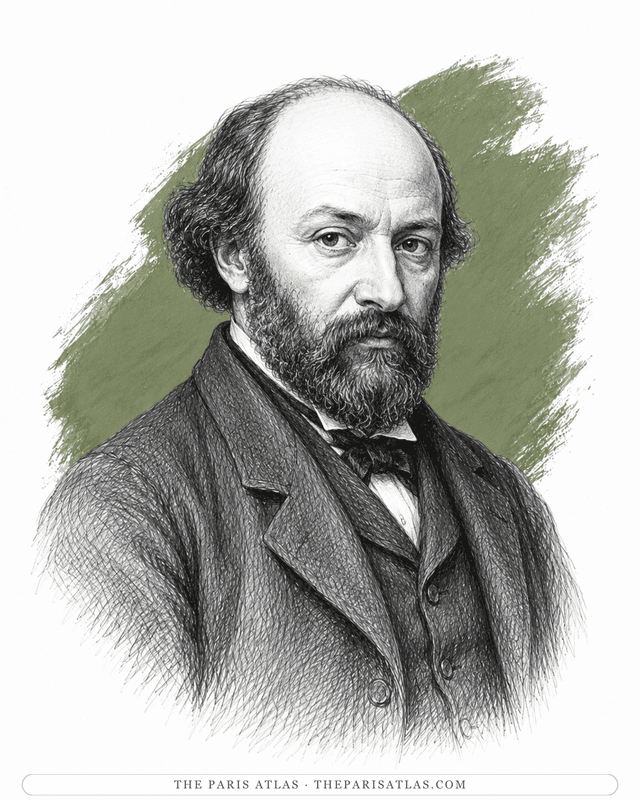
Paul Cézanne
Painter between Impressionism and everything after — shown in the independents' exhibitions, emulated by the Cubists, and present at the Orangerie through 15 works in the Walter-Guillaume collection.
View artist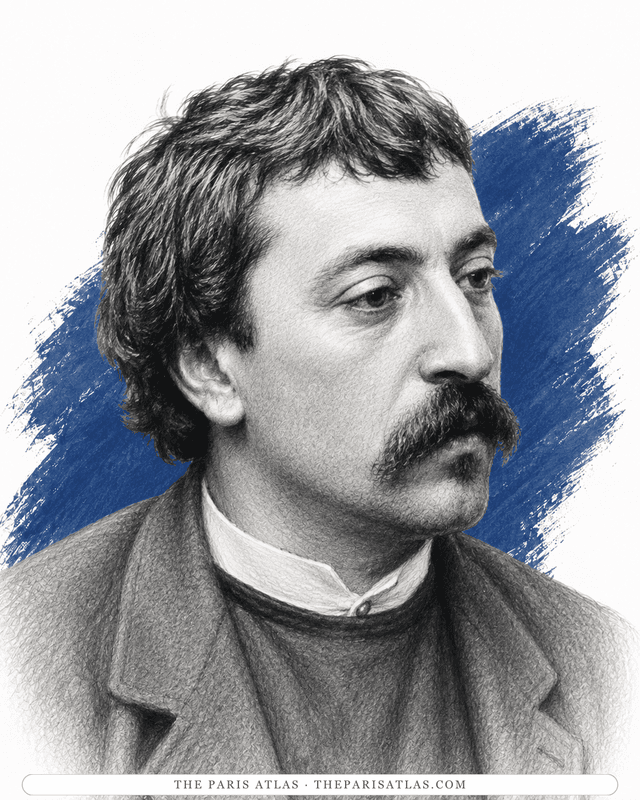
Paul Gauguin
Stockbroker turned painter who came into art through Camille Pissarro, showed with the Impressionists, and left Europe for Polynesia.
View artist
Camille Pissarro
The eldest of the Impressionists and the only painter to show in all eight of the group's exhibitions, 1874 to 1886.
View artist
References
The sources below include collection records, catalogues, scholarly research, and primary materials that informed this page. They document Models (Poseuses), its making, and its place in cultural history.


1Georges Seurat, Models (Poseuses), 1886–1888 (BF811)
WebsiteBarnes FoundationUsed forThe holding museum's record: date, medium, size, location, the studio setting and the Grande Jatte, the answer to the critics, the battle canvases, the three views, the sources in older art, the exhibitions and the 1928 book, and the image the close-reading views were cropped from.

2Proving his point: This Seurat masterpiece was the artist's heavily plotted retort to his critics
PeriodicalThe Washington Post, 2022Used forSebastian Smee on the critic's rachitic skeletons, Camille Pissarro's admiration while the picture was in progress, and the spine painted in dots.
3Georges Seurat, Poseuse de profil, 1887 (RF 1947 14)
WebsiteMusée d'OrsayUsed forOne of the small oil studies on wood for the models, from Félix Fénéon's collection, bought at the second sale of Félix Fénéon's collection in Paris on 30 May 1947.
4Georges Seurat, Study for "Poseuses", 1886–87 (1975.1.704)
WebsiteThe Metropolitan Museum of ArtUsed forThe Conté-crayon study for the picture, 1886–87, in the Robert Lehman Collection.
5Le peintre Georges Seurat et le 10e
WebsiteHistoire & Vies du 10e, 2016Used forOdile Mercier, citing the 1991 Seurat catalogue, on the studio at 128 bis boulevard de Clichy from June 1886, the family home on the boulevard de Magenta, Georges Seurat's death there, and Harry Kessler's purchase from Ambroise Vollard.

6Journal: Regards sur l'art et les artistes contemporains, 1889–1937 — table des illustrations
NonfictionÉditions de la Maison des sciences de l'homme, 2017Used forThe photograph of the dining room of Harry Kessler's Berlin flat, about 1900, with Henry van de Velde's setting for Les Poseuses.
7Microsoft co-founder Paul Allen's collection brings record-smashing $1.5bn at Christie's evening sale in New York
PeriodicalThe Art Newspaper, 2022Used forThe sale of the small version from Paul Allen's collection at Christie's in New York: $130 million hammer, $149.2 million with fees, a record for Georges Seurat.
8Circus Sideshow (Parade de cirque) — Georges Seurat
WebsiteThe Metropolitan Museum of ArtUsed forCircus Sideshow, shown in the same 1888 Salon des Indépendants as Models.
These references provide the documented foundation for this work's history and interpretation. Claim-level citations remain attached to the specific claims they support.
 Explore more resources