Vincent van Gogh painted The Starry Night while living at Saint-Paul-de-Mausole in southern France. Its bright stars, dark cypress, and small village combine observed features with changes made in the studio.
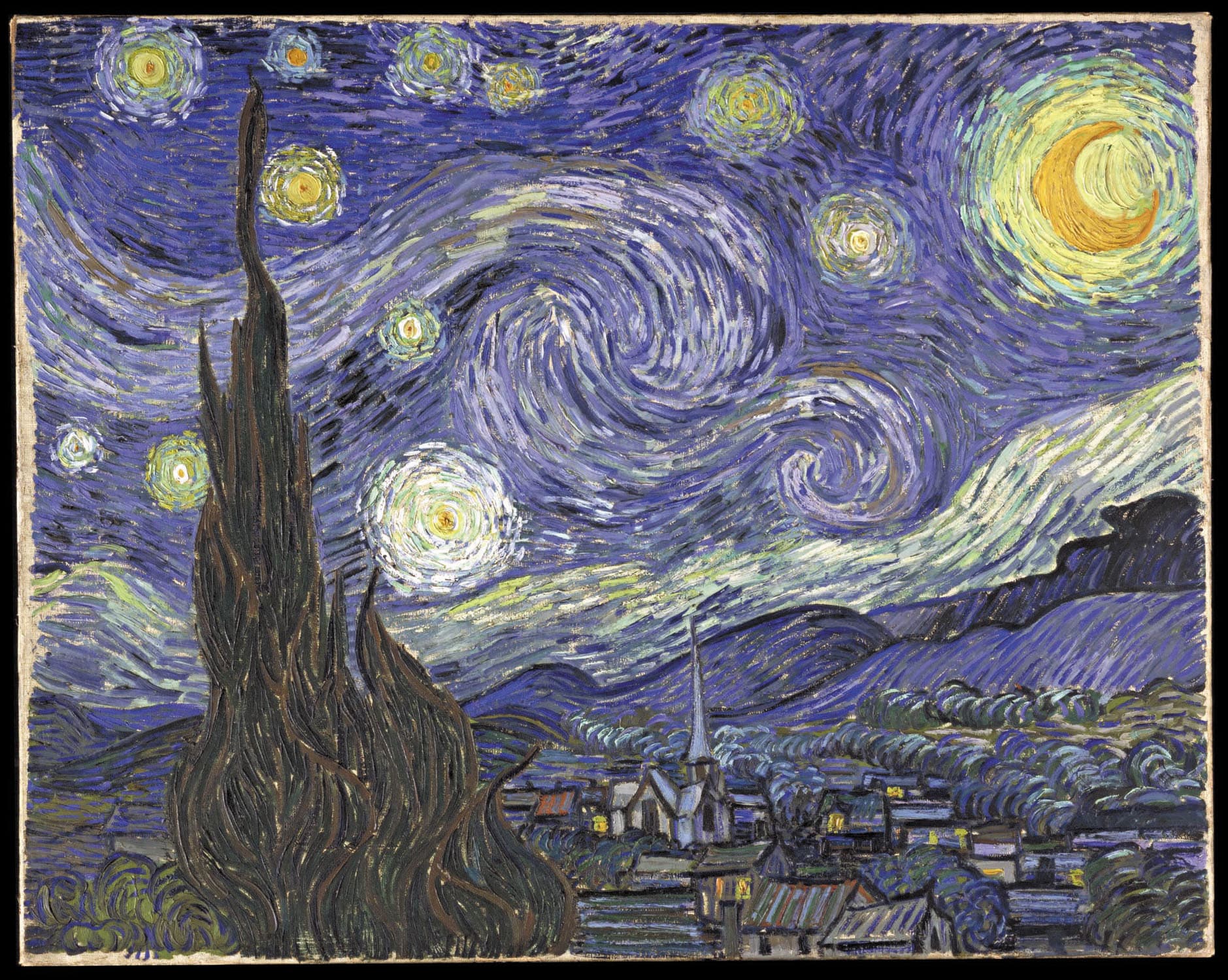
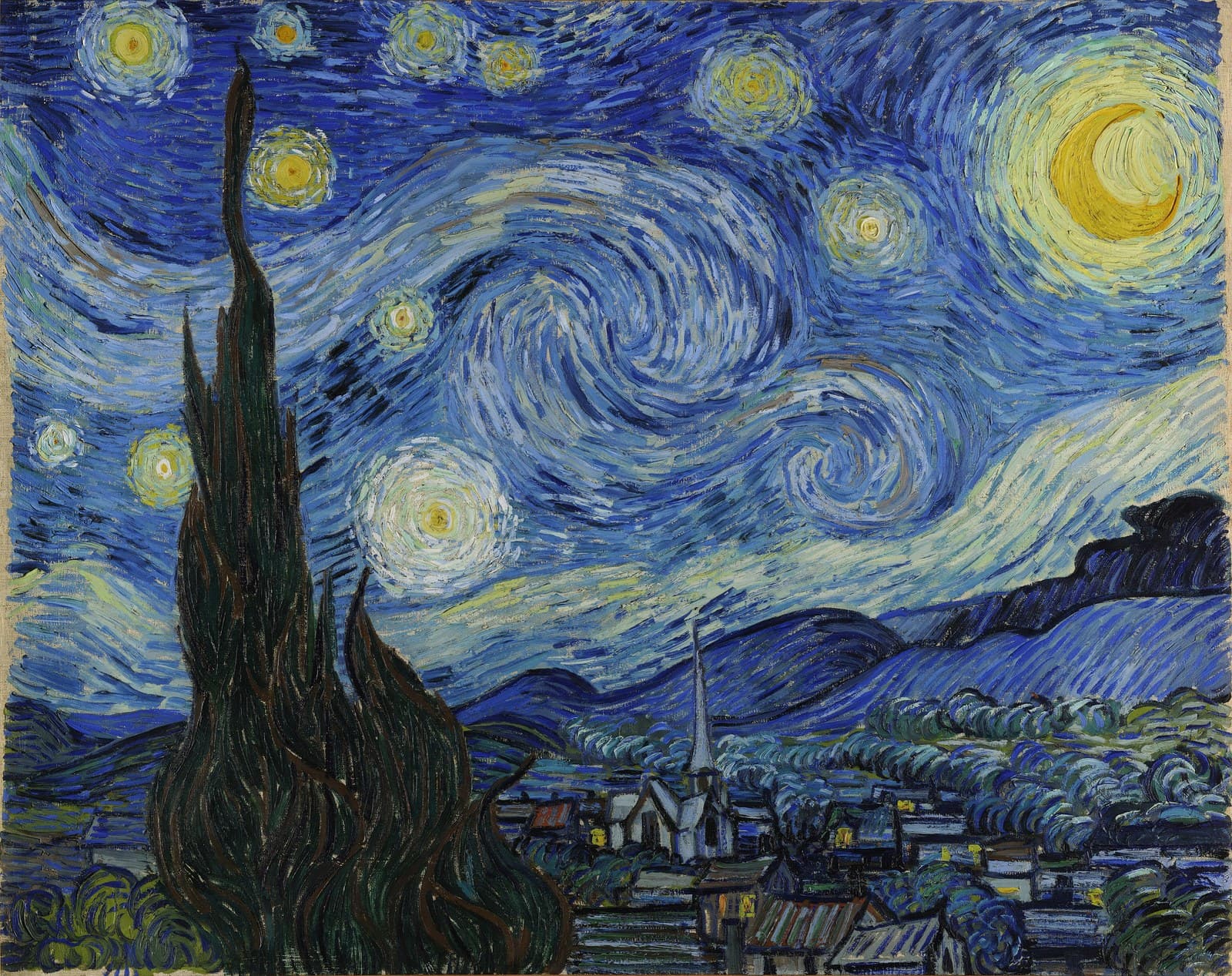
The blue area above the village occupies most of Vincent van Gogh's canvas. Rings of yellow and white surround the stars, while long blue strokes curve through the space between them. The village sits low in the picture, with tightly packed roofs and a narrow church steeple.
Look at the difference between the two kinds of marks. Short, straight lines describe the buildings. Sweeping curves fill the blue area above the village and continue along the hills. The dark cypress rises through almost the full height of the painting.
Several windows are lit, but people are too small or too far away to be visible. The enormous lights overhead draw more attention than the signs of life below.
A view rebuilt in the studio
Van Gogh made the painting in June 1889, during his stay at the psychiatric hospital of Saint-Paul-de-Mausole near Saint-Rémy-de-Provence. According to MoMA, he worked on the canvas during the day over several sessions.
The view from Van Gogh's room helped supply the subject of The Starry Night, but he altered it. MoMA says he combined several village views, used a Dutch-looking church steeple, and brought the cypress closer.
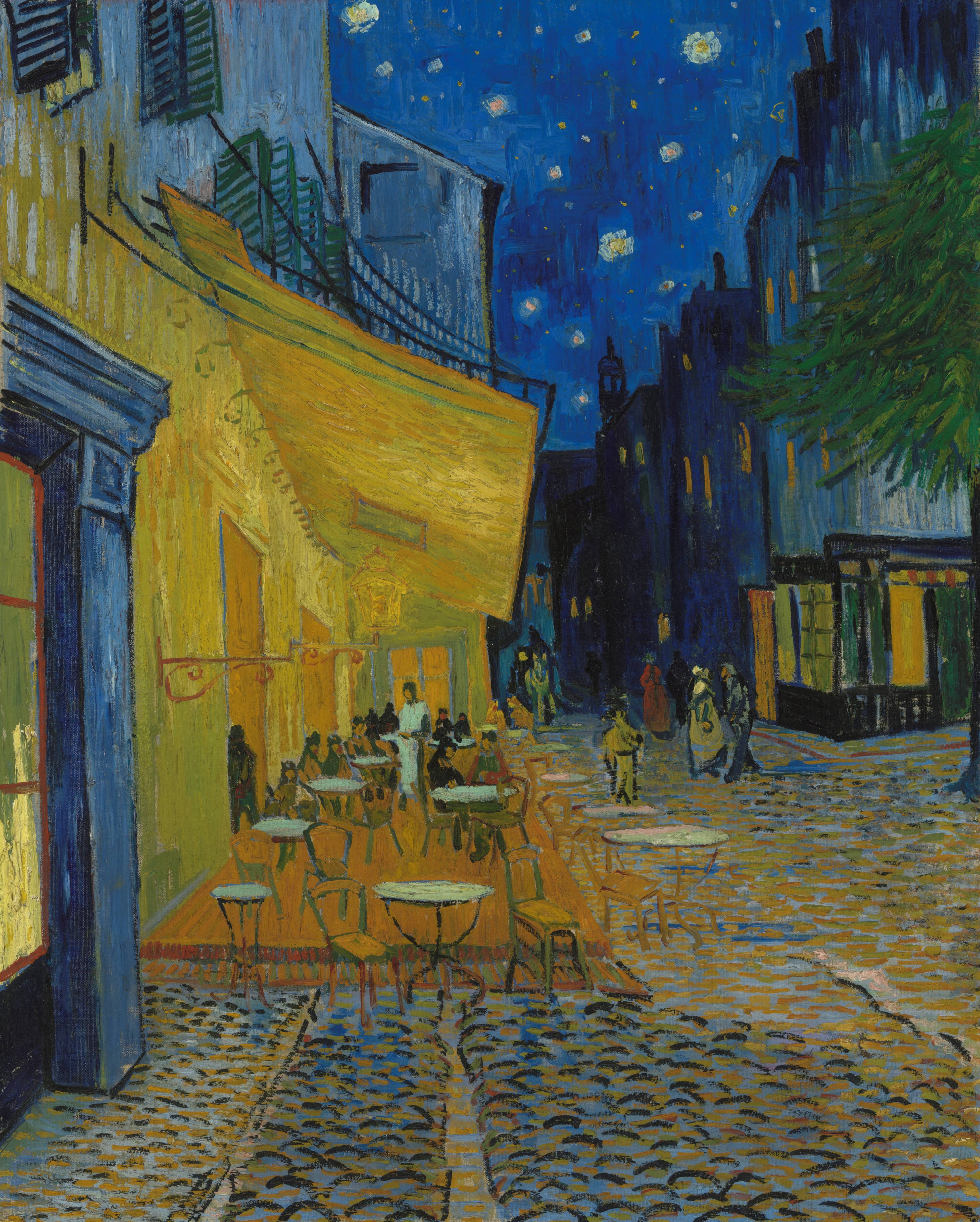
Compare two ways of painting night
Café Terrace at Night, painted in Arles in 1888, builds its light around a street lamp. In The Starry Night of 1889, the strongest light comes from the stars and moon, and the steep street gives way to a broad band of hills.
The circular marks can suggest motion, but they do not establish a medical explanation for the painting. The visible choices of scale, placement, and brush direction provide firmer ground for understanding how the composition works.
What Van Gogh's letters reveal
Van Gogh's correspondence gives unusually direct evidence about the painting's origins. In a letter written around the beginning of June 1889, he described looking at the countryside before sunrise and seeing an exceptionally large morning star. The observation connects the invented sky with his attention to what was actually outside the asylum.[1]
Around 18 June he told his brother Theo that he had made a new study of a starry sky. He set it among questions about expressive drawing and colour, including his admiration for Eugène Delacroix. The letter shows an artist weighing what painting could do, not a man recording an uncontrolled episode.[2]
His own judgement was not settled. Writing to Émile Bernard in November, he criticised his tendency to make the stars too large. The editors of his correspondence identify that passage as probably referring to The Starry Night, and note that he had defended the painting in earlier letters. A picture now treated as an unquestioned masterpiece stayed an open experiment for the man who made it.[3]
The painting has drawn readings about anxiety, spiritual longing, consolation, and where humanity stands in the universe. Those can illuminate its effects, but none of them is an explanation Van Gogh supplied. Reducing the picture to a symptom of illness is the least useful of them. His letters describe work as something that occupied and steadied him. The illness was part of the circumstances he painted in; it does not account for the decisions on the canvas.
The painting in New York
The painting belongs to the Museum of Modern Art in New York. MoMA acquired it in 1941 through the Lillie P. Bliss Bequest, by exchange. Consult the museum's object record for current display information.
Close reading
Reading the work, detail by detail
Follow the different kinds of marks in the sky, tree, hills, and village. Their direction helps separate parts of the landscape even when the colors are similar.
1.The cypress crosses the horizon
Long dark strokes follow the branches upward. The tree overlaps both the village and the sky, making its position in the foreground clear.
2.A broad curve fills the middle of the sky
Several rows of short strokes follow one large bend. The bright curve remains visible against the darker blue even where no star marks its path.
3.The crescent has a wide halo
The crescent occupies a much larger painted area than its thin outline alone. Surrounding yellow-green strokes increase the size of its glow.
4.A pale light beside the tree
The pale rings stand out against the dark branches nearby. Unlike a tiny white dot, the repeated circles give the light weight and texture.
5.Straight lines describe the roofs
The village relies on angles, rectangles, and short straight strokes. Its compact buildings provide a visible contrast to the broad curves above.
6.The hills repeat the sky's direction
Curved bands run along the slopes. Their lower, horizontal position helps distinguish the hills from the sky's much larger loops.
Timeline
June 1889
Van Gogh painted The Starry Night at Saint-Rémy-de-Provence in June 1889.
1941
In 1941, the Museum of Modern Art acquired The Starry Night through the Lillie P. Bliss Bequest, by exchange.
Where to see it
Museum of Modern Art, New York
11 West 53 Street, New York, NY 10019, United States
Displays and loans can change. Check whether this work is on view before making a special trip.
Vincent van Gogh painted The Starry Night at the asylum of Saint-Paul-de-Mausole in June 1889. The village was assembled from other observations and the celestial forms enlarged, so the picture is not the view from his window but a landscape rebuilt around line, colour and rhythm.
— Vincent van Gogh, The Starry Night — collection record
Explore painters from the same movements and circles.
Tarsila do Amaral
Brazilian painter who spent the 1920s moving between São Paulo and Paris, studied Cubism under André Lhote, Albert Gleizes and Fernand Léger, and used what she learned to paint Brazilian towns, railways, plants and bodies. Her 1928 painting Abaporu prompted the manifesto that gave the Anthropophagic movement its name.
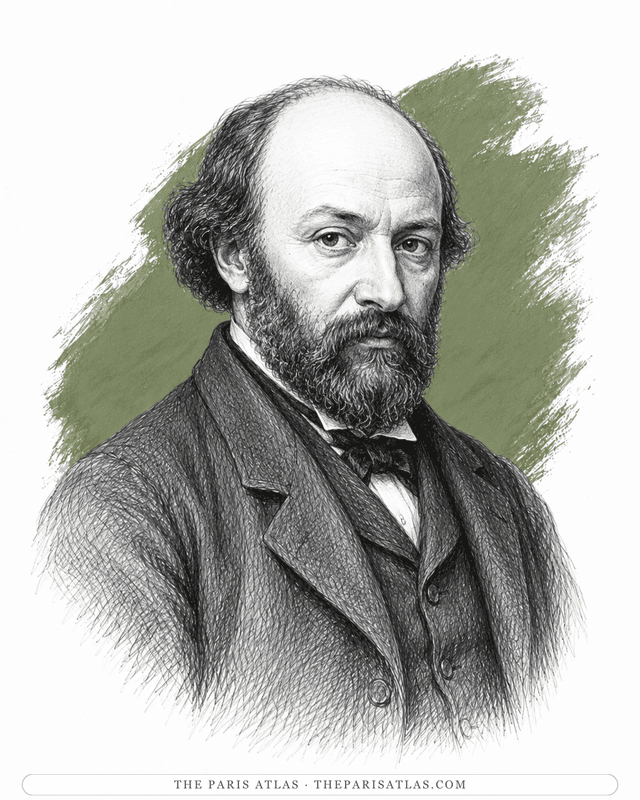
Painter between Impressionism and everything after — shown in the independents' exhibitions, emulated by the Cubists, and present at the Orangerie through 15 works in the Walter-Guillaume collection.
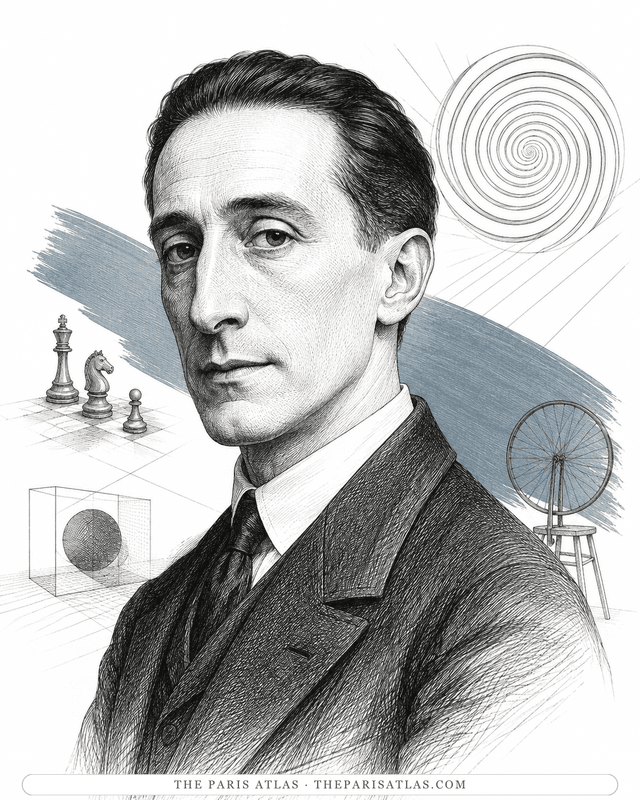
The century's quietest revolutionary — readymades, the abandonment of painting, chess on a Paris rooftop in Entr'acte, and one anemic film of spinning puns signed Rrose Sélavy.
The sources below include collection records, catalogues, scholarly research, and primary materials that informed this page. They document The Starry Night, its making, and its place in cultural history.
1↑Letter 777, to Theo van Gogh, Saint-Rémy-de-Provence, between about 31 May and about 6 June 1889
Letters
Vincent van Gogh: The Letters, Van Gogh Museum
Used for
Van Gogh describes an exceptionally large morning star over the countryside before sunrise, around the beginning of June 1889.
3↑Letter 822, to Émile Bernard, Saint-Rémy-de-Provence, November 1889
Letters
Vincent van Gogh: The Letters, Van Gogh Museum
Used for
Writing to Émile Bernard in November 1889 he criticises his own tendency to make the stars too large; the editors identify the passage as probably referring to this painting.
These references provide the documented foundation for this work's history and interpretation. Claim-level citations remain attached to the specific claims they support.

 View source
 View source