The Paris AtlasCharting the artists, works, and places worth returning to.

Art & design movement · Paris · circa 1910–1939

Art Deco

Geometry, luxury and the machine age — the style that gave modern life a look, from a Paris exhibition to Mumbai, Miami Beach and Napier.

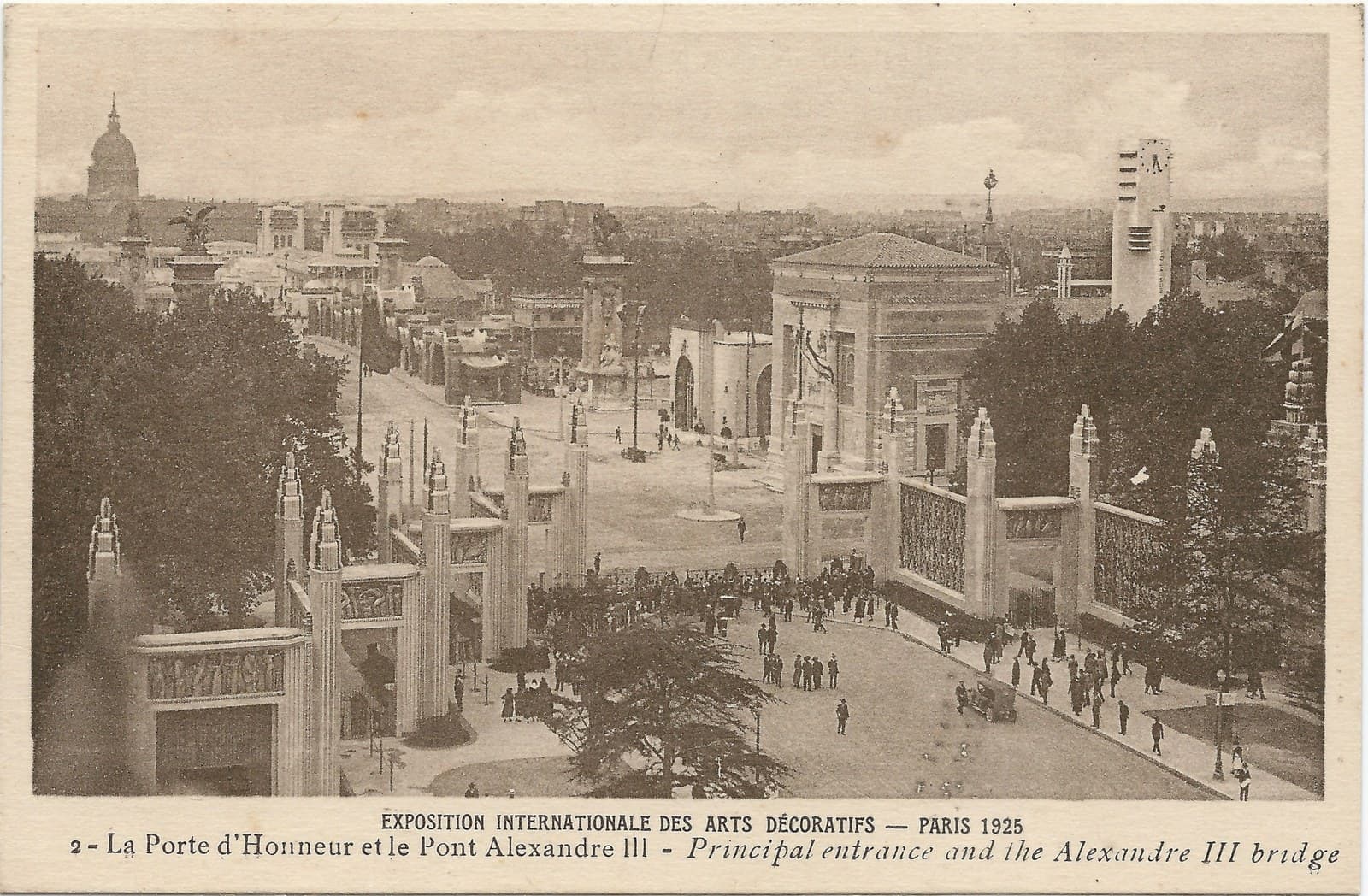
Aerial view of the 1925 Paris decorative arts exhibition: tall square pylons flanking the Porte d'Honneur entrance, crowds on the paths below, pavilions and a clock tower spreading toward the Invalides dome
Archival photographThe Porte d'Honneur and the Pont Alexandre III at the Exposition internationale des arts décoratifs et industriels modernes, Paris, 1925 — the exhibition the style is named after.

What Is Art Deco?

Art Deco is an international style of architecture, decorative arts, and design that developed before the First World War and flourished during the 1920s and 1930s. It combined bold geometry, stylized ornament, rich materials, and an enthusiasm for modern technology, shaping everything from skyscrapers and ocean liners to furniture, glass, ceramics, jewelry, fashion, posters, and radios. A skyscraper, a perfume bottle, a cinema, and a tea service could all express its distinctive approach to modern life. Although closely associated with luxury and the glamour of the Jazz Age, Art Deco also entered ordinary homes through affordable ceramics and manufactured household goods.

Art Deco is commonly called an art movement, but it was not a single organization with a founder, manifesto, or agreed artistic program. It is better understood as a family of related approaches to modern design. Its practitioners combined influences from historical craftsmanship, contemporary painting, ancient civilizations, and industrial technology. A hand-finished cabinet and a machine-made object could both belong to this world: what connected them was not necessarily their method of production, but a determination to give modern life a distinctive visual character.

Where the Name Comes From

The name derives from arts décoratifs, French for “decorative arts,” and particularly from the Exposition internationale des arts décoratifs et industriels modernes, the major international exhibition held in Paris in 1925. The exhibition became the event most closely associated with the style, although many of its defining characteristics had developed earlier.

“Art Deco” became widely established as a historical label during the revival of interest in interwar design in the 1960s. The Paris exhibition Les Années 25, held at the Musée des Arts Décoratifs in 1966, helped reexamine the period, while Bevis Hillier's book Art Deco of the 20s and 30s, published in 1968, helped popularize the terminology. During its original period, terms such as style moderne were more familiar. This retrospective naming helps explain why objects now grouped together as Art Deco were not necessarily understood by their makers as belonging to one unified movement.

Origins: Paris Before the First World War

Art Deco emerged partly from efforts to renew French decorative arts. Designers and manufacturers were concerned about competition from Austria and Germany and wanted to reaffirm France's position in the luxury trades. The challenge was to produce work that appeared unmistakably contemporary without abandoning the craftsmanship that had sustained the country's reputation in furniture, textiles, and other decorative arts.

Its artistic sources were varied. Cubism offered fragmented planes and geometric simplification, while other avant-garde movements encouraged experiments with color, abstraction, and the imagery of machines. Art Nouveau also remained important: its flowers and plants did not disappear but were often reorganized into more compact, stylized patterns. The geometric work of designers such as Josef Hoffmann and Charles Rennie Mackintosh helped connect earlier decorative experiments with the emerging style.

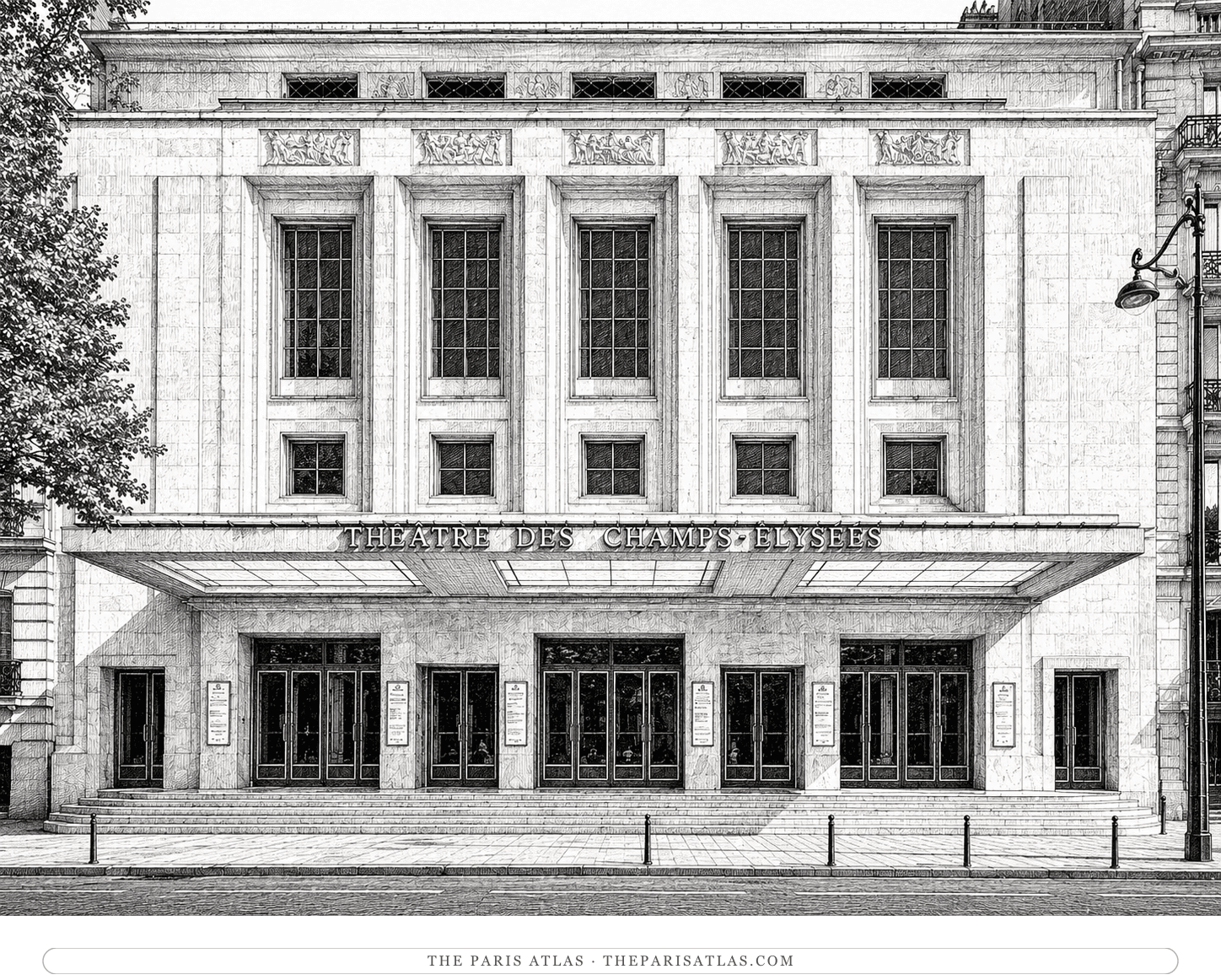
Architecture in Paris also demonstrates why Art Deco cannot be dated simply from 1925. The Théâtre des Champs-Élysées, completed in 1913, brought together reinforced-concrete construction, restrained architectural forms, and an ambitious decorative program. Auguste and Gustave Perret built it following an initial scheme by Henry van de Velde. Their architecture, Antoine Bourdelle's sculptural reliefs and Maurice Denis's painted dome made the building an important early expression of the combination of structural modernity and integrated ornament associated with Art Deco. Its existence more than a decade before the great exhibition illustrates the style's gradual formation.

Ancient Egypt and the Discovery of Tutankhamun's Tomb

One of Art Deco's apparent contradictions is that a style associated with the future drew enthusiastically on the ancient past. Designers borrowed from Egyptian, African, Asian, and Mesoamerican art, adapting motifs to contemporary clothing, interiors, and objects. The discovery of Tutankhamun's tomb by Howard Carter in November 1922 intensified the fashion for Egyptian imagery. Scarabs, hieroglyphic forms, pyramids, and other Egyptian references appeared on objects ranging from evening wear to cinema façades.

This was not an attempt to reconstruct ancient Egyptian life. Historical imagery was transformed into a fashionable decorative language. A modern evening jacket could evoke an archaeological discovery while remaining entirely a product of the 1920s, demonstrating how Art Deco made the remote past seem newly desirable. The V&A's Egyptian-inspired, hand-beaded jacket of 1923 provides a particularly clear example.

The Defining Characteristics of Art Deco

Geometry, Rhythm, and Stylized Ornament

Art Deco frequently uses chevrons, zigzags, sunbursts, fans, stepped outlines, repeated bands, and strong geometric divisions. Symmetry is common, especially in façades, entrances, and decorative compositions. Ornament may be concentrated around a doorway or arranged to emphasize the height of a building. Flowers, leaves, animals, and nautical imagery remain important, but they are often simplified into rhythmic patterns rather than rendered naturalistically.

These features work together rather than functioning as an inflexible checklist. A sunburst alone does not explain an entire building, and Art Deco need not contain every familiar motif. Its identity often lies in the coordination of shape, surface, proportion, and decoration. The geometric patterns and interlocking veneers of Ruhlmann's furniture, for example, produce a different effect from architectural ornament while sharing the broader interest in carefully controlled visual relationships.

Materials and Surface Effects

Art Deco ranged from expensive, labor-intensive objects to designs made with modern industrial materials. Chrome-plated steel, aluminum, mirrors, colored glass, and early plastics helped create bright, reflective interiors and streamlined household objects. Materials were chosen not only for utility but also for their visual effects: a polished surface, sharply defined edge, or contrasting texture could make an object appear sophisticated and contemporary.

Nor was Art Deco restricted to black and gold. Clarice Cliff's pottery, with its vivid blues, yellows, oranges, and greens, demonstrates how colorful and playful the style could be. Boldly painted everyday ceramics belong to its history just as much as monochrome interiors and precious-metal ornament.

The 1925 Paris Exhibition

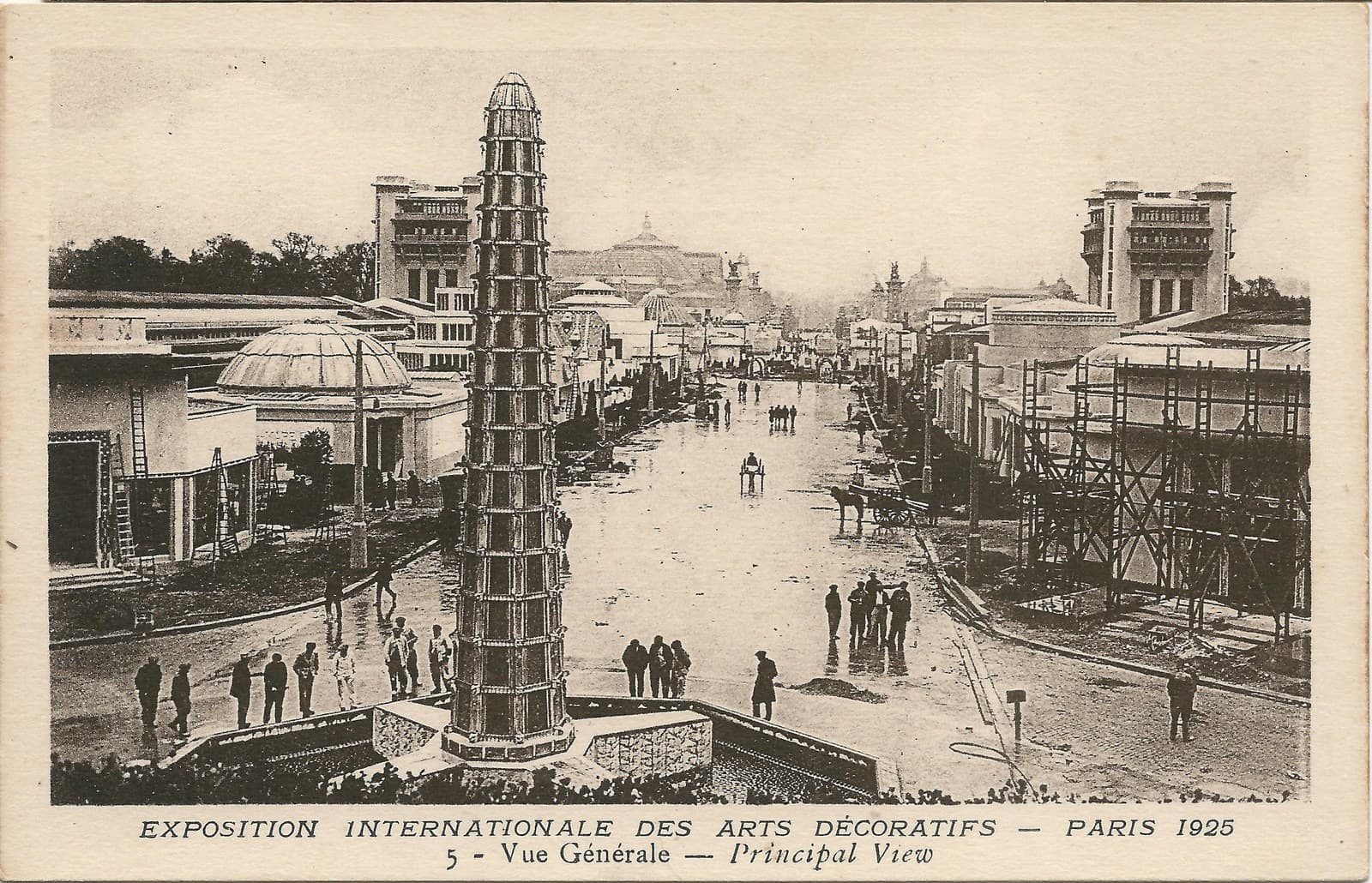
General view along the main avenue of the 1925 Paris exhibition, a tall tiered tower in the foreground, domed and stepped pavilions on either side, workmen and scaffolding still in place along the wet path
Archival photographThe exhibition's main avenue in 1925, one of the four wine towers in the foreground and pavilions still being finished on either side.

The 1925 Paris exhibition was Art Deco's great international showcase, not its point of invention. Originally planned for 1915 and delayed by the First World War, it attracted approximately sixteen million visitors over seven months. Its rules demanded modern work rather than copies of historical styles, although many exhibitors continued to draw on older traditions. This tension—between the demand for novelty and the authority of the past—was central to the exhibition's character.

Ruhlmann's House for an Imaginary Collector

Among its celebrated displays was Ruhlmann's Hôtel du Collectionneur, conceived as the residence of a wealthy, discerning collector. Despite its name, it was not a hotel for paying guests. This was not simply a showroom of unrelated furniture. It presented an entire coordinated environment in which rooms, furnishings, carpets, lighting, and works of art contributed to a carefully composed whole. The visitor encountered not just individual objects but a complete proposal for cultivated modern living.

Ruhlmann's achievement rested on the coexistence of innovation and tradition. His furniture drew on the refinement of eighteenth-century French cabinetmaking while using altered proportions, elegant tapering supports, and striking arrangements of materials. Modernity did not require him to reject luxury craftsmanship; it offered an opportunity to renew it. His work became a defining expression of the exhibition's high-end decorative ambitions.

The Pavilion Hidden Behind a Fence

A contrasting vision appeared in the Pavillon de l'Esprit Nouveau, designed by Le Corbusier and Pierre Jeanneret. Rather than presenting a unique luxury residence, it explored standardized housing, industrial production, and equipment suitable for repeatable manufacture. Its design even accommodated an existing tree, which passed through an opening in the roof.

According to the Fondation Le Corbusier, exhibition organizers erected a fence that partly concealed the pavilion. Le Corbusier appealed to the Ministry of Fine Arts, and its removal was ordered. The incident reveals that the exhibition did not represent a single agreed definition of modern design. Expensive craftsmanship and standardized production offered competing answers to the same question: what should the modern home become?

Furniture and the Art of the Complete Interior

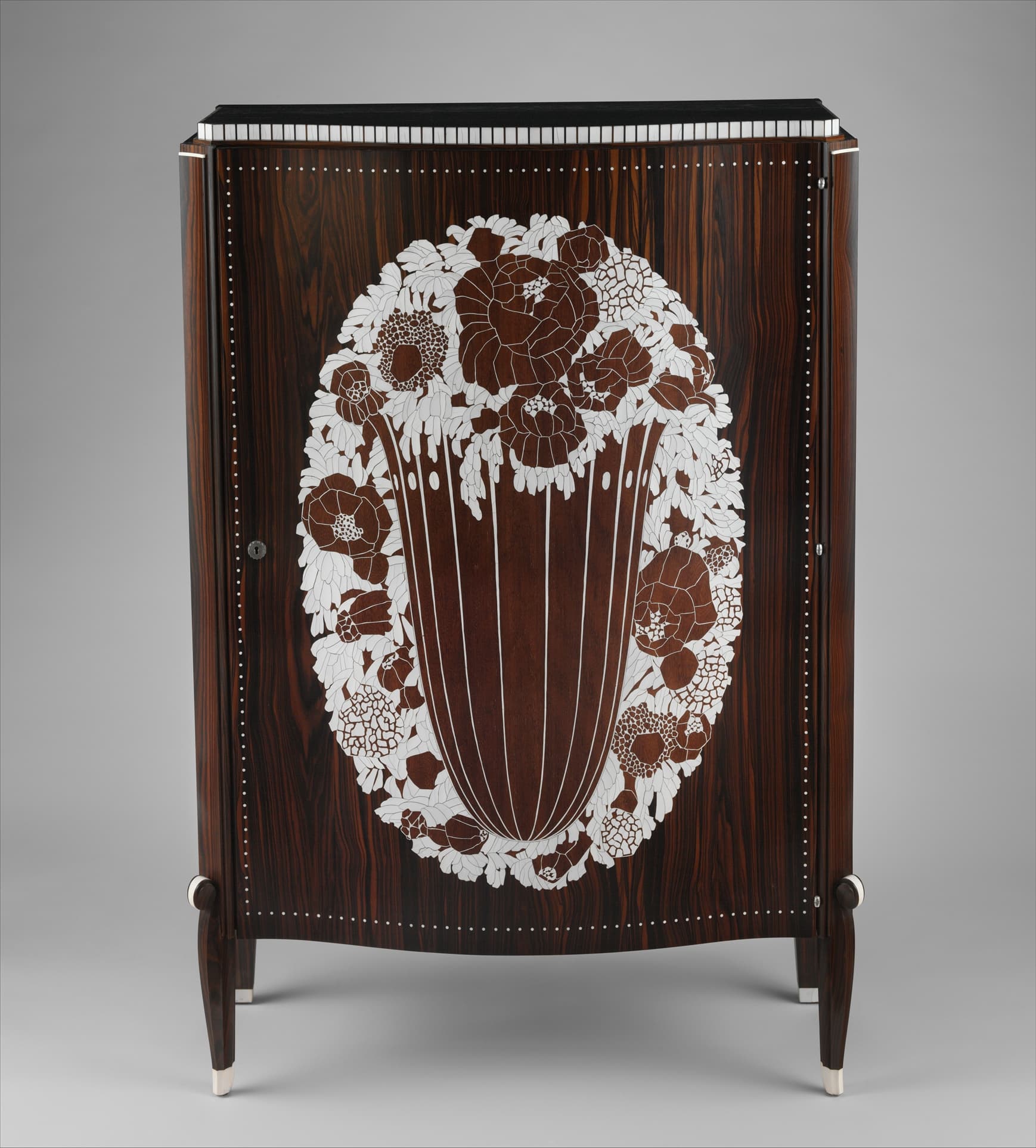
Ruhlmann was an ensemblier: a designer who conceived an interior as an integrated whole rather than merely selecting attractive objects for a room. Furniture, textiles, fittings, and architectural details could be designed or commissioned together so that nothing disrupted the intended effect. His État cabinet, designed in 1922 and represented at the Metropolitan Museum by an example manufactured in 1925–26, illustrates this precision through its elaborate arrangement of wood and ivory veneers. The cabinet's decoration is inseparable from its shape and proportions.

Jean Dunand, Japanese Lacquer, and a Courtyard of Chickens

The work of Jean Dunand reveals how much labor could lie behind an apparently effortless Art Deco surface. In 1912, Dunand began studying Asian lacquer techniques with the Japanese craftsman Seizo Sugawara, exchanging knowledge of metalworking for instruction. His notebooks recorded thirteen lessons. The collaboration makes clear that European lacquer design depended on the direct transmission of expertise, not merely on distant admiration for Asian objects.

Dunand became known for lacquered screens, panels, and objects incorporating materials such as gold, mother-of-pearl, and eggshell. Small pieces of eggshell could be embedded in lacquer to create pale, textured patterns. A conservation study records that his demand for eggs became so considerable that he kept a chicken coop in the courtyard of his workshop. Behind the glossy sophistication of a fashionable Parisian interior stood patient handwork, specialized knowledge, and a surprisingly practical supply arrangement.

Jean Dunand, Séraphin Soudbinine, and a Screen Called Very Loud

The screen Fortissimo of 1925–1926 was a collaboration between Séraphin Soudbinine and Jean Dunand. Soudbinine designed the composition and carved its figures, while Dunand executed the elaborate lacquer work. Made for Solomon R. Guggenheim's music room, it combined lacquer, eggshell, mother-of-pearl, and gold. Its title, a musical instruction meaning “very loud,” linked its dramatic appearance to the room's purpose.

The screen is also a reminder that celebrated Art Deco objects were often collaborative achievements. A famous designer's name can conceal the specialized work required to construct, carve, finish, and decorate an object. Here, the partnership itself is central to understanding the result.

Eileen Gray and the Boundaries of Art Deco

Eileen Gray also worked with Sugawara and developed a distinguished practice in lacquer and furniture before turning increasingly toward architecture. Her work complicates any rigid separation between Art Deco and modernism. The Pirogue chaise longue, dated 1919–22 and credited by the Virginia Museum of Fine Arts to Gray and Sugawara, belongs to a world of elaborate lacquer craftsmanship. Her later furniture and architectural investigations pursued different relationships between objects, space, and use. An individual designer's career could cross the boundaries that later histories imposed.

Glass, Ceramics, and Affordable Modern Design

René Lalique: Luxury Through Repetition

René Lalique moved from celebrated Art Nouveau jewelry into glass production and became a major figure in Art Deco design. His objects exploited contrasts between clear and frosted surfaces, molded relief, color, and the effects of light. Plants, animals, and human figures remained central to his imagery, but they were reorganized into designs suited to glassmaking processes. His output extended beyond vases to architectural panels and decorative fittings, including glasswork for the Côte d'Azur Pullman Express in 1928 and mascots mounted on the bonnets of cars, an object that brought decorative beauty and modern machinery together in one place.

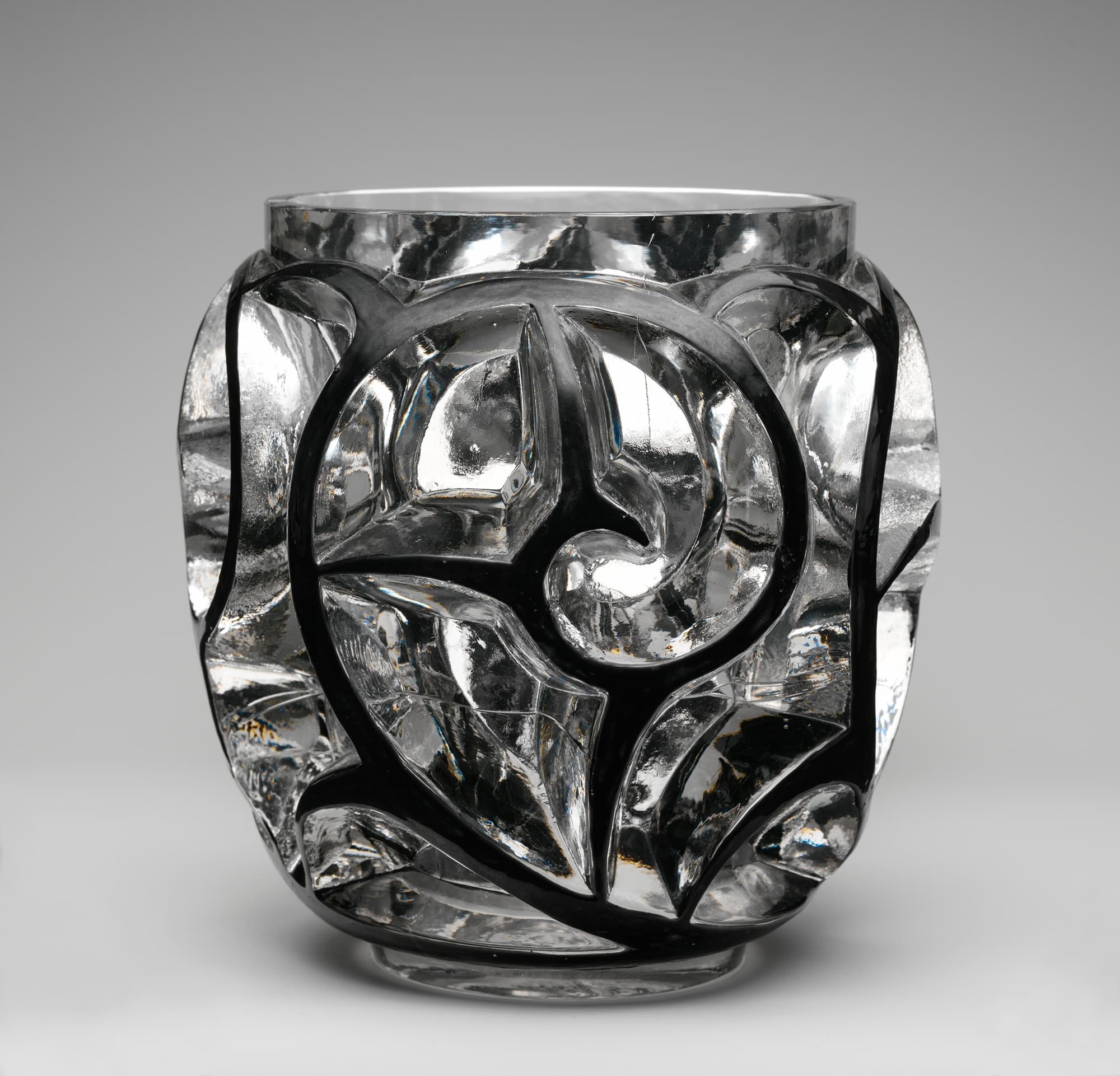
Lalique's Tourbillons, or Whirlwinds, vase of 1926 demonstrates the relationship between industrial repetition and the appearance of luxury. It was produced in quantity, yet its deeply modeled surface and elaborate finish could suggest an individually crafted object. Different color treatments altered its character, including a version in which black enamel emphasized the edges of clear glass. Quantity and sophistication were not necessarily opposites.

Clarice Cliff and the Modern Kitchen

In Britain, Clarice Cliff brought modern decoration to a much broader audience. Her Bizarre wares combined strong color with geometric patterns, while floral designs such as Crocus, introduced in 1928, remained highly stylized. Teams of women painters helped produce these designs, joining organized manufacture with visible hand decoration.

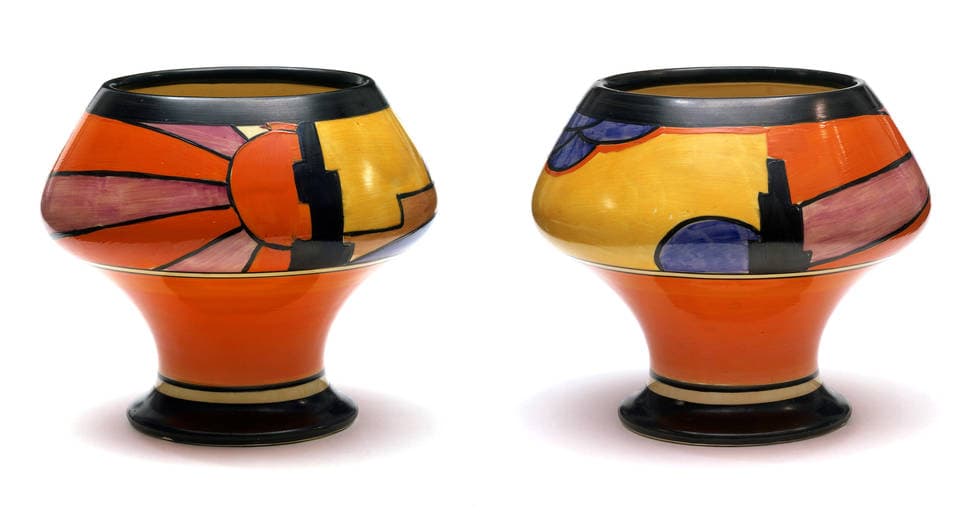
Cliff's pottery challenges the idea that Art Deco existed only in grand hotels or wealthy collectors' homes. A cup, jug, or vase could introduce the new style into everyday domestic life. Works such as the Sunray vase of 1929 show how forceful modern design could be achieved through painted earthenware rather than rare materials.

The expansion of manufactured household goods widened this reach further. Plastics such as Bakelite and Catalin could be molded into complex shapes, making them useful for objects including radios. Modern design increasingly became something consumers could purchase in a shop rather than commission from a specialist decorator.

The Beautiful Teacup That Was Difficult to Use

Not every geometric experiment improved daily life. Eric Slater's Vogue tea ware for Shelley, introduced in 1930, featured conical cups and solid triangular handles. Customers complained that they could not put a finger through the handles or hang the cups on hooks, while the wide shape allowed tea to cool quickly. The design is a revealing example of visual novelty coming into conflict with practical use.

Art Deco Painting and Sculpture

Painting and sculpture formed part of Art Deco's broader decorative world, particularly when commissioned for coordinated interiors. They should not, however, be treated as a single uniform school. The relationship between furniture, architectural setting, and displayed artwork was often as important as the characteristics of any individual painting. Ruhlmann's interiors, which brought together multiple artistic media, exemplify this approach.

Tamara de Lempicka and the Car She Did Not Own

Tamara de Lempicka is among the painters most closely associated with Art Deco. Her polished surfaces, strongly modeled bodies, and controlled geometric forms gave portraiture a distinctive combination of classical presence and modern sophistication. Their appearance drew on Cubist ideas and on older painting traditions, including the Renaissance and Ingres, producing a forceful reinvention of recognizable figures rather than an abstraction. Her Self-Portrait, or Tamara in a Green Bugatti, painted in 1929, became an especially memorable image of the fashionable modern woman.

Created for the German magazine Die Dame, the painting shows Lempicka at the wheel of an elegant green automobile. Yet the car she actually drove was a yellow Renault. The substitution is revealing: the painting was not simply an inventory of her possessions but an act of self-presentation. The Bugatti helped construct an image of independence, speed, confidence, and expensive taste. The portrait captures Art Deco's capacity to represent not only contemporary life but an aspirational version of it.

François Pompon's Late Success

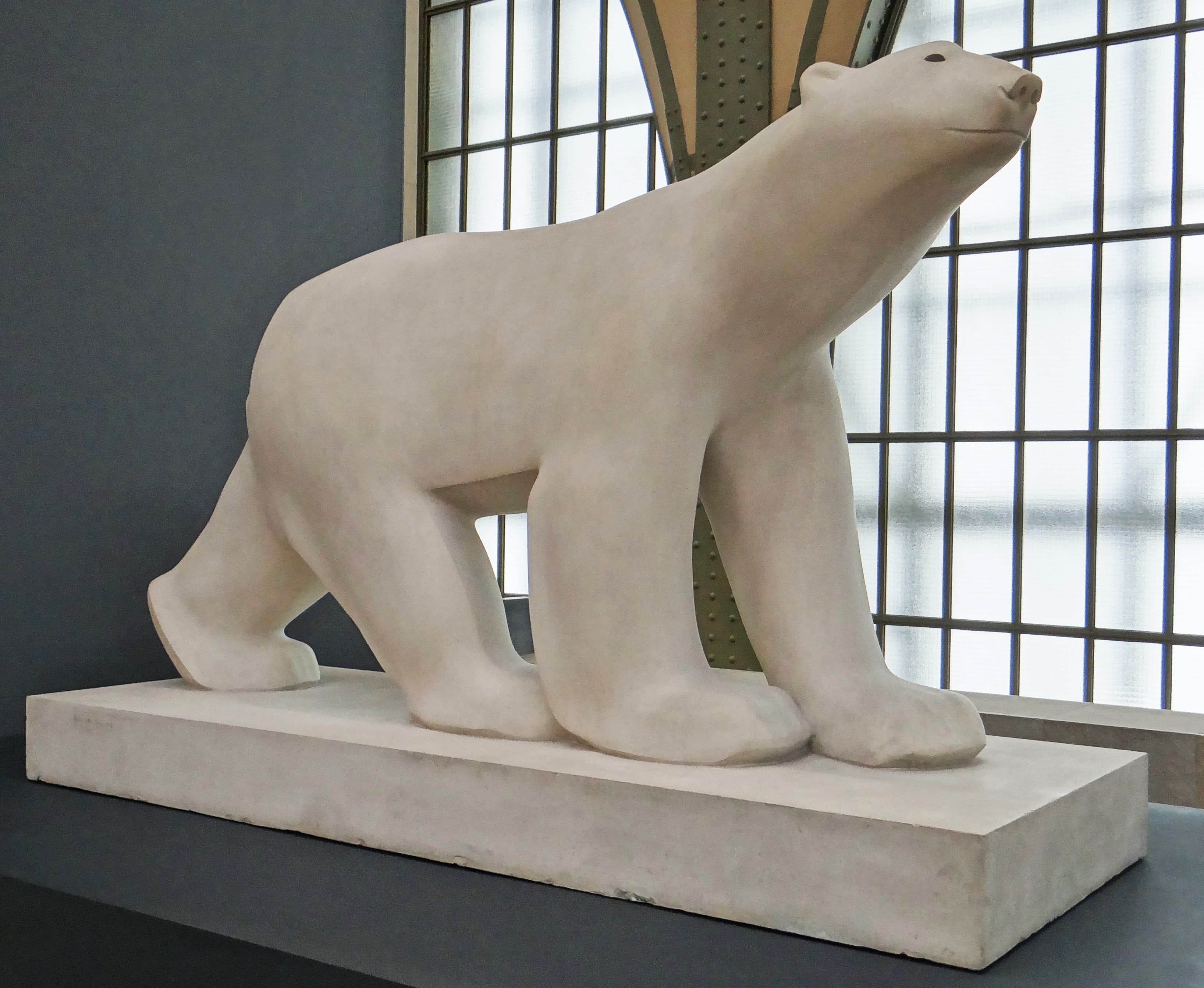
François Pompon's Polar Bear demonstrates a quieter side of Art Deco sculpture. Rather than emphasizing anatomical detail, the animal's body is reduced to a continuous, carefully balanced form. Its smoothness suggests both the bear's weight and its measured movement, without requiring the viewer to examine individual strands of fur.

Pompon was sixty-seven when a life-size plaster version attracted major attention in 1922. He had spent years working as a sculptor's assistant, including in Rodin's studio, before this breakthrough. The bear subsequently appeared in different sizes and materials, and Ruhlmann incorporated Pompon's sculpture into his exhibition environments. Its success challenges the assumption that artistic innovation belongs only to youthful rebellion.

Paul Manship's Prometheus

In sculpture, Paul Manship's gilded bronze Prometheus, created in 1934 for Rockefeller Center, joins ancient mythology to a modern architectural setting. The figure brings fire to humanity, turning a classical story into an image of knowledge, striving, and progress. Its integration into Rockefeller Center's larger artistic program shows how sculpture could help give a commercial complex a public identity and symbolic purpose. Art Deco's modernity did not exclude myth; it frequently gave old stories new settings and meanings.

Fashion, Jewelry, and the Modern Woman

Paul Poiret's “Thousand and Second Night”

The connection between fashion and decorative art was established before the 1925 exhibition. Paul Poiret treated clothing, interiors, publicity, and spectacle as parts of a wider aesthetic enterprise. His celebrated “Thousand and Second Night” party in 1911 turned a private gathering into an elaborate presentation of his imaginative world. His wife, Denise, wore a costume combining a lampshade-like tunic with harem trousers.

The event demonstrates how fashion could be promoted through an entire environment rather than through garments alone. Its theatrical Orientalism also reveals the period's habit of transforming imagined foreign settings into commercial fantasy. Poiret's importance lies partly in this coordination of design and publicity: he offered clients not simply something to wear but a recognizable way of presenting themselves.

Sonia Delaunay and Wearable Abstraction

Sonia Delaunay approached textiles and clothing through color and abstract composition. Her designs translated a painter's concerns into objects that could be worn and used, creating strong relationships between contrasting shapes and hues. Her 1925 portfolio brought together paintings, objects, textiles, and fashions, demonstrating how these activities could form a connected practice. Her participation in this design culture should not obscure the breadth of her independent contribution to modernist painting.

Other designers achieved modern effects through silhouette, cut, and carefully placed decoration. A 1935 evening gown by Jeanne Lanvin, for example, combined bias-cut satin with geometric elements in its collar. Such work shows that Art Deco fashion was not limited to a single familiar image of the 1920s flapper; it continued to develop through the changing forms of the 1930s.

Jewelry and the Machine Age

Art Deco jewelry could use geometry and material contrast to produce a sharp, contemporary appearance. Raymond Templier drew inspiration from machinery and automobiles, translating their forms into abstract jewelry rather than copying them literally. Platinum, diamonds, and rock crystal also offered designers opportunities to emphasize light, structure, and clear contrasts. Jewelry participated in the same search for modern form as furniture and architecture, but at an intimate scale.

Posters, Illustration, and Advertising

Art Deco spread partly through images that circulated much more widely than expensive original objects. Fashion magazines, advertisements, illustrated programs, and commercial publications carried its visual language to international audiences. Erté, born Romain de Tirtoff, worked across fashion illustration, theatrical costume, and stage design, while George Barbier likewise moved between related decorative and illustrative fields. Such careers demonstrate how readily artistic practice crossed the boundary between fine art and commercial design.

Modern Life as a Subject

The style's imagery frequently drew upon contemporary cities, travel, entertainment, and movement. Artists could transform the experience of urban life into simplified shapes and rhythmic patterns. Posters were especially effective vehicles for this approach because they had to communicate quickly and remain legible at a distance. A viewer passing through a street or station might have only seconds to register an image, so Art Deco's visual clarity had practical value as well as decorative appeal.

Cassandre's Normandie

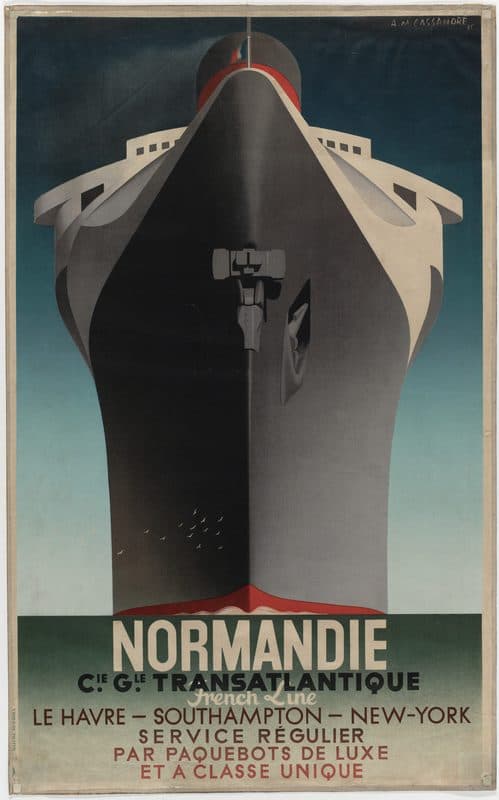
A. M. Cassandre's 1935 poster for the ocean liner Normandie is a particularly clear example of Art Deco graphic design. Seen almost directly from the front, the ship becomes an immense, simplified form rising above the viewer. Small birds emphasize its scale, while the lettering participates in the composition rather than functioning as an unrelated caption.

The poster offers more than a likeness of a vessel. Its exaggerated viewpoint makes the liner appear monumental and technologically commanding. Read as an advertisement, it turns a journey into an encounter with power, modernity, and prestige. Its impact depends on selection and simplification: relatively few forms carry the image's principal message.

Architecture and the Modern Skyline

Art Deco architecture could make a building seem both practical and spectacular. In New York, its appearance was shaped partly by circumstances beyond artistic preference. The 1916 zoning resolution required many tall buildings to step back as they rose, preserving greater access to light and air at street level. These rules contributed to the stepped silhouettes associated with the city's interwar skyscrapers.

Architects transformed these restrictions into expressive forms. Buildings could rise through a sequence of setbacks before culminating in a tower or crown. The resulting silhouettes were therefore not simply imitations of ancient pyramids or purely decorative inventions: they also emerged from the interaction of regulation, real-estate development, construction, and architectural ambition. The Chrysler Building, 40 Wall Street, and the Empire State Building all took shape within this framework.

The Chrysler Building's Secret Spire

Designed by William Van Alen and completed in 1930, the Chrysler Building became one of Art Deco's defining monuments. Its stainless-steel crown combines layered arches with triangular windows, turning the top of an office tower into an instantly recognizable composition, while its ornament quotes the car industry directly through radiator-cap forms, stylized automobiles and metal hubcaps. Its final height also resulted from a dramatic competition with another New York skyscraper, 40 Wall Street, which was being built by Van Alen's former partner, H. Craig Severance.

A steel spire approximately 185 feet long was assembled inside the Chrysler Building and raised into position on October 23, 1929. The operation took about ninety minutes and brought the building to 1,046 feet, securing the world's tallest-building title. The victory was brief: the Empire State Building surpassed it in 1931. The episode nevertheless captures how engineering, publicity, commercial rivalry, and visual spectacle could converge in Art Deco architecture.

The Empire State Building and the New Skyline

The Chrysler Building's height distinction was short-lived. The Empire State Building, designed by Shreve, Lamb & Harmon, opened on May 1, 1931, after a construction period of approximately one year and forty-five days. Its extraordinary speed of construction became part of its public identity, linking architectural achievement with the efficiency of modern building methods.

The building also entered popular culture almost immediately. Its role in King Kong in 1933 helped make the skyscraper an internationally recognizable setting for drama and spectacle. Art Deco architecture was not experienced only by people who entered its buildings; photography and cinema carried its forms far beyond their original locations.

The Normandie: Art Deco at Sea

The ocean liner Normandie, which entered service in 1935, brought the ambitions of the luxury interior into the world of transatlantic travel. Among its decorative achievements were glass murals designed by Jean Dupas and executed by Jacques-Charles Champigneulle. In the grand salon, paint and metal leaf applied to the reverse of the glass created a brilliant environment in which maritime subjects and mythological imagery complemented the experience of ocean travel.

The ship's fate provides a stark contrast to the confidence of its interiors. During conversion for wartime service in New York, it caught fire on February 9, 1942, and subsequently capsized. Some decorative elements had already been removed and survived, including panels from Dupas's History of Navigation, now represented in the Metropolitan Museum. These fragments preserve part of an environment designed to make modern travel feel like a total artistic experience.

Art Deco and Paris

Paris was Art Deco's principal early center and its most influential international showcase. The city brought together the people and institutions that helped the style flourish: decorative artists, fashion houses, skilled workshops, wealthy collectors, and exhibitions capable of attracting worldwide attention. Although Art Deco absorbed influences from many countries, Paris played a decisive role in transforming those influences into a recognizable expression of modern sophistication. Its importance extended beyond producing individual masterpieces to presenting a coordinated vision of how modern life could look.

Why Art Deco Flourished in Paris

Art Deco developed in Paris through the interaction of artistic experimentation and established luxury trades. French designers wanted to renew the country's reputation for exceptional craftsmanship while responding to new ideas about color, geometry, and modern life. Developments associated with Cubism and other avant-garde movements supplied possibilities that decorators could adapt to furniture, fabrics, jewelry, and interiors. The resulting designs could appear contemporary without abandoning the prestige of beautifully worked materials.

The career of Émile-Jacques Ruhlmann illustrates this connection between inherited craft and modern enterprise. Born in Paris, he took over his family's decorating business in 1907 and expanded it into furniture and interior design. By the 1920s, his operation employed more than one hundred skilled workers and assistants. His elegant cabinets and desks were therefore the products of an extensive working organization, not simply the inventions of an individual designer. Paris provided both the expertise needed to manufacture such demanding objects and the clients prepared to commission them.

Fashion strengthened these relationships. In 1911, Paul Poiret established a perfume and cosmetics business named after his daughter Rosine and a decorative-arts enterprise named after his daughter Martine. Both were located at 107 rue du Faubourg-Saint-Honoré. Clothing, scent, textiles, and furnishings could now be presented as related expressions of a designer's taste. Poiret helped establish a model in which a Parisian fashion house offered an entire style of living, extending its influence from the dressed body into the furnished home.

The 1925 Exhibition: A Temporary Design District Along the Seine

The Exposition internationale des arts décoratifs et industriels modernes of 1925 made Paris the center of an extraordinary international presentation of decorative design. Its grounds extended around the Grand Palais, across the Seine, and toward the Esplanade des Invalides. The Pont Alexandre III became part of the exhibition itself, lined with temporary shops. Visitors moved through a transformed section of the city in which pavilions, displays, gardens, and commercial spaces presented competing visions of contemporary taste. The exhibition supplied the name from which the later term Art Deco developed.

Ruhlmann's Hôtel du Collectionneur was among its defining attractions. Conceived as the home of an imaginary wealthy collector, it demonstrated how furniture, carpets, lighting, and decorative objects could be organized into a complete environment. Its importance lay in this coordination: the rooms presented a convincing image of cultivated modern living rather than a miscellaneous collection of expensive possessions. Parisian craftsmanship was being displayed as a comprehensive approach to interior design, capable of shaping every aspect of a room.

The exhibition also made the relationship between fashion and decoration visible. Armand-Albert Rateau's work appeared in the Pavillon de l'Élégance, which housed displays associated with Jeanne Lanvin, Worth, Callot Soeurs, Jenny, and Cartier. A bronze dressing-table design that Rateau included there drew on ancient sources, particularly Pompeian furniture, while serving a distinctly modern luxury setting. Such displays explain why Parisian Art Deco could embrace historical references without simply reproducing historical rooms: older forms were being rearranged for contemporary clients and commercial purposes.

The International Workshops Behind Parisian Elegance

The designation “French Art Deco” can obscure how international its production often was. Eileen Gray, an Irish artist who settled in Paris in 1902, developed her practice through collaboration with craftspeople from different backgrounds. In 1910, she opened a workshop with the Japanese lacquer specialist Seizo Sugawara at 11 rue Guénégaud. With Evelyn Wyld, she also established a rug-making workshop on rue Visconti. Lacquer, weaving, painting, and furniture design became connected activities through which she explored increasingly complex relationships between objects and space.

On May 17, 1922, Gray opened her gallery, Jean Désert, at 217 rue du Faubourg-Saint-Honoré. It connected her work with a network of Parisian and American clients. Her career demonstrates both the cosmopolitan character of Parisian design and the limitations of rigid stylistic categories: the same artist who produced elaborate lacquer furniture also became an important architectural modernist. Paris supported these overlapping practices rather than a single, universally accepted definition of what modern design should be.

Theaters, Brasseries, and the Parisian Night

Parisian Art Deco was experienced in public as well as private settings. An important early example is the Théâtre des Champs-Élysées, completed in 1913 on avenue Montaigne. Its creation involved Henry van de Velde, the Perret brothers, Antoine Bourdelle, and Maurice Denis, bringing architecture and decoration into a coordinated project. Reinforced concrete made the building structurally modern, while sculpture and painting gave it an artistic identity. Its opening year also brought the disruptive premiere of Stravinsky's The Rite of Spring, with choreography by Vaslav Nijinsky. The audience's notorious reaction concerned the performance rather than the building, but the association makes the theater a revealing meeting point between architectural innovation and Paris's experimental cultural life.

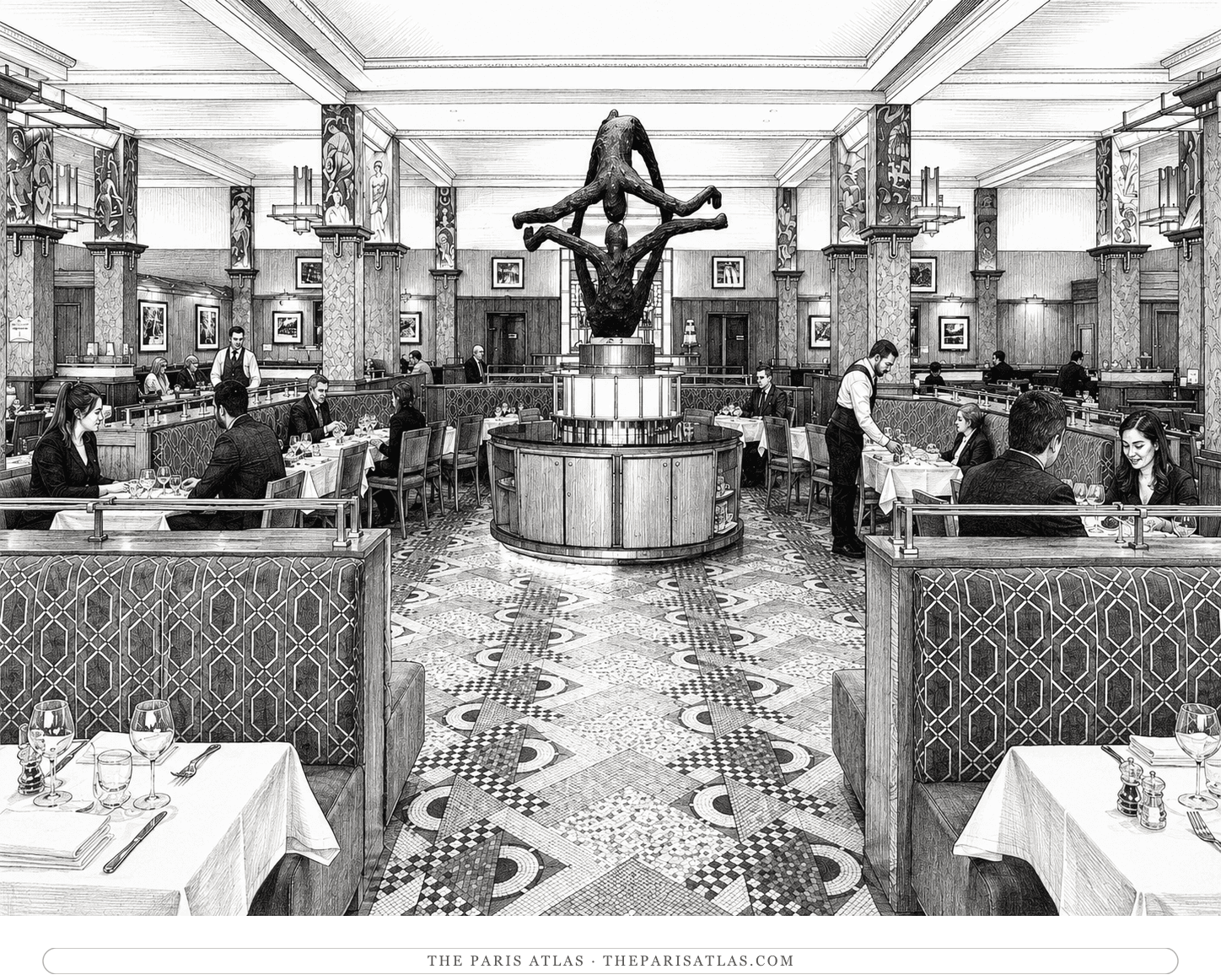
In Montparnasse, La Coupole, opened on December 20, 1927, brought Art Deco into the social world of artists and writers. Its interior incorporated painted pillars and pilasters decorated by artists associated with the neighborhood, including Marie Vassilieff, Othon Friesz, and Jeanne Rij-Rousseau. The paintings made the brasserie a collective artistic undertaking as well as a commercial establishment. Its significance is therefore greater than the familiar claim that famous people ate there: members of Montparnasse's artistic community helped shape the environment in which that community gathered.

The Grand Rex, which opened on December 8, 1932, offered a different kind of experience. Behind its imposing Art Deco façade, spectators encountered an auditorium designed to suggest an outdoor setting beneath a star-filled sky. Architectural scenery evoked Mediterranean places through balconies, colonnades, and other picturesque features. The cinema's founder, Jacques Haïk, conceived an attraction in which the surroundings were part of the entertainment. The contrast between the modern exterior and the imaginative interior also reveals Art Deco's flexibility: geometric architecture could coexist with theatrical historical references when both contributed to a carefully planned experience.

Together, these places show why Art Deco became so closely associated with Parisian leisure. A concert, a dinner, or a film could take place within an environment that was itself a major part of the occasion. Design helped distinguish a venue, attract its public, and give an ordinary commercial activity the character of a cultural event.

Department Stores, Swimming Pools, and Modern Leisure

The city's department stores provide a particularly useful way to distinguish Art Deco from its predecessor, Art Nouveau. At La Samaritaine, Frantz Jourdain's earlier work incorporated the colorful ornament and floral imagery associated with Art Nouveau. The extension toward the Seine, developed with Henri Sauvage between 1926 and 1928, introduced an Art Deco architectural character. The complex demonstrates that these styles did not always replace one another completely. They could occupy different parts of the same expanding business, recording changing tastes within a single Parisian site.

Swimming pools offered another setting for modern design. Molitor, designed by Lucien Pollet and inaugurated in 1929, combined swimming facilities with an architectural atmosphere often compared to an ocean liner. Its two pools and surrounding galleries made it a place for recreation, sociability, and display. The association with maritime travel was particularly appropriate to a period in which the ocean liner had become an important model for sophisticated interiors and modern leisure. At Molitor, that atmosphere could be experienced without leaving Paris.

One of the site's most famous episodes occurred after Art Deco's interwar heyday. On July 5, 1946, designer Louis Réard presented the swimsuit he called the bikini at Molitor, modeled by Micheline Bernardini, a performer from the Casino de Paris. Réard had struggled to find a conventional fashion model willing to wear his revealing design. The event belongs to the history of postwar fashion rather than the origins of Art Deco, but it illustrates how a building created for the leisure culture of the 1920s could continue to provide a setting for new forms of publicity and changing social conventions.

Monumental Art Deco: Paris in 1931 and 1937

Art Deco also became a language for large public buildings. The Palais de la Porte Dorée, constructed between 1929 and 1931 under architect Albert Laprade, is an especially concentrated example. Architecture, sculpture, frescoes, mosaics, metalwork, and furniture were conceived as parts of a unified undertaking. Its historic reception rooms preserve the work of two important decorators: Ruhlmann designed the Africa Salon, while Eugène Printz designed the Asia Salon. Their responsibilities extended beyond supplying furniture to coordinating materials, floor patterns, and the surrounding decoration. The building demonstrates Art Deco's ambition to integrate multiple crafts within a single architectural setting.

Its political purpose is inseparable from that artistic achievement. Built for the 1931 Colonial Exhibition, the Palais was intended to celebrate the French colonial empire. Its decoration must therefore be understood as an official representation of colonial power, not simply as an attractive collection of international motifs. The building now houses the Musée national de l'histoire de l'immigration, alongside its aquarium and historic spaces. Its present interpretation examines and questions the ideas that its original decorative program was designed to promote.

The 1937 International Exhibition added further monumental buildings to Paris, notably the Palais de Chaillot and Palais de Tokyo, which extended the period's interest in symmetry, large volumes, and integrated sculpture. These projects show that the Parisian history of Art Deco continued beyond the decorative extravagance associated with 1925. Its architectural language could become more restrained and monumental while retaining a strong relationship between structure and the arts.

One of the exhibition's most remarkable artistic commissions was Raoul Dufy's La Fée Électricité—The Electricity Fairy. Created for the electricity pavilion designed by Robert Mallet-Stevens on the Champ-de-Mars, the approximately 600-square-meter painting presents the history and applications of electricity through landscapes, machinery, mythological figures, and portraits of 110 scientists and inventors. Dufy completed the undertaking in about ten months from conception, using extensive preparatory work and projection to transfer compositions onto its panels. Installed at the Musée d'Art Moderne de Paris in 1964, it preserves the ambition of a period in which modern technology could become the subject of an immense decorative artwork.

The Parisian Legacy: Objects, Interiors, and a Way of Living

Paris preserves this history through both buildings and museum collections. The Musée des Arts Décoratifs holds furniture and decorative objects alongside reconstructed interiors, including rooms from Jeanne Lanvin's Parisian home, decorated by Armand-Albert Rateau. Such ensembles are particularly valuable because Art Deco often depends on relationships between objects: a chair, a textile, or a lamp may be impressive alone, but a coordinated room reveals how color, material, proportion, and placement were intended to work together.

Paris's distinctive contribution to Art Deco was the close connection it established between artistic invention, skilled manufacture, commerce, and daily experience. Its designers gave modern form to clothing and furniture, while its exhibitions and public interiors showed how those forms could operate within a larger environment. Seen across these settings, Parisian Art Deco was more than a decorative vocabulary. It was an influential attempt to make modern life feel coherent, sophisticated, and desirable—an ambition expressed as clearly in a neighborhood brasserie or a cinema as in a wealthy collector's drawing room.
Art Deco Around the World

Art Deco did not remain a French export reproduced identically elsewhere. Through commerce, travel, media, and the movement of designers, its forms were adapted to different places and purposes. Its international history is therefore a history of local reinterpretation as well as diffusion.

Miami Beach: Modernity on a Smaller Scale

Miami Beach developed an Art Deco landscape of hotels and apartment buildings rather than monumental skyscrapers. Architects including Henry Hohauser and L. Murray Dixon used geometric ornament, curved forms, nautical references, and decorative entrances to give relatively modest buildings a strong visual identity. Hohauser's Colony Hotel of 1935 shows how far the style could work below the scale of a Manhattan skyscraper: façade, decoration and signage gave one modest building a strong identity within a commercial street. The style's usefulness did not depend on great height or immense budgets.

The familiar appearance of the district also reflects later preservation. Its pastel colors are not simply an untouched record of the 1930s: designer Leonard Horowitz played an important role in introducing new color schemes during the revival of interest in these buildings. Miami Beach illustrates both the original adaptability of Art Deco and the influence of later generations on how it is remembered.

Mumbai: Art Deco as a Local Urban Language

In Mumbai, then known as Bombay, Art Deco became an important language for apartment buildings and cinemas. Around the Oval Maidan, twentieth-century Art Deco development stands in a striking relationship to the city's earlier Victorian Gothic architecture. UNESCO describes the adaptation of Art Deco through Indian decorative features as “Indo-Deco.”

These buildings demonstrate why the style should not be understood as exclusively European or American. Local patrons and designers used an international vocabulary to shape their own urban environment. The Victorian Gothic and Art Deco Ensembles of Mumbai were inscribed on the UNESCO World Heritage List in 2018, recognizing the significance of this architectural relationship.

Napier: A City Rebuilt After an Earthquake

On February 3, 1931, an earthquake devastated Napier, New Zealand, and fires caused further destruction. The subsequent rebuilding gave the city an unusually concentrated collection of architecture associated with the early 1930s, including Art Deco. Much of the central area was reconstructed within a short period, producing a coherence that cities rebuilt gradually over many decades rarely possess.

Napier offers a different story from that of a fashionable Parisian drawing room. Here, modern design was part of recovery after catastrophe. The style helped give a rebuilt commercial center a contemporary identity, showing that Art Deco could serve civic renewal as well as luxury consumption.
Japan and the Combination of Tradition and Technology

Art Deco also offered ways to combine modern infrastructure with established cultural imagery. A 1937 Japanese Government Railways poster by Munetsugu Satomi, for example, brings the imagery of modern transportation into a composition that also includes cherry trees. Such designs complicate the idea that becoming visually modern required abandoning local traditions. New technology and recognizable cultural forms could occupy the same image. Shanghai's commercial culture offered another setting in which modern products and visual design became closely connected. Art Deco spread through adaptation, not through the repetition of a single French model.

Art Deco, Colonialism, and Cultural Borrowing

Art Deco's international influences were not always exchanges between equal partners. Some works were directly connected to the political presentation of empire. The Palais de la Porte Dorée, designed by Albert Laprade for the Paris Colonial Exhibition of 1931, was conceived as an integrated architectural and decorative achievement. Its monumental setting joined architecture, sculpture, interiors, and furniture within a coordinated whole.

The building was also created to celebrate the French colonial empire. Its decorative program, including the façade relief by Alfred Janniot, must therefore be understood as more than a collection of attractive forms. It participated in an official representation of colonial power. Art Deco's capacity to appear elegant and modern did not make it politically neutral.

The exhibition presented colonial rule through carefully arranged displays and spectacle, but it also encountered opposition. Surrealists including André Breton and Paul Éluard urged people not to attend, while an alternative exhibition challenged the official presentation of colonial life. The political meanings of such environments were contested at the time, not only reconsidered by later historians.

Recognizing these connections does not require treating every Art Deco object as propaganda. It does require distinguishing appreciation of a work's design from acceptance of the ideology, commercial system, or social hierarchy behind its commission.

At the same time, a history concerned only with European appropriation would overlook actual collaboration. Sugawara's work with Dunand and Gray demonstrates the importance of named makers whose knowledge helped shape European design. Recognizing those relationships produces a fuller account than treating “Asian influence” as an anonymous collection of motifs.

Art Deco, Art Nouveau, and Modernism: The Differences

Art Deco and Art Nouveau

Art Nouveau developed earlier, flourishing around the turn of the twentieth century. It is especially associated with flowing lines, plant forms, and an ambition to integrate art with architecture and everyday objects. Art Deco generally placed greater emphasis on compact geometry, repeated patterns, and controlled decorative effects.

The distinction should not be reduced to “curves versus straight lines.” Art Nouveau included geometric approaches, and Art Deco continued to use flowers, animals, and curved forms. The two share concerns as well as differences, including the effort to give an entire interior or object a coherent design rather than treating ornament as an unrelated addition.

Art Deco and the Bauhaus

The Bauhaus, which operated in Germany from 1919 to 1933, was an actual school with an evolving educational program. Art Deco was a broader stylistic category rather than a comparable institution. Bauhaus teaching brought together artistic practice, craft, and design, with increasing attention to industrial production and the relationship between materials, form, and use.

There were overlaps in geometry, new materials, and the desire to shape modern life. The difference is therefore not that one valued beauty and the other rejected it. Rather, particular designers pursued different priorities and methods. Expensive decorative display was only one possible response to modernity, while systematic experiments in manufacture and everyday use offered another.

Art Deco and Streamline Moderne

Streamline Moderne is closely related to Art Deco, especially in its 1930s development. It favors the appearance of aerodynamic movement through rounded forms and smooth, continuous surfaces. These shapes spread from the imagery of transportation into household products, including objects that never moved at all.

Streamlining is best understood as a related tendency rather than a universal replacement for earlier Art Deco. Angular ornament and streamlined forms could coexist. The important change was often one of emphasis: from rich surface decoration toward an appearance of speed, efficiency, and technological sophistication.

The Depression, War, and Decline of Art Deco

The Great Depression did not simply end Art Deco in 1929. The style remained influential throughout the 1930s, encompassing both ambitious luxury projects and less expensive consumer goods. Its history spans the prosperity of the 1920s and the much harsher conditions that followed. The familiar association with Jazz Age glamour should not obscure this longer development.

The Second World War and its aftermath brought more decisive changes in domestic priorities and taste. Elaborate prewar interiors lost ground to less ornamented approaches, while production and furnishing increasingly addressed different circumstances. Art Deco ceased to hold its earlier position as a leading language of fashionable modern life, although its influence did not disappear.

Rediscovery and Preservation

The revival of the 1960s encouraged historians, collectors, and museums to reconsider work that had often been dismissed as outdated decoration. The 1966 Paris exhibition and Hillier's 1968 book helped establish Art Deco as a subject worthy of serious historical attention. Hillier's involvement in the 1971 Minneapolis exhibition further contributed to that reassessment.

Preservation campaigns made this change visible in the built environment. In Miami Beach, Barbara Capitman and Leonard Horowitz helped build support for the city's threatened interwar architecture. The district's recognition on the National Register of Historic Places in 1979 marked a major achievement. Buildings once regarded as unfashionable could now be understood as a significant part of architectural history.

Representative Art Deco Works and Landmarks

Théâtre des Champs-Élysées, Paris — Auguste and Gustave Perret, following an initial scheme by Henry van de Velde; 1913. An early combination of modern construction, geometric architecture, and integrated decoration.

Polar Bear — François Pompon; life-size plaster exhibited in 1922. A celebrated example of simplified animal sculpture; later versions appeared in different materials and sizes.

État Cabinet — Émile-Jacques Ruhlmann; designed 1922, this example manufactured 1925–26; Metropolitan Museum of Art, New York. Elaborate veneers and refined construction within a carefully controlled furniture design.

Tourbillons / Whirlwinds Vase — René Lalique, 1926; Metropolitan Museum of Art, New York. Dramatic glass modeling and sophisticated finishes in an object produced in quantity.

Sunray Vase — Clarice Cliff, 1929; Victoria and Albert Museum, London. Bright color and forceful pattern in accessible decorative ceramics.

Self-Portrait / Tamara in a Green Bugatti — Tamara de Lempicka, 1929; private collection. Modern identity presented through polished forms, fashion, and the imagery of speed.

Chrysler Building — William Van Alen, completed 1930; New York City. The transformation of a commercial skyscraper into a monumental decorative composition.

Empire State Building — Shreve, Lamb & Harmon, opened 1931; New York City. A defining architectural and cinematic symbol of the modern metropolis.

Normandie poster — A. M. Cassandre, 1935; examples include the Museum of Modern Art, New York. Simplified geometry and an imposing viewpoint used in commercial graphic design.

Why Art Deco Matters

Art Deco expanded the settings in which people encountered ambitious design. Its reach extended from clothing and jewelry to transportation, entertainment, communications, and the household. It belonged not only to galleries but also to cinemas, shops, hotels, and the objects through which people organized their everyday lives. That breadth is essential to understanding its significance as an artistic phenomenon.

Its central achievement was not the invention of a single motif or technique. It was the creation of persuasive relationships between objects, images, interiors, and ways of living. Ruhlmann's coordinated rooms illustrate this ambition particularly clearly: furniture and decoration were conceived as parts of an environment rather than isolated achievements. Seen in this light, Art Deco was more than an ornamental fashion. It was one of the twentieth century's influential attempts to give modern life a coherent and desirable appearance. The style is therefore not a checklist of gold accents, zigzags and glamorous interiors: those features matter, but they belong to a larger history of changing production, international exchange, commercial aspiration, and competing ideas about how modern life should look.

Art Deco connections

Timeline

Art Deco has no founding moment, so this run begins with the Paris theatre that predates the exhibition the style is named after.

  1. 1913

    Théâtre des Champs-Élysées opens

    The Perret brothers' reinforced-concrete theatre on avenue Montaigne, with Antoine Bourdelle's reliefs, combines structural modernity with an integrated decorative program twelve years before the exhibition that names the style.

  2. 1922

    Tutankhamun's tomb

    Howard Carter opens the tomb in November, and Egyptian motifs spread across evening wear, interiors and cinema façades.

  3. 1925

    The Paris exhibition

    The Exposition internationale des arts décoratifs et industriels modernes runs along the Seine, with Ruhlmann's Hôtel du Collectionneur and Le Corbusier's Pavillon de l'Esprit Nouveau presenting opposite answers to the same question.

  4. 1927

    La Coupole opens

    The Montparnasse brasserie opens on 20 December with pillars painted by artists from the quarter, including Marie Vassilieff, Othon Friesz and Jeanne Rij-Rousseau.

  5. 1929

    The Chrysler Building's spire

    A steel spire about 185 feet long is raised into position on 23 October, taking the building to 1,046 feet and the world's tallest-building title. Piscine Molitor opens in Paris the same year.

  6. 1931

    Palais de la Porte Dorée

    Albert Laprade's building for the Colonial Exhibition opens, with Ruhlmann's Africa Salon and Eugène Printz's Asia Salon. An earthquake destroys Napier, New Zealand, on 3 February; the rebuilt centre becomes an Art Deco city.

  7. 1935

    Cassandre's Normandie

    The poster for the new liner reduces the ship to an immense frontal form; the Normandie enters service the same year.

  8. 1937

    La Fée Électricité

    Raoul Dufy's roughly 600-square-metre painting for the electricity pavilion at the Paris International Exhibition presents the history of electricity across 110 portraits of scientists and inventors.

  9. 1966–1968

    The revival names the style

    Les Années 25 at the Musée des Arts Décoratifs reexamines the period, and Bevis Hillier's Art Deco of the 20s and 30s popularizes the term.

  10. 1979

    Miami Beach protected

    The Miami Beach Architectural District enters the National Register of Historic Places after campaigning by Barbara Capitman and Leonard Horowitz.

  11. 2018

    Mumbai inscribed by UNESCO

    The Victorian Gothic and Art Deco Ensembles of Mumbai join the World Heritage List, recognising what UNESCO calls “Indo-Deco.”

Art Deco: frequently asked questions

What is Art Deco?

An international design style of the 1920s and 1930s, built on geometric forms, stylized ornament, rich surfaces and the imagery of modern life. It ran through architecture, furniture, glass, ceramics, fashion, jewellery, posters and ocean liners. It had no founder and no manifesto, which is why it is better described as a family of related approaches than as a movement in the strict sense.

Where does the name Art Deco come from?

From arts décoratifs, and specifically from the Exposition internationale des arts décoratifs et industriels modernes held in Paris in 1925. The label itself came later: it took hold during the 1960s revival, after the 1966 exhibition Les Années 25 in Paris and Bevis Hillier's 1968 book Art Deco of the 20s and 30s.

What is the difference between Art Deco and Art Nouveau?

Art Nouveau came first, around 1900, and is associated with flowing lines and plant forms. Art Deco leaned toward compact geometry, repeated pattern and controlled decorative effect. The contrast is not simply curves against straight lines — Art Nouveau had geometric strands and Art Deco kept flowers and animals — and both wanted a whole interior to hold together rather than treating ornament as an addition.

Where can I see Art Deco in Paris?

The Théâtre des Champs-Élysées on avenue Montaigne (1913), La Coupole in Montparnasse (1927), the Grand Rex cinema (1932), Piscine Molitor (1929), the Seine-side extension of La Samaritaine (1926–28), and the Palais de la Porte Dorée (1931), whose Africa and Asia salons were designed by Ruhlmann and Eugène Printz. The Musée des Arts Décoratifs holds reconstructed interiors, including rooms from Jeanne Lanvin's home.

Was Art Deco only for the rich?

No. Ruhlmann's cabinets and Lalique's glass were expensive, but Clarice Cliff's brightly painted earthenware put the style on ordinary tables, and Bakelite and Catalin let manufacturers mould it into radios and household objects. The same visual language covered a collector's drawing room and a shop-bought jug.

When did Art Deco end?

It did not stop with the Depression in 1929 — the style ran through the whole of the 1930s, in luxury commissions and cheap consumer goods alike. The Second World War and the years after it changed domestic taste more decisively, and elaborate prewar interiors lost ground to plainer approaches.

References

References

The sources below include histories, manifestos, scholarly research, and primary materials that informed this page. They document Art Deco, its development, and the artists and works associated with it.

  1. 1An Introduction to Art Deco

    Website
    Victoria and Albert Museum
    Used for

    Web source consulted for documented facts and historical context presented on the Art Deco page.

    View source
  2. 2French Art Deco

    Website
    The Metropolitan Museum of Art
    Used for

    Web source consulted for documented facts and historical context presented on the Art Deco page.

    View source
  3. 3Art Deco 1910–1939 — exhibition

    Website
    National Gallery of Victoria
    Used for

    Web source consulted for documented facts and historical context presented on the Art Deco page.

    View source
  4. 4Art Deco Around the World

    Website
    Victoria and Albert Museum
    Used for

    Web source consulted for documented facts and historical context presented on the Art Deco page.

    View source
  5. 5Art Deco's Global Influences

    Website
    Victoria and Albert Museum
    Used for

    Web source consulted for documented facts and historical context presented on the Art Deco page.

    View source
  6. 6Art Deco in the Home

    Website
    Victoria and Albert Museum
    Used for

    Web source consulted for documented facts and historical context presented on the Art Deco page.

    View source
  7. 7Les Années 25 — exhibition catalogue record, Musée des Arts Décoratifs, 1966

    Archive
    Cité de l'Architecture et du Patrimoine
    Used for

    Archival evidence used to document the historical record connected to Art Deco.

    View source
  8. 8History & Archives

    Website
    Théâtre des Champs-Élysées
    Used for

    Web source consulted for documented facts and historical context presented on the Art Deco page.

    View source
  9. 9Art Deco — architecture guide

    Website
    City of Miami Beach
    Used for

    Web source consulted for documented facts and historical context presented on the Art Deco page.

    View source
  10. 10Émile-Jacques Ruhlmann, État cabinet — collection record

    Website
    The Metropolitan Museum of Art
    Used for

    Web source consulted for documented facts and historical context presented on the Art Deco page.

    View source
  11. 11Art Deco: Clarice Cliff

    Website
    Victoria and Albert Museum
    Used for

    Web source consulted for documented facts and historical context presented on the Art Deco page.

    View source
  12. 12Ruhlmann: Genius of Art Deco / Art Deco Paris — exhibition press release

    Website
    The Metropolitan Museum of Art
    Used for

    Web source consulted for documented facts and historical context presented on the Art Deco page.

    View source
  13. 13Pavillon de l'Esprit Nouveau, Paris, France, 1924–1925

    Website
    Fondation Le Corbusier
    Used for

    Web source consulted for documented facts and historical context presented on the Art Deco page.

    View source
  14. 14Jean Dunand — A French Art Déco Artist Working with Asian Lacquer

    Periodical
    Wooden Artifacts Group, American Institute for Conservation, 2002
    Used for

    Contemporary reporting or criticism used to document the historical reception and context of Art Deco.

    View source
  15. 15Eileen Gray architectural drawings, 1930–1947 — collection record

    Archive
    Getty Research Institute
    Used for

    Archival evidence used to document the historical record connected to Art Deco.

    View source
  16. 16Art Deco: René Jules Lalique

    Website
    Victoria and Albert Museum
    Used for

    Web source consulted for documented facts and historical context presented on the Art Deco page.

    View source
  17. 17René Lalique, Tourbillons vase — collection record

    Website
    The Metropolitan Museum of Art
    Used for

    Web source consulted for documented facts and historical context presented on the Art Deco page.

    View source
  18. 18Self-Portrait (Tamara in a Green Bugatti) — Tamara Łempicka

    Website
    Culture.pl
    Used for

    Web source consulted for documented facts and historical context presented on the Art Deco page.

    View source
  19. 19The Story of the Prometheus Sculpture at Rockefeller Center

    Website
    Rockefeller Center
    Used for

    Web source consulted for documented facts and historical context presented on the Art Deco page.

    View source
  20. 20Poiret

    Exhibition catalogue
    The Metropolitan Museum of Art
    Used for

    Catalogue scholarship used to verify attribution, provenance, chronology, and interpretive context for Art Deco.

    View source
  21. 21Exploring Art Deco Textile and Fashion Designs

    Website
    The Metropolitan Museum of Art
    Used for

    Web source consulted for documented facts and historical context presented on the Art Deco page.

    View source
  22. 22Art Deco Fashion

    Website
    Victoria and Albert Museum
    Used for

    Web source consulted for documented facts and historical context presented on the Art Deco page.

    View source
  23. 23Modern Design for a Modern World: Art Deco Paris

    Website
    Royal Ontario Museum
    Used for

    Web source consulted for documented facts and historical context presented on the Art Deco page.

    View source
  24. 24A. M. Cassandre, Normandie, 1935 — collection record

    Website
    The Museum of Modern Art
    Used for

    Web source consulted for documented facts and historical context presented on the Art Deco page.

    View source
  25. 25The 1916 zoning resolution and the setback skyscraper

    Website
    The Skyscraper Museum
    Used for

    Web source consulted for documented facts and historical context presented on the Art Deco page.

    View source
  26. 26Chrysler Building — Ten Tops

    Website
    The Skyscraper Museum
    Used for

    Web source consulted for documented facts and historical context presented on the Art Deco page.

    View source
  27. 27Jean Dupas, The History of Navigation panels from the Normandie — collection record

    Website
    The Metropolitan Museum of Art
    Used for

    Web source consulted for documented facts and historical context presented on the Art Deco page.

    View source
  28. 28Miami Beach Deco — American Experience

    Website
    PBS
    Used for

    Web source consulted for documented facts and historical context presented on the Art Deco page.

    View source
  29. 29Victorian Gothic and Art Deco Ensembles of Mumbai

    Official record
    UNESCO World Heritage Centre
    Used for

    Official record used to verify names, dates, institutional details, or other factual information on this page.

    View source
  30. 30How an Earthquake Helped Turn This City Into the Art Deco Capital of the World

    Periodical
    Smithsonian Magazine
    Used for

    Contemporary reporting or criticism used to document the historical reception and context of Art Deco.

    View source
  31. 31An Art Deco Palace

    Website
    Palais de la Porte Dorée
    Used for

    Web source consulted for documented facts and historical context presented on the Art Deco page.

    View source
  32. 32One Palais, Three Experiences

    Website
    Palais de la Porte Dorée
    Used for

    Web source consulted for documented facts and historical context presented on the Art Deco page.

    View source
  1. 33Eileen Gray and Seizo Sugawara, Pirogue Chaise Longue — collection record

    Website
    Virginia Museum of Fine Arts
    Used for

    Web source consulted for documented facts and historical context presented on the Art Deco page.

    View source
  2. 34Art Nouveau — Explore the Collections

    Website
    Victoria and Albert Museum
    Used for

    Web source consulted for documented facts and historical context presented on the Art Deco page.

    View source
  3. 35Art Nouveau — an International Style

    Website
    Victoria and Albert Museum
    Used for

    Web source consulted for documented facts and historical context presented on the Art Deco page.

    View source
  4. 36The Bauhaus, 1919–1933

    Website
    The Metropolitan Museum of Art
    Used for

    Web source consulted for documented facts and historical context presented on the Art Deco page.

    View source
  5. 37My Portrait (Tamara in the Green Bugatti), 1929 — Art on Demand record

    Website
    Fine Arts Museums of San Francisco
    Used for

    Web source consulted for documented facts and historical context presented on the Art Deco page.

    View source
  6. 38Paul Poiret (1879–1944)

    Website
    The Metropolitan Museum of Art
    Used for

    Web source consulted for documented facts and historical context presented on the Art Deco page.

    View source
  7. 39Eileen Gray — exhibition

    Website
    Centre Pompidou
    Used for

    Web source consulted for documented facts and historical context presented on the Art Deco page.

    View source
  8. 40Armand-Albert Rateau, Dressing Table — collection record

    Website
    The Metropolitan Museum of Art
    Used for

    Web source consulted for documented facts and historical context presented on the Art Deco page.

    View source
  9. 41Toute une histoire — the Grand Rex

    Website
    Le Grand Rex
    Used for

    Web source consulted for documented facts and historical context presented on the Art Deco page.

    View source
  10. 42Raoul Dufy, La Fée Électricité — collection record

    Website
    Musée d'Art Moderne de Paris
    Used for

    Web source consulted for documented facts and historical context presented on the Art Deco page.

    View source
  11. 43Molitor Paris — hotel, pools and history

    Website
    Molitor Paris
    Used for

    Web source consulted for documented facts and historical context presented on the Art Deco page.

    View source
  12. 44Bikini Introduced, July 5, 1946

    Website
    HISTORY
    Used for

    Web source consulted for documented facts and historical context presented on the Art Deco page.

    View source
  13. 45International Exhibition of Modern Decorative and Industrial Arts

    Website
    Wikipedia
    Used for

    Web source consulted for documented facts and historical context presented on the Art Deco page.

    View source
  14. 46La Coupole (brasserie)

    Website
    Wikipédia
    Used for

    Web source consulted for documented facts and historical context presented on the Art Deco page.

    View source
  15. 47La Samaritaine

    Website
    Wikipedia
    Used for

    Web source consulted for documented facts and historical context presented on the Art Deco page.

    View source
  16. 48Musée des Arts Décoratifs, Paris

    Website
    Wikipedia
    Used for

    Web source consulted for documented facts and historical context presented on the Art Deco page.

    View source
  17. 49Art Deco — Explore the Collections

    Website
    Victoria and Albert Museum
    Used for

    Web source consulted for documented facts and historical context presented on the Art Deco page.

    View source
  18. 50Ruhlmann: Genius of Art Deco — exhibition

    Website
    The Metropolitan Museum of Art
    Used for

    Web source consulted for documented facts and historical context presented on the Art Deco page.

    View source
  19. 51Art Deco: Where Tradition Meets Modernity

    Website
    Victoria and Albert Museum
    Used for

    Web source consulted for documented facts and historical context presented on the Art Deco page.

    View source
  20. 52Séraphin Soudbinine and Jean Dunand, Fortissimo — collection record

    Website
    The Metropolitan Museum of Art
    Used for

    Web source consulted for documented facts and historical context presented on the Art Deco page.

    View source
  21. 53Tamara de Lempicka — exhibition

    Website
    Museum of Fine Arts, Houston
    Used for

    Web source consulted for documented facts and historical context presented on the Art Deco page.

    View source
  22. 54François Pompon, Polar Bear — collection record

    Website
    The Metropolitan Museum of Art
    Used for

    Web source consulted for documented facts and historical context presented on the Art Deco page.

    View source
  23. 55Art Deco Printmakers

    Website
    Victoria and Albert Museum
    Used for

    Web source consulted for documented facts and historical context presented on the Art Deco page.

    View source
  24. 56Chrysler Building — Landmarks Preservation Commission designation report

    Official record
    New York City Landmarks Preservation Commission
    Used for

    Official record used to verify names, dates, institutional details, or other factual information on this page.

    View source
  25. 57History — the Empire State Building

    Website
    Empire State Realty Trust
    Used for

    Web source consulted for documented facts and historical context presented on the Art Deco page.

    View source
  26. 58La commande architecturale du Palais de la Porte Dorée

    Website
    Palais de la Porte Dorée
    Used for

    Web source consulted for documented facts and historical context presented on the Art Deco page.

    View source
  27. 59L’Exposition coloniale de 1931

    Website
    Palais de la Porte Dorée
    Used for

    Web source consulted for documented facts and historical context presented on the Art Deco page.

    View source
  28. 60About the House

    Periodical
    The New Yorker, 1971
    Used for

    Contemporary reporting or criticism used to document the historical reception and context of Art Deco.

    View source
  29. 61Théâtre des Champs-Élysées

    Website
    Wikipedia
    Used for

    Web source consulted for documented facts and historical context presented on the Art Deco page.

    View source
  30. 62Autoportrait (Tamara in a Green Bugatti)

    Website
    Wikipedia
    Used for

    Web source consulted for documented facts and historical context presented on the Art Deco page.

    View source
  31. 63Streamline Moderne

    Website
    Wikipedia
    Used for

    Web source consulted for documented facts and historical context presented on the Art Deco page.

    View source
i
Why these sources are here

These references provide the documented foundation for this movement's history and interpretation. Claim-level citations remain attached to the specific claims they support.

Explore more resources