The Paris AtlasCharting the artists, works, and places worth returning to.
  • Designer
· French · 1860–1945

René Lalique

French jeweller who turned to glass after 1900 and built a factory at Wingen-sur-Moder, making moulded vases, lighting and car mascots in quantity.

Details

Lived
1860–1945
Born
1860-04-06
Birth name
René Jules Lalique
Died
1945-05-01
Place of death
Paris, France
Nationality
French
Roles
Designer

About René Lalique

René Jules Lalique (6 April 1860–1 May 1945) was a French jeweler, glass designer, and manufacturer whose career encompassed two major transformations in the decorative arts. During the 1890s, he became one of the leading figures of Art Nouveau jewelry, creating extraordinary ornaments in which insects, flowers, serpents, and female figures appeared to merge. In the twentieth century, he redirected his attention toward glass, becoming an influential designer of perfume bottles, vases, lighting, architectural decoration, and automobile ornaments. His achievement lay not simply in producing luxurious objects, but in questioning what made an object valuable. First he placed artistic invention above the price of gemstones. Later he demonstrated that industrially manufactured glass could possess considerable artistic distinction.[1]

Connection to Paris

Paris was the principal setting for René Lalique’s artistic career, from his apprenticeship in Louis Aucoc’s workshop in 1876 to his international recognition as a jeweler and glass designer. After designing for houses including Cartier and Boucheron, he established his own Parisian workshops, moving to 20 Rue Thérèse in 1890 and opening a shop at 24 Place Vendôme in 1905.[2] The city also provided the stage for two defining public triumphs. The first was his display of approximately one hundred pieces at the Exposition Universelle of 1900. The second was his monumental Sources de France fountain at the 1925 International Exhibition of Modern Decorative and Industrial Arts. Together, these appearances charted his movement from the imaginative natural forms of Art Nouveau jewelry to the architectural possibilities of Art Deco glass.[3][4] Although his manufacturing operations extended beyond the capital, Paris remained central to his life. He died at his home at 40 Cours-la-Reine on 1 May 1945 and was buried in Père-Lachaise Cemetery, where his grave incorporates a glass image of Christ based on his own work.[5]

Early life and artistic training

Lalique was born in Aÿ, in the Champagne region of northeastern France. His family moved to the Paris area during his childhood, but visits to Champagne maintained his connection with the countryside. The plants, insects, and animals he observed there became enduring subjects. The Musée Lalique identifies the natural environment around his maternal grandparents’ home as an important source of the botanical and zoological imagery that would recur throughout his work. His later fascination with dragonflies, branches, flowers, and birds was therefore rooted partly in close observation rather than solely in fashionable decorative motifs.[2]

After his father’s death in 1876, the sixteen-year-old Lalique entered the workshop of the Parisian jeweler Louis Aucoc as an apprentice. Alongside this practical instruction, he attended classes at the École des Arts Décoratifs. Aucoc’s workshop introduced him to the demanding craftsmanship of fine jewelry, giving him a technical foundation that he would eventually use to challenge its conventions. Between 1878 and 1880, he continued his education in England, studying at Sydenham, near London. These years brought together formal drawing, ornamental design, and workshop experience rather than preparing him exclusively for painting or sculpture.[2]

Establishing a career in Paris

On returning to France, Lalique worked as a freelance designer for established jewelry houses, including Cartier and Boucheron. This period allowed him to develop his ideas within the commercial world of Parisian luxury while learning how designs were translated into finished objects. In 1885, he took over the workshop of Jules Destape on Place Gaillon. Subsequent moves included premises on Rue du Quatre-Septembre and, in 1890, a workshop at 20 Rue Thérèse. These addresses trace his development from a designer supplying other firms to an independent maker whose name became an attraction in its own right.[2]

Drawing remained fundamental to his practice. The surviving designs reveal an artist who worked through an object’s structure and proportions before its manufacture, combining delicate pencil work with careful geometric organization. This is an important qualification to the apparent spontaneity of his jewelry: its curling stems and flowing bodies were not casually improvised. They emerged from a disciplined process of design. His work also entered the orbit of the dealer Bing’s Maison de l’Art Nouveau, placing him within the Parisian network that promoted new approaches to decorative art during the 1890s.[6]

Reimagining the art of jewelry

Lalique’s central departure from conventional high jewelry concerned the relationship between design and material. Rather than treating a jewel principally as a framework for displaying expensive stones, he treated the entire object as an artistic composition. Gold and diamonds remained part of his vocabulary, but so did horn, ivory, enamel, glass, and semiprecious stones. A relatively inexpensive substance might be the most important part of a design, while diamonds supplied only a few accents. Materials were selected for their color, translucency, texture, and expressive possibilities rather than being arranged according to a hierarchy of monetary value.[7]

This approach gave his ornaments an unusual range of effects. Horn could become a branch or the structural support for an elaborate comb; ivory could suggest the flesh of a flower; enamel could provide luminous color across an insect’s wings. His use of plique-à-jour enamel, which allows light to pass through translucent areas rather than reflecting from a continuous metal backing, was particularly suited to delicate leaves and other natural forms. Such objects challenged the distinction between personal adornment and miniature sculpture. Some were wearable ornaments, while others pushed the jewelry format toward the status of an independent exhibition piece.[7]

Artistic influences: nature, Japanese art, and Symbolism

Nature supplied Lalique with more than a repertory of attractive flowers. He was interested in branching structures, folded wings, segmented bodies, and the relationship between growth and movement. His principal subjects are sometimes summarized as the “three Fs”: femme, flore, and faune—woman, flora, and fauna. Japanese art offered another important stimulus. Its naturalism and sensitive treatment of plant forms provided alternatives to heavier European ornamental conventions. In works such as his Apple Tree Bough diadem, botanical structure becomes the organization of the ornament itself rather than a decoration added to an unrelated shape.[2]

His imagery also belongs to the imaginative world of Symbolism. Women transform into flowers or insects; faces emerge from vegetation; beauty acquires an unsettling or dreamlike character. In the Female Face pendant, an opalescent glass face is surrounded by poppies, flowers associated with sleep and dreams, while a suspended baroque pearl recalls Renaissance jewelry. Another pendant combines an orchid with a female face, joining the human and botanical worlds. Curator Luísa Sampaio connects its blue-flower imagery with the Romantic poet Novalis. Such references show that Lalique’s naturalism was rarely straightforward botanical illustration: observed forms became vehicles for fantasy, desire, and metamorphosis.[8]

Patrons, artistic recognition, and the triumph of 1900

Lalique’s ambitions were recognized by other makers. In 1895, he told the jeweler and historian Henri Vever that he wanted to create “something never seen before.” Two years later, the glass artist Émile Gallé praised his contribution to modern jewelry. The Paris Exposition Universelle of 1900 established that achievement before an international audience. Lalique displayed approximately one hundred pieces in specially designed cases, presenting jewelry as a coherent artistic world rather than simply an assortment of valuable merchandise. The exhibition became the culmination of his emergence as an Art Nouveau jeweler.[3]

The actress Sarah Bernhardt was an important admirer, and she probably introduced him to the collector Calouste Gulbenkian in the mid-1890s. Gulbenkian became both a major patron and a lasting friend. Between 1899 and 1927, he purchased an extensive group of Lalique’s works, almost entirely directly from the artist; the collection described by the Gulbenkian Museum comprises 175 objects. Their association endured for roughly half a century, preserving an exceptionally rich record of Lalique’s imagination across jewelry and decorative objects.[8]

Marriage, children, and personal loss

Lalique’s family life was more complicated than the later image of a smoothly continuous artistic dynasty might suggest. His first marriage, to Marie-Louise Lambert in the 1880s, produced a daughter, Georgette, born in 1888; the marriage ended in divorce in 1898. By about 1890, he had formed a relationship with Augustine-Alice Ledru, daughter of the sculptor Auguste Ledru. Their daughter Suzanne was born in 1892 and their son Marc in 1900, before the couple married in 1902. Alice died in 1909, and Georgette died the following year. Lalique also had children from other relationships: René-Claude Le Mesnil, Jean-Raymond, and Renée-Jeanne-Georgette. Suzanne and Marc would become particularly important to the continuation of his artistic and manufacturing work.[9]

Major works of jewelry

*Dragonfly Woman* corsage ornament, about 1897–1898

The Dragonfly Woman, in the Calouste Gulbenkian Museum, is among Lalique’s most remarkable inventions. Measuring approximately 23 centimeters high and 26.5 centimeters wide, it is a substantial sculptural ornament rather than a small conventional brooch. A female torso carved in chrysoprase emerges from a fantastic creature with an open mouth and claw-like extremities. Enormous articulated wings extend to either side, combining enamel with diamonds and moonstones, while beetles appear on the woman’s helmet. Its luxurious materials are subordinated to the construction of a creature that belongs neither entirely to nature nor entirely to mythology.[10]

The work’s power comes from its tension between attraction and menace. The translucent wings suggest fragility, but the body has something predatory about it. The woman is not merely accompanied by a dragonfly: she is becoming one, or emerging from something stranger. This fusion of human beauty and an unsettling animal form makes the ornament a particularly concentrated expression of Lalique’s interest in metamorphosis. It was exhibited at the 1900 Exposition Universelle, where its scale and technical intricacy helped demonstrate how far jewelry could move beyond familiar floral sprays and gemstone settings.[10]

Necklace designed for Alice Ledru, about 1897–1899

A necklace made for Alice Ledru, now in the Metropolitan Museum of Art, demonstrates Lalique’s ability to combine personal association with an elaborate decorative scheme. Executed in gold, enamel, opals, and amethysts, it incorporates female figures whose arms and flowing hair become parts of the ornamental structure. Swans appear within the compositions, and oval amethysts alternate with pendants containing fiery opals. The figures do not function as isolated portraits or additions to a chain; they help generate the necklace’s continuous rhythm.[11]

The piece also makes clear that Lalique’s rejection of conventional priorities was not a rejection of precious materials themselves. He continued to exploit the richness of gold and gemstones, but placed them within a more integrated design. Human bodies, birds, stones, and enamel participate in the same arrangement. The result has the complexity of a small sculptural ensemble while retaining the circular structure of an ornament intended to surround the wearer’s neck.[11]

*Fern Leaves* brooch, 1903–1904

The Fern Leaves brooch in the Walters Art Museum transforms a familiar plant into an intricate study of layered translucency. Made with gilded silver, glass, enamel, diamonds, and an opal, it combines fern forms in opalescent cameo glass with green enamel. Diamonds mark the stems, while a central opal supplies a concentrated point of shifting color. Hinged lateral elements introduce actual movement into a design already suggestive of overlapping fronds. Its approximate dimensions, 7 by 13.4 centimeters, give the botanical composition a breadth that is easy to underestimate in photographs.[12]

Henry Walters purchased the brooch directly from Lalique at the Saint Louis World’s Fair in 1904. That provenance illustrates the importance of international exhibitions to his career: they enabled collectors to encounter decorative objects as major artistic achievements and to acquire them directly from their makers. The brooch’s coordinated surfaces also anticipate his later work in glass, where the contrast between transparency, opacity, and relief would become a central means of expression.[12]

*Orchid Comb*, 1903–1904

Also acquired by Henry Walters at the Saint Louis exhibition, the Orchid Comb is an especially revealing example of Lalique’s material choices. Its central flower was carved from a single piece of ivory. Three narrow leaves employ luminous plique-à-jour enamel, with diamonds emphasizing their veins, while a gold hinge connects the stem to a three-pronged horn comb. The relatively modest materials of horn and ivory provide the work’s principal forms; the diamonds play a supporting role.[13]

The Walters Art Museum records an unexpected detail: the comb was never intended to be worn. It entered the collection as a demonstration of exceptional accomplishment in the decorative arts. Its functional name therefore conceals an object that had moved beyond ordinary use. The relationship between a delicate flower and the hard, carefully worked substances from which it was made offered a display of technical ingenuity as well as a reconsideration of what a piece of jewelry could be.[13]

Perfume bottles and the move toward glass

Glass did not suddenly enter Lalique’s work after he became a celebrated jeweler. He had already used it alongside precious materials and had undertaken experiments at his property in Clairefontaine, near Rambouillet. In 1905, he opened a shop at 24 Place Vendôme where glass objects appeared alongside jewelry. His collaboration with the perfumer François Coty, beginning in 1907, gave these experiments a major commercial direction. Perfume packaging offered a field in which artistic design could be reproduced in quantities far beyond those possible for elaborate individual jewels.[2]

Lalique’s significance was not that he invented the decorated perfume bottle; such objects had a long history. Rather, he helped bring an unusually close relationship between the identity of a fragrance, the appearance of its container, and repeatable manufacture. His bottles could suggest the atmosphere or imagery associated with a perfume rather than merely hold it. Alongside Coty, his clients included Houbigant, Molinard, d’Orsay, Roger & Gallet, and Worth. Floral stoppers, sculptural relief, and carefully coordinated silhouettes turned packaging into an essential part of the product’s appeal.[14]

*Dans la nuit* for Worth, 1924

The bottle designed in 1924 for Worth’s Dans la nuit—“In the Night”—shows how successfully Lalique could give a fragrance a visual identity. Its rounded body is covered with small stars and treated with a blue patina. The original circular stopper carries a crescent moon and stars; a later version incorporated the perfume’s name. The bottle’s effect depended partly on its contents: the golden color of the fragrance made the stars appear to glow against their nocturnal setting. The museum’s example measures 14 centimeters high.[15]

Its success led to production in several sizes and to related objects, including a vaporizer and powder boxes. This was therefore more than a self-contained sculptural bottle. It was a design capable of organizing a family of products while maintaining a recognizable identity. The example also shows why Lalique’s work belongs to the history of modern commercial design as well as to the history of glassmaking: artistic form, manufacture, and the presentation of a luxury product had become closely connected.[15]

From individual craftsmanship to industrial production

By the early 1910s, glass had become the principal focus of Lalique’s career. He purchased the Combs-la-Ville glassworks in 1913, establishing greater control over production. During the First World War, the factory manufactured practical glassware for medical and pharmaceutical use. After the war, expansion continued with a new factory at Wingen-sur-Moder in Alsace, established in 1921, with production beginning in 1922. The location offered an established glassmaking tradition and skilled workers. The enterprise was no longer simply a Parisian artist’s workshop: it had become a substantial manufacturing operation.[2]

Lalique’s technical practice combined design with an understanding of repeatable processes. The Musée Lalique highlights his patent for a method combining molding, blowing, and pressing, developed in connection with perfume-bottle production. Such methods enabled intricate forms to be made in quantities that reduced their cost relative to individually fabricated objects. The artistic challenge consequently shifted: rather than relying entirely on the uniqueness of a handmade jewel, a successful design had to retain its distinction through repetition. His growing output included tableware, lamps, clocks, mirrors, inkstands, and decorative figures. He also continued to make glass jewelry, so his departure from traditional fine jewelry should not be mistaken for the abandonment of adornment altogether.[14]

Art Deco glass: form, surface, and light

In his mature glasswork, Lalique favored contrasts between clear and frosted surfaces, sometimes enhanced by patina or enamel. Relief decoration became especially important: flowers, animals, and human figures could emerge from a vessel’s surface while the surrounding glass remained translucent. His commercial range also included colored glass, not merely the clear or cloudy white objects most closely associated with his name. The result was an Art Deco vocabulary that retained his lifelong interest in nature but often organized it into more compact, repeated, and architecturally controlled forms.[16]

*Bacchantes* vase, 1927

The Bacchantes vase, designed in 1927, is one of the clearest statements of this mature style. A continuous sequence of nude female figures surrounds the vessel in relief. The title refers to the female followers of Bacchus, corresponding to the maenads of Greek mythology. Their changing poses establish a rhythm around the vase, making it an object that must be viewed from several directions rather than understood from a single frontal image. Classical subject matter is translated into a modern manufactured form, with the figures belonging to the vessel’s structure rather than appearing as a separate painted decoration.[17]

The contrast between projecting bodies and recessed spaces allows light to shape the composition. Depending on the version and illumination, the figures may appear soft and atmospheric or more sharply sculptural. An opalescent example in the Reims museum collection, approximately 25 centimeters high, demonstrates how differences in the density and finish of the glass affect that experience. The original model was made in glass; production in crystal began after René’s death, in 1947. This distinction is important because later crystal editions should not be confused with the material of every original version.[17]

Suzanne and Marc: the family’s creative contribution

Lalique’s mature output was not the work of an isolated individual. His daughter Suzanne Lalique-Haviland became a significant collaborator, contributing to decorative objects and helping shape the company’s Art Deco designs. The Musée Lalique emphasizes her involvement in numerous projects attributed to her father, including vases and bowls of the 1920s. Her interests extended well beyond glass: she designed screens, worked in ceramics and porcelain, and developed an important career in theatrical scenery and costume. In 1917, she married the photographer Paul Burty-Haviland, connecting her with another prominent family in the decorative arts. Recognizing her contribution gives a more accurate picture of the collaborative environment behind the Lalique name.[18]

Marc Lalique joined the business in 1922 after studying at the École des Arts Décoratifs. He brought a particular interest in technical matters and became increasingly involved with the Wingen factory. His role was important not only for maintaining production but also for developing the manufacturing knowledge that would sustain the company after his father’s death. René supplied the enterprise’s founding artistic direction, but its survival depended upon designers, technicians, and skilled workers whose contributions turned drawings into reproducible objects.[19]

Monumental glass and architectural decoration

Lalique also extended glass beyond the scale of the hand-held object. At the 1925 International Exhibition of Modern Decorative and Industrial Arts in Paris, his monumental Sources de France fountain demonstrated its potential within a large public installation. The exhibition provided another major moment of recognition, this time for the glass designer and manufacturer rather than the Art Nouveau jeweler. His pavilion and fountain presented decorative glass as a material capable of organizing an architectural setting, combining sculptural form with the effects of light and water.[4]

Luxury transport provided another setting. In 1928, he was selected to contribute to the decoration of the Côte d’Azur Pullman Express. His Blackbirds and Grapes panel, represented in the Victoria and Albert Museum, combines transparent and frosted glass within a partition design. He subsequently supplied major lighting elements for the first-class dining room of the liner Normandie, which entered service in 1935. These projects placed his work within coordinated interiors rather than treating it simply as movable ornament.[16][20]

The residence of Prince Asaka in Tokyo

Lalique contributed chandeliers and glass entrance doors to the residence of Prince Asaka in Tokyo, now the Tokyo Metropolitan Teien Art Museum. The project brought together Japanese architectural expertise and French decorative design, with Henri Rapin responsible for several principal interiors. Lalique’s doors were designed specifically for the residence rather than drawn from an ordinary commercial model.[4]

The surviving design process preserves an illuminating episode. Lalique initially proposed nude female figures for the entrance doors, but the Japanese clients requested that they be clothed. He revised the figures accordingly, and the alteration can be traced in his drawings. The episode reveals an artist adapting his established imagery to a particular commission and cultural setting. His contribution was not the architecture of the entire residence, but a carefully defined group of glass elements integrated into a much larger collaborative work.[4]

St Matthew’s, the Glass Church in Jersey

One of his most distinctive religious commissions was the interior of St Matthew’s Church in Jersey. Florence Boot commissioned the work in memory of her husband, Jesse Boot, associated with the Boots pharmacy business. Completed in 1934 in collaboration with the local architect A. B. Grayson, the scheme incorporated glass into the church’s principal furnishings and devotional imagery. Angels appear in the entrance doors, while a tall glass cross rises above the altar between illuminated pillars. Screens, a glass font, and further angel figures establish a consistent visual character throughout the interior.[21]

The commission translated familiar Lalique devices into a different emotional register. Frosted surfaces, repeated floral motifs, and the interaction of glass and illumination no longer served principally to convey fashionable luxury. They contributed to an atmosphere of stillness and devotion. The lilies and angelic figures demonstrate how adaptable his decorative vocabulary could be: forms associated elsewhere with sensuality or ornament were reorganized to support a religious setting.[21]

Automobile ornaments and the imagery of speed

During the late 1920s and early 1930s, Lalique also designed glass automobile mascots, usually mounted near the radiator cap. The best-known, Spirit of the Wind, presents a head with hair swept dramatically backward. Its compact, directional form translates the idea of speed into sculpture. Unlike the organic entanglements of his Art Nouveau jewelry, it concentrates its effect into a streamlined silhouette suited to the machine age.[16]

War, declining health, and death

The outbreak of the Second World War threatened the manufacturing enterprise Lalique had built. A contemporary report published in Time in October 1939 described the seventy-nine-year-old designer traveling from Paris to Wingen as the border region faced evacuation. He attempted to safeguard works, materials, and molds at a moment when the factory’s future was uncertain. The episode underscores how closely his later career was tied to the physical means of production: the molds were essential records of his designs, not merely replaceable factory equipment.[22]

His final years were affected by painful rheumatism. A letter from Suzanne to Gulbenkian, dated 6 June 1945 and discussed in the documentary account published by R.Lalique, described the deterioration of his hands and the eventual loss of his ability to draw. Shortly before his death, he received news that Wingen had been liberated and that the factory and its important molds had survived. These reports connect the end of his life with two central concerns of his career: the physical act of designing and the preservation of the enterprise that gave those designs material form.[5]

René Lalique died at his home at 40 Cours-la-Reine in Paris on 1 May 1945, aged eighty-five, one week before Victory in Europe Day. His immediate medical cause of death is not clearly established in the biographical accounts consulted; the documented rheumatism should not automatically be treated as the cause. He was buried in Père-Lachaise Cemetery, where his grave incorporates a glass image of Christ based on his own work. Some older publications give different death dates, but 1 May is the date used by the Musée Lalique.[5]

Legacy and historical importance

After René’s death, Marc Lalique took control of the business, modernized its facilities, and directed its postwar transition toward crystal. This development helped establish the clear-and-satin crystal aesthetic associated with the later company, but it should be distinguished from René’s own predominantly glass-based production. Marc remained at the head of the enterprise until his death in 1977. The family’s continuing activity preserved important elements of René’s approach while also creating new designs, materials, and commercial identities.[19]

Lalique’s historical importance rests on the relationship between the two principal phases of his career. As a jeweler, he expanded the expressive possibilities of adornment, showing that an ornament could carry the invention and complexity of sculpture. As a glass designer and manufacturer, he applied artistic ambition to objects intended for repeated production and wider distribution. The contrast between the fantastic Dragonfly Woman and a commercially produced perfume bottle is therefore not simply a contrast between art and industry. Both reveal his sustained interest in making the material, structure, and imagery of an object work together—whether the result was an exceptional collector’s piece, a useful household object, or part of an entire interior.[7]

Life events

  1. 1860

    Born René Jules Lalique on 6 April, in the Marne.

  2. 1890s

    Becomes a leading figure of Art Nouveau jewellery, working with horn, enamel, glass and semi-precious stones as readily as with diamonds.

  3. 1900

    His showing at the Exposition universelle in Paris establishes his reputation. Calouste Gulbenkian becomes a patron and collector.

  4. 1907

    Begins working for the perfumer François Coty, the commission that moves him decisively from jewellery into glass.

  5. 1921

    Founds the glassworks at Wingen-sur-Moder in Alsace, and moulded production becomes the basis of the business.

  6. 1925

    The Exposition internationale des arts décoratifs in Paris, where his glass reaches its widest audience.

  7. 1930s

    Architectural and transport commissions: fittings for the liner Normandie, glass doors and chandeliers for Prince Asaka's Tokyo residence, and the interior of St Matthew's at Millbrook in Jersey, the Glass Church.

  8. 1939

    Time reports the seventy-nine-year-old travelling from Paris to Wingen as the border region faces evacuation, to safeguard works, materials and moulds.

  9. 1945

    Dies at 40 Cours-la-Reine in Paris on 1 May, aged eighty-five, a week before Victory in Europe Day. Buried at Père-Lachaise. His son Marc takes the firm toward crystal.

Selected works

Cataloged from the holding institutions' records. Reproductions appear only where the rights are verified.

Glass

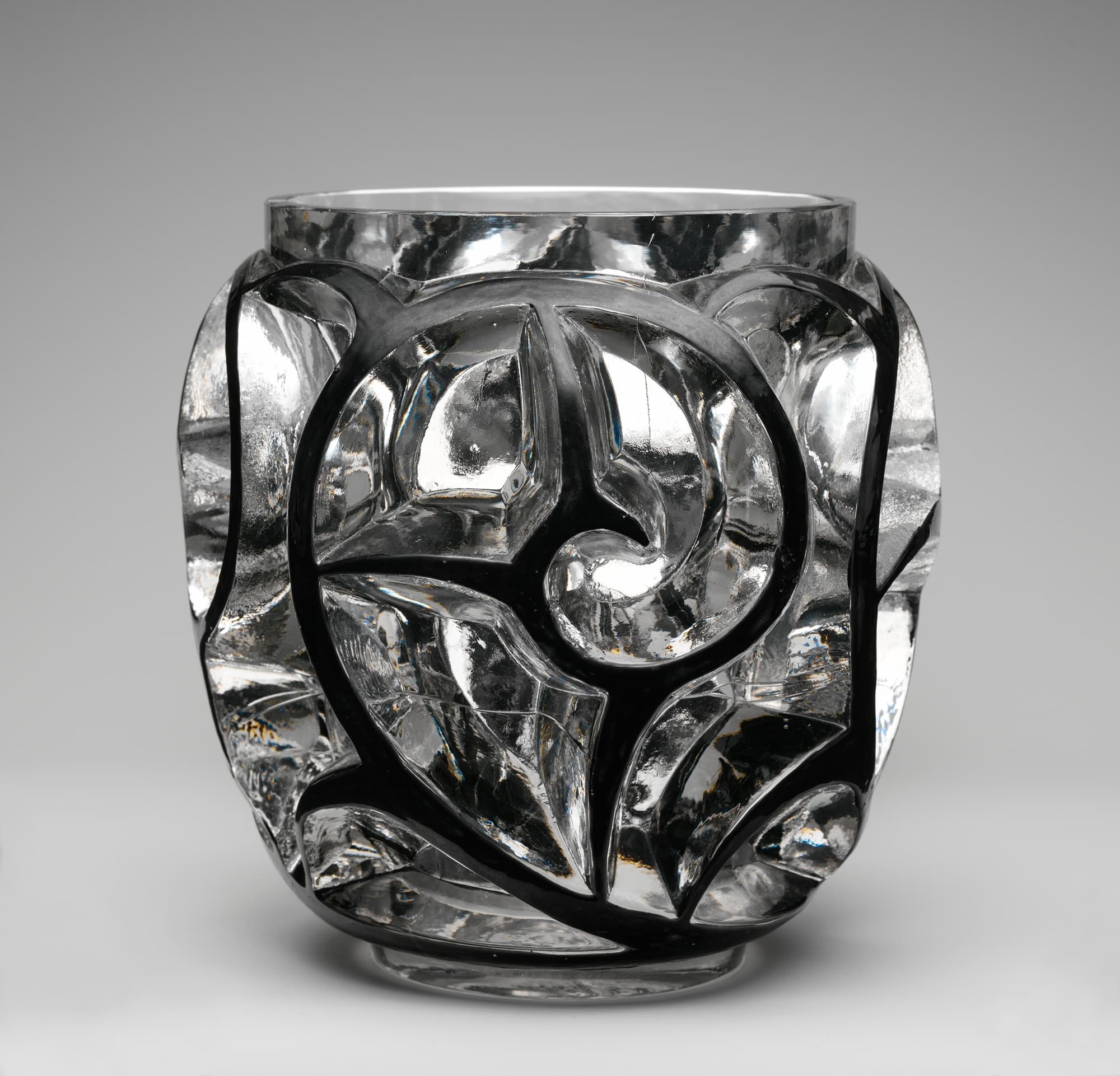
A squat clear glass vase, wider at the shoulder than at the foot. Thick curling forms are cut deep into the wall and sweep around it, one spiralling inward at the centre. Black enamel fills the recessed channels between them. The neck and the foot are left smooth.

Artwork reproduction

Glass · Art Deco

“Tourbillons” (Whirlwinds) Vase

1926 · Clear glass with black enamel detailing

The Tourbillons vase, introduced by the Lalique firm in 1926, is a rounded glass vessel whose surface is worked into thick curling forms that sweep around the body. The Metropolitan Museum of Art's example is clear glass about 20 centimetres high, with black enamel run along the edges of the curls. Who designed it is unsettled: the Met credits René Lalique, while Lalique's own centenary account credits his daughter, Suzanne Lalique-Haviland.
The Metropolitan Museum of Art

René Lalique, “Tourbillons” (Whirlwinds) Vase, 1926. The Metropolitan Museum of Art. Image: CC0.

Movements

The artistic and literary currents this life ran through.

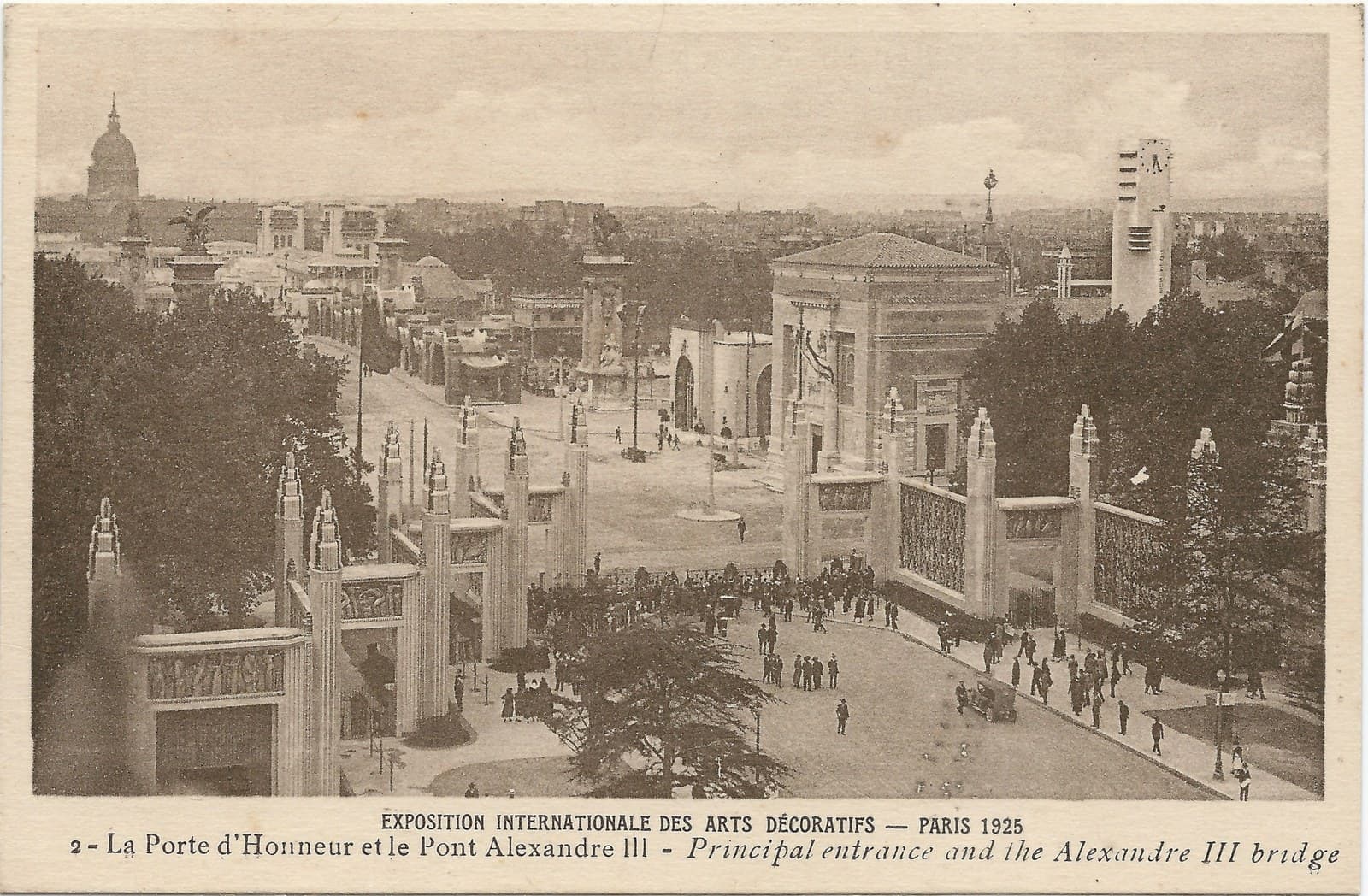
Aerial view of the 1925 Paris decorative arts exhibition: tall square pylons flanking the Porte d'Honneur entrance, crowds on the paths below, pavilions and a clock tower spreading toward the Invalides dome

Art & design movement · circa 1910–1939

Art Deco

Lalique moved artistic design into objects made in quantity. His Wingen-sur-Moder glassworks, founded in 1921, moulded vases, lighting, perfume bottles and car mascots, and his architectural commissions ran from the liner Normandie to a church in Jersey fitted throughout in glass.

Art Deco: René Jules Lalique; Architectural commissions and the liner Normandie

Questions about René Lalique

What is René Lalique known for?

Two careers. In the 1890s he was one of the leading jewellers of Art Nouveau, making ornaments in which insects, flowers, serpents and female figures merge. After 1900 he turned to glass, producing perfume bottles, vases, lighting, architectural fittings and car mascots in quantity.

Why did Lalique move from jewellery to glass?

The commission from the perfumer François Coty, beginning in 1907, was the turn. It let him apply artistic design to objects made in numbers rather than one at a time, and by 1921 he had founded the Wingen-sur-Moder glassworks in Alsace to do it at scale.

Is Lalique glass or crystal?

Interwar Lalique is glass. The firm moved toward crystal after René Lalique's death in 1945, under his son Marc, so the later material should not be assumed for an early piece.

Did his children work for the firm?

Yes. His daughter Suzanne Lalique-Haviland contributed designs for glass, decorative objects and textiles, and work she took part in was often manufactured under her father's signature. His son Marc ran the company after 1945 and shifted it to crystal.

What did Lalique make besides jewellery and vases?

Architecture and transport. He fitted out St Matthew's at Millbrook in Jersey, known as the Glass Church, and made glass doors and chandeliers for Prince Asaka's residence in Tokyo. He supplied fittings for the liner Normandie. He also designed the car mascots that sat on radiator caps in the 1920s and 1930s.

When did René Lalique die?

On 1 May 1945, at his home at 40 Cours-la-Reine in Paris, aged eighty-five, a week before Victory in Europe Day. Rheumatism had cost him the use of his hands and the ability to draw, but no medical cause of death is established in the published accounts. Some older publications give other dates; 1 May is the date the Musée Lalique uses.

Connections and Sources

René Lalique’s connections to people, places, and works, with the sources behind each one.

Associated with · 1921–1945

Art Deco

Lalique moved artistic design into objects made in quantity. His Wingen-sur-Moder glassworks, founded in 1921, moulded vases, lighting, perfume bottles and car mascots, and his architectural commissions ran from the liner Normandie to a church in Jersey fitted throughout in glass.

Art Deco: René Jules Lalique; Architectural commissions and the liner Normandie

References

References

The sources below include biographies, scholarly essays, interviews, and primary materials that informed this page. They reflect both the historical record and ongoing critical conversations about René Lalique and their work.

  1. 1Additional general biographical reference

    Website
    Wikipedia
    Used for

    General biographical reference.

    View source
  2. 2abcdefgEarly life, training, and career

    Website
    Musée Lalique
    Used for

    The museum's biography: his early life, training and career.

    View source
  3. 3abCalouste Gulbenkian, artistic recognition, and the 1900 Exposition Universelle

    Website
    Calouste Gulbenkian Museum
    Used for

    Calouste Gulbenkian's patronage and the recognition Lalique won at the 1900 Exposition.

    View source
  4. 4abcdGlass doors and chandeliers for Prince Asaka's residence

    Website
    Tokyo Metropolitan Teien Art Museum
    Used for

    The glass doors and chandeliers made for Prince Asaka's Tokyo residence.

    View source
  5. 5abcFinal illness, death, and burial

    Website
    R.Lalique.com
    Used for

    Suzanne's letter of 6 June 1945 on the loss of his ability to draw, his death at 40 Cours-la-Reine on 1 May 1945, and the burial at Père-Lachaise.

    View source
  6. 6Drawing and design methods

    Website
    Musée Lalique
    Used for

    His drawing and design methods, and the surviving sheets.

    View source
  7. 7abcArt Nouveau jewelry, materials, and techniques

    Website
    Musée Lalique
    Used for

    The Art Nouveau jewellery, its materials and techniques.

    View source
  8. 8abSymbolism, the female figure, and the woman-flower motif

    Website
    Calouste Gulbenkian Museum
    Used for

    Luísa Sampaio on Symbolism, the female figure, and the woman-flower motif.

    View source
  9. 9Marriages, children, and family life

    Website
    R.Lalique.com
    Used for

    His marriages, children and family life.

    View source
  10. 10abDragonfly Woman corsage ornament - René Lalique

    Website
    Calouste Gulbenkian Museum, via Google Arts & Culture
    Used for

    The Dragonfly Woman corsage ornament, in the Gulbenkian collection.

    View source
  11. 11abNecklace designed for Augustine-Alice Ledru - René Lalique

    Website
    The Metropolitan Museum of Art
    Used for

    The necklace designed for Augustine-Alice Ledru.

    View source
  1. 12abFern Leaves brooch - René Lalique

    Website
    The Walters Art Museum
    Used for

    The Fern Leaves brooch at the Walters Art Museum.

    View source
  2. 13abOrchid Comb - René Lalique

    Website
    The Walters Art Museum
    Used for

    The Orchid Comb at the Walters Art Museum.

    View source
  3. 14abPerfume bottles, François Coty, and manufacturing techniques

    Website
    Musée Lalique
    Used for

    The perfume bottles, the work for François Coty, and the manufacturing techniques behind them.

    View source
  4. 15abDans la nuit perfume bottle for Worth - René Lalique

    Website
    Musée Lalique
    Used for

    The Dans la nuit bottle made for Worth.

    View source
  5. 16abcArt Deco: René Jules Lalique

    Website
    Victoria and Albert Museum
    Used for

    His Art Deco glass, the Pullman Express commission, and the automobile mascots.

    View source
  6. 17abBacchantes vase - René Lalique

    Website
    Musée Lalique
    Used for

    The Bacchantes vase.

    View source
  7. 18Suzanne Lalique-Haviland

    Website
    Musée Lalique
    Used for

    His daughter Suzanne's creative contribution, often manufactured under her father's signature.

    View source
  8. 19abMarc Lalique and the continuation of the company

    Website
    Musée Lalique
    Used for

    His son Marc, and the firm's move to crystal after 1945.

    View source
  9. 20Architectural commissions and the liner Normandie

    Website
    Lalique
    Used for

    The architectural commissions, including the fittings for the liner Normandie.

    View source
  10. 21abSt Matthew's, the Glass Church - Jersey

    Website
    St Matthew's Glass Church
    Used for

    St Matthew's at Millbrook in Jersey, the Glass Church, fitted throughout by Lalique.

    View source
  11. 22The Wingen factory at the outbreak of the Second World War

    Website
    R.Lalique.com
    Used for

    The Time report of October 1939 on his journey to Wingen as the border region faced evacuation.

    View source
i
Why these sources are here

These references anchor the page in the documented record and in the scholarly conversations around René Lalique. Every claim on this page traces back to one or more of the works listed here.

Explore more resources