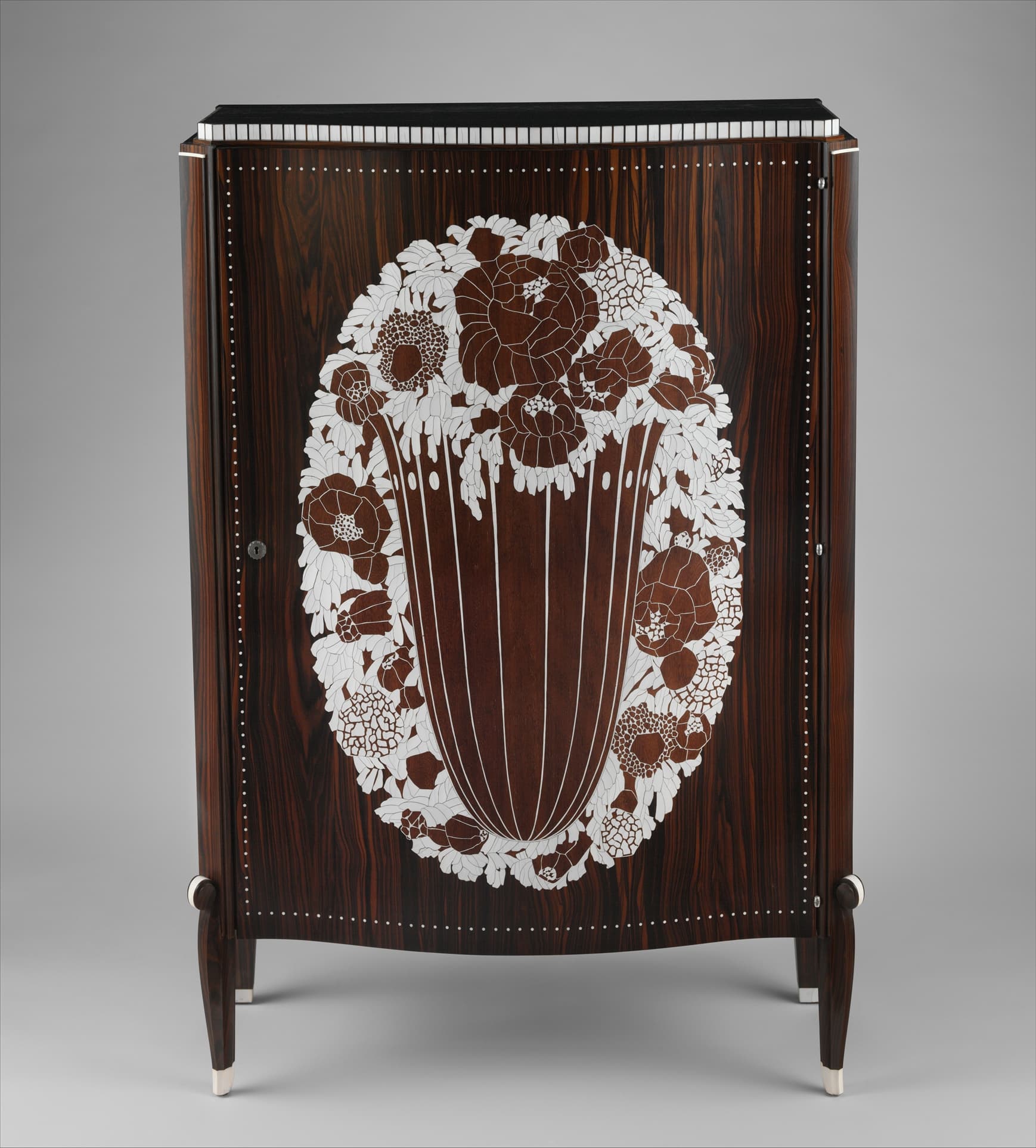
Émile-Jacques Ruhlmann designed the État cabinet in 1922, and the Metropolitan Museum of Art commissioned its own example in 1925. It is an upright case on slender tapering legs, veneered in dark Macassar ebony and inlaid with a large oval of pale stylised flowers in ivory. The name comes from the French state, which bought a related cabinet after the 1925 Paris decorative-arts exhibition.
The État Cabinet exemplifies the luxurious furniture through which Émile-Jacques Ruhlmann helped define French Art Deco. Its effect depends on the relationship between a relatively simple architectural form and exceptionally elaborate surface decoration. Ruhlmann drew on the traditions of eighteenth-century French cabinetmaking, but his furniture was not intended to reproduce an earlier period. He adapted its refinement, craftsmanship, and concern for proportion to the tastes of wealthy twentieth-century clients.[1]
Design and Appearance
The cabinet has an upright rectangular body supported on slender, tapering legs. Its dark, strongly patterned wood is interrupted by pale ornament: a large oval arrangement of stylized flowers and foliage occupies the front, while small repeated details establish a delicate border. The decoration is contained rather than allowed to spread freely across every surface. This gives the cabinet a composed appearance despite the density of its central floral design.
The contrast between the dark wood and pale inlay makes the ornament legible from a distance, but closer examination reveals its intricacy. The flowers have been simplified and reorganized into a symmetrical composition, showing that Art Deco did not necessarily reject botanical decoration. Here, nature becomes a carefully controlled pattern. The narrow legs also contribute to the cabinet's apparent lightness: the decorated body seems elevated rather than planted heavily on the floor.
Materials and Craftsmanship
The cabinet measures 128.2 × 84.4 × 35.6 centimeters. Its materials include Macassar ebony, amaranth, ivory, oak, poplar, chestnut, mahogany, lumber-core plywood, and silvered brass. Its decoration uses marquetry, in which pieces of veneer are cut and fitted together to form a pattern. The combination of different structural woods, veneers, and fittings is important: the finished appearance results from a complex construction, not simply from carving a single valuable material.[2]
Ruhlmann's surviving drawings help explain the discipline behind such objects. His working process could move from preliminary sketches through elaborate colored presentations for clients to full-size drawings used by craftspeople. The apparent effortlessness of the finished furniture concealed extensive planning and highly specialized execution.[1]
Why Is It Called the État Cabinet?
The name État, meaning “state,” refers to the purchase of a related cabinet by the French government following its presentation at the 1925 Paris decorative-arts exhibition. The Metropolitan Museum commissioned its own example from Ruhlmann in 1925. It is therefore a variant of the exhibition model, not the same physical cabinet bought by the French state. Ruhlmann sometimes adapted an established design, changing details to suit a particular commission.[2]
Paris and the Dream of a Complete Interior
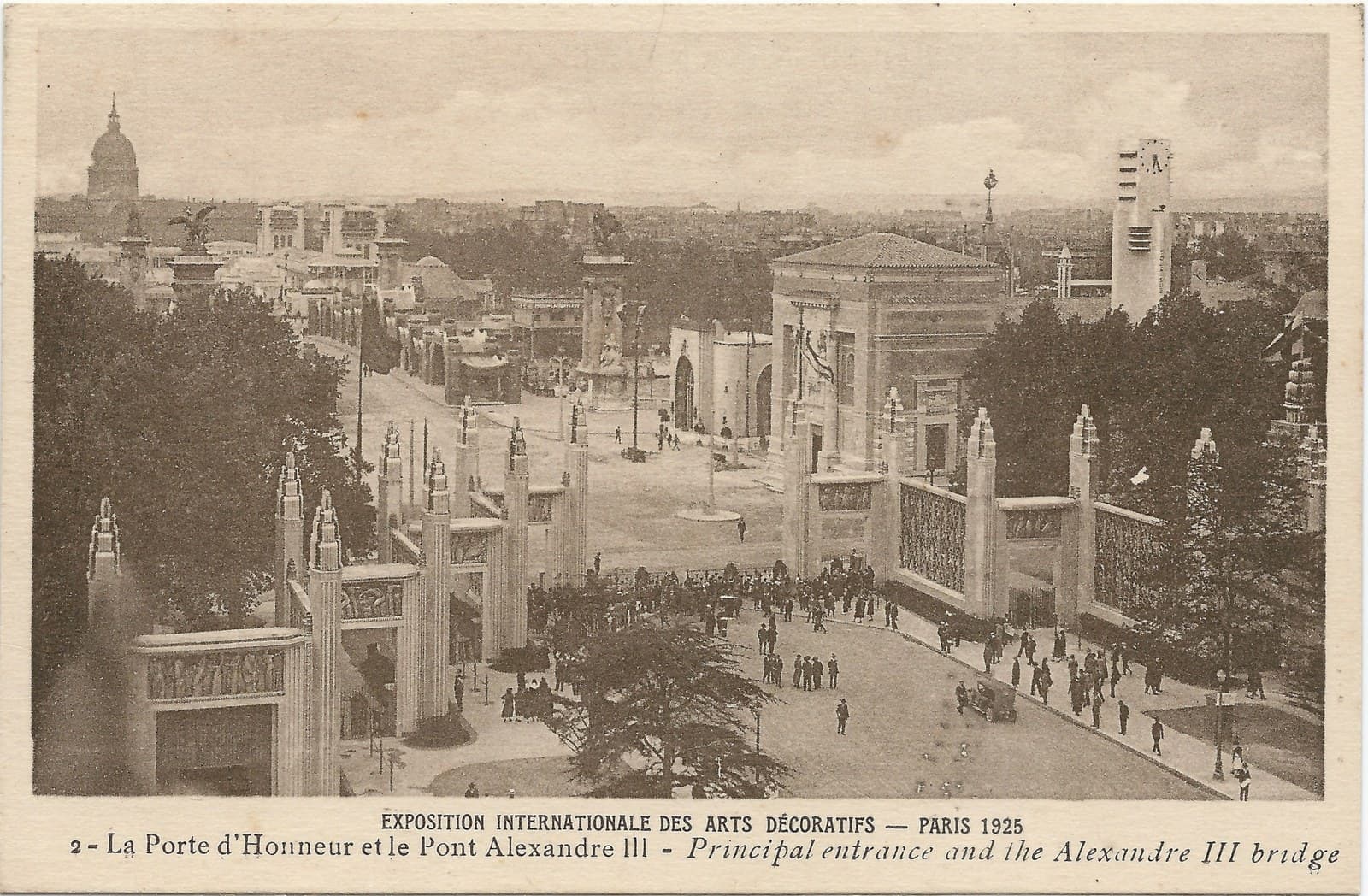
The cabinet belongs to the same design culture represented by Ruhlmann's Hôtel du Collectionneur at the 1925 exhibition. That pavilion presented the imaginary residence of a wealthy collector, with furnishings and decoration coordinated into complete rooms. It offered visitors more than a collection of attractive objects: it proposed an entire environment in which modern wealth could be expressed through cultivated taste.[1]
The Metropolitan Museum's acquisition also places the cabinet within an early international response to French Art Deco. During the 1920s, curator Joseph Breck actively collected contemporary European design, supported by the Edward C. Moore Jr. fund. Ruhlmann's furniture entered the museum as modern work, rather than being recovered decades later as an overlooked historical curiosity.[3]
Significance
The État Cabinet represents Art Deco's exclusive, labor-intensive side. Its modernity does not depend on eliminating ornament or making the object inexpensive. Instead, it lies in reorganizing established craftsmanship into a distinctive contemporary design. Compared with the manufactured household goods that also belonged to Art Deco, it demonstrates how widely the style could vary in cost, production, and intended audience.[4]
Close reading
Reading the work, detail by detail
The cabinet is a plain rectangular case carrying an enormous amount of inlay. The details below show where the ivory goes and what it is doing: an oval bouquet on the front, a run of ivory teeth along the top edge, dotted lines down the door joints, and caps on the feet.
1.A run of ivory teeth along the top edge
Short ivory bars alternate with the dark wood the whole way across, like the keys of a piano. It marks where the top meets the body, so the heaviest concentration of pale material sits at the cabinet's widest visible line.
2.The flowers at the top of the bouquet
Each bloom is built from cut pieces of veneer rather than drawn or carved. Some flowers are pale with dark centres and others reverse it, which is what keeps a symmetrical arrangement from reading as a repeated stamp.
3.The vase the flowers rise from
Fine ivory lines divide the urn into narrow flutes and run almost the full height of the door. They are the only long straight elements in the whole composition, and they hold the spreading bouquet above them.
4.Dotted ivory lines, and the keyhole
A line of small ivory dots runs down each side and across the bottom, framing the doors without drawing a solid border. The keyhole sits in the middle of the left door, small enough that it is easy to miss.
5.The legs, and the ivory on their feet
The legs taper to a narrow foot capped in ivory, with an ivory disc where each leg meets the body. Because the case sits on four thin supports rather than on the floor, the decorated body reads as raised.
6.The grain of the Macassar ebony
The sides carry no inlay at all, only the striped veneer. Its dark bands run vertically and are matched across the surface, which gives the plain areas a pattern of their own and makes the pale front inlay read at a distance.
Where to see it
The Metropolitan Museum of Art
1000 Fifth Avenue, New York, NY 10028, United States
Gallery displays change, so check the museum's own object record before making a special visit.
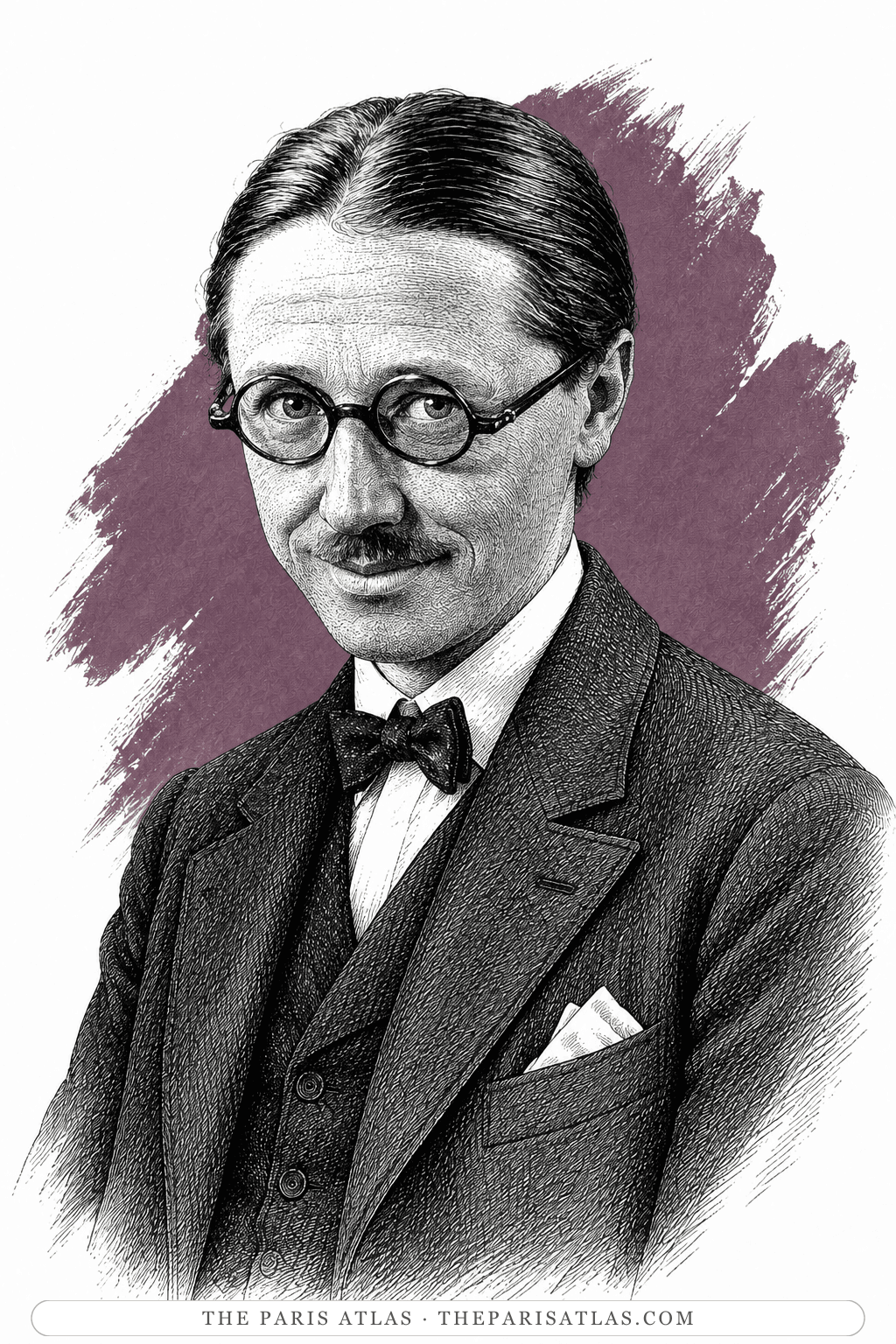
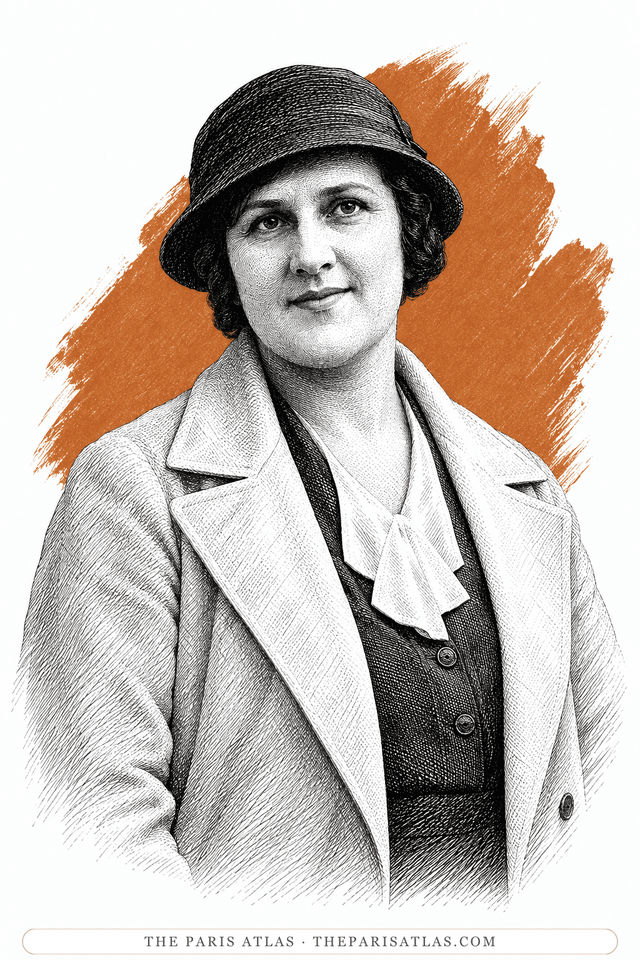
Émile-Jacques Ruhlmann, the French furniture designer, in 1922. The Metropolitan Museum of Art's example was manufactured in 1925–26.
Why is it called the État cabinet?
État is French for “state.” The French government bought a related cabinet after it was shown at the 1925 Paris decorative-arts exhibition. The Metropolitan Museum's cabinet is a variant of that exhibition model, commissioned separately in 1925, not the cabinet the state bought.
What is the État cabinet made of?
Macassar ebony, amaranth, ivory, oak, poplar, chestnut, mahogany, lumber-core plywood and silvered brass. The pale floral oval on the front is marquetry: veneer cut into pieces and fitted together to make the pattern.
How big is the État cabinet?
128.2 centimetres high, 84.4 wide and 35.6 deep. It stands on slender tapering legs, which make the decorated body look raised rather than planted on the floor.
Where can I see the État cabinet?
At the Metropolitan Museum of Art in New York. Gallery displays change, so check the museum's own object record before making a special visit.
In the atlas
What the graph records about this work — every claim carries its citation.
Ruhlmann's cabinet is the luxury end of Art Deco: a plain architectural case carrying elaborate ivory marquetry on Macassar ebony. Its name comes from the French state's purchase of a related cabinet after the 1925 Paris exhibition, where Ruhlmann's Hôtel du Collectionneur presented coordinated rooms rather than separate objects.
— Émile-Jacques Ruhlmann, État cabinet — collection record; Ruhlmann: Genius of Art Deco / Art Deco Paris — exhibition press release; Jared Goss, French Art Deco
If you like Émile-Jacques Ruhlmann
Explore designers from the same movements and circles.
A. M. Cassandre
French poster designer whose advertisements for railways, liners and aperitifs — Nord Express, Dubonnet, Normandie — reduced their subjects to a few commanding shapes.
British ceramic designer who began factory work at thirteen and whose brightly painted Bizarre range, launched in 1927, put Art Deco on ordinary tables.
Irish designer and architect, a pioneer of modern furniture and architecture whose Riviera house E-1027 is a landmark of the movement; her furniture stayed obscure until a 1970s rediscovery.
The sources below include collection records, catalogues, scholarly research, and primary materials that informed this page. They document État Cabinet, its making, and its place in cultural history.
1abcRuhlmann: Genius of Art Deco / Art Deco Paris — exhibition press release
Website
The Metropolitan Museum of Art
Used for
Ruhlmann's career, craftsmanship and design process, and the Hôtel du Collectionneur at the 1925 Paris exhibition.
2abÉmile-Jacques Ruhlmann, État cabinet — collection record
Website
The Metropolitan Museum of Art
Used for
The holding museum's record: the 1922 design date, the 1925–26 manufacture of this example, the materials and 128.2 by 84.4 by 35.6 cm dimensions, the marquetry, and the relationship to the cabinet bought by the French state.
These references provide the documented foundation for this work's history and interpretation. Claim-level citations remain attached to the specific claims they support.



 View source