The Paris AtlasCharting the artists, works, and places worth returning to.
  • Designer
  • Architect
· Irish · 1878–1976

Eileen Gray

Irish designer and architect, a pioneer of modern furniture and architecture whose Riviera house E-1027 is a landmark of the movement; her furniture stayed obscure until a 1970s rediscovery.

Details

Lived
1878–1976
Born
9 August 1878
Birthplace
Enniscorthy, County Wexford, Ireland
Birth name
Kathleen Eileen Moray Smith
Died
31 October 1976 · aged 98
Place of death
Paris
Nationality
Irish
Profession
Designer and architect
Major works
the lacquer screens and the Bibendum chair, the Jean Désert shop, the E-1027 table, and the house E-1027
Partner
Jean Badovici · c. 1921–1932
Roles
DesignerArchitect

About Eileen Gray

Irish designer and architect, maker of the lacquer furniture and the house E-1027

Eileen Gray was an Irish designer and architect, born Kathleen Eileen Moray Smith near Enniscorthy in County Wexford on 9 August 1878. She spent almost her whole working life in Paris, where she made her name first in lacquer furniture and interiors and then in architecture. Her house E-1027, built on the Riviera between 1926 and 1929, is regarded as a landmark of the modern movement.

She learned the craft at both ends. Years of Japanese lacquer technique under Seizo Sugawara left her with a painful rash on her hands. Then, in her forties, she built a self-made architectural apprenticeship, since no school would train a woman as an architect. Her shop Jean Désert sold her rugs and furniture to clients including James Joyce and Ezra Pound, and her Bibendum chair and E-1027 side table are now design classics, still in production.

Recognition came only at the very end of her long life. Forgotten for decades, Gray was rediscovered in the early 1970s, given her first retrospective at ninety-three, and lived to see her work reappraised before her death in Paris on 31 October 1976, aged 98. In 2009 one of her armchairs sold for over 21 million euros, an auction record for twentieth-century decorative art.

Ireland, the Slade, and the lacquer years, 1878–1913

Kathleen Eileen Moray Smith was born on 9 August 1878 at Brownswood, an estate near Enniscorthy in County Wexford, the youngest of five children of a Scottish landscape painter and an Anglo-Irish mother who became Baroness Gray in 1895. The family took the name Gray, and Eileen grew up between Ireland and Kensington. She studied painting at the Slade School in London from 1900, one of many women in a bohemian, co-educational school.

In London she met the furniture restorer Dean Charles and took her first lessons in lacquer. She moved to Paris in 1902 and, back in the city for good, trained under Seizo Sugawara, a Japanese lacquer master in Paris to restore pieces for the Exposition Universelle. The work was so demanding it gave her the painful lacquer rash on her hands, but by 1912 she was producing lacquer screens and furniture on commission for wealthy Paris clients.

Jean Désert and the modern turn, 1917–1930

After the war Gray moved from lacquer objects into whole interiors. Her redesign of the milliner Juliette Lévy's apartment on the rue de Lota, finished around 1919, became a showcase of Art Deco and introduced two of her most famous designs, the tyre-shaped Bibendum chair and the gondola-like Pirogue day bed. Its success let her open her own shop.

Jean Désert opened in 1922 on the fashionable rue du Faubourg Saint-Honoré, named for an imaginary male proprietor and Gray's love of the North African desert; she designed the shopfront herself. It sold her abstract geometric rugs and her furniture to clients including James Joyce, Ezra Pound and Elsa Schiaparelli. Through the 1920s her work shed its early luxury of ivory and exotic wood and turned simpler and more industrial, following her growing interest in Le Corbusier and the modernists. Jean Désert closed at a loss in 1930.

E-1027 and the move into architecture, 1921–1932

By 1921 Gray was involved with the Romanian architect and writer Jean Badovici, fifteen years younger, who encouraged her toward building. With no formal training open to her, she taught herself, studying technical books, taking drafting lessons, and visiting sites with the architect Adrienne Gorska. From 1926 to 1929 she designed and built a holiday house near Roquebrune-Cap-Martin on the Riviera, staying on site through the construction while Badovici visited.

The house is called E-1027, a code for the couple's initials: E for Eileen, 10 for the J of Jean, 2 for the B of Badovici, 7 for the G of Gray. Because a foreigner could not fully own French property, she bought the land in Badovici's name, making him her client on paper. A white box raised on pillars, it follows Le Corbusier's five points. But Gray filled it with her own idea of use. She built in folding, multi-purpose furniture she called camping style, a cork-topped tea trolley to stop the cups rattling, and mirrors set so a guest could see the back of their own head.

When the house was finished, Badovici devoted an issue of his magazine to it and announced himself as its joint architect. The National Museum of Ireland curator Jennifer Goff later disputed the claim: the surviving plans are all in Gray's hand, and Goff calls Badovici the client and consultant, not the designer. Gray and Badovici's relationship ended in 1932, and she went on to build a second house nearby, Tempe à Pailla, for herself.

The Le Corbusier murals, 1938–1939

Gray had wanted E-1027 kept free of any decoration. In 1938 and 1939, staying in the house as Badovici's guest after Gray had left it, Le Corbusier painted eight large murals on its walls, in some accounts working in the nude. Gray regarded it as a violation, and later critics have read it the same way: the architect Rowan Moore called it an act of naked phallocracy, a man marking his dominion over another architect's work. The murals made the house famous under Le Corbusier's name for decades and helped push Gray's own authorship into the shadows.

Obscurity, rediscovery, and death, 1940–1976

For most of the mid-century Gray was forgotten. As the critic Reyner Banham put it, if the canon-defining books of the 1930s and 1940s did not publish you, you dropped off the record, and Gray's rich, personal style was too much for the pundits to place. She kept working quietly in France through the war and after.

The recovery came suddenly in the early 1970s. Yves Saint Laurent bought a Gray lacquer panel at a 1972 Paris auction, reviving interest. The first retrospective, Eileen Gray: Pioneer of Design, opened in London the same year, and a Dublin show followed. There the ninety-five-year-old Gray was made an honorary fellow of the Royal Institute of the Architects of Ireland. In 1973 she signed a contract with Aram Designs in London to reproduce the Bibendum chair and other pieces, which remain in production. She died in Paris on 31 October 1976, aged 98, and is buried in Père Lachaise, though her grave is unmarked because the licence fee went unpaid.

How Gray worked

Gray started from the object and the body, not the facade. She learned lacquer as a craft over years of apprenticeship, and she carried that patience into furniture and buildings: pieces that fold, extend, pivot and multitask, designed around how a person actually moves through a room. She rejected the modernists' focus on the exterior, writing that the interior plan should not be the incidental result of the facade but should lead to a complete, harmonious and logical life.

Her materials moved with the century, from ivory, exotic wood and hand-laid lacquer in the 1910s to tubular steel, cork and celluloid by the late 1920s, but the attention to use never changed. E-1027, in the critic Rowan Moore's phrase, grows from furniture into a building, and it is that seamlessness, object and architecture thought as one, that marks her apart from the men whose movement she joined.

Reputation

Gray is now counted among the major designers and architects of the twentieth century, and E-1027 has been restored and opened to visitors as a monument of modern architecture. The Bibendum chair and the adjustable E-1027 table are permanent fixtures of design, still manufactured, and the National Museum of Ireland keeps a permanent Gray exhibition at Collins Barracks in Dublin.

The market caught up hardest of all: in 2009 her Dragons armchair, once owned by Yves Saint Laurent and Pierre Bergé, sold in Paris for 21.9 million euros, a record for twentieth-century decorative art. Documentaries and a 2015 biopic, The Price of Desire, have retold her story, and the fight over E-1027's authorship has become a set piece in the history of how women were written out of modernism.

Life events

  1. 1878

    Born Kathleen Eileen Moray Smith near Enniscorthy, County Wexford, Ireland, on 9 August.

    Eileen Gray

  2. 1900

    Begins fine-art study at the Slade School in London, and takes her first lacquer lessons.

    Eileen Gray

  3. 1907

    Settles in Paris and trains under the Japanese lacquer master Seizo Sugawara.

    Eileen Gray

  4. 1919

    Completes the rue de Lota apartment for Juliette Lévy, introducing the Bibendum chair.

    Eileen Gray

  5. 1922

    Opens her shop Jean Désert on the rue du Faubourg Saint-Honoré.

    Eileen Gray

  6. 1929

    Completes E-1027, the Riviera house she designed and built with Jean Badovici as client.

    Eileen Gray Collection

  7. 1938

    Le Corbusier begins painting murals inside E-1027 against Gray's wishes.

    Eileen Gray

  8. 1972

    Yves Saint Laurent's auction purchase and a London retrospective revive interest in her work.

    Eileen Gray

  9. 1973

    At ninety-five, is made an honorary fellow of the Royal Institute of the Architects of Ireland, and licenses Aram Designs to reproduce her furniture.

    Eileen Gray

  10. 1976

    Dies in Paris on 31 October, aged 98, and is buried in Père Lachaise.

    Eileen Gray

  11. 2009

    Her Dragons armchair sells in Paris for 21.9 million euros, a record for twentieth-century decorative art.

    Eileen Gray

People they knew

Documented connections — every one carries its source.

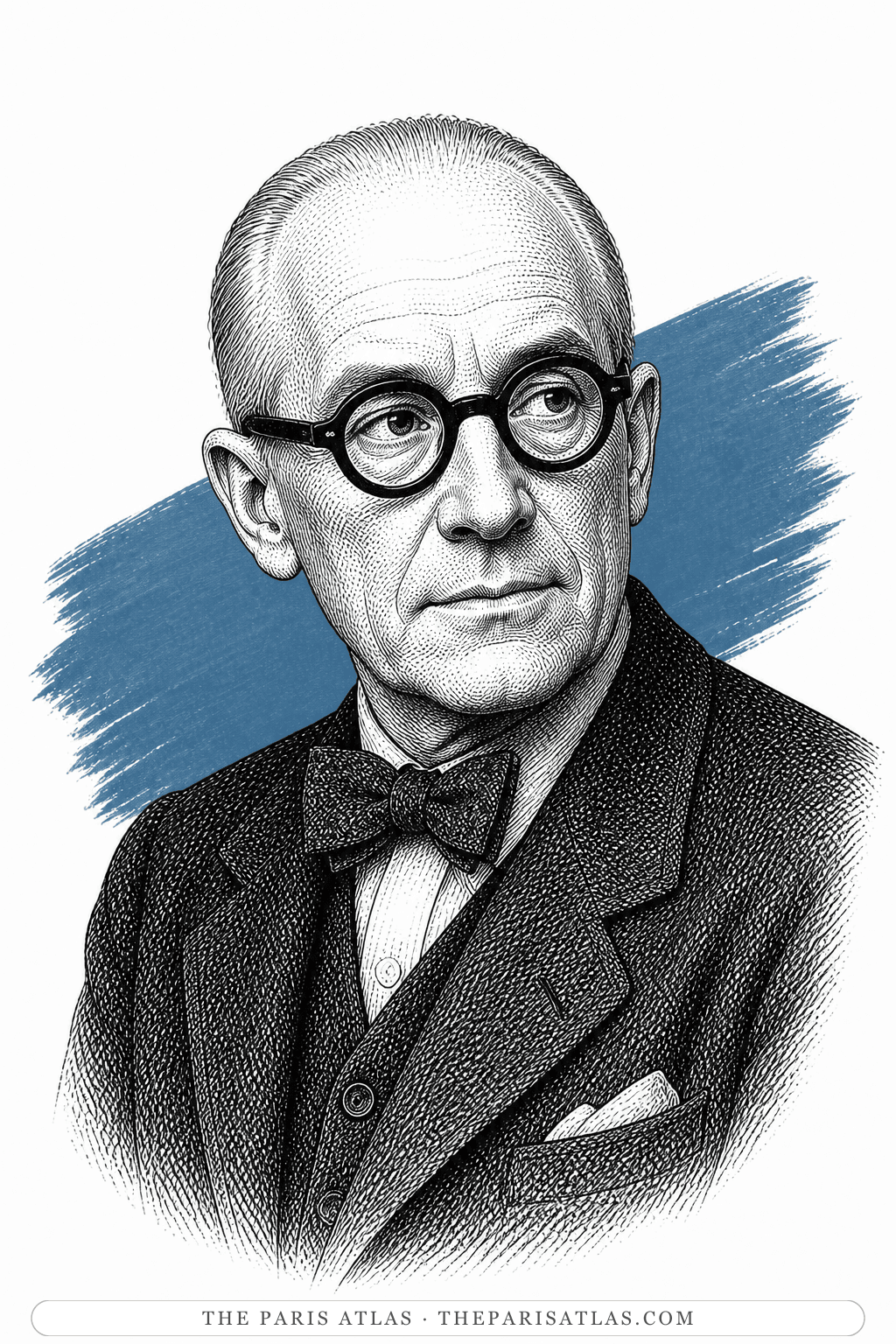
Illustrated portrait of Le Corbusier

Le Corbusier

  • Architect
  • Painter
  • Author

Met

Le Corbusier admired and then, in 1938–39, painted eight murals inside Gray's house E-1027 while staying there as the guest of its co-owner Jean Badovici, against Gray's wish that the house stay free of decoration. Critics have since read the act as a man imposing himself on a woman's masterwork; the episode ties the two architects together for good, and Le Corbusier died swimming below the house in 1965.

Eileen Gray

Questions about Eileen Gray

Who was Eileen Gray?

Eileen Gray (1878–1976) was an Irish designer and architect who worked mainly in Paris. She began in Japanese lacquer and luxury furniture, opened her own shop Jean Désert in 1922, and then taught herself architecture, building the Riviera house E-1027, now regarded as a landmark of the modern movement. Forgotten for decades, she was rediscovered in the early 1970s and is now counted among the century's major designers.

What is E-1027?

E-1027 is a white modernist villa Gray designed and built between 1926 and 1929 at Roquebrune-Cap-Martin on the French Riviera, for herself and her partner Jean Badovici. The name is a code for their initials. Raised on pillars and filled with Gray's ingenious folding and multi-purpose furniture, it is considered a masterpiece of modern architecture. It has been restored and opened to visitors.

What did Le Corbusier do to E-1027?

In 1938 and 1939, staying in the house as Jean Badovici's guest after Gray had moved out, Le Corbusier painted eight large murals on its walls, which Gray had wanted left bare. Gray considered it a violation of her work, and later critics have agreed; the architecture writer Rowan Moore called it an act of naked phallocracy. The murals also had the effect of attaching the famous house to Le Corbusier's name and helping obscure Gray's authorship for decades.

Why was Eileen Gray forgotten for so long?

Her work fell outside the canon that the design histories of the 1930s to 1950s fixed. As the critic Reyner Banham observed, if those canon-defining books did not include you, you simply dropped off the record. Gray's rich, personal style did not fit the movement's official story, and she was a woman working in a field that credited men. The misattribution of E-1027 to Badovici and its association with Le Corbusier pushed her further out of view until the 1970s.

How did Eileen Gray die?

She died in Paris on 31 October 1976, at the age of 98, having lived just long enough to see her work rediscovered and celebrated. She is buried in the Père Lachaise Cemetery, but her grave is unmarked and hard to locate because her family did not pay the burial licence fee.

What is the Bibendum chair?

The Bibendum chair is one of Gray's best-known furniture designs, created around 1919 for the rue de Lota apartment. Its plump, curved leather back, made of two semicircular padded tubes on a chromed steel frame, echoes the Michelin Man, whose nickname is Bibendum. Along with her adjustable E-1027 side table, it is a design classic and has been in continuous production since Aram Designs began reproducing her work in 1973.

Sourced claims

Every connection the graph holds for Eileen, with the evidence behind it.

Met

Le Corbusier

Le Corbusier admired and then, in 1938–39, painted eight murals inside Gray's house E-1027 while staying there as the guest of its co-owner Jean Badovici, against Gray's wish that the house stay free of decoration. Critics have since read the act as a man imposing himself on a woman's masterwork; the episode ties the two architects together for good, and Le Corbusier died swimming below the house in 1965.

Eileen Gray

References

References

The sources below include biographies, scholarly essays, interviews, and primary materials that informed this page. They reflect both the historical record and ongoing critical conversations about Eileen Gray and their work.

  1. 1Eileen Gray

    Website
    Wikipedia
    Used for

    Reference article cross-checked for the biography, the lacquer training, Jean Désert, E-1027, the Le Corbusier murals, and the rediscovery.

    View source
  2. 2Eileen Gray Collection

    Website
    National Museum of Ireland
    Used for

    The National Museum of Ireland's Gray collection, and Jennifer Goff's finding on the E-1027 authorship.

    View source
  1. 3Eileen Gray

    Website
    The Museum of Modern Art
    Used for

    The Museum of Modern Art's artist record.

    View source
  2. 4Eileen Gray

    Website
    Encyclopaedia Britannica
    Used for

    Encyclopaedia Britannica's biography, used to confirm dates and the career outline.

    View source
i
Why these sources are here

These references anchor the page in the documented record and in the scholarly conversations around Eileen Gray. Every claim on this page traces back to one or more of the works listed here.

Explore more resources