Modernity
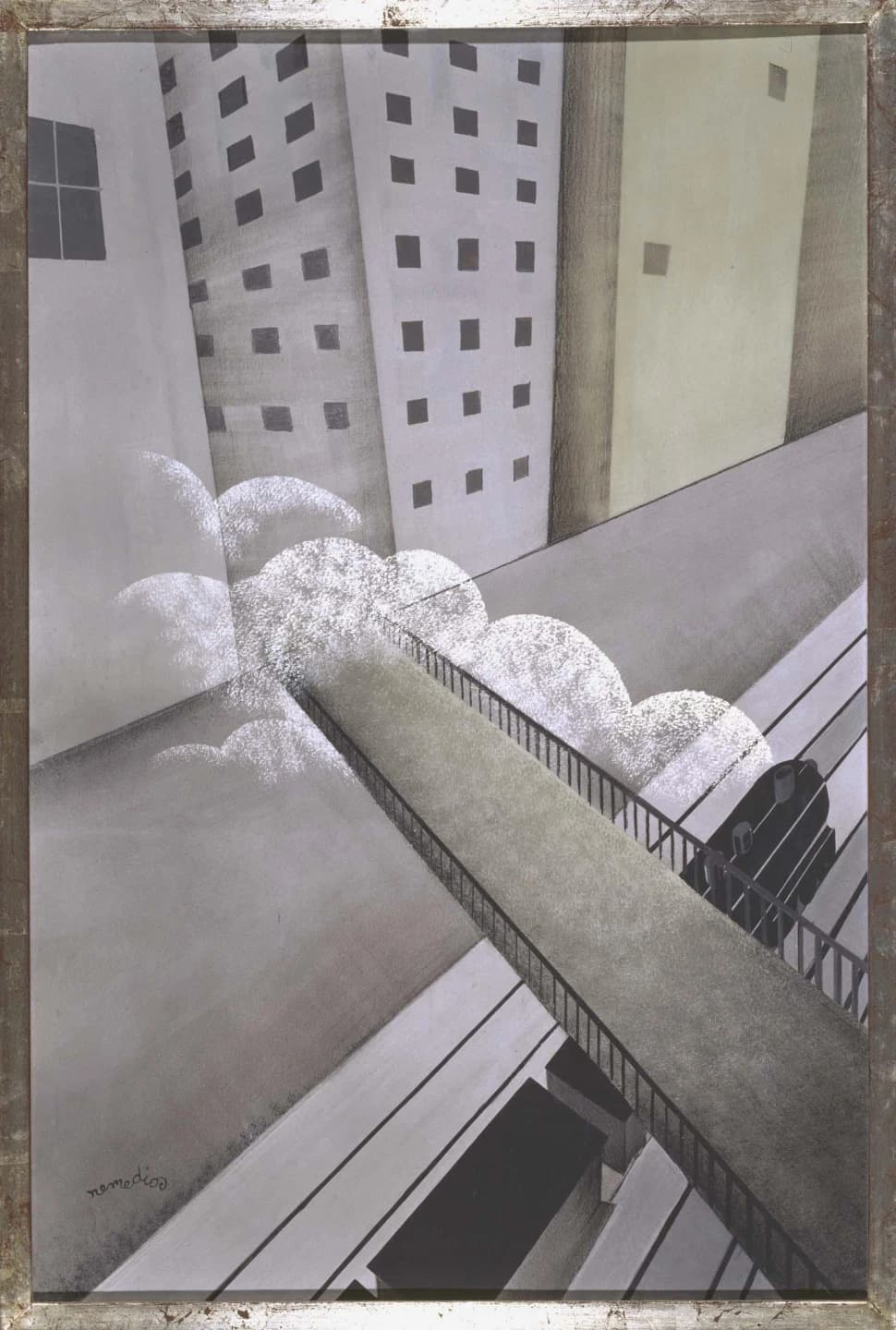
A city of pale tower blocks seen from high up, with a viaduct cutting across it and a steam locomotive running along the viaduct. Remedios Varo painted it in Spain in 1936, the year the Spanish Civil War began and the last year she lived there. There is almost no colour in it. The Museo Nacional Centro de Arte Reina Sofía in Madrid bought it into the collection in 2000.
- 1936
- Pencil, gouache and graphite on plywood
- Museo Nacional Centro de Arte Reina SofíaMadrid, Spain
About Remedios Varo
What the painting shows
The viewpoint is above the city and tipped over, so the buildings lean and the ground is not where a standing person would expect it. Four or five pale slabs rise on the left and in the middle distance, each punched with dark square windows set in an irregular grid. A wide ramp runs diagonally from the lower left to the upper right, carrying a railing of thin black uprights.
A steam locomotive runs on that ramp, low in the picture and to the right. It is a black mass seen from above and behind, with a tall chimney and a shorter dome on top of the boiler, and the rails show as pale parallel lines under it. Ahead of it a bank of white steam boils up, painted as dense stippled dots against the flat grey planes.
The whole sheet is grey, off-white and black, with one warmer cream plane at the upper right. The support is plywood, and its grain shows through the thin gouache as fine vertical striations across the tower blocks. Remedios Varo signed it at the lower left, in a small cursive hand, with her given name alone: remedios.
The title is the subject
The Museo Nacional Centro de Arte Reina Sofía catalogues the work in Spanish as Modernidad and gives Modernity as the English form. The picture takes the word literally. Tower blocks, a concrete viaduct, a railway and a locomotive were the standard furniture of what the 1930s meant by a modern city.
Nothing human appears. There are no figures on the ramp, none at the windows, and no driver visible on the engine. What the picture gives instead is machinery and housing, seen from an angle no inhabitant would occupy.
Painted in the year the war began
The date the museum records is 1936. In July of that year army officers under General Francisco Franco rose against Spain's elected Republican government, and the Spanish Civil War began. Remedios Varo was twenty-eight and living in Barcelona, where she had joined the Logicofobistas, a short-lived group of Catalan Surrealists whose invented name means, roughly, those who fear logic.
The museum's own account of her life records that she took part in the Exposición Logicofobista in Barcelona in 1936 and moved to Paris in 1937. She left Spain with the French Surrealist poet Benjamin Péret, who had come to fight on the Republican side. She did not live in Spain again.
How it reached Madrid
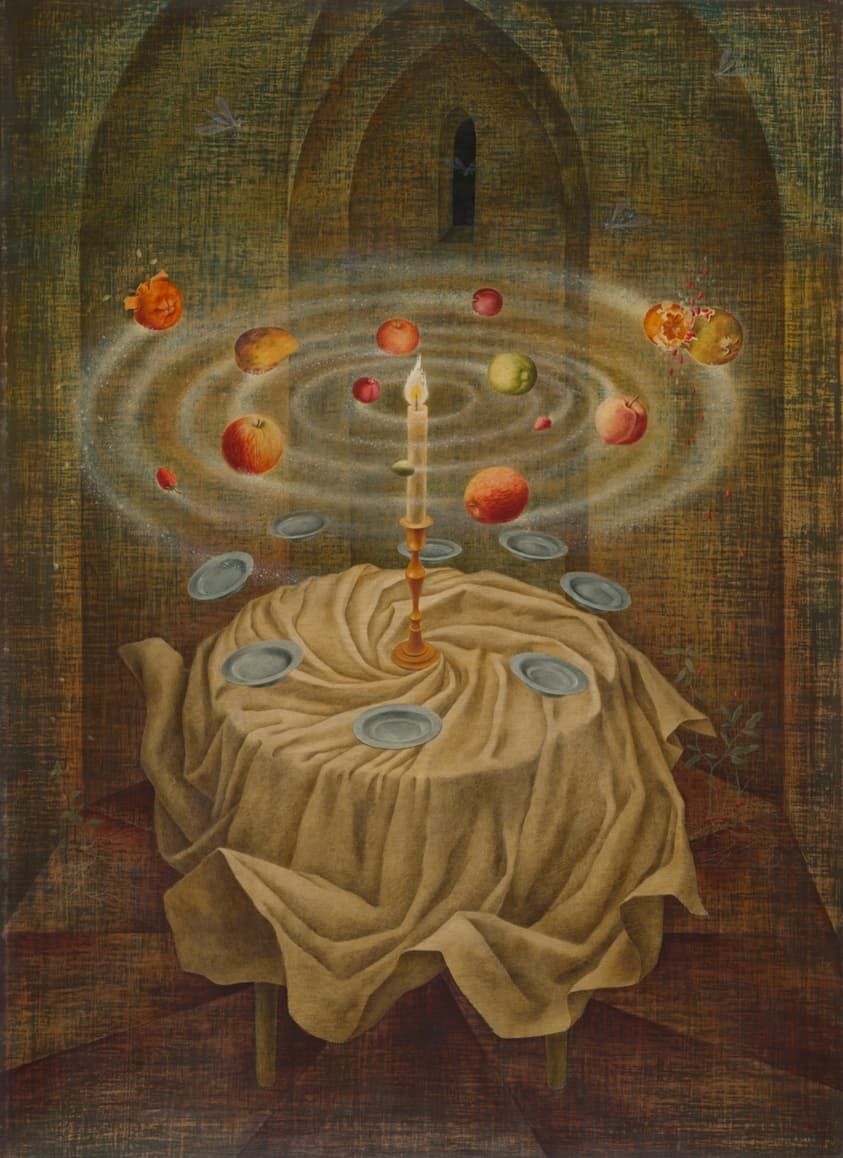
The Museo Nacional Centro de Arte Reina Sofía records the year of entry as 2000 and the registration number as AD01916. It is the earliest of the four works by Remedios Varo the museum holds, and the only one of them painted in Spain.
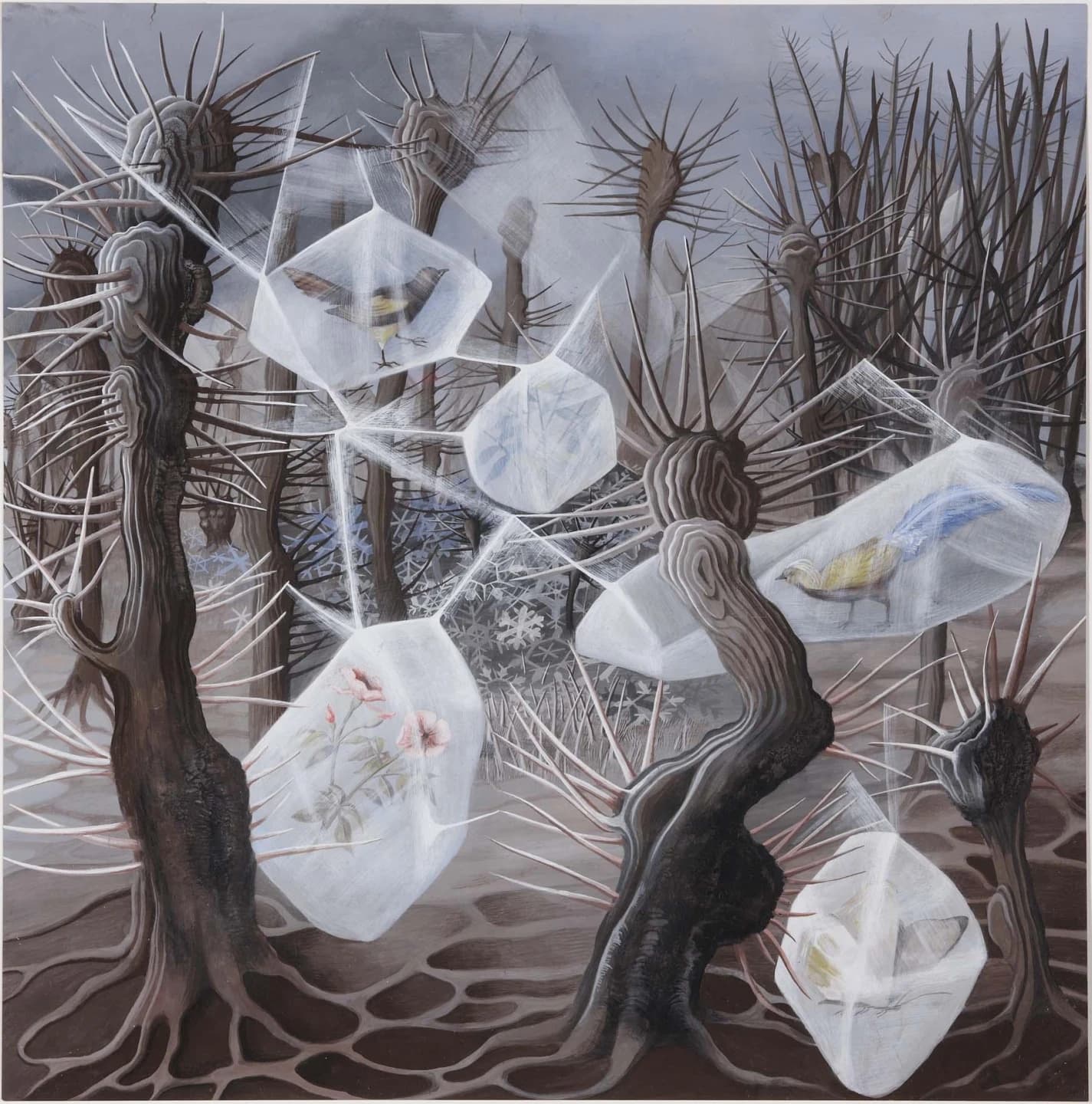
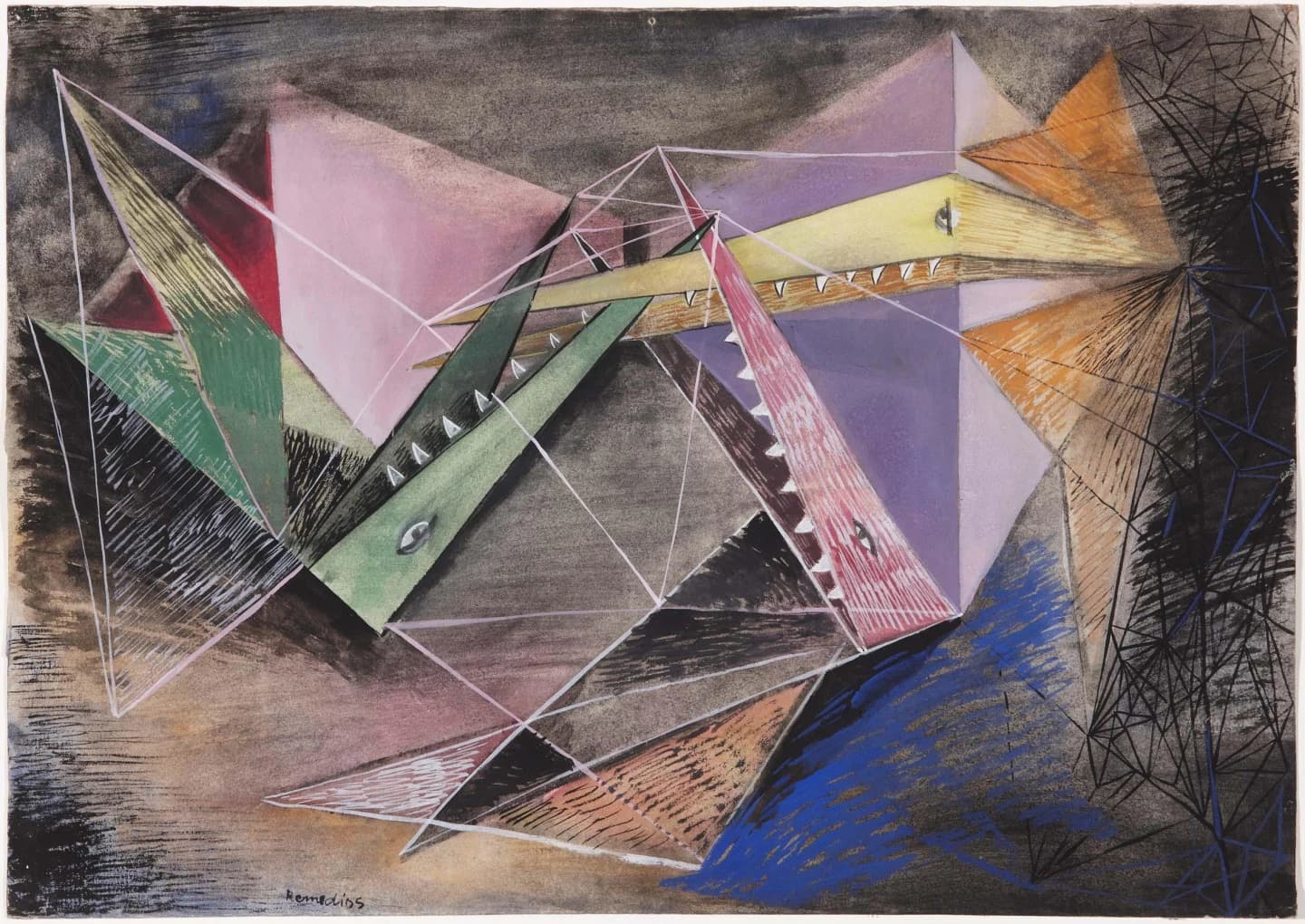
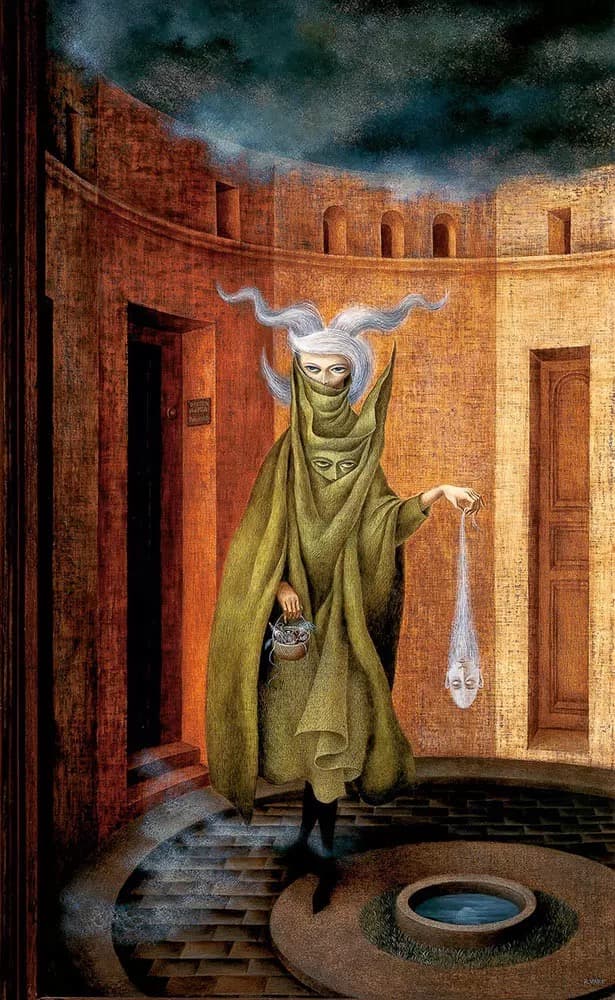
The other three arrived later. La Faim, made in Paris in 1938, and Alegoría del invierno, made in Mexico in 1948, both entered in 2012; Mujer o el espíritu de la noche, of 1952, entered in 2023. Almost everything else she made stayed in Mexico.
Close reading
Reading the work, detail by detail
Remedios Varo painted a city from above and tilted it over, in grey, off-white and black on a plywood panel. The Museo Nacional Centro de Arte Reina Sofía gives the technique as pencil, gouache and graphite. The close views take the machinery a part at a time.
1.Windows punched in a leaning slab
The slab carries about twenty dark square windows, set in rows that do not line up with each other. The squares are filled with flat graphite, and their edges are drawn rather than painted. Fine vertical striations run down the whole face of the building: that is the grain of the plywood underneath, showing through gouache laid thin.
2.One window is drawn as a window
In the top left corner one window is given glazing bars, dividing it into four panes. Every other opening in the picture is a plain dark square. The wall it sits in has no other feature at all.
3.The ramp and its railing
The ramp runs corner to corner as a flat pale band with no texture on it. Its railing is drawn as a row of thin black uprights carrying two horizontal rails, and the uprights are evenly spaced along the whole length. The railing is the only thing in the picture drawn at the scale of a human hand.
4.A locomotive seen from above
The engine is a solid black mass with two cylinders standing up from the boiler: a tall chimney forward and a shorter, wider dome behind it. Beneath it four pale parallel lines give the rails and the sleeper ends. The black railing crosses in front, so the engine is seen through it, from above and from behind.
5.Steam painted as dots
The steam is the only part of the picture with a broken surface. It is built from thousands of small white dots stippled over the grey, massed into rounded lobes with hard outer edges. Everything around it — walls, ramp, sky — is laid in flat unbroken tone.
6.The one warm plane
At the upper right a single plane is cream rather than grey, and it carries one dark square window near its top. It is the only warm colour in the picture. The grey plane beside it is separated only by a drawn edge.
7.Signed with her first name
The signature reads remedios, in a small cursive hand, with no surname and no date. She signed La Faim and Alegoría del invierno the same way. The lettering sits directly on the flat grey of the ramp.
8.The frame is part of the object
The museum photographs the panel in its frame. The frame is silver-leafed and worn, with the leaf rubbed through to a reddish ground along the edges and corners. It reads as part of the object rather than as a later mount, though the museum's record does not describe it.
Timeline
1936
Painted in Spain, in pencil, gouache and graphite on a plywood panel.
1936
The Spanish Civil War begins in July. Remedios Varo is in Barcelona, showing with the Logicofobistas.
1937
She moves to Paris with the Surrealist poet Benjamin Péret and joins the circle around André Breton.
2000
Enters the collection of the Museo Nacional Centro de Arte Reina Sofía in Madrid as AD01916.
Where to see it
Museo Nacional Centro de Arte Reina Sofía
Calle Santa Isabel 52, 28012 Madrid, Spain
The museum records the year of entry as 2000 and does not publish a permanent gallery location for the work. Check the collection record before travelling.
Plan your visit on the museum’s official website (opens in a new tab)Frequently asked questions
Where is Remedios Varo's Modernidad?
At the Museo Nacional Centro de Arte Reina Sofía in Madrid, registration number AD01916. The museum records the year of entry as 2000. It is one of four works by Remedios Varo the museum holds.
What is Modernidad painted on?
Plywood. The museum gives the technique as pencil, gouache and graphite on plywood, and the sheet measures 79 by 49 centimetres. The wood grain is visible through the thin paint across the tower blocks.
What does Modernidad show?
A city of pale tower blocks seen from above and tilted, with a diagonal ramp carrying a railing and a steam locomotive. White steam rises ahead of the engine. There are no people anywhere in the picture.
When did Remedios Varo paint Modernidad?
In 1936, the year the Spanish Civil War began. She was twenty-eight, living in Barcelona, and showing with the Logicofobistas, a small group of Catalan Surrealists. She left Spain for Paris the following year.
Does Modernidad look like her famous paintings?
No. The pictures she is known for were painted in Mexico in the late 1950s and are full of colour, invented machinery and heart-faced figures. Modernidad is almost monochrome, geometric, and has no figures in it at all.
How did Remedios Varo sign Modernidad?
With her given name alone, written small in cursive at the lower left: remedios. She signed La Faim and Alegoría del invierno the same way.
More by Remedios Varo
If you like Remedios Varo
Explore painters from the same movements and circles.
Jean Arp
Strasbourg-born sculptor and poet — Hans in German, Jean in French, both all his life — who co-founded Dada at the Cabaret Voltaire in 1916, composed collages by dropping torn paper 'according to the laws of chance', and settled at Meudon outside Paris in a house his wife Sophie Taeuber-Arp designed.
View artist
Leonora Carrington
English painter and writer who fled a debutante's future for Surrealist Paris at twenty, survived the war's wreckage of that life — internment for her lover Max Ernst, an asylum in Spain for her — and rebuilt herself in Mexico into one of the century's great painters of the uncanny.
View artist
Henri Cartier-Bresson
French photographer who turned a pocket-sized 35mm camera into an instrument of split-second composition — the idea the world knows as 'the decisive moment'. He trained as a painter, was taken prisoner in 1940 and escaped on his third try, photographed the Liberation of Paris in August 1944, co-founded the photographer-owned agency Magnum Photos in 1947, gave up reporting for drawing in the 1970s, and left Paris a foundation in the Marais that deliberately hangs no permanent display of his own pictures.
View artist
References
The sources below include collection records, catalogues, scholarly research, and primary materials that informed this page. They document Modernity, its making, and its place in cultural history.

1Modernidad (Modernity), 1936 — collection record, Museo Nacional Centro de Arte Reina Sofía
WebsiteMuseo Nacional Centro de Arte Reina Sofía, MadridUsed forTitle, date, technique, dimensions and year of entry, read off the museum's own object record.
2Alegoría del invierno (Allegory of Winter), 1948 — collection record, Museo Nacional Centro de Arte Reina Sofía
WebsiteMuseo Nacional Centro de Arte Reina Sofía, MadridUsed forThe museum's account of her training, the 1936 Exposición Logicofobista and the move to Paris in 1937.
3Remedios Varo — collection record, Museo Nacional Centro de Arte Reina Sofía
WebsiteMuseo Nacional Centro de Arte Reina Sofía, MadridUsed forThe museum's artist record, listing the four works by Remedios Varo it holds.
4Remedios Varo — Gallery Wendi Norris (biography and chronology)
WebsiteGallery Wendi Norris, San FranciscoUsed forChronology from the gallery that has shown her work since 2004: Barcelona, the Logicofobistas and the flight from Spain.
These references provide the documented foundation for this work's history and interpretation. Claim-level citations remain attached to the specific claims they support.
 Explore more resources