The Hunger
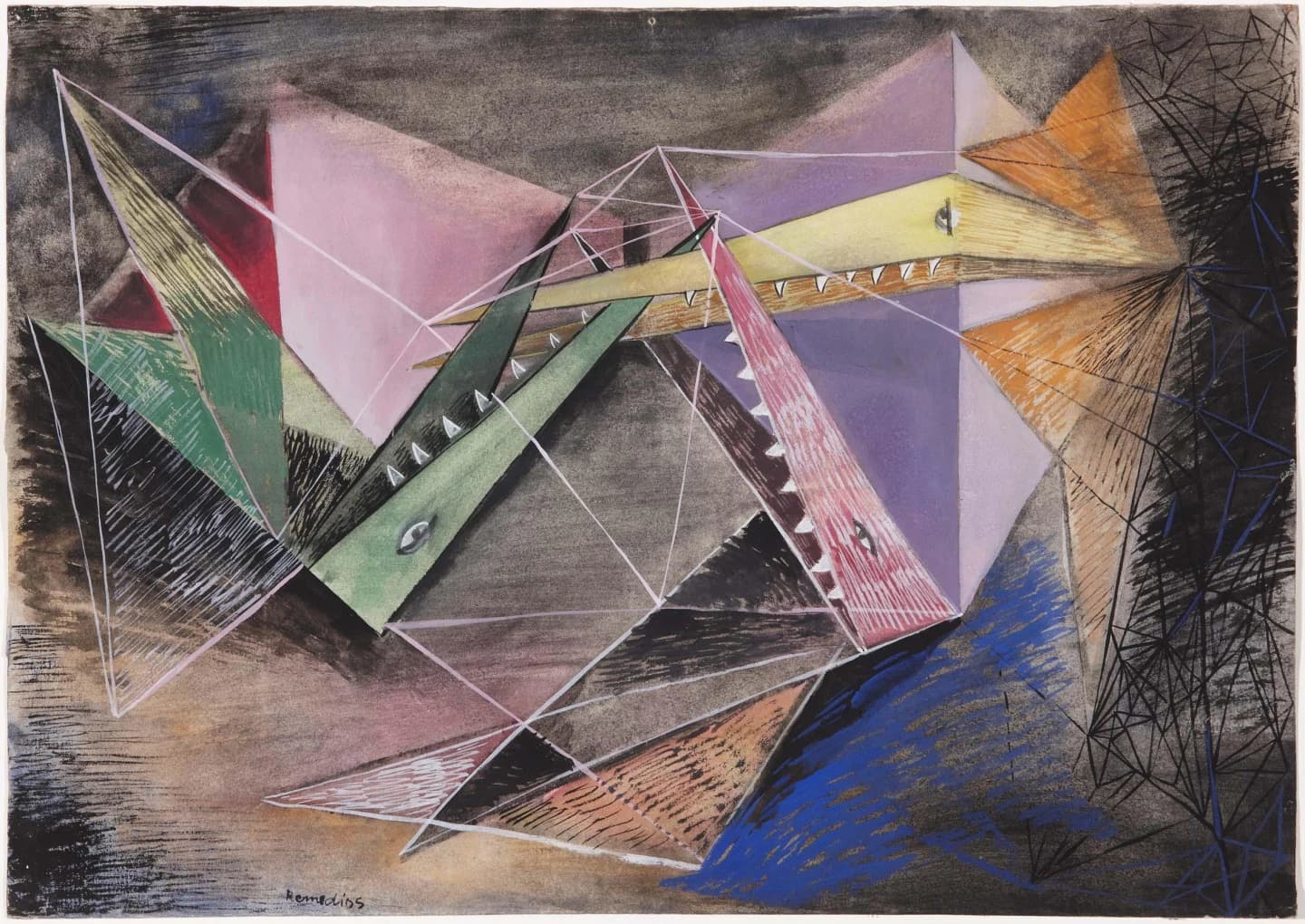
A tangle of hard angular planes, two of them opening into jaws set with white triangular teeth. Remedios Varo painted it in Paris in 1938, in her second year inside the Surrealist group, and gave it a French title. André Breton, the poet who had founded Surrealism, kept it in his own collection until he died. It is now at the Museo Nacional Centro de Arte Reina Sofía in Madrid, registration number AD06621.
- 1938
- Gouache and black chalk on paper
- Museo Nacional Centro de Arte Reina SofíaMadrid, Spain
About Remedios Varo
What the picture shows
The sheet is filled with flat faceted planes in pink, mauve, olive green, grey and orange, laid over a ground of black chalk hatching. Pale ruled lines run between the planes like the wires of a frame drawing, tying the shapes into a single structure. Nothing in it is a recognisable object.
Two of the shapes are jaws. The larger runs across the upper right: a pale yellow plane above and an orange plane below, both hatched with fine parallel strokes, meeting along an edge set with a row of white triangular teeth. A small grey lens sits in the yellow plane near the tip, in the position an eye would take. A second toothed wedge, green and pink, bites in from the left.
At the right edge a black thicket of ruled lines closes the picture off, with blue chalk beneath it. Remedios Varo signed at the lower left, in a small cursive hand, with her given name alone: remedios.
She titled it in French
The Museo Nacional Centro de Arte Reina Sofía catalogues the picture under its French title, La Faim, and gives The Hunger as the English form. Remedios Varo was Spanish and would spend the rest of her life in a Spanish-speaking country. She titled this one in the language of the city she was living in.
The word is not figurative. She had left Spain in the middle of a civil war with the poet Benjamin Péret, and the two were living in Paris on very little.
André Breton kept it
The museum's curatorial note, by Paloma Esteban Leal, records that La Faim was one of two paintings by Remedios Varo that entered the private collection of André Breton, and that he kept them with him until his death. André Breton had founded Surrealism in Paris in 1924 and ran it as a group, admitting and expelling members.
Remedios Varo had reached Paris in 1937 with Benjamin Péret, who was one of Surrealism's founders and André Breton's closest ally. The museum sets La Faim in her years of activity inside the group, and names the Exposition Internationale du Surréalisme of 1938 and Le Rêve dans l'Art of 1939 as the shows she took part in. She was twenty-nine or thirty when she made it.
The museum records that the picture matters twice over: for itself, and because it belonged to the man who founded the movement. Its note adds that this is one of the few works in which she used forms closer to geometrical abstraction than to the organic shapes she usually painted.
The teeth
The museum reads the toothed forms against Pablo Picasso's Surrealist figures of 1929 and 1930, which have the same prominent, voracious teeth. That is the museum's comparison, and it is the only source that offers one.
What the sheet itself supplies is a mechanism rather than a creature. The jaws are built from flat planes and ruled lines, the teeth are drawn as even triangles along a straight edge, and the whole assembly is held in a wire frame. It is closer to a diagram of a bite than to an animal making one.
How it reached Madrid
The Museo Nacional Centro de Arte Reina Sofía gives the year of entry as 2012 and the registration number as AD06621. Alegoría del invierno, of 1948, entered in the same year under the adjacent number AD06620.
The museum holds four works by Remedios Varo in all. La Faim is the only one of them painted in Paris.
Close reading
Reading the work, detail by detail
Remedios Varo painted La Faim in Paris in 1938, in gouache and black chalk on a sheet 32.5 by 45.7 centimetres. André Breton kept it in his own collection. The close views follow the toothed structure across the sheet.
1.The long jaw and its teeth
The wedge is built from two planes, pale yellow above and orange below, each filled with fine parallel chalk strokes running lengthwise. They meet along a straight edge carrying about seven white triangles of even size and spacing. The triangles are left as bare paper, not painted white.
2.A grey lens where an eye would be
A small grey oval sits in the yellow plane a short way back from the tip. It is drawn as a disc with a darker rim and a lighter centre, like a lens or a stud rather than an eye. It is the only curved element in that half of the sheet.
3.The green wedge bites in from the left
A second toothed form comes in from the left, its plane dark green and its teeth ranged along the upper edge. It overlaps a pink plane behind it and is crossed by three pale ruled lines that pass straight over both. The lines do not stop at the edges of either shape.
4.A pink blade with teeth on its underside
The pink blade runs from the upper centre down to the lower left, its surface streaked with lighter strokes along its length. Its teeth are on the underside, pointing down, and they get smaller towards the bottom. It crosses in front of the green wedge and behind the yellow one.
5.Ruled lines tie the planes together
Pale ruled lines radiate from two points near the top edge and run right across the sheet. They pass over planes, teeth and hatching alike without breaking. Where several meet they enclose empty triangles of ground, so the structure reads as a wire frame drawn over the colour rather than an object lit from a side.
6.The right edge closes in black
At the right edge the ruled lines multiply and darken into a black fan, drawn in chalk over patches of deep blue. Nothing of the faceted structure continues into it. It reads as a thicket or a screen, and it stops the composition from running off the sheet.
7.Blue chalk under the lower right
Broad strokes of ultramarine are laid across the lower right, following the paper's tooth so the grain shows through them. A pale plane and a small orange hatched triangle sit over the blue. It is the only place where the ground is a colour rather than black or bare paper.
8.Signed remedios, lower left
The signature reads remedios, written small and quickly in black, with no surname and no date. It sits over the chalk hatching at the bottom of the sheet, where the tone is warm brown rather than black.
Timeline
1936
Remedios Varo leaves Spain with the Surrealist poet Benjamin Péret as the civil war spreads.
1937
She settles in Paris and joins the circle of André Breton's closest associates.
1938
Paints La Faim in gouache and black chalk on paper, and takes part in the Exposition Internationale du Surréalisme.
1939
Takes part in Le Rêve dans l'Art. At some point the painting enters the private collection of André Breton; the museum does not date the acquisition.
1940–1941
With France under German occupation, she and Benjamin Péret escape and cross the Atlantic to Mexico City.
1966
André Breton dies. The museum records that he kept his two Remedios Varo paintings with him until then.
2012
Enters the collection of the Museo Nacional Centro de Arte Reina Sofía in Madrid as AD06621.
Where to see it
Museo Nacional Centro de Arte Reina Sofía
Calle Santa Isabel 52, 28012 Madrid, Spain
The museum records the year of entry as 2012 and does not publish a permanent gallery location for the work. Check the collection record before travelling.
Plan your visit on the museum’s official website (opens in a new tab)Frequently asked questions
Where is Remedios Varo's La Faim?
At the Museo Nacional Centro de Arte Reina Sofía in Madrid, registration number AD06621. The museum records the year of entry as 2012. It is the only one of the museum's four Remedios Varo works that she painted in Paris.
Did André Breton own a Remedios Varo painting?
Two of them. The Museo Nacional Centro de Arte Reina Sofía records that La Faim was one of two paintings by Remedios Varo in André Breton's private collection, and that he kept them with him until his death in 1966.
Why does a Spanish painter's work have a French title?
Because she painted it in Paris. Remedios Varo had left Spain during the civil war with the French poet Benjamin Péret and was living in France when she made it. The museum catalogues the work under the French title La Faim and gives The Hunger as the English form.
What is La Faim made of?
Gouache and black chalk on paper, 32.5 by 45.7 centimetres — about thirteen by eighteen inches. It is a small sheet.
What does La Faim show?
Flat angular planes tied together by pale ruled lines, with two of the shapes opening into jaws set with rows of white triangular teeth. A small grey lens sits in one of them where an eye would be. There is no figure and no setting.
Is La Faim typical of Remedios Varo?
No, and the museum says so. Its note calls it one of the few works in which she used forms closer to geometrical abstraction than to the organic shapes she usually painted. The meticulous dreamworlds she is known for came nearly twenty years later, in Mexico.
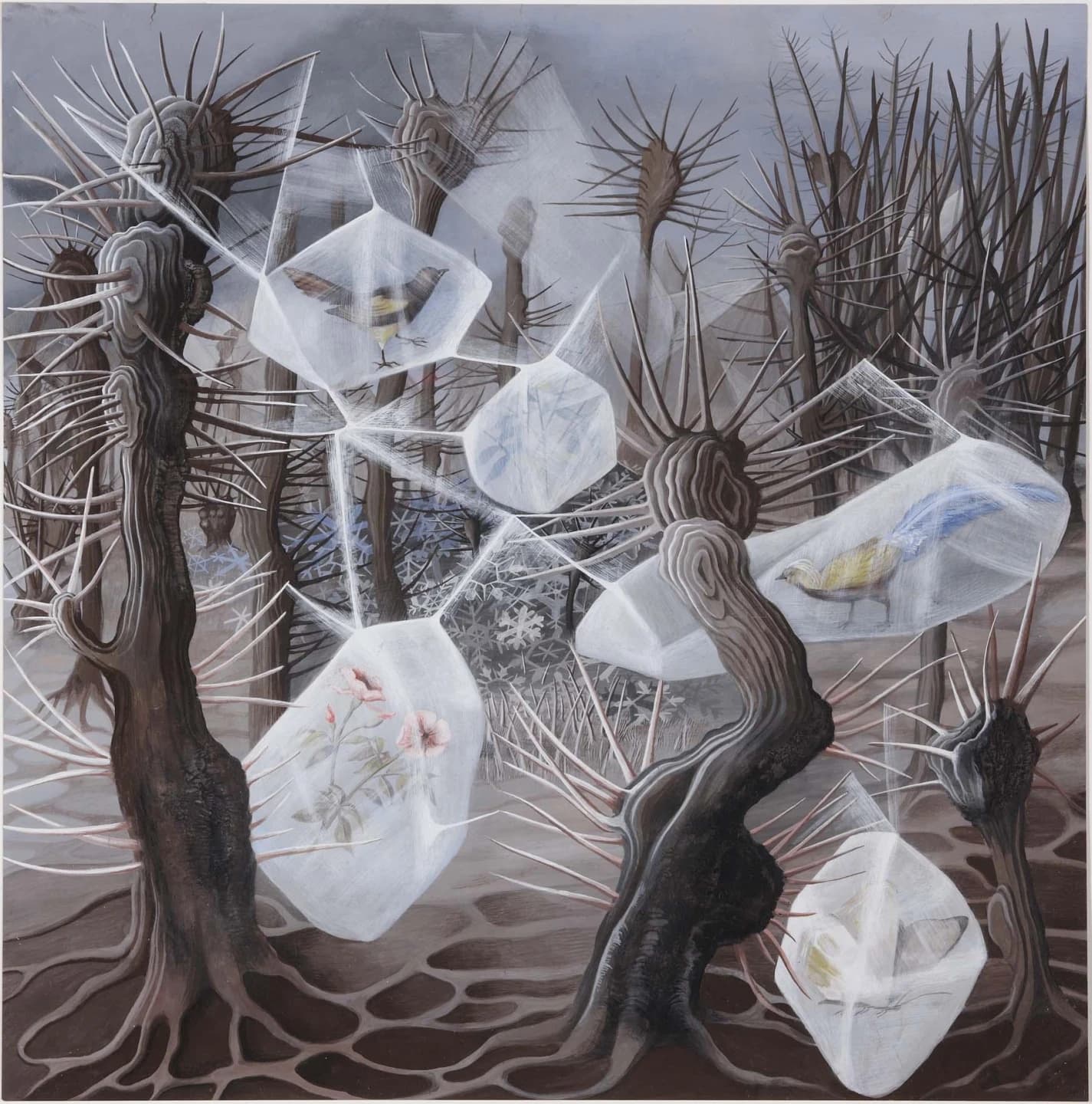
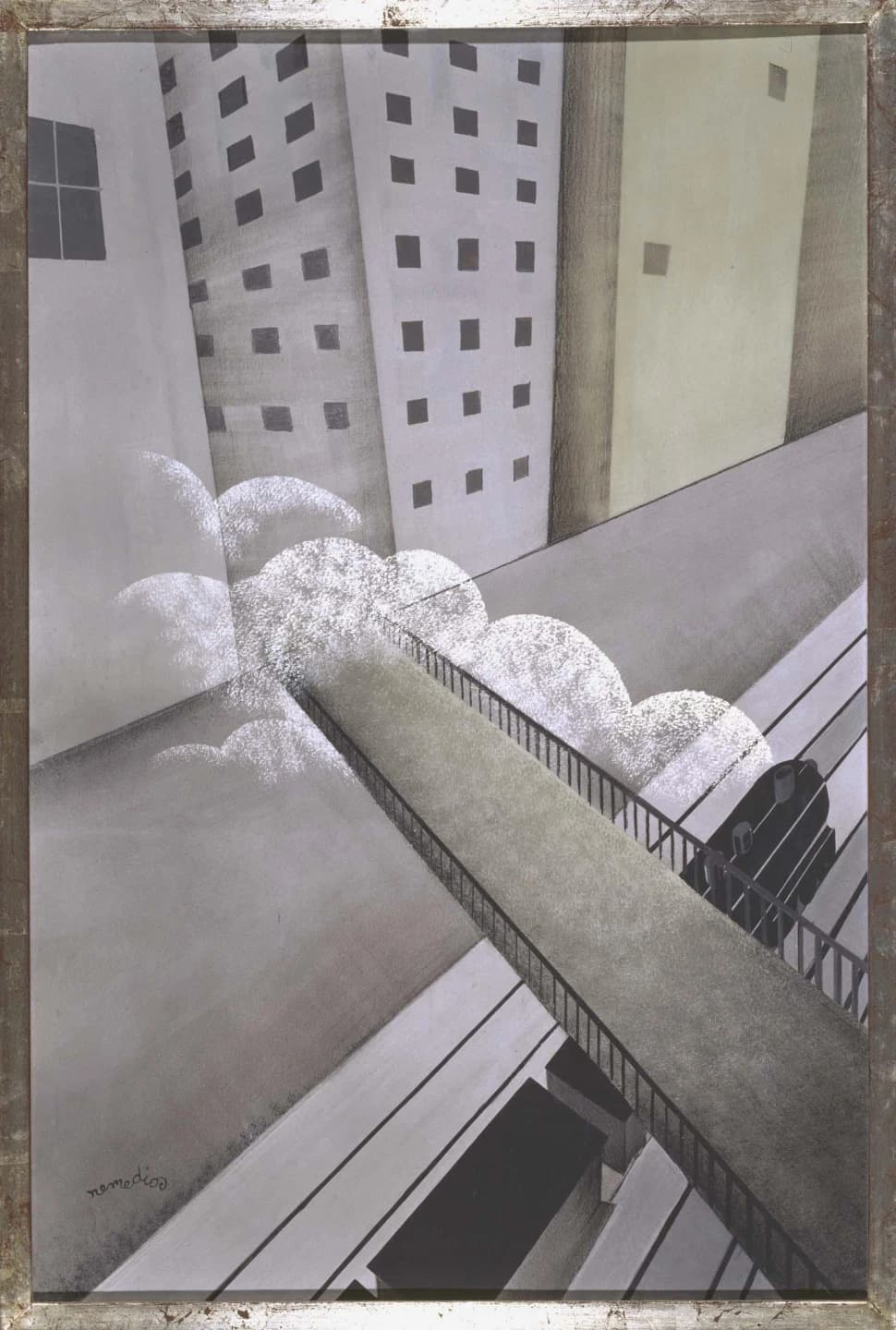
More by Remedios Varo
If you like Remedios Varo
Explore painters from the same movements and circles.
Jean Arp
Strasbourg-born sculptor and poet — Hans in German, Jean in French, both all his life — who co-founded Dada at the Cabaret Voltaire in 1916, composed collages by dropping torn paper 'according to the laws of chance', and settled at Meudon outside Paris in a house his wife Sophie Taeuber-Arp designed.
View artist
Leonora Carrington
English painter and writer who fled a debutante's future for Surrealist Paris at twenty, survived the war's wreckage of that life — internment for her lover Max Ernst, an asylum in Spain for her — and rebuilt herself in Mexico into one of the century's great painters of the uncanny.
View artist
Henri Cartier-Bresson
French photographer who turned a pocket-sized 35mm camera into an instrument of split-second composition — the idea the world knows as 'the decisive moment'. He trained as a painter, was taken prisoner in 1940 and escaped on his third try, photographed the Liberation of Paris in August 1944, co-founded the photographer-owned agency Magnum Photos in 1947, gave up reporting for drawing in the 1970s, and left Paris a foundation in the Marais that deliberately hangs no permanent display of his own pictures.
View artist
References
The sources below include collection records, catalogues, scholarly research, and primary materials that informed this page. They document The Hunger, its making, and its place in cultural history.

1La Faim (The Hunger), 1938 — collection record, Museo Nacional Centro de Arte Reina Sofía
WebsiteMuseo Nacional Centro de Arte Reina Sofía, MadridUsed forTitle, date, technique, dimensions, year of entry, and the curatorial note by Paloma Esteban Leal recording André Breton's ownership.
2Remedios Varo — collection record, Museo Nacional Centro de Arte Reina Sofía
WebsiteMuseo Nacional Centro de Arte Reina Sofía, MadridUsed forThe museum's artist record, listing the four works by Remedios Varo it holds.
3Remedios Varo — Gallery Wendi Norris (biography and chronology)
WebsiteGallery Wendi Norris, San FranciscoUsed forChronology for the flight from Spain with Benjamin Péret and the Paris years inside the Surrealist group.
4Unexpected Journeys: The Art and Life of Remedios Varo
BiographyAbbeville Press, 1988Used forThe standard biography, listed as further reading for the Paris years and the escape to Mexico.
These references provide the documented foundation for this work's history and interpretation. Claim-level citations remain attached to the specific claims they support.
 Explore more resources