Still Life Reviving
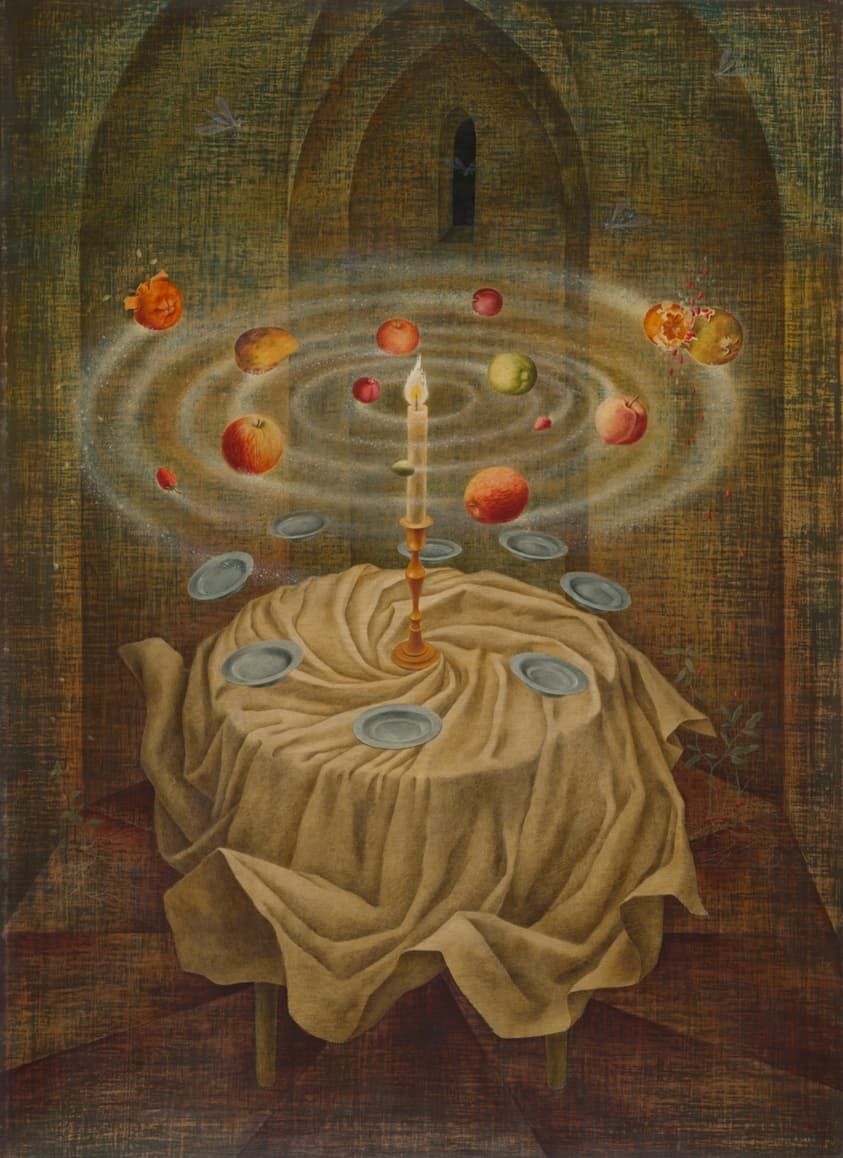
A round table rises off the floor of a stone tower, its cloth twisting into a vortex, while fruit orbits above it in rings of light. It is the last painting Remedios Varo made, finished in 1963, the year she died. The Art Institute of Chicago bought it in June 2024 and holds it as 2024.87, in the Joseph Winterbotham Collection.
- 1963
- Oil on canvas
- Art Institute of ChicagoChicago, United States
About Remedios Varo
What the painting shows
The setting is the inside of a stone tower. Pointed arches rise behind the table and a narrow lancet window opens high in the far wall. The floor is deep red-brown, the walls olive and gold.
A round table stands at the centre, covered by a heavy fawn cloth that falls in deep folds to the floor. The cloth is turning. It winds anticlockwise into a spiral centred on the foot of a candlestick, and the folds run round with it. The candlestick is turned wood in warm orange-brown, with a knopped stem, a stepped base and a shallow drip-pan, and it carries a single lit candle.
Grey pewter plates ride the cloth — some still lying on it, others already lifted clear and floating at the table's edge. Above them the fruit orbits in wide elliptical rings drawn as fine granular bands of pale light: red apples, a peach, a yellow-green apple, an orange, small scarlet berries. At the upper right a pomegranate has split open against a pear, throwing off a spray of seeds that drift away one by one. Four insects with long transparent wings hold their positions in the corners. At the foot of the table, on the right, thin green seedlings rise from the floor carrying paired leaves and small red buds.
What the museum says about it
The Art Institute of Chicago describes the picture as turning the quietude of a traditional still life into a supernatural scene. A table for eight begins to levitate. Above it, in the museum's words, apples, peaches, pomegranates and strawberries orbit like planets in a solar system. It names the four insects as mosquitos, and reads them as looking on warily while the fruits collide.
The museum sets the picture in a pattern: the emergence of new life is a common theme of her work of the 1960s, and here the seedlings sprout while the cloth itself seems animated. Everything flows into the vortex except the insects.
The Spanish title carries a joke the English one loses. A still life in Spanish is a naturaleza muerta — a dead nature. Naturaleza muerta resucitando is therefore a dead nature coming back to life, which is what the painting shows happening.
Her last painting
Remedios Varo finished it in 1963 and died in Mexico City that year, of a heart attack, at fifty-four. She had painted full time for about eight years. The Art Institute of Chicago's exhibition history records that the picture was shown the following summer in Mexico City. The show was La obra de Remedios Varo, at the museum then called the Museo Nacional de Arte Moderno, from 3 to 31 August 1964. The painting was catalogue number 8, and it was on the cover.
The picture has been reproduced steadily since. André Breton printed it in the Surrealist review La Brèche in December 1964, fifteen months after her death. It appears in the book on her by Roger Caillois, Juliana González and Octavio Paz in 1966. It went on the cover of a Carl Gustav Jung volume in 1978 and the back cover of a planetary-science magazine in 1987. It is number 361 in the catalogue raisonné edited by Ricardo Ovalle.
How it reached Chicago
The museum publishes the chain. The painting passed on her death to Walter Gruen in Mexico City, then to Ignacia Uranga Bergareche in Valencia by 1964, and by descent in the 1970s to her granddaughter Beatriz Varo Jiménez, also in Valencia. It was sold at Sotheby's in New York on 15 November 1994, lot 52, to a private collection in London. Gallery Wendi Norris in San Francisco sold it to the Art Institute of Chicago on 11 June 2024.
The museum's credit line is the Joseph Winterbotham Collection, and the picture is one of the thirty-five works in it. The reference number is 2024.87.
Canvas, not panel
Remedios Varo is known for painting in thin glazes on masonite, a smooth pressed-board panel, and most of her late pictures are on it. This one is not. The Art Institute of Chicago gives the medium as oil on canvas, and the weave of the canvas shows through the thin paint across the olive wall and the red floor.
The Louisiana Museum of Modern Art, which has the painting on loan, makes the same distinction independently. Its Danish exhibition page credits this picture as olie på lærred — oil on canvas — while crediting Papilla estelar of 1958 and Aurora of 1962 as olie på masonit on the same page.
Close reading
Reading the work, detail by detail
The last painting Remedios Varo made, in oil on canvas, 109.9 by 80.1 centimetres. The Art Institute of Chicago bought it in 2024 and describes a table for eight beginning to levitate. The close views follow the mechanism that is lifting it.
1.One lit candle on a turned stick
The candlestick is turned wood in warm orange-brown, with a knopped stem, a shallow drip-pan and a stepped foot. One cream candle stands in it, lit, its flame yellow at the base and white above. The candle passes up through the orbiting rings, and a small olive-green fruit crosses in front of its shaft.
2.The cloth winds into a spiral
Every fold in the cloth runs anticlockwise into a spiral centred on the candlestick's foot, tightening as it goes in. The cloth is painted as a thick soft weave, and the folds keep their thickness all the way round. Below the table edge the same cloth hangs straight down in ordinary vertical folds.
3.Plates lifting off the cloth
The plates are grey pewter, each drawn with two concentric rings inside the rim. Some still lie flat on the cloth. Others have tilted up and float clear of the table edge, holding the same spacing they had when they were laid. The museum describes the table as set for eight.
4.The fruit runs in banded rings
The orbits are painted as wide elliptical bands of pale granular light, four or five of them nested inside each other and all tilted to the same angle. The fruit rides along the bands rather than sitting on them. Each band is built from fine dry dots, so the light reads as dust rather than as a drawn line.
5.A pomegranate splits against a pear
The pomegranate has burst along one side, and the opening shows a pale rosette of inner membrane. Where it meets the yellow-green pear, red seeds are thrown off in a spray that fans above and below the pair. The seeds furthest away are painted as separate pips with their own highlights.
6.Seedlings rising from the floor
Thin green stems come up out of the dark red floor at the right of the table, one of them already taller than the cloth's hem. Each carries paired oval leaves along its length and three or four small scarlet buds. The museum reads them as the dropped seeds of the orbiting fruit growing into new life.
7.An insect holds its position
The insect has a long thin body and two pairs of transparent wings held out flat, drawn with their veining visible. It hangs motionless against the wall while everything else in the picture turns. Three more are placed near the other corners. The museum calls them mosquitos.
8.The tower and its lancet window
Behind the table two pointed arches rise, and between them a narrow lancet window opens on flat darkness. The wall around it is olive and gold, brushed thin enough that the weave of the canvas reads through the paint. That weave is the medium the museum records: oil on canvas, not the masonite panel she used for most of her late work.
Timeline
1955
Remedios Varo begins to paint full time, at forty-seven.
1963
Paints Naturaleza muerta resucitando in oil on canvas, and dies in Mexico City the same year at fifty-four.
1964
Shown at the Museo Nacional de Arte Moderno in Mexico City, in La obra de Remedios Varo, 3 to 31 August, as catalogue number 8 and on the catalogue cover.
1964
André Breton reproduces it in the Surrealist review La Brèche in December.
1987
Shown at the 19th Bienal Internacional de São Paulo, as catalogue number 15.
1994
Sold at Sotheby's, New York, on 15 November, lot 52, to a private collection in London.
2023
Shown at Gallery Wendi Norris in San Francisco, in Remedios Varo: Encuentros.
2024
Bought by the Art Institute of Chicago on 11 June, as 2024.87, into the Joseph Winterbotham Collection.
2026
On loan to the Louisiana Museum of Modern Art at Humlebæk for Remedios Varo: A Retrospective, which opens on 18 September and runs to 10 January 2027.
Where to see it
Art Institute of Chicago
111 South Michigan Avenue, Chicago, IL 60603, United States
On loan to the Louisiana Museum of Modern Art at Humlebæk for Remedios Varo: A Retrospective, which opened on 18 September 2026 and runs to 10 January 2027. Check the museum's record before travelling.
Plan your visit on the museum’s official website (opens in a new tab)Frequently asked questions
What was Remedios Varo's last painting?
Naturaleza muerta resucitando, in English Still Life Reviving, finished in 1963, the year she died in Mexico City at fifty-four. The Art Institute of Chicago bought it in June 2024 and holds it as 2024.87.
Where is Still Life Reviving?
At the Art Institute of Chicago, reference number 2024.87, in the Joseph Winterbotham Collection. As of September 2026 it is on loan to the Louisiana Museum of Modern Art at Humlebæk for Remedios Varo: A Retrospective, which runs to 10 January 2027.
What does Still Life Reviving show?
A round table lifting off the floor of a stone tower, its cloth spiralling into a vortex around a lit candle. Plates float clear of the cloth, fruit orbits above in rings of light, a pomegranate splits open against a pear, and seedlings rise from the floor. Four winged insects hold their positions around the edges.
Is Still Life Reviving painted on masonite?
No. The Art Institute of Chicago gives the medium as oil on canvas, and the canvas weave is visible through the thin paint. Most of her late paintings are on masonite panel, and the Louisiana Museum of Modern Art distinguishes the two on the same page, crediting this picture as oil on canvas and Papilla estelar and Aurora as oil on masonite.
Why is the painting called a still life when everything is moving?
The Spanish title turns on it. A still life in Spanish is a naturaleza muerta, a dead nature, so Naturaleza muerta resucitando means a dead nature coming back to life. The Art Institute of Chicago describes the picture as transforming the quietude of a traditional still life into a supernatural scene.
How did the Art Institute of Chicago get it?
It bought the painting through Gallery Wendi Norris in San Francisco on 11 June 2024. Before that the picture had passed from the artist to Walter Gruen, then to Ignacia Uranga Bergareche in Valencia by 1964, and by descent to her granddaughter Beatriz Varo Jiménez. It was sold at Sotheby's in New York in November 1994 to a private collection in London.
How big is Still Life Reviving?
109.9 by 80.1 centimetres, about forty-three by thirty-one and a half inches.
More by Remedios Varo
If you like Remedios Varo
Explore painters from the same movements and circles.
Jean Arp
Strasbourg-born sculptor and poet — Hans in German, Jean in French, both all his life — who co-founded Dada at the Cabaret Voltaire in 1916, composed collages by dropping torn paper 'according to the laws of chance', and settled at Meudon outside Paris in a house his wife Sophie Taeuber-Arp designed.
View artist
Leonora Carrington
English painter and writer who fled a debutante's future for Surrealist Paris at twenty, survived the war's wreckage of that life — internment for her lover Max Ernst, an asylum in Spain for her — and rebuilt herself in Mexico into one of the century's great painters of the uncanny.
View artist
Henri Cartier-Bresson
French photographer who turned a pocket-sized 35mm camera into an instrument of split-second composition — the idea the world knows as 'the decisive moment'. He trained as a painter, was taken prisoner in 1940 and escaped on his third try, photographed the Liberation of Paris in August 1944, co-founded the photographer-owned agency Magnum Photos in 1947, gave up reporting for drawing in the 1970s, and left Paris a foundation in the Marais that deliberately hangs no permanent display of his own pictures.
View artist
References
The sources below include collection records, catalogues, scholarly research, and primary materials that informed this page. They document Still Life Reviving, its making, and its place in cultural history.


1Still Life Reviving (Naturaleza muerta resucitando), 1963 — collection record, Art Institute of Chicago
WebsiteArt Institute of ChicagoUsed forTitle, date, medium, dimensions, credit line, provenance, exhibition and publication history, and the museum's own description of the painting.
2Remedios Varo: A Retrospective, 18 September 2026 – 10 January 2027 — exhibition record, Louisiana Museum of Modern Art
WebsiteLouisiana Museum of Modern Art, HumlebækUsed forThe 2026 retrospective that has the painting on loan, and the credit lines distinguishing oil on canvas from oil on masonite across her late work.
3Remedios Varo: Science Fictions (2023) — Art Institute of Chicago exhibition and collection records, public API
WebsiteArt Institute of ChicagoUsed forThe museum's 2023 survey exhibition, mounted the year before it bought the painting.
4Remedios Varo — Gallery Wendi Norris (biography and chronology)
WebsiteGallery Wendi Norris, San FranciscoUsed forThe gallery that sold the painting to the museum and has shown her work since 2004.
5Unexpected Journeys: The Art and Life of Remedios Varo
BiographyAbbeville Press, 1988Used forThe standard biography, listed as further reading; it reproduces the painting under the title Still Life Being Resuscitated.
These references provide the documented foundation for this work's history and interpretation. Claim-level citations remain attached to the specific claims they support.
 Explore more resources