Allegory of Winter
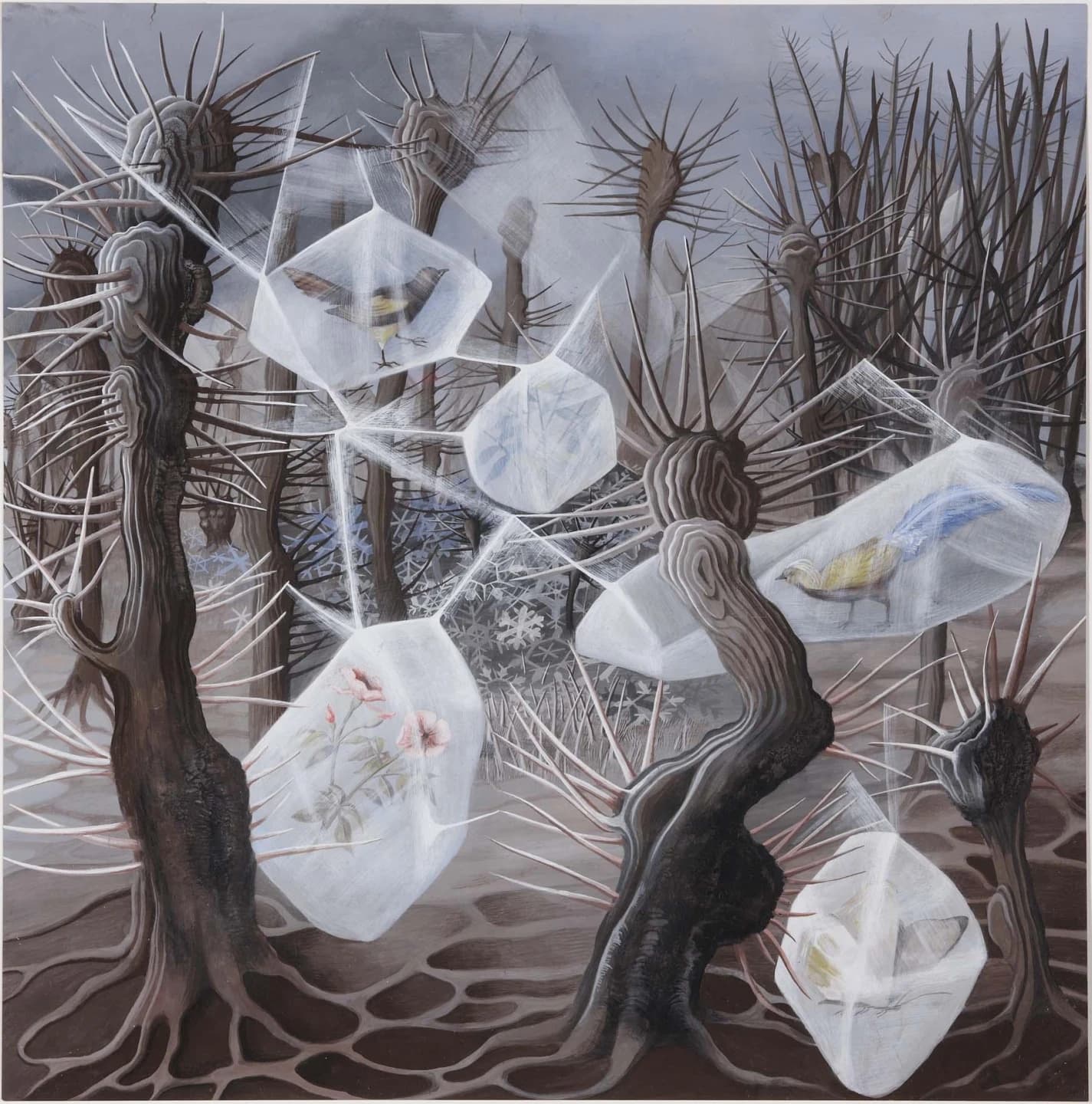
A grove of spined trees with faceted translucent cases hanging among them, each case holding a bird, a flowering plant or a drift of snowflakes. Remedios Varo painted it in Mexico in 1948, during the years she was earning her living as a commercial artist and seven years before she began to paint full time. The square sheet is at the Museo Nacional Centro de Arte Reina Sofía in Madrid, registration number AD06620.
- 1948
- Gouache on paper
- Museo Nacional Centro de Arte Reina SofíaMadrid, Spain
About Remedios Varo
What the picture shows
The trees have been cut back to knobbed stumps, and from each stump a burst of long pale spines radiates in every direction. Their trunks are dark and banded with growth rings drawn as fine concentric lines. On the right the grove thickens into a mass of bare branches; on the left two trunks stand clear against a flat grey sky.
Seven or eight translucent cases hang among the trees. Each is a many-sided solid, built up from thousands of fine white strokes, so that the trees behind show through its walls. The spines of the trees pass into and across the cases rather than stopping at them. The cases are not tied or hung from anything.
Inside each case is something the winter has not reached. One holds a small bird with brown wings, a barred grey breast, a yellow belly and two thin dark feet. Another holds a pink single flower with a dark centre, a bud and pointed green leaves on a stem. A third holds a bird in blue and yellow, a fourth a cluster of snowflakes, a fifth pale leaves. The ground below is dark brown, covered by a net of pale winding roots.
How the cases are made
The museum's catalogue line is gouache on paper, and the cases are the clearest evidence of what that means here. Each facet is a patch of parallel white strokes laid at a slightly different angle from its neighbours, so the planes separate by direction rather than by tone. Where two facets meet, a harder white line marks the edge.
The effect is a solid that is fully transparent. A tree trunk seen through a case is drawn in full, then veiled by the strokes laid over it. Nothing inside a case is distorted or refracted, which is not how ice behaves and is how a drawing behaves.
Painted in the middle of the commercial years
The date the museum records is 1948. Remedios Varo had reached Mexico City in 1941 as a refugee, first from Franco's Spain and then from occupied France. From 1942 to 1949 she earned her living drawing advertising and illustration for Casa Bayer, the Mexican arm of the German pharmaceutical firm. She was forty in 1948 and painting on her own account in the gaps.
The precision on show here is the same precision the commercial work required. The bird is drawn with its feet, its bill and the barring on its breast all in place, at a size of a few centimetres.
How it reached Madrid
The Museo Nacional Centro de Arte Reina Sofía gives the year of entry as 2012 and the registration number as AD06620. La Faim, painted in Paris in 1938, entered in the same year under the adjacent number AD06621.
Of the four works by Remedios Varo the museum holds, two were made in Europe and two in Mexico. Alegoría del invierno is the earlier of the two Mexican ones.
Close reading
Reading the work, detail by detail
A square sheet of gouache, 44 centimetres each way, showing a grove of spined trees with translucent cases hanging among them. The Museo Nacional Centro de Arte Reina Sofía holds it as AD06620. The close views open the cases one at a time.
1.A bird inside a faceted case
The case has about eight flat faces, each filled with fine white strokes laid at its own angle, so the planes separate by direction alone. Inside it a bird stands on two thin dark feet, its wings brown, its breast barred grey and white, its belly yellow, its bill dark and short. The trees behind are drawn in full and then veiled by the strokes laid over them.
2.A flowering plant in a second case
The second case holds a single stem: one open pink flower with a dark centre, one bud still closed, and four or five pointed green leaves. Long pale spines from the tree at the left pass straight across the face of the case and out the other side. Nothing inside is bent or displaced where a spine crosses it.
3.A second bird, in blue and yellow
The bird on the right stands in profile with its wing folded, the wing blue and the body and tail yellow, the head pale. Its case is wider and shallower than the others and tilts to the right. Three spines enter it from above.
4.Snowflakes drawn six-armed
Behind the cases in the middle of the sheet, snowflakes are drawn as six-armed figures with branched arms, in grey on a darker ground. They are of several sizes and none repeats another exactly. They lie behind the trees rather than falling between them.
5.The trees are cut back to stumps
Each tree ends in a knobbed head from which twenty or more pale spines radiate in every direction, the longest reaching a third of the way across the sheet. The cut faces are drawn with fine concentric rings, like the end grain of sawn timber. The spines come out of the stump, not out of the bark.
6.A trunk banded like a section
The trunk bends twice as it rises, and its whole surface is drawn in bands of concentric line that follow the bends. The effect is of a tree shown in section along its length rather than in bark. The darkest bands run down the side turned away from the light.
7.The ground is a net of roots
The floor of the grove is dark brown, crossed by pale roots that wind, divide and rejoin to enclose irregular cells of darker earth. The net runs unbroken from edge to edge. Where a trunk meets it, the roots continue around the trunk rather than stopping at it.
8.The lowest case holds pale leaves
The lowest case on the right is the smallest of them and holds a loose group of pale yellow-grey forms that read equally as leaves or as feathers. Its facets are fewer and larger than those of the bird's case. A stump with short spines stands immediately behind it.
Timeline
1941
Remedios Varo and Benjamin Péret reach Mexico City after escaping occupied France.
1942–1949
She earns her living drawing pharmaceutical advertising and illustration for Casa Bayer in Mexico City.
1948
Paints Alegoría del invierno in gouache on a square sheet of paper.
1955
Her circumstances steady and she begins to paint full time.
2012
Enters the collection of the Museo Nacional Centro de Arte Reina Sofía in Madrid as AD06620.
Where to see it
Museo Nacional Centro de Arte Reina Sofía
Calle Santa Isabel 52, 28012 Madrid, Spain
The museum records the year of entry as 2012 and does not publish a permanent gallery location for the work. Check the collection record before travelling.
Plan your visit on the museum’s official website (opens in a new tab)Frequently asked questions
Where is Remedios Varo's Alegoría del invierno?
At the Museo Nacional Centro de Arte Reina Sofía in Madrid, registration number AD06620. The museum records the year of entry as 2012. It is one of four works by Remedios Varo the museum holds.
What does Alegoría del invierno show?
A grove of trees cut back to stumps, each throwing out a burst of long pale spines, with translucent many-sided cases hanging among them. Each case holds something alive or intact: a bird, a flowering plant, snowflakes, pale leaves. A net of pale roots covers the dark ground below.
What is Alegoría del invierno painted in?
Gouache on paper. The sheet is square, 44 by 44 centimetres — about seventeen inches each way.
When did Remedios Varo paint it?
In 1948, in Mexico City. She was forty, had been in Mexico for seven years as a refugee, and was earning her living drawing advertising and illustration for Casa Bayer. She did not paint full time until about 1955.
Are the cases in Alegoría del invierno made of ice?
The museum does not say what they are, and neither does the picture. They are drawn as faceted transparent solids built from fine white strokes, with the trees fully visible through them and the trees' spines passing into them. Nothing seen through them is refracted or distorted.
Is Alegoría del invierno one of her famous paintings?
No. The pictures she is best known for — the towers, the machines, the heart-faced travellers — were painted in Mexico from about 1955 onwards. Alegoría del invierno comes seven years earlier and is on paper rather than on panel or canvas.
More by Remedios Varo
If you like Remedios Varo
Explore painters from the same movements and circles.
Jean Arp
Strasbourg-born sculptor and poet — Hans in German, Jean in French, both all his life — who co-founded Dada at the Cabaret Voltaire in 1916, composed collages by dropping torn paper 'according to the laws of chance', and settled at Meudon outside Paris in a house his wife Sophie Taeuber-Arp designed.
View artist
Leonora Carrington
English painter and writer who fled a debutante's future for Surrealist Paris at twenty, survived the war's wreckage of that life — internment for her lover Max Ernst, an asylum in Spain for her — and rebuilt herself in Mexico into one of the century's great painters of the uncanny.
View artist
Henri Cartier-Bresson
French photographer who turned a pocket-sized 35mm camera into an instrument of split-second composition — the idea the world knows as 'the decisive moment'. He trained as a painter, was taken prisoner in 1940 and escaped on his third try, photographed the Liberation of Paris in August 1944, co-founded the photographer-owned agency Magnum Photos in 1947, gave up reporting for drawing in the 1970s, and left Paris a foundation in the Marais that deliberately hangs no permanent display of his own pictures.
View artist
References
The sources below include collection records, catalogues, scholarly research, and primary materials that informed this page. They document Allegory of Winter, its making, and its place in cultural history.


1Alegoría del invierno (Allegory of Winter), 1948 — collection record, Museo Nacional Centro de Arte Reina Sofía
WebsiteMuseo Nacional Centro de Arte Reina Sofía, MadridUsed forTitle, date, technique, dimensions and year of entry, read off the museum's own object record, with its account of her training and move to Paris.
2Remedios Varo — collection record, Museo Nacional Centro de Arte Reina Sofía
WebsiteMuseo Nacional Centro de Arte Reina Sofía, MadridUsed forThe museum's artist record, listing the four works by Remedios Varo it holds.
3Remedios Varo — Gallery Wendi Norris (biography and chronology)
WebsiteGallery Wendi Norris, San FranciscoUsed forChronology for the arrival in Mexico, the Casa Bayer years from 1942 to 1949, and the move to full-time painting.
4Unexpected Journeys: The Art and Life of Remedios Varo
BiographyAbbeville Press, 1988Used forThe standard biography, listed as further reading for the Mexican years before she painted full time.
These references provide the documented foundation for this work's history and interpretation. Claim-level citations remain attached to the specific claims they support.
 Explore more resources