The Paris AtlasCharting the artists, works, and places worth returning to.
  • Designer
· British · 1899–1972

Clarice Cliff

British ceramic designer who began factory work at thirteen and whose brightly painted Bizarre range, launched in 1927, put Art Deco on ordinary tables.

Details

Lived
1899–1972
Born
1899-01-20
Birthplace
Tunstall, Staffordshire, England
Died
1972-10-23
Place of death
Clayton, Staffordshire, England
Nationality
British
Roles
Designer

About Clarice Cliff

Overview

Clarice Cliff (20 January 1899–23 October 1972) was an English ceramic designer and modeller whose vividly coloured pottery became one of the most recognisable expressions of British Art Deco. Working principally for A. J. Wilkinson and the adjoining Newport Pottery in Staffordshire, she created tableware and ornamental ceramics that combined geometric forms, stylised landscapes, exuberant flowers, and unusually bold colour combinations. Her best-known achievement was the Bizarre range, introduced in 1927, which transformed her from a factory employee into an internationally successful designer. Her career encompassed both the decoration of ceramic surfaces and the development of the objects themselves: she designed not only the pictures on teapots, cups, and vases, but also many of their distinctive shapes.[1]

Cliff’s reputation rests on work made within an industrial setting rather than the production of isolated studio masterpieces. Her ceramics were manufactured in factories and decorated by teams working under her direction, yet they carried a forceful and recognisable artistic identity. That combination of individual design, skilled collective labour, and commercial production is central to understanding her achievement. Objects intended for ordinary domestic rituals—pouring tea, serving breakfast, arranging flowers—became vehicles for an adventurous visual language associated with modern life. The museum collections that preserve her work therefore document both an artist’s imagination and the changing appearance of the twentieth-century home.[2]

Childhood in the Staffordshire Potteries

Clarice Cliff was born on 20 January 1899 in Meir Street, Tunstall, one of the Staffordshire pottery towns now forming Stoke-on-Trent. She was one of seven children in a working-class family. Her father, Harry Thomas Cliff, worked in an iron foundry, while her mother, Ann, née Machin, supplemented the household income by washing clothes. Cliff grew up in a district where ceramics were not a remote artistic pursuit but an everyday occupation: factories, workshops, and the families employed in them shaped the surrounding community. Her eventual career developed directly from this environment rather than from an early introduction to elite artistic circles.[3]

In 1912, at the age of thirteen, Cliff entered the pottery industry. Her first employment was at Lingard Webster, where she learned gilding, applying gold decoration to traditionally designed wares. She subsequently worked at Hollinshead & Kirkham, gaining experience in lithographic decoration. These early jobs introduced her to the disciplined, repetitive processes through which ceramic designs were reproduced commercially. Rather than remaining within a single specialism, however, she continued acquiring different skills. This willingness to move between tasks became important to her development: the future designer learned how pottery was actually decorated and manufactured before gaining the authority to determine what it should look like.[3]

Training, Modelling, and Early Supporters

Cliff joined A. J. Wilkinson in Burslem in 1916. Alongside factory work, she pursued artistic training, including evening study at the Burslem School of Art. Her interests extended beyond painted ornament to modelling in clay, an aspect of her career sometimes overshadowed by the fame of her colourful patterns. The Potteries Museum & Art Gallery preserves The Turk, a seated figure dated 1924, which she made for Wilkinson while attending the school. Its survival establishes that figurative modelling was already part of her professional practice before the appearance of Bizarre.[1][4]

Several people helped her develop these abilities. The decorating manager Jack Walker recognised her promise and brought her work to the attention of factory owner Arthur Colley Austin Shorter, generally known as Colley. Within the modelling department, she worked alongside experienced designers including John Butler and Fred Ridgway. Another early supporter was Reg Lamb, a fellow worker who became a longstanding friend and supplied her with modelling clay. According to specialist research drawing on her surviving apprenticeship documents, Cliff formally became a modelling apprentice in September 1922. Recollections of this period describe her making portrait studies of family members and people connected with Shorter.[3][5]

Shorter’s encouragement gave Cliff opportunities beyond the usual progression of a factory decorator. In 1927 she undertook brief periods of study at London’s Royal College of Art, where modelling remained an important part of her work. She also visited Paris, widening her exposure to contemporary art and design. These experiences supplemented, rather than replaced, her practical education in the Potteries. Her mature work would depend on the combination: an awareness of modern visual ideas, together with detailed knowledge of clay, moulds, decoration, firing, and the demands of repeat production.[5]

The Beginnings of Bizarre

By 1927, Cliff had been given a studio at Newport Pottery, adjoining Wilkinson’s works. The beginnings of Bizarre were unusually pragmatic. She experimented with old undecorated wares, including pieces whose imperfect glazing made them unsuitable for conventional sale, covering their surfaces with bold painted ornament. Large triangles, angular divisions, and emphatic bands of colour could conceal flaws while giving the objects an entirely new character. What began as a way of making existing stock commercially useful became the foundation of a distinctive new product range.[1]

The earliest designs, now generally described as Original Bizarre, relied on comparatively simple geometric arrangements. Their strength came from the relationships between strongly contrasting colours and the confident scale of the decoration, rather than from intricate drawing. A bowl in the Potteries Museum, dated approximately 1928–1930, demonstrates this early approach through overglaze-painted geometric ornament. Such pieces show how readily a familiar ceramic form could be transformed by its surface: the bowl remained usable tableware, but its decoration announced a conspicuous departure from restrained or naturalistic floral patterns.[6]

The name Bizarre subsequently became broader than any single pattern. Early pieces could carry a hand-painted inscription, while more systematic stamped marks soon identified the wares with Cliff’s name and Newport Pottery. As additional designs appeared, Bizarre functioned increasingly as a commercial identity encompassing a wide variety of decoration. This distinction matters because a range, an individual pattern, and a vessel shape are not interchangeable terms. Two objects might belong to Bizarre while looking quite different, or share a pattern while being made in different shapes. The mark associated the product with Cliff’s design organisation; it did not necessarily mean that she had personally painted that particular object.[7]

Crocus and the Bizarre Girls

Introduced in 1928, Crocus became one of Cliff’s most enduring patterns. Its orange, blue, and purple flowers were painted with upward brushstrokes, while the narrow green leaves were added by turning the vessel upside down and drawing lines between the blooms. The technique was economical but visually effective: a relatively small vocabulary of brush movements produced a lively border that could adapt to curved or flat surfaces. Unlike the sharper geometry of Original Bizarre, Crocus retained an immediately recognisable natural subject, helping it appeal to customers who welcomed colour without necessarily wanting conspicuously abstract decoration.[8]

The success of Cliff’s designs required an expanding workforce. Gladys Scarlett was among her earliest assistants, while Ethel Barrow became particularly associated with Crocus, helping train other decorators in its execution. The painters became known as the “Bizarre Girls,” although the workforce was not exclusively female. By the end of the 1920s it numbered around seventy. Their contribution was essential: Cliff devised and supervised designs, but these workers gave individual objects their finished appearance through repeated acts of skilled hand-painting. The ceramics were therefore neither anonymous mechanical products nor entirely solitary creations, but the result of a closely organised relationship between design and making.[9]

Artistic Style and Influences

Cliff’s work belongs to the wider history of Art Deco, but its character is more varied than a simple association with zigzags and bright colours suggests. Her designs move between abstraction and recognisable subjects, sometimes reducing flowers and landscapes to a few forceful shapes, sometimes allowing decoration to become almost wholly geometric. The angular construction of Cubist art and the broader European interest in simplified form provided important precedents. Contemporary design journals also helped circulate ideas across national boundaries. Her knowledge of these developments should not, however, be confused with evidence of personal acquaintance with every modern artist whose work resembles hers.[10]

Her work also formed part of a larger effort to adapt modern design to domestic production. Art Deco could encompass costly, individually commissioned objects, but manufacturers increasingly translated its visual language into goods made in quantity. Cliff’s achievement lay in making that translation unusually distinctive. She did not simply place miniature modern paintings on conventional crockery; she considered how an image would behave around a rim, across the sides of a pot, or against an unusually shaped handle. The factory setting imposed practical constraints, but it also allowed her designs to circulate far beyond the audience available to an individual maker of unique objects.[11]

Connection to Paris

Clarice Cliff’s connection to Paris was rooted in travel and artistic influence, although her career remained centred on the Staffordshire Potteries.[12] Colley Shorter arranged a visit to the French capital after her studies at London’s Royal College of Art, giving her an opportunity to encounter contemporary fashions during the formative period preceding the success of Bizarre.[12] Her later angular handles, conical vessels, and boldly simplified decoration reflected Art Deco’s engagement with Cubist geometry.[8] A more specific Parisian connection appears in her Bon Jour teaware, introduced in 1933: specialist historian Doreen Mann identifies designs by Tétard Frères, a Paris silver manufacturer, as the inspiration for its round, flat-sided teapot body and small tubular feet.[13][14] Cliff adapted this form into ceramics, using its broad surfaces for colourful painted patterns.[13] Taken together, these connections suggest that Paris mattered to her career not as a permanent working base, but as a source of ideas that she reinterpreted for everyday domestic objects made in England.[8][12]

Major Patterns and Ceramic Forms

Sunray and Geometric Design

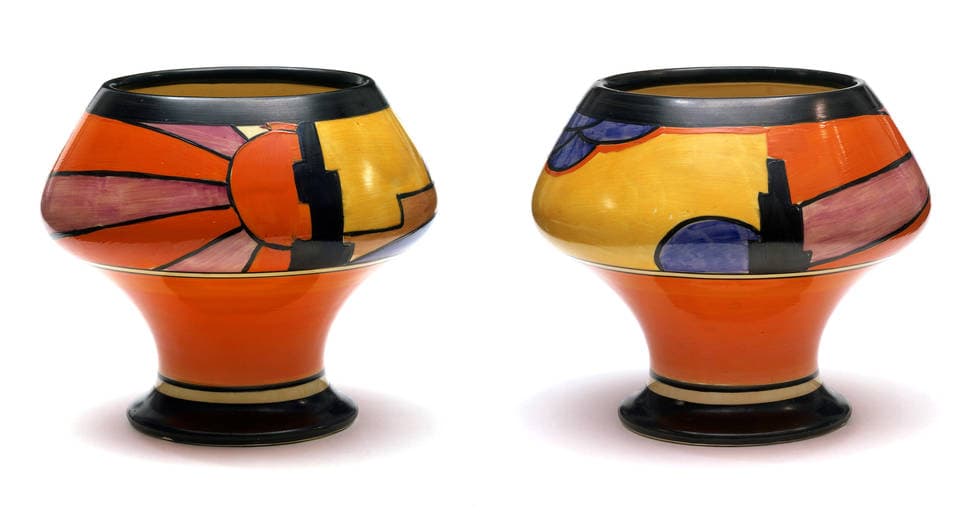
Sunray, represented by a 1929 vase in the Victoria and Albert Museum, illustrates Cliff’s ability to turn a familiar Art Deco motif into emphatic ceramic decoration. The sunburst was widely used in the period, appearing in architecture, interiors, and decorative objects. Cliff adapted its radiating structure to the surface of earthenware, using enamel colours to create a strong visual rhythm. The effect depends less on depicting a convincing natural sunrise than on arranging contrasting areas so that the vessel appears animated by the design.[8]

Fantasque and Imagined Landscapes

The Fantasque range offered another important direction. Its landscapes were not topographical records but decorative constructions of cottages, trees, hills, and other simplified forms. A sugar sifter in the Potteries Museum, dated approximately 1929–1934, combines a cottage-and-tree scene with a sharply conical body pierced at the top. The object brings together two apparently different impulses: the familiarity of a small domestic landscape and the modernity of an assertive geometric form. Its decoration belongs to the vessel rather than behaving like an independent picture simply transferred onto it.[15]

Cliff’s landscapes also appeared on larger ornamental pieces. A tall baluster vase dated around 1930 in the same museum carries a stylised arrangement of mountains and trees. On such forms, the scene could extend around the body, encouraging the viewer to turn the object rather than apprehend it from a single fixed position. This is an important distinction between her ceramic landscapes and conventional framed paintings: their composition responds to a three-dimensional surface, with changing widths, curves, and viewpoints becoming part of the design.[16]

Stamford and Bon Jour

The shapes of Cliff’s tableware could be as memorable as their painted patterns. Her Stamford teapot used a flattened, broadly semicircular body, but the practical requirements of serving tea sometimes forced modifications to the geometry. Specialist historian Doreen Mann records that Shorter criticised the poor pouring of an early square-lipped spout, prompting the introduction of a more drooping, teardrop-like version. The episode reveals an ordinary but important reality behind these celebrated objects: a teapot had to function successfully as well as look modern.[13]

The Bon Jour form, introduced in 1933, developed a different relationship between circles and flattened surfaces. Its rounded body stood on small tubular feet, with a compact knob on the lid; related coffee pots elongated the same underlying profile. Mann identifies French silver designs by Tétard Frères as an important precedent. Cliff’s originality here lay in adaptation as well as invention, converting a form associated with metalwork into painted ceramics and developing it across a coordinated family of useful objects.[13]

Age of Jazz

Cliff’s sculptural work included the Age of Jazz figures, designed around 1930. These strongly coloured, stylised groups translate the movement and theatricality associated with contemporary popular entertainment into ceramic form. Rather than presenting the body with academic naturalism, they emphasise pose, rhythm, and decorative silhouette. They demonstrate that her interest in modernity extended beyond abstract ornament to the people and performances associated with the period. Their surviving examples also make clear why describing Cliff simply as a designer of floral crockery gives an incomplete account of her imagination.[17]

Artistic Direction and Public Reputation

By the early 1930s, Cliff had become an art director at the factories producing her wares, a remarkable advancement from her teenage employment as a decorator. Her name was now a central element in the marketing of the products, and her work attracted national and international attention. This public identification of a commercially successful pottery range with a working-class woman designer was a significant feature of her career. Nevertheless, her prominence should not obscure the enterprise behind it: factory management, sales staff, modellers, decorators, and other workers all helped turn the designs into objects that could reach customers.[18]

The publicity could be inventive and deliberately playful. An American newspaper, the Pasadena Evening Post, reproduced a photograph of Cliff with a horse approximately five feet high assembled from Bizarre pottery. It was a promotional construction rather than a single modelled ceramic animal, turning a collection of saleable objects into a memorable spectacle. Such stunts helped communicate the liveliness of the range to audiences far from Staffordshire. Her wares also reached overseas markets, extending the commercial life of designs conceived within a relatively small geographical area of the English pottery industry.[19]

Collaborations with Other Artists

Cliff’s professional world expanded beyond her own factory designs through the initiative commonly known as Artists in Industry. Between 1932 and 1934, she helped direct the production of tableware involving contemporary artists, including Duncan Grant, Vanessa Bell, Paul Nash, Barbara Hepworth, and Laura Knight. The resulting project, Modern Art for the Table, was launched at Harrods in October 1934. These were professional collaborations rather than evidence that every participant belonged to her intimate social circle, but they brought her practical knowledge of ceramic manufacture into contact with a wider network of British artists.[9]

Laura Knight’s circus-themed plates provide a particularly clear surviving example. The Potteries Museum identifies them as Knight’s designs produced by Cliff for A. J. Wilkinson in 1934. Their attribution preserves the distinction between the originating artist and the ceramic production process that made the designs reproducible. In this context, Cliff’s contribution was not to substitute her own style for Knight’s, but to help carry another artist’s imagery into manufactured tableware. The project therefore reveals her importance as an artistic organiser and interpreter of designs, not only as the author of recognisable patterns.[20]

A plate designed by Graham Sutherland for the same Harrods exhibition illustrates another approach. Its leaf motif and chain-like border were produced through a combination of overglaze printing and painted details at Wilkinson’s works. Such objects show that “art for the table” could involve several relationships between handwork and reproduction. They also place Cliff within an interwar discussion about whether contemporary artists should participate in industry and how their designs could retain character when translated into goods made for sale.[21]

Private Life and Marriage to Colley Shorter

Cliff’s private surroundings reflected the colour and eclecticism associated with her pottery. At the height of her success she occupied a first-floor flat at 20 Snow Hill, near Newport Pottery. Visitors remembered red wallpaper, modern-looking pictures, antique furniture, and hand-painted murals. The bathroom ceiling was covered with black and yellow paper, while her bedroom used blue and pink. Her own ceramics appeared throughout the rooms, including dinnerware bearing her initials. The flat suggests that her enthusiasm for decoration was not confined to products designed for other people’s homes.[18]

Her relationship with Shorter gradually became romantic while he was still married, and the affair was conducted discreetly. Following the death of his first wife, Ann, Cliff and Shorter married in 1940. She moved to Chetwynd House in Clayton, Staffordshire, an Arts and Crafts house with a substantial garden. Gardening became a shared interest, providing another outlet for her engagement with colour, plants, and arrangement. Although the marriage is an important part of her biography, it should not be treated as the moment her professional life simply ended: ceramics bearing her name continued to be designed and produced for many years afterward.[22]

Later Designs and Changing Tastes

Cliff’s output became increasingly varied during the later 1930s, and not all of it followed the sharply geometric appearance most often associated with her name. A cockerel-shaped teapot dated approximately 1938–1939, now in the Potteries Museum, demonstrates her continuing interest in modelling. The bird’s head and neck form the spout, its tail becomes the handle, and its legs support the vessel. Here the challenge is not merely to decorate a teapot with an animal image but to make the animal’s body perform the functions of the teapot. The result connects her later commercial work with the sculptural interests of her apprenticeship.[23]

The Second World War disrupted production, while changing tastes further reduced the prominence of the exuberant interwar designs. Newport Pottery closed in 1942, and the remaining Cliff team moved back to Wilkinson’s. Her career did not stop abruptly, but its commercial and stylistic setting changed. The period most celebrated by later collectors was comparatively brief, whereas the production history of ceramics carrying her name extended into the postwar decades. Distinguishing those two histories prevents her later output from disappearing behind the fame of Bizarre.[24]

Museum collections preserve examples of this later production. A Tonquin dish dated approximately 1950–1960 was manufactured under the Royal Staffordshire name for export, using underglaze-printed decoration. A Jersey Lily plate from the same broad period carries an underglaze-painted floral pattern. These pieces differ in both appearance and technique from the brilliantly coloured overglaze work of the late 1920s. They document a designer and manufacturing business responding to different markets rather than endlessly repeating the style on which her subsequent fame would depend.[25][26]

Retirement, Final Years, and Death

Colley Shorter died in 1963. In 1964 the business was sold to Midwinter, and Cliff retired, remaining at Chetwynd House. Her later life became much more private, in contrast to the publicity surrounding her earlier career. Yet she lived long enough to see the beginnings of a reassessment of her work. Brighton Museum held its pioneering Cliff exhibition in 1972; she contributed notes to the catalogue and donated pieces to its collection. These contributions connected the emerging museum interpretation of her career with her own memories and surviving possessions.[27]

Cliff died suddenly at Chetwynd House on 23 October 1972, aged seventy-three, and was buried in Tunstall Cemetery. The biographical sources cited here establish the date and place of her death but do not specify a medical cause. Her death occurred just as objects formerly valued primarily as decorative household goods were beginning to receive sustained attention as significant works of twentieth-century design. She witnessed the opening stage of that revival, but not the much larger international reputation that developed afterward.[27][22]

Rediscovery and Legacy

A further important exhibition at London’s L’Odeon gallery in 1976 helped strengthen the revival of interest, followed by growing attention during the 1980s. Leonard Griffin founded the Clarice Cliff Collectors’ Club in 1982, and research into her career increasingly drew on the recollections of former factory workers. These accounts were especially valuable because they restored some visibility to the decorators whose hands had produced the finished wares. The rediscovery of Cliff was therefore also, in part, the rediscovery of a community of skilled workers and of the practical knowledge behind familiar designs.[24]

Her cultural visibility has continued through exhibitions, publications, and popular representations, including the 2021 film The Colour Room. In 2024, Historic England commemorated her former home at 20 Snow Hill with a blue plaque recognising both her design work and her position as a factory art director. That dual description is particularly appropriate. Cliff’s achievement cannot be separated into a purely artistic story on one side and an industrial one on the other. Her influence arose from bringing the two together, making ambitious decoration and inventive form part of objects intended to be handled and used.[18]

The breadth of her surviving work remains the strongest explanation of her importance. A small painted flower jug, a conical sugar sifter, an animated figure, an artist-designed exhibition plate, and a sculptural novelty teapot each reveal a different aspect of her practice. Together they show a designer who understood that everyday objects could carry both usefulness and visual pleasure, and that commercial manufacture need not exclude artistic individuality. Cliff’s most distinctive contribution was not a single motif or colour combination, but an unusually resourceful exploration of what modern ceramics could become.[15]

---

Life events

  1. 1899

    Born on 20 January in Tunstall, in the Staffordshire Potteries, into a working-class family.

  2. 1912

    Begins work in the pottery industry at thirteen, moving between jobs — enamelling, lithography, gilding, modelling — rather than staying in one specialised task.

  3. 1916

    Joins A. J. Wilkinson at Newport, the firm where she would spend the rest of her working life.

  4. 1927

    The Bizarre range is shown to the trade. Hand-painted in bold enamel colours over existing stock shapes, it becomes a commercial success and is soon marketed under her own name.

  5. 1929

    The Sunray vase, made by Newport Pottery; the Victoria and Albert Museum holds one as C.74-1976.

  6. 1934

    The Artists in Industry scheme brings Laura Knight, Graham Sutherland and others into the pottery to design ware, shown at Harrods.

  7. 1940

    Marries Colley Shorter after the death of his first wife, and moves to Chetwynd House in Clayton.

  8. 1964

    Shorter having died in 1963, the business is sold to Midwinter and Cliff retires, remaining at Chetwynd House.

  9. 1972

    Brighton Museum's pioneering exhibition reassesses her work; she contributes notes to the catalogue and donates pieces. She dies suddenly at Chetwynd House on 23 October, aged seventy-three, and is buried in Tunstall Cemetery.

Selected works

Cataloged from the holding institutions' records. Reproductions appear only where the rights are verified.

Ceramics

Two views of the same vase side by side, each with a broad upper body narrowing to a flared foot. The front shows a half-disc sun in orange and red throwing straight rays across yellow and pink panels; the reverse shows dark blue half-discs against orange and yellow. Both carry a black band at the rim, black outlines between colours, and a stepped black form at the right.

Artwork reproduction

Ceramic · Art Deco

Sunray Vase

1929 · Earthenware decorated with enamel colors

Clarice Cliff designed the Sunray vase in 1929 for Newport Pottery, which made it in earthenware painted with enamel colours. A partial sun throws sharply cut rays across a broad body that narrows to a raised foot, in yellow, orange, red, dark blue and black. The Victoria and Albert Museum in London holds one as museum number C.74-1976.

Victoria and Albert Museum

Clarice Cliff, Sunray Vase, 1929. Victoria and Albert Museum. Image © the rights holder, shown under fair use.

Movements

The artistic and literary currents this life ran through.

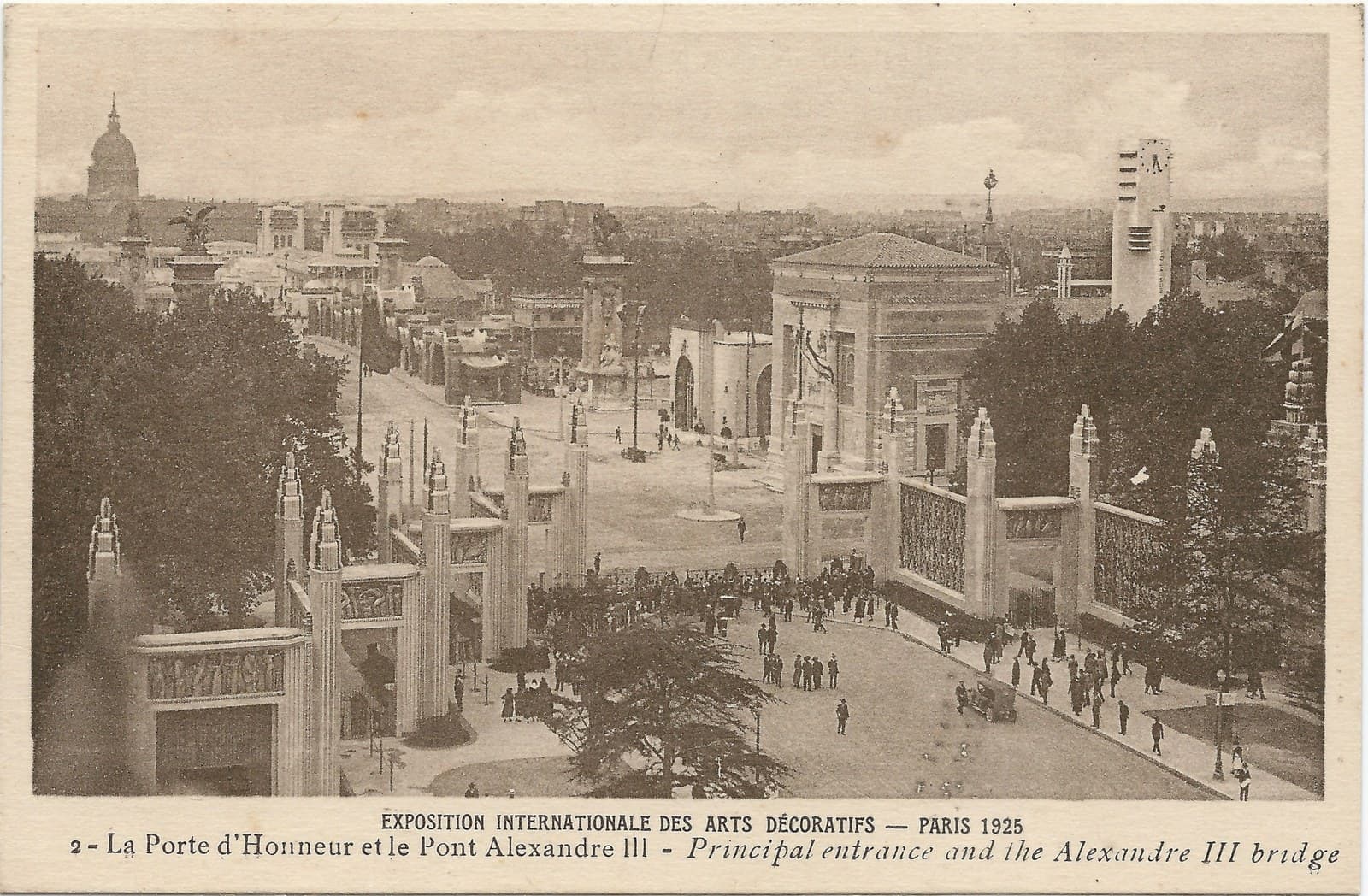
Aerial view of the 1925 Paris decorative arts exhibition: tall square pylons flanking the Porte d'Honneur entrance, crowds on the paths below, pavilions and a clock tower spreading toward the Invalides dome

Art & design movement · circa 1910–1939

Art Deco

Cliff is the cheap end of Art Deco, and the evidence that the style was not only black, gold and expensive. Her Bizarre range put bold enamel geometry on earthenware sold for ordinary tables from 1927, using motifs like the sunburst that Art Deco also put on windows and hotel interiors.

Art Deco: Clarice Cliff; Art Deco in the Home; Clarice Cliff (1899 to 1972)

Questions about Clarice Cliff

What is Clarice Cliff best known for?

Bizarre, the hand-painted range she launched in 1927 — bold enamel colours, geometric shapes and stylised landscapes on earthenware for ordinary tables. Crocus was its best-selling pattern; Sunray is among the most striking.

Did Clarice Cliff paint the pottery herself?

No, not the production ware. She designed the patterns and directed the work. The painting was done by a team of young women decorators known as the Bizarre Girls, and recognising them is part of understanding how the ware was actually made.

How did she get started?

She began in the pottery industry at thirteen, in 1912, and moved deliberately between jobs — enamelling, lithography, gilding, modelling — instead of staying in one specialised task. That range of skills is what let her move into design at A. J. Wilkinson rather than remaining a decorator.

Was Clarice Cliff influenced by Paris?

Yes. A visit to Paris brought her into contact with modern French painting and design, and the geometry and colour of her patterns draw on it. The Bon Jour shape has been connected to Parisian silverware by Tétard Frères.

When did her work become collectable?

In the 1970s and 1980s. Brighton Museum's exhibition in 1972 was the pioneering one, and Cliff lived just long enough to take part — she contributed notes to the catalogue and gave pieces to the collection. She died in October that year, before the much larger international reputation developed.

Where can I see Clarice Cliff's work?

The Victoria and Albert Museum in London holds the Sunray vase, museum number C.74-1976. The Potteries Museum and Art Gallery in Stoke-on-Trent holds a large group including The Turk, Fantasque and landscape pieces, and the Metropolitan Museum of Art in New York has Bizarre ware.

Connections and Sources

Clarice Cliff’s connections to people, places, and works, with the sources behind each one.

Associated with · 1927–1939

Art Deco

Cliff is the cheap end of Art Deco, and the evidence that the style was not only black, gold and expensive. Her Bizarre range put bold enamel geometry on earthenware sold for ordinary tables from 1927, using motifs like the sunburst that Art Deco also put on windows and hotel interiors.

Art Deco: Clarice Cliff; Art Deco in the Home; Clarice Cliff (1899 to 1972)

References

References

The sources below include biographies, scholarly essays, interviews, and primary materials that informed this page. They reflect both the historical record and ongoing critical conversations about Clarice Cliff and their work.

  1. 1abcClarice Cliff - Biography, Family, and Career

    Website
    Encyclopedia.com
    Used for

    A biographical overview: her family, her career and the arc of her reputation.

    View source
  2. 2Bizarre Jam Pot with Cover - Clarice Cliff, 1929–1939

    Website
    The Metropolitan Museum of Art
    Used for

    A Bizarre jam pot with cover, 1929-39, at the Metropolitan Museum of Art.

    View source
  3. 3abcChildhood in Tunstall and Early Pottery Employment

    Website
    The Potteries
    Used for

    The local Staffordshire record of her childhood in Tunstall and her first pottery employment at thirteen.

    View source
  4. 4The Turk - Clarice Cliff, 1924

    Website
    The Potteries Museum & Art Gallery
    Used for

    The Turk, 1924, in the Potteries Museum and Art Gallery.

    View source
  5. 5abApprenticeship, Modelling, and Early Supporters

    Website
    ClariceCliff.com
    Used for

    Peggy Wilson on Cliff as a modeller: the apprenticeship, the modelling work, and her early supporters.

    View source
  6. 6Original Bizarre Bowl - Clarice Cliff, Approximately 1928–1930

    Website
    The Potteries Museum & Art Gallery
    Used for

    An original Bizarre bowl of about 1928-29.

    View source
  7. 7Backstamps and the Bizarre Name

    Website
    ClariceCliff.com
    Used for

    The backstamps, and how the Bizarre name was applied to the ware.

    View source
  8. 8abcdArt Deco: Clarice Cliff

    Website
    Victoria and Albert Museum
    Used for

    The Victoria and Albert Museum on Bizarre, Crocus and the Sunray vase, museum number C.74-1976, and the paintresses who decorated them.

    View source
  9. 9abThe Bizarre Girls and Artists in Industry

    Website
    Wikipedia
    Used for

    The Bizarre Girls, and the Artists in Industry scheme.

    View source
  10. 10Paris, Modern Art, and Artistic Influences

    Website
    Architectural Digest
    Used for

    Paris, modern art, and the influences behind the patterns.

    View source
  11. 11Art Deco in the Home

    Website
    Victoria and Albert Museum
    Used for

    Art Deco and the modern home, and how manufactured goods carried the style.

    View source
  12. 12abcClarice Cliff's Visit to Paris and Modernist Influences

    Website
    Christie's
    Used for

    Her visit to Paris and the modernist influences she brought back.

    View source
  13. 13abcdStamford and Bon Jour - Design, Function, and Influences

    Website
    ClariceCliff.com
    Used for

    Doreen Mann on the Bon Jour shape: its design, its function and its sources.

    View source
  14. 14Tétard Frères - Parisian Silverware and the Bon Jour Connection

    Website
    The Metropolitan Museum of Art
    Used for

    Tétard Frères Parisian silverware, and its connection to the Bon Jour shape.

    View source
  1. 15abFantasque Sugar Sifter - Clarice Cliff, Approximately 1929–1934

    Website
    The Potteries Museum & Art Gallery
    Used for

    A Fantasque sugar sifter of about 1929-30.

    View source
  2. 16Landscape Vase - Clarice Cliff, Approximately 1930

    Website
    The Potteries Museum & Art Gallery
    Used for

    A landscape vase of about 1930.

    View source
  3. 17Age of Jazz - Clarice Cliff, Around 1930

    Website
    Woolley & Wallis
    Used for

    The Age of Jazz figures of about 1930.

    View source
  4. 18abcClarice Cliff (1899 to 1972)

    Website
    Historic England
    Used for

    The blue-plaque record: her artistic direction, her flat at 20 Snow Hill, and her public recognition.

    View source
  5. 19Publicity, International Appeal, and the Pottery Horse

    Website
    Andrew Muir
    Used for

    Her publicity, the international appeal of the ware, and the pottery horse.

    View source
  6. 20Circus-Themed Plates - Laura Knight and Clarice Cliff, 1934

    Website
    The Potteries Museum & Art Gallery
    Used for

    The Circus plates designed by Laura Knight and produced with Cliff, 1934.

    View source
  7. 21Harrods Exhibition Plate - Graham Sutherland, 1934

    Website
    The Potteries Museum & Art Gallery
    Used for

    Graham Sutherland's plate for the 1934 Harrods exhibition.

    View source
  8. 22abMarriage to Colley Shorter and Burial in Tunstall

    Website
    The Potteries
    Used for

    Her marriage to Colley Shorter and her burial in Tunstall Cemetery.

    View source
  9. 23Cockerel Teapot - Clarice Cliff, Approximately 1938–1939

    Website
    The Potteries Museum & Art Gallery
    Used for

    A cockerel teapot of about 1938-39.

    View source
  10. 24abWartime Changes, Rediscovery, and Collecting History

    Website
    Antiques Trade Gazette
    Used for

    The wartime changes to production, the rediscovery of her work, and its collecting history.

    View source
  11. 25Tonquin Dish - Clarice Cliff, Approximately 1950–1960

    Website
    The Potteries Museum & Art Gallery
    Used for

    A Tonquin dish of about 1950-60.

    View source
  12. 26Jersey Lily Plate - Clarice Cliff, Approximately 1950–1960

    Website
    The Potteries Museum & Art Gallery
    Used for

    A Jersey Lily plate of about 1950-60.

    View source
  13. 27abRetirement, the Brighton Exhibition, and Death

    Website
    ClariceCliff.com
    Used for

    Her retirement, the 1972 Brighton exhibition she contributed to, and her death.

    View source
i
Why these sources are here

These references anchor the page in the documented record and in the scholarly conversations around Clarice Cliff. Every claim on this page traces back to one or more of the works listed here.

Explore more resources