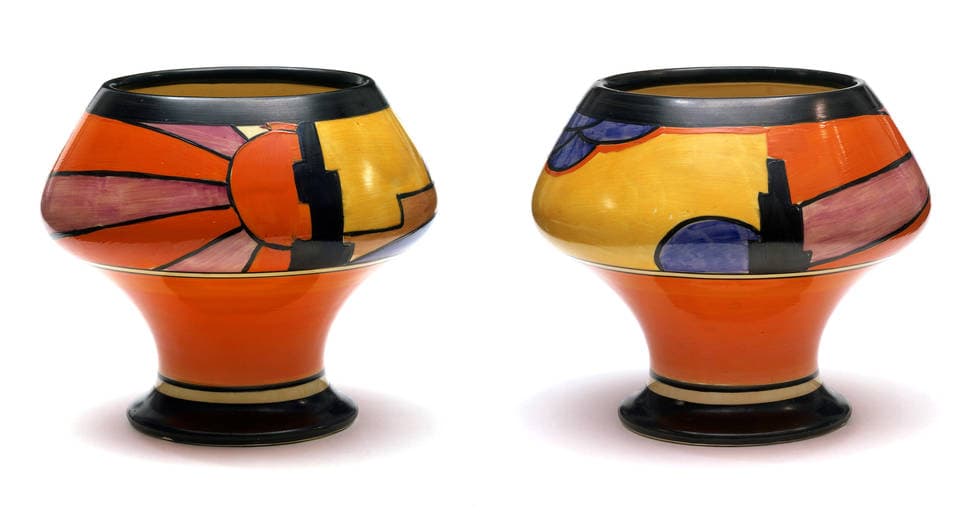
Clarice Cliff designed the Sunray vase in 1929 for Newport Pottery, which made it in earthenware painted with enamel colours. A partial sun throws sharply cut rays across a broad body that narrows to a raised foot, in yellow, orange, red, dark blue and black. The Victoria and Albert Museum in London holds one as museum number C.74-1976.
The Sunray Vase presents a bright, energetic version of Art Deco associated with British ceramic designer Clarice Cliff. Rather than relying on rare woods or precious metals, it creates its effect through color, shape, and painted decoration. Cliff's work helped bring contemporary design into domestic life, making the appearance of an ordinary room or table a field for artistic experimentation.[1]
Design and Color
The V&A's vase has a broad upper body that narrows toward a raised foot. Its decoration combines yellow, orange, red, dark blue or purple, and black in a pattern of bands, wedges, curved shapes, and stepped forms. On one side, the partial disk of a sun sends sharply defined rays across the surface. The reverse continues the same visual language without simply duplicating the front.
The contrast between the vessel and its decoration is central to the effect. The rounded body provides a continuous surface, while the painted pattern breaks it into strongly divided sections. Black outlines and bands keep the vivid colors distinct. The result is lively without becoming visually shapeless: the decoration repeatedly directs attention across the width of the vase and around its changing contours.
The sunburst was a widely used Art Deco motif, appearing in settings ranging from windows to hotel interiors. Cliff adapted it to pottery through bold enamel decoration. Rather than painting a naturalistic landscape, she turned the sun into an abstract arrangement of expanding shapes.[2]
From Factory Worker to Designer
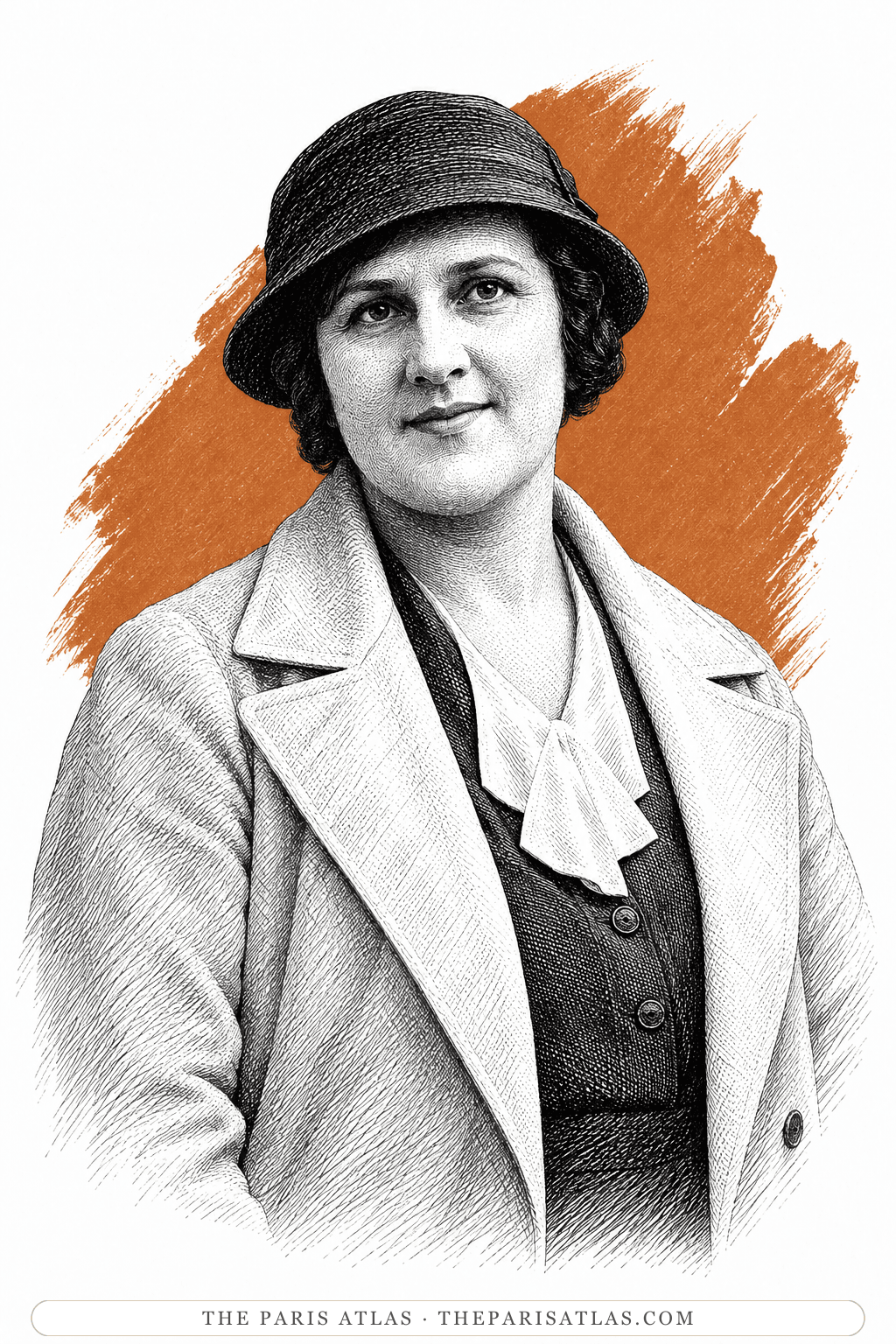
Cliff was born into a working-class family in Tunstall in 1899 and began pottery work at thirteen. She developed a range of skills by moving between jobs rather than remaining within a single specialized task. Her Bizarre range, shown to the trade in 1927, became an important commercial success and was soon marketed under her own name. Her career transformed a factory worker into a nationally recognized designer and art director.[1]
Hand-Painted Design Within a Factory System
Cliff's ceramics complicate the distinction between handmade craft and industrial manufacture. The vessels were factory products, but painted decoration remained central to their appeal. Her work also depended on a team: the V&A records the women decorators, or “paintresses,” who helped produce her successful Crocus pattern and the wider output of domestic ceramics.[2]
A vase credited to Cliff should therefore not automatically be described as an object she personally formed and painted from beginning to end. Her achievement lay in design and artistic direction within a manufacturing enterprise. Recognizing that system preserves the contribution of the workers who translated her ideas into objects for sale.[2]
Color Beyond the Pottery
Cliff's enthusiasm for strong color extended into her own surroundings. Historic England records recollections of her flat at 20 Snow Hill in Stoke-on-Trent, where red wallpaper, murals, colorful pottery, and modern pictures were combined with antique furniture. The bathroom ceiling was covered with black and yellow paper, while her bedroom used blue and pink. These details suggest that the visual exuberance of her ceramics was not merely a commercial formula; it also shaped her personal environment.[1]
Significance and Later Recognition
Sunray is valuable to an understanding of Art Deco because it challenges the idea that the style was invariably solemn, expensive, or restricted to black and gold. Its appeal depends on a comparatively accessible material and a deliberately emphatic decorative scheme. It belongs to the broader expansion of modern design into manufactured household goods, where artistic distinction could be achieved through repeatable production.[3]
The revival of interest in Cliff's ceramics during the 1970s and 1980s established them as important examples of interwar design. The V&A's Sunray vase preserves that history in a single object: a practical vessel whose color and decoration made it a conspicuous expression of modern taste.[2]
Close reading
Reading the work, detail by detail
The Victoria and Albert Museum photographs its vase from both sides at once, which is the useful way to see it: the pattern is not one picture wrapped around a pot but a set of shapes rearranged face to face. The details show the sun, the black scaffolding that holds the colours apart, and the shape of the vessel underneath.
1.The sun, and the rays leaving it
The sun is a half-disc sitting on the widest part of the body, and the rays leave it as straight-sided wedges rather than lines. Each wedge is a flat area of one colour, so the burst is built from blocks of paint, not from drawing.
2.The stepped black shape
A black form rises in right-angled steps beside the sun, on both faces of the vase. It is the one motif with no curve in it, and it stops the rays from running the whole way around the body.
3.The black band at the rim
A solid black band runs around the lip, with a matching one at the foot. Between them the pattern can be as loud as it likes; the two bands are what keep the object reading as a vessel.
4.The reverse is not a copy
On the other side the sun is gone. Two dark blue half-discs sit against orange and yellow, using the same colours and the same black outlines to different effect. A buyer turning the vase on a table got a second arrangement rather than the same one again.
5.Black outlines hold the colours apart
Every colour meets its neighbour across a black line. Without them the orange, red, pink and yellow would run together at a distance; with them each area stays a distinct shape.
6.The body narrows to a flared foot
Below the pattern the vessel pulls in sharply and then flares out to a raised foot. That waist is why the decorated upper body reads as the top of an object rather than as the side of a bowl.
Where to see it
Victoria and Albert Museum
London, United Kingdom
A public viewing address has not yet been confirmed for this holding.
Gallery displays change, so check the museum's own object record before making a special visit.
Frequently asked questions
Who made the Sunray vase?
Clarice Cliff designed it in 1929, and Newport Pottery Co. Ltd. manufactured it. Cliff was born in Tunstall in 1899 and began pottery work at thirteen; her Bizarre range, shown to the trade in 1927, made her a nationally known designer and art director.
Did Clarice Cliff paint the vases herself?
Not from beginning to end. These were factory products, and the painting was done by a team of women decorators known as paintresses. Cliff's achievement was design and artistic direction inside a manufacturing business.
What is the Sunray pattern?
A partial sun on one side throwing sharply defined rays across the surface, worked in yellow, orange, red, dark blue or purple and black, with bands, wedges, curved shapes and stepped forms. Black outlines keep the colours distinct. The reverse uses the same language without copying the front.
What is the Sunray vase made of?
Earthenware decorated with enamel colours. The material is ordinary and comparatively cheap, which is the point: Cliff's pottery put Art Deco on tables that could not afford Ruhlmann's furniture or Lalique's glass.
Where can I see the Sunray vase?
The Victoria and Albert Museum in London holds one, museum number C.74-1976. Gallery displays change, so check the museum's own object record before making a special visit.
In the atlas
What the graph records about this work — every claim carries its citation.
Cliff's vase is the cheap end of the same style: earthenware painted with enamel colours and sold for ordinary tables, using the sunburst motif that Art Deco put on windows and hotel interiors. It is evidence against the idea that the style was only black, gold and expensive.
— Art Deco: Clarice Cliff; Art Deco in the Home
If you like Clarice Cliff
Explore designers from the same movements and circles.
A. M. Cassandre
French poster designer whose advertisements for railways, liners and aperitifs — Nord Express, Dubonnet, Normandie — reduced their subjects to a few commanding shapes.
Irish designer and architect, a pioneer of modern furniture and architecture whose Riviera house E-1027 is a landmark of the movement; her furniture stayed obscure until a 1970s rediscovery.
French designer who worked in glass, porcelain, textiles and stage design, and whose contributions to the Lalique firm were often manufactured under her father's signature.
The sources below include collection records, catalogues, scholarly research, and primary materials that informed this page. They document Sunray Vase, its making, and its place in cultural history.
Cliff's birth in Tunstall in 1899, her start in pottery work at thirteen, the 1927 trade launch of Bizarre, and recollections of her flat at 20 Snow Hill.
The holding museum's account of the Sunray vase: the 1929 date, Newport Pottery as manufacturer, the enamel-painted earthenware, museum number C.74-1976, and photographs of both sides. Also the Bizarre and Crocus ranges and the paintresses who decorated them.
These references provide the documented foundation for this work's history and interpretation. Claim-level citations remain attached to the specific claims they support.



 View source