The Paris AtlasCharting the artists, works, and places worth returning to.
  • Designer
· French · 1879–1933

Émile-Jacques Ruhlmann

French furniture designer whose rare-wood cabinets and coordinated interiors, including the Hôtel du Collectionneur at the 1925 Paris exhibition, defined the luxury side of Art Deco.

Details

Lived
1879–1933
Born
1879-08-26
Birthplace
Paris, France
Died
1933-11-15
Place of death
Paris, France
Nationality
French
Roles
Designer
Also known as
Jacques-Émile Ruhlmann

About Émile-Jacques Ruhlmann

Émile-Jacques Ruhlmann (26 August 1879–15 November 1933), also known as Jacques-Émile Ruhlmann, was a French furniture designer and interior decorator whose work became one of the defining expressions of Art Deco. His cabinets, desks, chairs, and decorative ensembles combined elegant proportions with exceptional craftsmanship and materials such as Macassar ebony, ivory, lacquer, and finely patterned veneers. Although frequently compared with the great cabinetmakers of eighteenth-century France, Ruhlmann was not himself a trained cabinetmaker. His achievement lay in designing objects and interiors, then directing the specialists who brought them into existence. At the height of his career, his work offered wealthy patrons a modern counterpart to the refined domestic environments of the French aristocracy.[1][2]

Connection to Paris

Paris was the center of Émile-Jacques Ruhlmann’s life and career. Born in the city in 1879, he developed his design practice from his family’s decorating business, later working on the rue de Lisbonne and opening his own cabinetmaking workshop on the rue d’Ouessant in 1923.[1][3] The capital also supplied the setting for his most influential exhibition project: the Hôtel du Collectionneur at the 1925 Exposition internationale des arts décoratifs et industriels modernes. There his collaboration with the architect Pierre Patout and other artists presented a coordinated vision of modern French luxury.[4] His work entered Parisian public interiors through furniture for Drouant restaurant and the Salon Afrique at the Palais de la Porte Dorée, created as the reception office of the minister of the colonies for the 1931 Colonial Exhibition.[5][6] Ruhlmann died in Paris on 15 November 1933 and was buried in Passy Cemetery, for which he had designed his own funerary monument, executed with the involvement of Patout and the sculptor Alfred Janniot.[1][3]

Early life and family background

Ruhlmann was born in Paris into a family of Alsatian origin. His parents were François Antoine Ruhlmann and Marie Valentine Septant, and the family had settled in the French capital before his birth. His father operated a business specializing in decorative painting, wallpaper, and mirrors, providing the young Ruhlmann with an early introduction to the practical business of furnishing and decorating buildings. Rather than entering the decorative arts through an established artistic academy, he developed within a commercial environment in which materials, workmanship, clients, and the coordination of different trades were everyday concerns.[7]

There are minor inconsistencies in accounts of his name and birth date. The Bibliothèque nationale de France records his birth as 26 August 1879, the date also used by the Palais de la Porte Dorée, while the Getty Research Institute’s biographical account gives 28 August. Both Jacques-Émile and Émile-Jacques appear in authoritative records. According to the Getty, he was registered at birth as Jacques-Émile but subsequently favored Émile-Jacques, Émile, or his initials; among friends, he was also known as “Milo.” These variations concern the same designer, not two different members of the Ruhlmann family.[1][8][3]

Drawing interested him from an early age. The Getty dates his first furniture design to 1900 and records that he began studying landscape painting in 1901, retaining painting as a lifelong private interest. Around this period, he also formed an enduring friendship with the architect Pierre Patout, who would become one of his most important collaborators. In 1907, Ruhlmann married Marguerite Seabrook. That year also brought his father’s death and his inheritance of the family business, giving him greater freedom to develop his artistic ambitions.[8]

From the family business to furniture design

The existing decorating business provided a foundation for Ruhlmann’s development as a designer. It supplied both commercial experience and an organization through which he could pursue increasingly ambitious commissions. He began exhibiting at the Salon d’Automne in 1910, and by 1913 his furniture was attracting attention for its distinctive combination of restrained forms and costly materials. His professional identity developed around the idea of the ensemblier: a designer responsible not merely for individual furnishings but for the coordinated appearance of an entire room.[3]

After the First World War, the enterprise became more firmly organized around this comprehensive approach to decoration. In 1919, Ruhlmann established Ruhlmann et Laurent with the decorating contractor Pierre Laurent. Furniture formed only one part of its activity; textiles, wall coverings, upholstery, and other elements of interiors belonged to the same undertaking. The relationship between design and business was fundamental to his career. His interiors required more than artistic inspiration: they depended on the ability to organize several specialist trades while maintaining a consistent visual standard.[8]

Artistic style and principal influences

Ruhlmann’s most important historical reference was the sophisticated furniture of late-eighteenth-century France. He admired its proportions, carefully controlled ornament, and technical refinement, but did not simply reproduce antique models. Instead, he translated their architectural clarity into forms suited to the twentieth century. His furniture often combines a substantial cabinet or tabletop with remarkably slender supports, creating an impression of lightness without sacrificing the object’s presence. The comparison with Jean-Henri Riesener, the celebrated cabinetmaker associated with Louis XVI’s court, recognized this continuation of a prestigious French tradition.[2]

His relationship with modernity therefore differed from that of designers who wanted to eliminate ornament and break decisively with historical styles. Ruhlmann’s modernism depended on transformation rather than rejection: simplified profiles, more concentrated decoration, and new combinations of familiar furniture types. This placed him within an important current of French Art Deco that sought to renew national traditions of luxury craftsmanship. The broader movement was not a single, uniform style; it contained both highly decorative work and increasingly industrial approaches to modern life.[9]

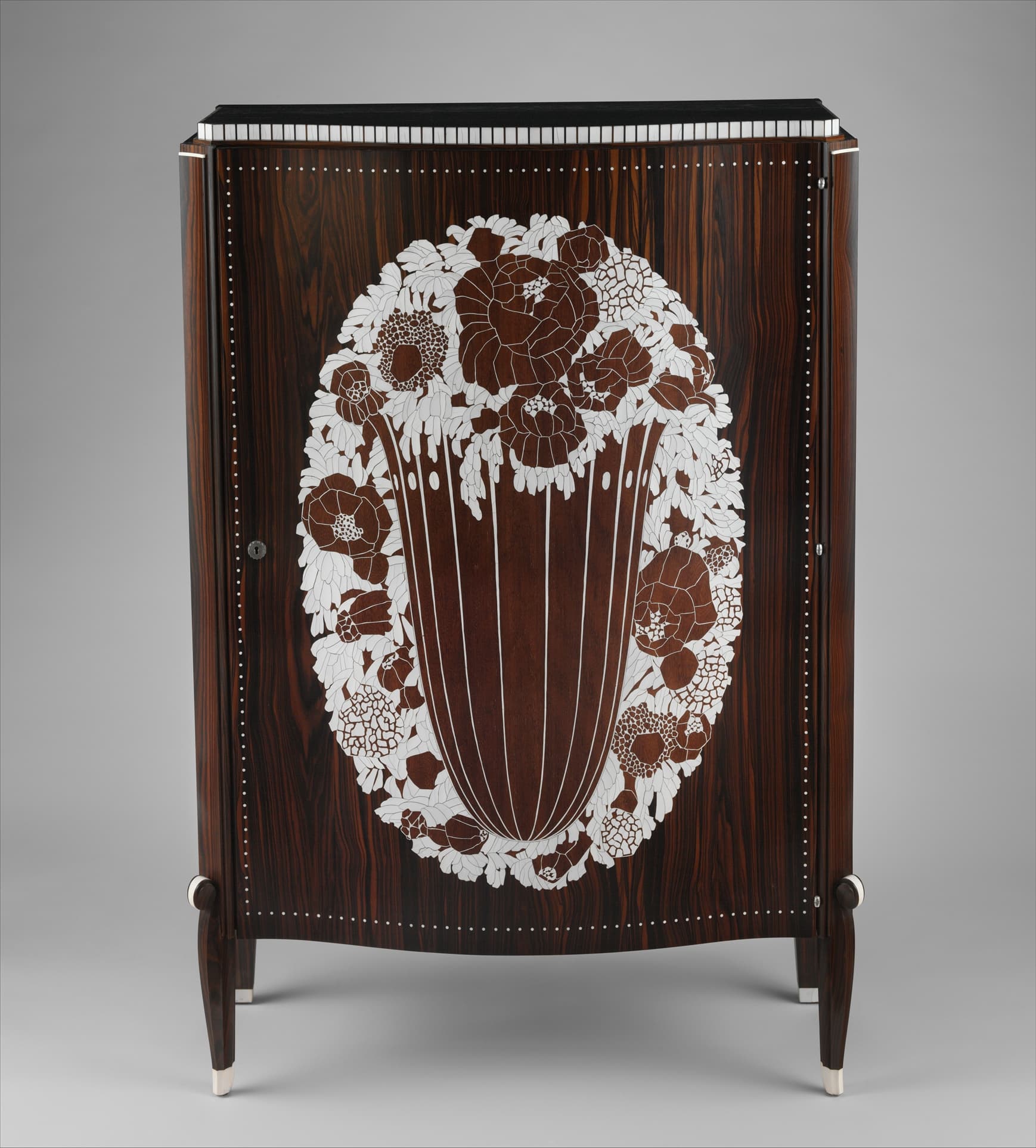
Materials were integral to this visual language. In the État cabinet, for example, the decoration is constructed from precisely fitted pieces of wood and ivory veneer, rather than being merely painted onto the surface. Such work makes craftsmanship part of the composition itself. Ruhlmann could also vary an established model’s form or decoration for a particular commission, balancing a recognizable design vocabulary with the requirements of an individual patron.[10]

The David-Weill desk: modern furniture among antiques

The David-Weill desk, made around 1918–1919, provides an especially revealing example of Ruhlmann’s relationship with the past. Its patron, David David-Weill, was a financier associated with Lazard Frères and a major collector with a particular interest in eighteenth-century French art. Rather than demanding that the client abandon his existing collection, Ruhlmann designed a modern desk that could belong comfortably within it. The kidney-shaped form recalls French and English rognon desks of the late eighteenth century, while its materials include amboyna veneer, ivory, sharkskin, and silk.[11]

David-Weill used a Louis XVI armchair with the desk, a small but telling detail. The pairing demonstrates that Ruhlmann’s furniture was not always intended for a completely new, stylistically uniform interior. It could also mediate between a collector’s inherited taste and contemporary design. The desk’s originality lay in its proportions, surfaces, and refinement rather than in the denial of historical precedent. It is now in the Metropolitan Museum of Art.[11]

The *Meuble au char* and the illusion of lightness

Among Ruhlmann’s most recognizable designs is the Meuble au char, usually called the Chariot sideboard in English. The model appeared in 1919 and was subsequently produced in different examples. Its identity centers on the contrast between an elongated cabinet and slender, tapering legs, together with an ivory representation of a classical charioteer. The subject gives the piece its name and links its modern geometry to an imagery drawn from antiquity.[2]

An example dated around 1921, belonging to the Musée d’Art Moderne de Paris, combines Macassar ebony, ivory, mahogany, and portor marble. At approximately 2.28 meters wide, it is a substantial furnishing, yet the long body and delicate supports prevent it from appearing inert. Its effect depends on proportion and contrast: dark wood against pale inlay, the breadth of the cabinet against the narrowness of the legs, and a strongly horizontal composition interrupted by the compact figurative motif. The design illustrates how Ruhlmann could give a large storage piece the visual precision of a carefully composed decorative object.[12]

The workshop and the role of drawing

Ruhlmann’s authorship depended on a division between invention and execution. His furniture was initially made by outside workshops, including established craftspeople in the Faubourg Saint-Antoine. In 1923, he opened his own cabinetmaking workshop on the rue d’Ouessant, while design activity remained associated with the rue de Lisbonne. Many of the cabinetmakers responsible for executing his designs had trained at the École Boulle, and specialist collaborators supplied elements such as lacquer and metalwork.[3]

Drawing provided the connection between his initial ideas and the finished object. His office developed sketches into progressively more detailed designs and ultimately full-size working drawings. This process allowed a design conceived on paper to be translated into precise proportions, joinery, fittings, and surface treatments. Although his name identified the finished furniture, its production was collective. The disciplined coordination of designers, cabinetmakers, upholsterers, and other specialists was as essential to the result as the initial sketch.[13]

The workshop also maintained organized catalogs of models, known as référenciers. The Collectionneur armchair, for example, was recorded under both an older and a newer reference number. This documentation is an important reminder that Ruhlmann’s work was not simply a succession of unrelated, unique masterpieces. It included identifiable models that could be ordered, adapted, and incorporated into different settings. Such records now help museums connect surviving furniture with drawings, photographs, and exhibition installations.[14]

Early international recognition: the *Tibattant* desk

Ruhlmann’s international reputation was already developing before his celebrated appearance at the 1925 Paris exhibition. In 1923, the Metropolitan Museum of Art’s curator Joseph Breck purchased a Tibattant desk directly from him. The museum identifies it as the first work by Ruhlmann to enter a public collection. This early acquisition gave institutional recognition to a living designer whose furniture was still being produced for contemporary interiors, rather than collected as the decorative art of a completed historical period.[15]

The desk combines Macassar ebony and ivory with leather, silk, silver, and aluminum leaf. Its construction also includes ordinary structural woods and plywood beneath the luxurious visible surfaces. That combination is instructive: Ruhlmann’s craftsmanship did not require every part of an object to be made from a single rare timber. The relationship between structural materials and carefully selected exterior finishes was part of its technical sophistication.[15]

The 1925 exhibition and the *Hôtel du Collectionneur*

The decisive public event of Ruhlmann’s career was the Exposition internationale des arts décoratifs et industriels modernes, held in Paris in 1925. His principal contribution, the Hôtel du Collectionneur, was conceived as the residence of an imaginary wealthy collector. It was not a commercial hotel but an ideal private house, designed to demonstrate how architecture, furniture, painting, sculpture, textiles, and lighting could form a coherent modern environment. Ruhlmann entrusted the architecture to his longtime friend Pierre Patout and brought together a large network of artists and manufacturers.[4]

The pavilion was also a considerable personal gamble. The Musée des Années 30 describes it as a project that Ruhlmann had to finance himself, with the fictional collector standing in for the real patrons he hoped to attract. Its eight rooms displayed the breadth of his enterprise, from reception and working spaces to a bedroom, boudoir, and bathroom. The central oval salon rose to an eight-meter ceiling and functioned as the architectural and decorative focus of the house. Every room was simultaneously an artistic composition and a demonstration of the firm’s capabilities.[4]

The collaboration brought Ruhlmann into close working relationships with several important artists. Joseph Bernard supplied the Frieze of the Dance, Alfred Janniot contributed Hommage à Jean Goujon, and Henri Marret painted exterior frescoes. Within the principal salon, sculpture by Antoine Bourdelle appeared alongside a cabinet lacquered by Jean Dunand. This arrangement exemplified Ruhlmann’s approach: furniture did not merely fill a room but established relationships with painting, sculpture, architecture, and fabric. The pavilion became one of the exhibition’s best-known achievements and an enduring reference point for French Art Deco.[4]

The *État* cabinet and museum patronage

The État cabinet further strengthened Ruhlmann’s connection with public collections. The Metropolitan Museum commissioned its example in 1925, and the object was manufactured in 1925–1926 from a design dating to 1922. It is a variation on a cabinet shown at the Paris exhibition and purchased by the French state, explaining the model’s name: État, or “State.” Its elaborate marquetry combines wood and ivory in a tightly interlocking decorative pattern.[10]

The cabinet illustrates both the richness of his surface design and the adaptability of his production. A museum commission could become a distinct version of an existing model rather than a straightforward duplicate. It also demonstrates how quickly his work moved between private luxury, international exhibition, and institutional collecting. These were not separate phases of his reputation; during the 1920s, they developed alongside one another.[10]

Textiles, ceramics, and the publication of his designs

Furniture dominates Ruhlmann’s reputation, but his work extended to the surfaces and objects that gave an interior its atmosphere. The Sarrazin textile, dated around 1917, belongs to this broader production. Textiles could establish color, rhythm, and visual continuity across an interior, rather than serve as neutral coverings for the furniture. The Collectionneur fabric of 1925, associated with Ruhlmann and Henri Stéphany and manufactured by Cornille & Cie in Lyon, further demonstrates the collaboration between the design studio and specialist textile producers.[16][12]

Ruhlmann also worked with the Manufacture nationale de Sèvres, designing a series of vases and a cup and saucer during the second half of the 1920s. These objects extended his interest in simplified, carefully balanced forms into porcelain. Their importance lies partly in the transfer of a consistent approach across different media: the same concern for silhouette and proportion could shape a cabinet, a vessel, or an interior. Sèvres’s records place these ceramic designs within the wider development of his increasingly pared-down late work.[17]

His interiors and drawings circulated through published portfolios as well as exhibitions. Harmonies: Intérieurs de Ruhlmann, issued in 1924 by Éditions Albert Morancé with Jean Badovici as editor, presented his work through collotype prints, some hand-colored. Another portfolio of the same year, Croquis de Ruhlmann, was edited by Léon Moussinac and published by Éditions Albert Lévy. These publications made his designs available beyond the limited audience able to visit a private residence or purchase his furniture, and they remain valuable records of his graphic and decorative practice.[18][19]

Parisian clients, restaurants, and ocean liners

Ruhlmann’s clientele included figures from finance, industry, fashion, and literature. Among the patrons associated with his work were members of the Rothschild and Worms families, the industrialist Eugène Schueller, the aircraft and automobile manufacturer Gabriel Voisin, the fashion designer Jeanne Paquin, and the writer Colette. The playwright Paul Géraldy also commissioned stage designs. These relationships placed Ruhlmann within a social world in which modern interiors could express professional success, cultivated taste, and a desire to participate in contemporary artistic life.[13]

His work also entered fashionable public settings. The Drouant chair, designed for the Paris restaurant, uses subtle curves, counter-curves, and tapered forms rather than conspicuous ornament. The Metropolitan Museum purchased its example directly from Ruhlmann in 1925. Its original silk damask upholstery, also designed by him and woven in Lyon, eventually deteriorated so severely that it was replaced with a digitally printed reproduction intended to evoke the original fabric. The object’s conservation history reveals a vulnerability concealed by the appearance of luxury: even exceptionally refined materials can be fragile.[5]

In 1927, Ruhlmann designed the decoration and furniture of the first-class tea salon aboard the ocean liner Île-de-France. The commission extended his work beyond the private house into the carefully staged world of luxury travel, where a French liner’s interiors could serve as a moving presentation of national decorative art.[3]

The Maharaja of Indore and the technologically equipped interior

One of Ruhlmann’s most intriguing late projects developed around Yashwant Rao Holkar II, the Maharaja of Indore. At the 1929 Salon des Artistes Décorateurs, Ruhlmann presented an ensemble conceived for an Indian prince, associated with the future furnishings of Manik Bagh, the palace designed by Eckart Muthesius. The Maharaja did not purchase the entire display. According to the surviving commission history discussed by Sotheby’s, his selections included a bookcase and a monumental black-lacquered desk and chair. His patronage was selective, bringing Ruhlmann’s work into a collection that also embraced more explicitly industrial forms of modern design.[20]

The most memorable object associated with this presentation is the chaise longue “aux skis.” Its adjustable black-lacquered frame rested on ski-like supports, and it incorporated a heated footrest and a reading light. Although designed for the princely ensemble, the chaise was not ultimately used in the palace. The distinction matters because the chair is frequently discussed as though it had necessarily furnished the Maharaja’s home. Its importance is broader: it demonstrates Ruhlmann’s willingness to combine luxurious materials with technological convenience, bodily comfort, and dynamic forms. Far from being concerned only with decorative surfaces, he was investigating how furniture could accommodate the habits and expectations of modern life.[20]

The Salon Afrique and the Palais de la Porte Dorée

For the 1931 Colonial Exhibition, Ruhlmann created the furnishings of the Salon Afrique at the Palais de la Porte Dorée, used as the reception office of Paul Reynaud, the minister of the colonies. The room is one of the clearest surviving demonstrations of his comprehensive approach to interior design. Furniture, woodwork, doors, and the geometric patterning of the floor were coordinated within an oval space of approximately ninety square meters. The ensemble also incorporated monumental metal vessels by Raymond Subes and a mural by Louis Bouquet.[6]

The central desk provides unusually precise evidence of the labor behind Ruhlmann’s furniture. Known as the Bloch model, the 1931 example combined polished Macassar ebony with a shagreen-covered top and ivory inlay. The cabinetmaker Jules Deroubaix recorded the work involved: preparing and fitting 54 ray skins, inserting 27 meters of ivory strips, machining the timber, and constructing the desk. The documented total was 1,067 hours. This tally turns an otherwise abstract reputation for exceptional craftsmanship into something measurable and shows how much skilled labor lay beneath a seemingly controlled, uncluttered surface.[21]

The room’s Éléphant armchairs reveal another aspect of Ruhlmann’s design. First presented as a model in 1926, they took their name from their generous proportions and broad, rounded arms. Rather than minimizing the appearance of mass, as he did with a slender-legged cabinet, Ruhlmann made these chairs deliberately expansive and enveloping. Their success depended on comfort and upholstery as much as on formal elegance. The contrast between such seating and the room’s disciplined geometry shows the range contained within his mature style.[22]

The Salon Afrique also requires attention to its colonial setting. It was created for an exhibition promoting the French empire, and its precious woods, ivory, and animal skins belonged to the international material networks that sustained luxury decorative production. French Art Deco’s relationship with colonial resources was part of its historical context, not simply a matter of exotic appearance. Recognizing that context does not diminish the technical achievement of the room, but it prevents its original political purpose from disappearing behind an exclusively aesthetic appreciation.[9][6]

Late experiments and changing ideas of luxury

During his final years, Ruhlmann increasingly explored geometric simplification and practical equipment. Sèvres’s biographical account notes his incorporation of devices such as telephones, lighting, and lighting-control panels into furniture. These developments complicate the idea that he stood entirely outside the functional concerns of modern design. His aim was not necessarily to make furniture inexpensive or suitable for mass production, but to integrate modern convenience into the refined environments expected by his clients.[17]

The Rendez-vous des pêcheurs de truites furniture of 1932, associated with his country house at Lyons-la-Forêt, suggested another possible direction. With metal elements, lighter woods, and straw-seated chairs, the ensemble introduced a more rustic and less ceremonious character than his grand urban interiors. The economic crisis and changing aesthetic debates formed the background to these late experiments, but his death prevented their development into a longer phase of his career. They remain important evidence that his work was still changing rather than simply repeating the celebrated formulas of 1925.[7]

Final illness and death

Ruhlmann became seriously ill in 1933. The Getty Research Institute records that, following a sudden illness, he prepared a detailed will in August directing the closure of his business after his death. He died in Paris on 15 November 1933, aged 54. The institutional biographical accounts cited here do not identify his fatal illness by a specific medical diagnosis, so a more precise cause of death cannot be established from them. His final arrangements nevertheless show that he anticipated his death and took deliberate steps to determine what would happen to the enterprise afterward.[8]

He also designed his own funerary monument for Passy Cemetery, entrusting its execution to Pierre Patout and Alfred Janniot, whose black-marble sculpture was titled La Flamme du souvenir. The business was wound down in accordance with his wishes, although unfinished commissions still required completion. Alfred Porteneuve, his nephew by marriage and collaborator, continued that work; the interior for the architect André Granet, begun in 1932, was completed in 1934.[8][3]

Legacy and historical importance

Ruhlmann’s influence extended through designers who had worked within his professional circle, including Maxime Old, Jean-Maurice Rothschild, and Henry Jacques Le Même. His workshop offered a model of exacting coordination between drawing, architecture, furniture, and specialist craftsmanship. The survival of drawings, model catalogs, photographs, and published portfolios is particularly important because many of his interiors were temporary, altered, or dispersed. These documents make it possible to study not only isolated furnishings but also the relationships for which they were originally designed.[8][7]

His surviving works also resist a narrow definition of Art Deco as decorative extravagance. The historically responsive David-Weill desk, the carefully documented État cabinet, the Drouant chair, and the technologically equipped chaise longue address different problems of use, comfort, setting, and representation. Ruhlmann’s distinctive contribution was to treat these practical questions as inseparable from artistic composition. His career demonstrates how furniture and interiors could become major vehicles of artistic expression without ceasing to serve the everyday activities for which they were made.[11][10][5][20]

---

Life events

  1. 1879

    Born in Paris on 26 August, into a family running a decorating business. His name also appears as Jacques-Émile Ruhlmann.

  2. 1923

    Opens his own cabinetmaking workshop on the rue d'Ouessant, having worked from the rue de Lisbonne. He designs and directs; the making is done by specialists.

  3. 1925

    The Hôtel du Collectionneur at the Exposition internationale des arts décoratifs et industriels modernes, built with the architect Pierre Patout — a whole imagined residence rather than a stand of objects.

  4. 1925

    The Metropolitan Museum of Art commissions its État cabinet, accession 25.231.1, through the Edward C. Moore Jr. fund. It is manufactured in 1925–26.

  5. 1931

    The Salon Afrique at Albert Laprade's Palais de la Porte Dorée, built for the Colonial Exhibition, with the Éléphant armchair and the desk made for Paul Reynaud.

  6. 1933

    Falls seriously ill and prepares a detailed will in August directing that the business be closed after his death. He dies in Paris on 15 November, aged fifty-four.

  7. 1934

    Alfred Porteneuve, his nephew by marriage, completes the unfinished commissions, including the interior for the architect André Granet begun in 1932. Ruhlmann had designed his own monument at Passy Cemetery.

Selected works

Cataloged from the holding institutions' records. Reproductions appear only where the rights are verified.

Furniture

A tall dark cabinet on four slender tapering legs. The front carries a large oval of pale ivory inlay: stylised flowers massed above a tall fluted urn. A band of short ivory bars runs along the top edge, lines of small ivory dots frame the doors, and the feet are capped in ivory.

Artwork reproduction

Furniture · Art Deco

État Cabinet

designed 1922; this example manufactured 1925–26 · Macassar ebony, amaranth, ivory, oak, poplar, chestnut, mahogany, lumber-core plywood, and silvered brass

Émile-Jacques Ruhlmann designed the État cabinet in 1922, and the Metropolitan Museum of Art commissioned its own example in 1925. It is an upright case on slender tapering legs, veneered in dark Macassar ebony and inlaid with a large oval of pale stylised flowers in ivory. The name comes from the French state, which bought a related cabinet after the 1925 Paris decorative-arts exhibition.

The Metropolitan Museum of Art

Émile-Jacques Ruhlmann, État Cabinet, designed 1922; this example manufactured 1925–26. The Metropolitan Museum of Art. Image: CC0.

Movements

The artistic and literary currents this life ran through.

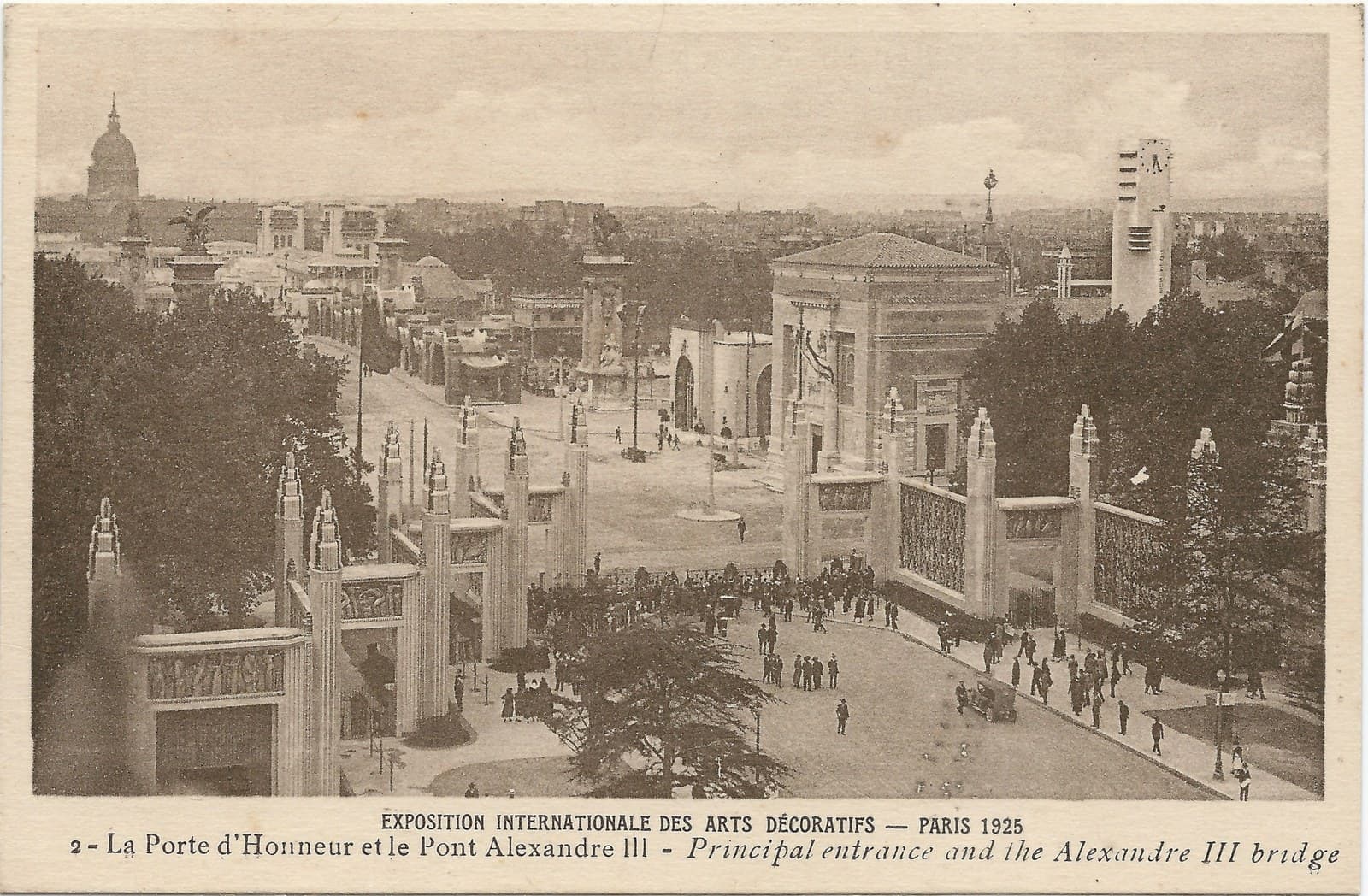
Aerial view of the 1925 Paris decorative arts exhibition: tall square pylons flanking the Porte d'Honneur entrance, crowds on the paths below, pavilions and a clock tower spreading toward the Invalides dome

Art & design movement · circa 1910–1939

Art Deco

Ruhlmann is the luxury end of Art Deco: rare-wood cabinets with ivory marquetry, made for wealthy Paris clients by specialists he directed. His Hôtel du Collectionneur at the 1925 Paris exhibition presented coordinated rooms rather than separate objects, which is the ambition the style is usually credited with.

Ruhlmann: Genius of Art Deco / Art Deco Paris — exhibition press release; Hôtel du Collectionneur - the 1925 Paris exhibition; Jared Goss, French Art Deco

Questions about Émile-Jacques Ruhlmann

Was Émile-Jacques Ruhlmann a cabinetmaker?

No, and the distinction matters. He was a designer and interior decorator who directed the specialists who built his furniture. He is often compared to the great French cabinetmakers of the eighteenth century, but he was not trained in the trade himself.

What was the Hôtel du Collectionneur?

Ruhlmann's pavilion at the 1925 Paris decorative-arts exhibition, built with the architect Pierre Patout. It presented the imaginary home of a wealthy collector, with the furniture, textiles and decoration coordinated into complete rooms rather than shown as separate objects.

What materials did Ruhlmann use?

Macassar ebony, amaranth, ivory, lacquer and finely figured veneers, over structural woods like oak, poplar and chestnut, with silvered brass for fittings. The expense was part of the point: his clients were buying a modern equivalent of an aristocratic interior.

Where can I see Ruhlmann's work in Paris?

The Palais de la Porte Dorée holds the Salon Afrique, with the Éléphant armchair and the desk made for Paul Reynaud. The Musée des Années 30 at Boulogne-Billancourt has the Collectionneur armchair. Outside France, the Metropolitan Museum of Art in New York holds the État cabinet and several other pieces.

What happened to his business after he died?

He closed it deliberately. The will he prepared in August 1933, three months before his death, directed that the enterprise be wound down. Unfinished commissions were completed by his nephew by marriage, Alfred Porteneuve — the interior for the architect André Granet, begun in 1932, was finished in 1934.

Why are his name and dates sometimes given differently?

He appears as both Émile-Jacques Ruhlmann and Jacques-Émile Ruhlmann; the Bibliothèque nationale de France records the variants. He was born on 26 August 1879 and died on 15 November 1933, aged fifty-four.

Connections and Sources

Émile-Jacques Ruhlmann’s connections to people, places, and works, with the sources behind each one.

Associated with · 1913–1933

Art Deco

Ruhlmann is the luxury end of Art Deco: rare-wood cabinets with ivory marquetry, made for wealthy Paris clients by specialists he directed. His Hôtel du Collectionneur at the 1925 Paris exhibition presented coordinated rooms rather than separate objects, which is the ambition the style is usually credited with.

Ruhlmann: Genius of Art Deco / Art Deco Paris — exhibition press release; Hôtel du Collectionneur - the 1925 Paris exhibition; Jared Goss, French Art Deco

References

References

The sources below include biographies, scholarly essays, interviews, and primary materials that informed this page. They reflect both the historical record and ongoing critical conversations about Émile-Jacques Ruhlmann and their work.

  1. 1abcdBirth, death, and variations of his name

    Website
    Bibliothèque nationale de France
    Used for

    The national library's authority record: born 26 August 1879, died 15 November 1933, and the variant orderings of his name.

    View source
  2. 2abcRuhlmann: Genius of Art Deco / Art Deco Paris — exhibition press release

    Website
    The Metropolitan Museum of Art
    Used for

    The 2004 exhibition: his materials, eighteenth-century points of reference, and the design process from sketch to full-size drawing.

    View source
  3. 3abcdefgCareer, workshops, collaborators, ocean-liner commission, and burial

    Website
    Palais de la Porte Dorée
    Used for

    His workshops and collaborators, the ocean-liner commission, and the funerary monument at Passy.

    View source
  4. 4abcdHôtel du Collectionneur - the 1925 Paris exhibition

    Website
    GrandPalaisRmn, Histoire par l'image
    Used for

    The Hotel du Collectionneur at the 1925 Paris exhibition, and Pierre Patout's part in it.

    View source
  5. 5abcDrouant Side Chair - Émile-Jacques Ruhlmann

    Website
    The Metropolitan Museum of Art
    Used for

    The holding museum's record for the Drouant side chair.

    View source
  6. 6abcSalon Afrique - Palais de la Porte Dorée

    Website
    Palais de la Porte Dorée
    Used for

    The Salon Afrique at the Palais de la Porte Doree and the furniture Ruhlmann made for it.

    View source
  7. 7abcFamily background, late rustic furniture, and professional legacy

    Website
    Wikipedia, French
    Used for

    Family background, the late rustic furniture, and his professional legacy.

    View source
  8. 8abcdefEarly life, marriage, professional development, and final illness

    Website
    Getty Research Institute
    Used for

    The Getty's finding aid for his drawings, and the August 1933 will directing that the business be closed after his death.

    View source
  9. 9abFrench Art Deco

    Website
    The Metropolitan Museum of Art
    Used for

    The wider context of French Art Deco and the Metropolitan Museum's early collecting of it.

    View source
  10. 10abcdÉmile-Jacques Ruhlmann, État cabinet — collection record

    Website
    The Metropolitan Museum of Art
    Used for

    The holding museum's record for the Etat cabinet, accession 25.231.1.

    View source
  11. 11abcDavid-Weill Desk - Émile-Jacques Ruhlmann

    Website
    The Metropolitan Museum of Art
    Used for

    The holding museum's record for the David-Weill desk.

    View source
  1. 12abMeuble au char / Chariot Sideboard - Émile-Jacques Ruhlmann

    Website
    The Metropolitan Museum of Art
    Used for

    The exhibition photo gallery, the source for the Meuble au char and for the Collectionneur textile designed with Henri Stephany.

    View source
  2. 13abPatrons, drawing procedures, and workshop organization

    Website
    Wikipedia, English
    Used for

    His patrons, his drawing procedures, and how the workshop was organised.

    View source
  3. 14Collectionneur Armchair - Émile-Jacques Ruhlmann

    Website
    Musée des Années 30
    Used for

    The Collectionneur armchair, in the collection of the Musee des Annees 30 at Boulogne-Billancourt.

    View source
  4. 15abTibattant Desk - Émile-Jacques Ruhlmann

    Website
    The Metropolitan Museum of Art
    Used for

    The holding museum's record for the Tibattant desk.

    View source
  5. 16Sarrazin Textile - Émile-Jacques Ruhlmann

    Website
    The Metropolitan Museum of Art
    Used for

    The holding museum's record for the Sarrazin textile.

    View source
  6. 17abSèvres ceramics and late design developments

    Website
    Sèvres
    Used for

    His work with the Sevres manufactory and the late developments in his designs.

    View source
  7. 18Harmonies: Intérieurs de Ruhlmann - published portfolio

    Website
    The Metropolitan Museum of Art
    Used for

    Harmonies: Interieurs de Ruhlmann, the published portfolio of his interiors.

    View source
  8. 19Croquis de Ruhlmann - published portfolio

    Website
    The Metropolitan Museum of Art
    Used for

    Croquis de Ruhlmann, the published portfolio of his sketches.

    View source
  9. 20abcChaise Longue aux Skis and the Maharaja of Indore

    Website
    Sotheby's
    Used for

    The auction catalogue for the Chaise longue aux skis and its commission for the Maharaja of Indore.

    View source
  10. 21Bureau de Paul Reynaud / Bloch Desk - Émile-Jacques Ruhlmann

    Website
    Palais de la Porte Dorée
    Used for

    The Bloch desk, made for the minister Paul Reynaud's office at the Palais de la Porte Doree.

    View source
  11. 22Éléphant Armchair - Émile-Jacques Ruhlmann

    Website
    Palais de la Porte Dorée
    Used for

    The Elephant armchair at the Palais de la Porte Doree.

    View source
i
Why these sources are here

These references anchor the page in the documented record and in the scholarly conversations around Émile-Jacques Ruhlmann. Every claim on this page traces back to one or more of the works listed here.

Explore more resources

