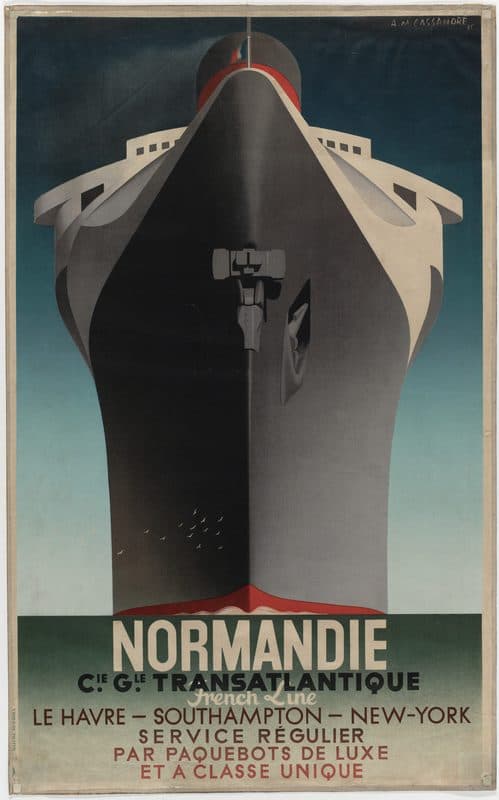
A. M. Cassandre designed this poster in 1935 to advertise the French liner Normandie. He drew the ship head-on, so the bow fills the sheet and rises toward the upper decks, with a few small white birds beside the hull to give the scale. The ship's name runs in heavy letters along the bottom. The Museum of Modern Art in New York holds a lithograph of it, about a metre tall.
Normandie is a poster designed by A. M. Cassandre to advertise the French ocean liner of the same name. The artwork is the printed image, not the ship itself. By representing the liner almost directly from the front, Cassandre transformed a commercial vessel into a monumental arrangement of geometric forms. The poster's power comes from simplification and viewpoint rather than from a detailed description of life on board.[1]
Cassandre and Modern Advertising
Cassandre's work included advertising for newspapers, railways, and consumer products. His earlier designs included Nord Express and Étoile du Nord, both from 1927, and the Dubonnet advertising design of 1932. Normandie belongs to this broader practice of creating strong, readily recognizable images for commercial communication.[2]
His position between art and advertising was recognized during his working career. MoMA's 1936 presentation described his attention to the needs of poster design and his command of techniques including lettering and lithography. He was not simply applying an existing painting to a commercial surface; the purpose and conditions of the poster were central to the conception of the image.[3]
Composition and Viewpoint
The ship's bow dominates the composition, rising from near the bottom of the image toward a series of curved upper decks. A central vertical division and large areas of dark and light give the vessel both symmetry and volume. Tiny white birds near the hull provide a striking scale contrast, making the ship seem immense without requiring a human figure beside it.[1]
The viewpoint places the spectator below the vessel rather than comfortably alongside it. As a result, the liner appears less like a vehicle available for inspection than an imposing technological achievement. Cassandre leaves much of its real-world complexity out of the picture, allowing a few shapes to carry the image's principal effect.[1]
Lettering and the Advertising Message
The large word NORMANDIE forms a broad horizontal foundation beneath the ship. Smaller lettering identifies the Compagnie Générale Transatlantique, the French Line, and the connection between Le Havre, Southampton, and New York. The hierarchy moves from immediate recognition to practical information: the viewer first encounters the vessel and its name, then the service being advertised.[1]
The Ship as an Ambassador for France
The actual Normandie entered transatlantic service in 1935 and was conceived as much more than a means of transportation. Government support helped sustain an enormously ambitious project during a period of economic crisis. Its luxurious interiors, food, and decorative arts were intended to project French prestige internationally.[4]
Among its interior achievements were glass murals designed by Jean Dupas and executed by Jacques-Charles Champigneulle. Their reflective surfaces and elaborate imagery created an environment of extraordinary decorative richness. Cassandre's poster approached the same promotional purpose from the opposite direction. Where the interiors accumulated sumptuous detail, the poster concentrated its appeal into a few commanding forms.[4]
The Liner's Destruction
The ship's later fate gives the image an additional historical poignancy. While undergoing conversion for American wartime service in New York, Normandie caught fire on February 9, 1942, and subsequently capsized. Some of its decoration had been removed and survived; the vessel was ultimately scrapped. The poster preserves the liner in the confident public image created before that destruction.[4]
Museum Recognition and Significance
MoMA held Posters by Cassandre from January 14 to February 16, 1936, only a year after Normandie appeared. That early recognition demonstrates that his advertising was already being considered within the history of modern art and design, rather than acquiring cultural value only after its original commercial purpose had faded.[3]
The museum's Normandie is cataloged as a lithograph in its Department of Architecture and Design. Its importance lies in the relationship between artistic decisions and communicative purpose: scale, geometry, contrast, and typography work together to make a service recognizable and desirable. It shows how Art Deco could operate not only through buildings and luxurious objects, but through reproducible images encountered by a much wider public.[1]
Close reading
Reading the work, detail by detail
Cassandre put the viewer in the water directly under the bow. The details show how few elements he needed: a black wedge, two white wings, a funnel, a flock of birds for scale, and the lettering that turns the picture into an advertisement.
1.The bow, straight at the viewer
The stem runs up the middle of the sheet as one vertical line, with the hull falling away either side in two flat tones. Seen head-on the ship has no length at all, which is what makes it read as a wall rather than a vehicle.
2.The birds that give the scale
A dozen small white birds cross the hull near the waterline. They are the only thing in the picture whose real size a viewer already knows, and they do the whole job of making the ship enormous. No human figure appears anywhere.
3.The funnel at the top
One funnel, banded red and black, closes the composition at the top. Smoke drifts to the left in a thin grey wash, the only soft edge in the picture.
4.The white deck wings
The superstructure spreads sideways in two white wings, each pierced by a row of small square windows. They are the widest elements in the picture and they sit almost at the top, which makes the ship look top-heavy and close.
5.The red band at the waterline
A band of red marks where the hull meets the water. It is the only place the ship and the sea actually touch, and it separates the black mass above from the green below.
6.The lettering, in four sizes
NORMANDIE runs in heavy capitals the full width of the sheet. Below it, in three decreasing sizes, come the company, the line and the route: Le Havre, Southampton, New-York. The order is the argument — the ship first, the service afterwards.
Where to see it
The Museum of Modern Art
11 West 53 Street, New York, NY 10019, United States
Gallery displays change, so check the museum's own object record before making a special visit.
A. M. Cassandre, in 1935, to advertise the French liner Normandie for the Compagnie Générale Transatlantique. His earlier posters included Nord Express and Étoile du Nord, both 1927, and Dubonnet in 1932.
Is the artwork the poster or the ship?
The poster. The artwork is the printed image Cassandre designed, not the vessel it advertises.
What makes the ship look so big?
The viewpoint and the birds. Cassandre drew the liner almost head-on and placed the viewer below it, so the bow rises through the sheet. A few tiny white birds near the hull supply the scale, which means no human figure is needed to show how large the ship is.
How big is the Normandie poster?
The Museum of Modern Art's example is a lithograph measuring 99.7 by 61.9 centimetres, held in its Department of Architecture and Design.
What happened to the Normandie?
It caught fire in New York on 9 February 1942, while being converted for American wartime service, and capsized. Some of its decoration had already been removed and survived. The ship itself was scrapped.
In the atlas
What the graph records about this work — every claim carries its citation.
Cassandre's poster shows Art Deco working through printed commercial images rather than buildings or luxury objects. He reduced the liner to a few geometric forms seen head-on, and the Museum of Modern Art gave him a solo exhibition a year later, in 1936.
— A. M. Cassandre, Normandie, 1935 — collection record; Posters by Cassandre, 14 January – 16 February 1936 — exhibition archive
If you like A. M. Cassandre
Explore painters from the same movements and circles.
Suzanne Lalique-Haviland
French designer who worked in glass, porcelain, textiles and stage design, and whose contributions to the Lalique firm were often manufactured under her father's signature.
Painter who arrived from Odessa via St Petersburg in 1905, co-invented Simultanism with Robert Delaunay, made the two-metre folding artist's book La Prose du Transsibérien with the poet Blaise Cendrars in 1913, dressed 1920s Paris from her Atelier Simultané, and in 1964 became the first living woman shown at the Louvre.
Swiss-born architect who arrived in Paris in 1917 as the painter Charles-Édouard Jeanneret, took the name Le Corbusier in 1920, and ran one atelier — his studio — at 35 rue de Sèvres for four decades. In 1925 he proposed demolishing much of the Right Bank of central Paris and replacing it with sixty-storey towers. Paris refused; the rest of the world adopted the idea after 1945.
The sources below include collection records, catalogues, scholarly research, and primary materials that informed this page. They document Normandie, its making, and its place in cultural history.
1abcdeA. M. Cassandre, Normandie, 1935 — collection record
Website
The Museum of Modern Art
Used for
The holding museum's record: the 1935 date, the lithographic medium, the 99.7 by 61.9 cm dimensions, and the Department of Architecture and Design.
4abcJean Dupas, The History of Navigation panels from the Normandie — collection record
Website
The Metropolitan Museum of Art
Used for
The liner's interiors and national purpose, Jean Dupas's glass murals executed by Jacques-Charles Champigneulle, the fire of 9 February 1942, and the surviving furnishings.
These references provide the documented foundation for this work's history and interpretation. Claim-level citations remain attached to the specific claims they support.


 View source