François Pompon's Polar Bear is a walking bear with the fur, claws and muscle detail taken out, so that light runs across a continuous pale surface. He showed it as a life-size plaster at the 1922 Salon d'Automne, at sixty-seven, and it made his name after decades spent carving in other sculptors' studios. The monumental limestone version in the Musée d'Orsay was commissioned by the French state and carved in 1928–29.
Created
life-size plaster first exhibited 1922; Musée d'Orsay version executed 1928–29
Medium
Pierre de Lens limestone (Musée d'Orsay version); other versions in marble, bronze, plaster and porcelain
*François Pompon's Polar Bear*** depicts an animal walking with an unhurried, powerful stride. Its broad, smooth surfaces make it immediately recognizable without reproducing every feature of a living bear. The sculpture became the decisive public success of an artist who had spent decades working in the studios of more famous sculptors, bringing him widespread recognition at the age of sixty-seven.[1]
An Experienced Sculptor's Late Breakthrough
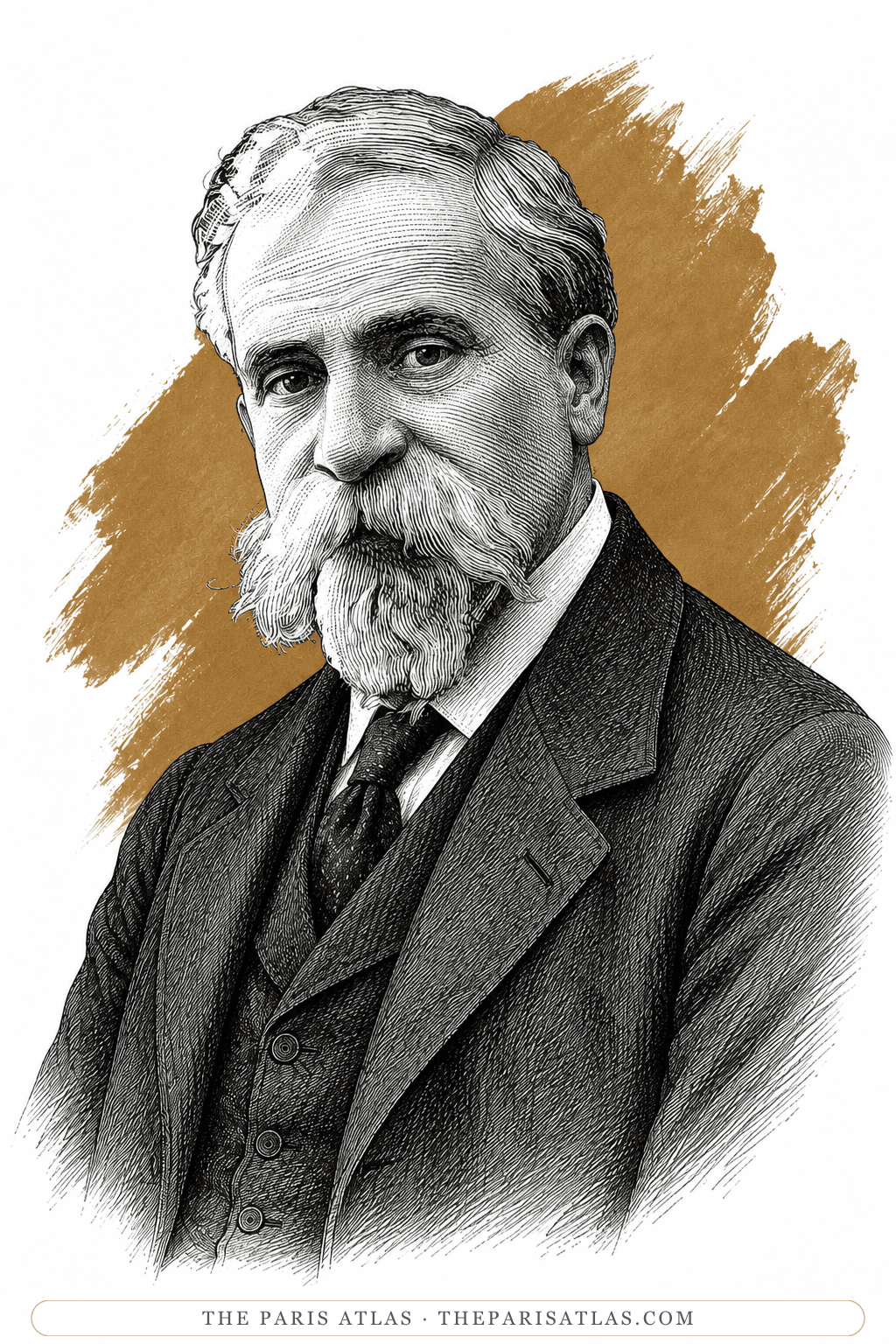
Pompon was not an inexperienced outsider suddenly discovered in old age. Born in Saulieu in 1855, he trained as a stonecarver and developed the skills that made him a valued studio practitioner in Paris. His work included carving for Auguste Rodin and Camille Claudel, among others. His own reputation emerged from a long professional life in which much of his labor had contributed to other artists' achievements.[2]
His growing interest in animals offered a different direction from the expressive human figures associated with Rodin. Instead of emphasizing turbulent surfaces or psychological drama, he increasingly sought rounded, continuous forms. The change was not a rejection of observation: simplification became the result of studying an animal closely and then deciding which details were unnecessary.[1]
Studying Bears at the Jardin des Plantes
Paris's Jardin des Plantes provided Pompon with living models. According to the Dijon museums' account, he devised a portable modeling apparatus attached to his torso, allowing him to work in clay while moving alongside an animal's enclosure. He could follow the bear's changing position rather than depend entirely on a single stationary view.[3]
This working method helps explain the sculpture's convincing sense of movement. Pompon was not trying to record only the outward appearance of a bear; he was studying how its body carried its weight and how one movement followed another. The final sculpture's economy grew out of repeated encounters with a living creature, not from treating the animal as an arbitrary collection of abstract shapes.[3]
The Bear That Surprised the Exhibition Jury
The large plaster exhibited at the 1922 Salon d'Automne transformed the reception of Pompon's work. Dijon's museum recounts that the jury had accepted the sculpture from a photograph and had not fully appreciated its dimensions. When the enormous bear arrived, its scale came as a surprise; it was given a prominent position at the exhibition entrance.[3]
The decision to work at this size also had an artistic backstory. The Grand Palais–Rmn account identifies Antoine Bourdelle as the friend who encouraged Pompon to make larger sculpture. Enlarging the animal made its simplified forms commanding rather than merely charming—a change that helped visitors recognize the ambition of the work.[2]
Form, Surface, and Movement
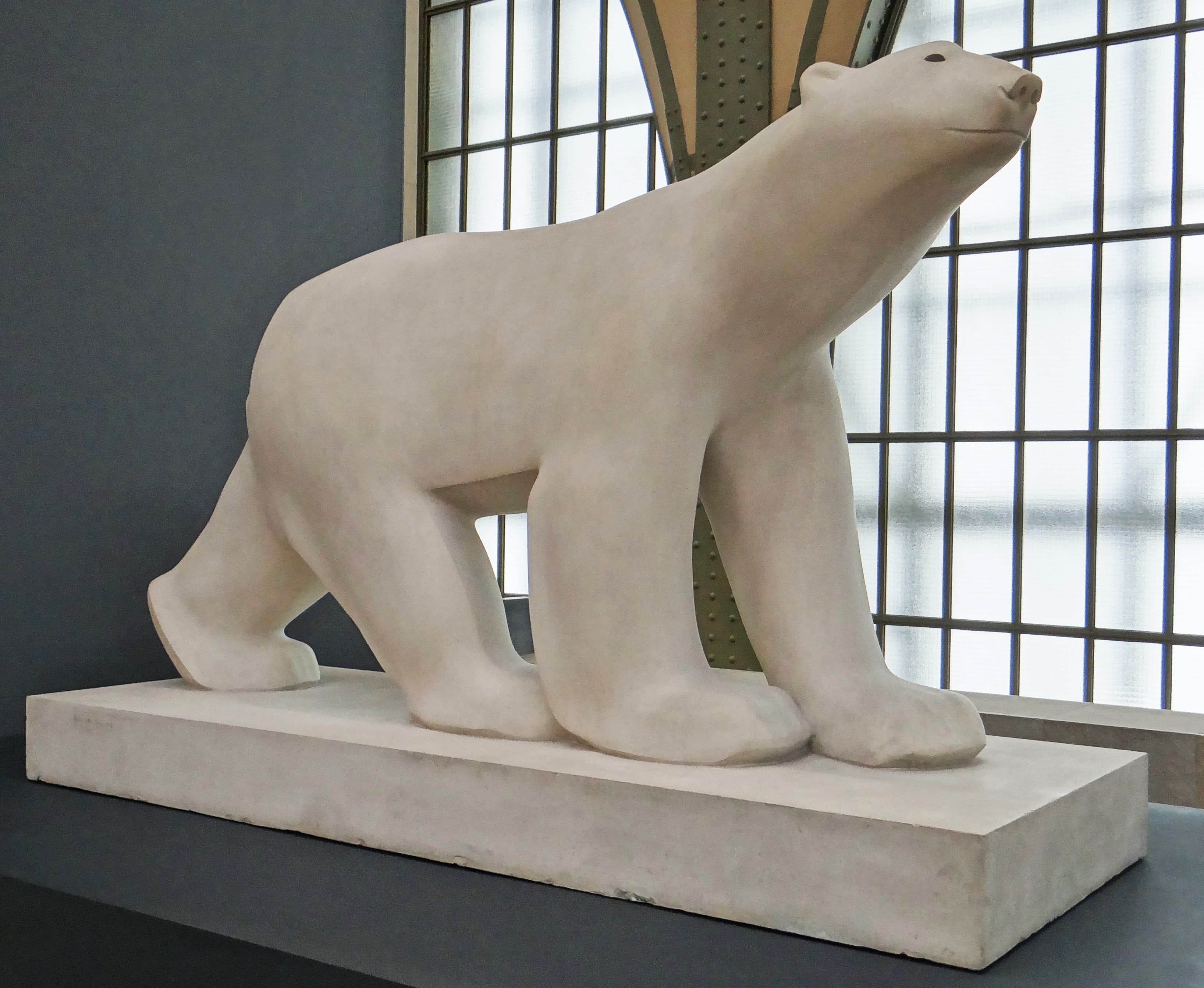
The bear's head extends forward and slightly upward, while its heavy paws establish a measured walking rhythm. Small ears, shallow eyes, and a minimally described muzzle are enough to identify the animal. Across the shoulders, back, and flanks, the transitions are gradual rather than sharply divided. The body appears substantial, but the extended neck and alternating placement of the legs keep it from feeling immobile.
Pompon suppresses the distracting texture of fur and the detailed articulation of claws. Light can consequently travel across the pale surface with relatively little interruption. The result is not strictly geometric abstraction: the Musée d'Orsay specifically emphasizes his preference for rounded forms and his resistance to geometric schematization. His achievement lies in making the animal simpler without making it lifeless.[1]
The Musée d'Orsay Version: Limestone, Not Marble
The famous monumental bear at the Musée d'Orsay should not be confused with the plaster exhibited in 1922. The French state commissioned a stone version in 1927, and it was executed in 1928–29 in pierre de Lens, a limestone. Measuring approximately 163 centimeters high, 251 centimeters long, and 90 centimeters deep, it preserves the imposing scale central to the work's impact.[2]
Its realization also depended on another skilled practitioner, Jean-Joachim Supéry, who carved the commissioned version. This is a useful reminder that sculptural authorship and physical execution were not always performed by the same person. Pompon, who had spent years carving for other artists, now relied on a collaborator to help realize his own design at monumental scale.[2]
Its Connection to Art Deco Interiors
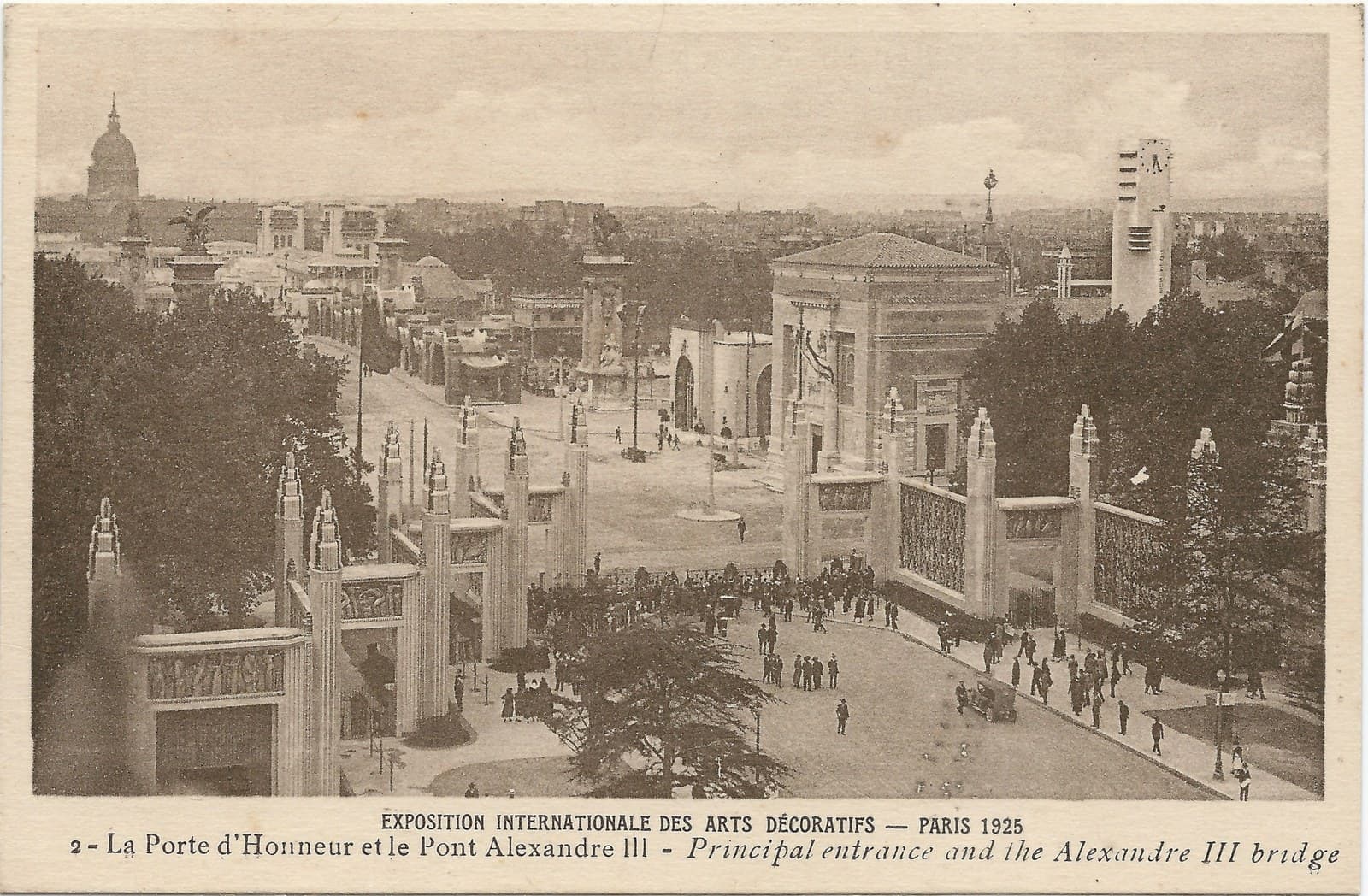
The sculpture's inclusion in Art Deco history is supported by more than a general resemblance to streamlined design. Émile-Jacques Ruhlmann, Pompon's friend, favored the model and included it in his interiors, notably in room settings at the 1925 Paris decorative-arts exhibition. The bear became part of the same coordinated decorative world as Ruhlmann's furniture.[4]
The Metropolitan Museum's smaller marble version, dated approximately 1923, provides another connection. The museum acquired it in 1930 from Galerie Edgar Brandt, the Paris showroom of the celebrated metalworker. Brandt displayed sculpture alongside furniture, glass, ceramics, and other decorative arts, illustrating how these categories were brought together in the presentation of French Art Deco.[4]
Versions and Legacy
Following its success, Polar Bear appeared at different scales and in several materials. The Sèvres manufacture began producing ceramic versions in 1924, while stone and bronze examples extended its presence in collections and interiors. It is therefore important to identify the material, dimensions, and date of a particular example rather than assume that every photograph represents the same object.[2]
The sculpture's enduring appeal rests on a productive balance: it remains unmistakably a bear, yet its smooth, simplified form gives it a presence beyond literal animal illustration. Its association with Art Deco does not exhaust its significance. It also belongs to the broader twentieth-century investigation of how much a sculptor can remove while preserving the character and vitality of a subject.[1]
Close reading
Reading the work, detail by detail
Pompon took the fur, claws and muscle detail out of a walking bear and kept its weight and stride. The details show what he removed, what he left, and the few incised marks that are enough to make the head read as a face.
1.The head, lifted and turned slightly up
The eye is a small dark mark and the mouth and nostril are shallow incised lines. Nothing is modelled in relief. Those few marks are the entire face, and they are enough to identify the animal.
2.The back is one unbroken curve
From the shoulders to the hindquarters the stone runs in one line, dipping slightly behind the shoulder and rising again. There is no break where a real bear's shoulder blade would show.
3.The surface, with no fur
The flank is a plain matte surface. With no fur cut into it, light crosses the stone gradually instead of catching on texture, and the body reads as a single mass.
4.The front paw, carrying the weight
The paw is a rounded block set flat on the base, with no claws or toes cut into it. The leg above it is vertical, which is what makes the front of the animal look as though it is bearing the load.
5.The hind leg, still behind
The back leg is stretched behind with the heel off the stone. Set against the planted front paw, it fixes the animal in the middle of a stride rather than standing still.
6.The plinth
A plain rectangular slab, undecorated and slightly longer than the animal. It gives the walking figure a level ground line and nothing else to look at.
Where to see it
Musée d'Orsay
Esplanade Valéry Giscard d’Estaing, 75007 Paris, France
The monumental limestone version. A smaller marble of about 1923 is at the Metropolitan Museum of Art in New York, and bronze, plaster and Sèvres porcelain versions are held elsewhere. Gallery displays change, so check the museum's own object record before making a special visit.
François Pompon, a French sculptor born in Saulieu in 1855. He trained as a stonecarver and spent years carving in other sculptors' studios, including for Auguste Rodin and Camille Claudel. He was sixty-seven when the life-size plaster bear was shown at the 1922 Salon d'Automne and made his name.
Where can I see Pompon's Polar Bear?
The monumental stone version is at the Musée d'Orsay in Paris. A smaller marble of about 1923 is at the Metropolitan Museum of Art in New York, and bronze, plaster and Sèvres porcelain versions are held elsewhere. Identify the material and size of any particular example rather than assuming every photograph shows the same object.
What is the Polar Bear made of?
It depends which one. The Musée d'Orsay version is pierre de Lens, a limestone, commissioned by the French state in 1927 and carved in 1928–29 by Jean-Joachim Supéry. The Metropolitan Museum's is marble. Sèvres began producing porcelain versions in 1924.
How big is the Polar Bear?
The Musée d'Orsay version is about 163 centimetres high, 251 centimetres long and 90 centimetres deep. That scale matters to the effect, and it was deliberate: Antoine Bourdelle encouraged Pompon to work larger.
How did Pompon study the bears?
At the Jardin des Plantes in Paris. He made a portable modelling apparatus that strapped to his torso so he could work in clay while walking alongside the enclosure, following the animal instead of relying on one fixed view.
Why has the sculpture no fur or claws?
Pompon removed them after studying the animal closely, not instead of studying it. Light runs across the pale surface with little interruption. The Musée d'Orsay stresses that he preferred rounded forms and resisted turning the bear into a geometric scheme.
In the atlas
What the graph records about this work — every claim carries its citation.
Pompon's simplified walking bear became part of the Art Deco decorative world rather than only the sculpture galleries. His friend Émile-Jacques Ruhlmann put the model in his room settings at the 1925 Paris decorative-arts exhibition, and the Metropolitan Museum of Art bought its marble version in 1930 from Galerie Edgar Brandt, where sculpture was shown alongside furniture, glass and ceramics.
— François Pompon, Polar Bear — collection record; Ours blanc — œuvre d'art analysée en images
If you like François Pompon
Explore sculptors from the same movements and circles.
Arman
French-American artist, lifelong friend of Yves Klein, and a founder of New Realism.
Strasbourg-born sculptor and poet — Hans in German, Jean in French, both all his life — who co-founded Dada at the Cabaret Voltaire in 1916, composed collages by dropping torn paper 'according to the laws of chance', and settled at Meudon outside Paris in a house his wife Sophie Taeuber-Arp designed.
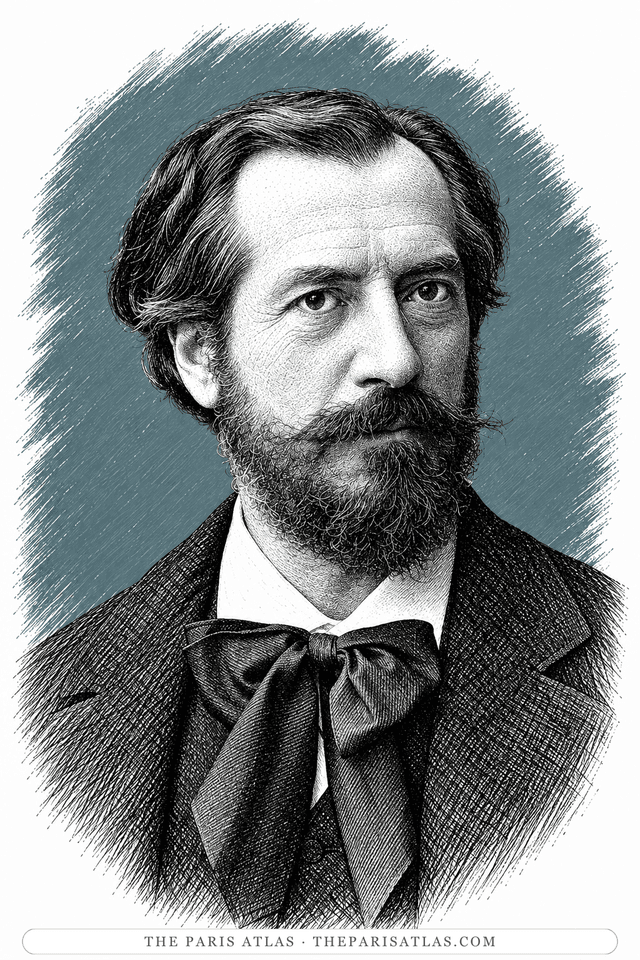
Frédéric Auguste Bartholdi was a French sculptor best known for designing the Statue of Liberty, dedicated in New York Harbor in 1886. Born in Colmar and based in Paris, he created public monuments that gave visible form to ideas of freedom, resistance and national memory. His other major works include the Lion of Belfort and the fountain in Lyon's Place des Terreaux.
The sources below include collection records, catalogues, scholarly research, and primary materials that informed this page. They document Polar Bear, its making, and its place in cultural history.
1abcdFrançois Pompon, Ours blanc — collection record
Website
Musée d'Orsay
Used for
The holding museum's account: the sculpture's development, Pompon's preference for rounded forms over geometric schematization, and its place in his career.
The 1922 Salon d'Automne showing, the 1927 state commission, the 1928–29 execution in pierre de Lens at 163 by 251 by 90 cm, Jean-Joachim Supéry's carving, Bourdelle's encouragement to work large, and the Sèvres porcelain versions from 1924.
3abcFrançois Pompon, Ours blanc — collection record
Website
Dijon Musées
Used for
Pompon's animal studies at the Jardin des Plantes, the portable modelling apparatus strapped to his torso, and the jury that accepted the plaster from a photograph without grasping its size.
4abFrançois Pompon, Polar Bear — collection record
Website
The Metropolitan Museum of Art
Used for
The smaller marble version of about 1923, its 1930 acquisition from Galerie Edgar Brandt, and Ruhlmann's use of the model in his interiors at the 1925 Paris exhibition.
These references provide the documented foundation for this work's history and interpretation. Claim-level citations remain attached to the specific claims they support.





 View source