The Paris AtlasCharting the artists, works, and places worth returning to.
  • Sculptor
· French · 1834–1904

Frédéric Auguste Bartholdi

Frédéric Auguste Bartholdi was a French sculptor best known for designing the Statue of Liberty, dedicated in New York Harbor in 1886. Born in Colmar and based in Paris, he created public monuments that gave visible form to ideas of freedom, resistance and national memory. His other major works include the Lion of Belfort and the fountain in Lyon's Place des Terreaux.

In images

Details

Lived
1834–1904
Born
2 August 1834
Birthplace
Colmar, Alsace
Died
4 October 1904 · aged 70
Place of death
Paris
Nationality
French
Profession
Sculptor
Major works
Liberty Enlightening the World, the Statue of Liberty (1886); the Lion of Belfort (1880); the Bartholdi Fountain in Lyon's Place des Terreaux (1892); the Fountain of Light and Water, Washington (1876); the Monument to General Rapp, Colmar (1856)
Married
Jeanne-Émilie Baheux de Puysieux · 1876–1904
Roles
Sculptor

About Frédéric Auguste Bartholdi

French sculptor of public monuments, best known for the Statue of Liberty and the Lion of Belfort.

Frédéric Auguste Bartholdi (1834–1904) created one of the world's most recognizable sculptures, but the Statue of Liberty was part of a much broader career devoted to public monuments. His subjects included military commanders, intellectuals, regional heroes and personifications of rivers and nations. He worked across stone, bronze and architectural metalwork, designing figures for city squares, fountains, buildings and a harbor entrance. The monumental scale associated with his name developed through a sustained interest in how sculpture could establish a place's identity and make a public idea immediately visible.

His career also depended on bringing people together around an ambitious design. The realization of Liberty Enlightening the World required political advocates, fundraising committees, architects, engineers, model makers and metalworkers on both sides of the Atlantic. Bartholdi supplied the sculptural conception and remained an energetic promoter of the project, but its construction was a collective undertaking. The distinction between the artist's authorship and the many kinds of labor required to realize it is essential to understanding his achievement.

Childhood in Colmar and Paris

Bartholdi was born in Colmar on 2 August 1834, into a prosperous Alsatian family. His father, the prefectural councillor Jean-Charles Bartholdi, died in 1836. His mother, Charlotte Beysser, moved to Paris with Auguste and his older brother in 1843. The boys attended the Lycée Louis-le-Grand, while family holidays maintained their connection with Colmar.

This connection with Alsace endured throughout his life. The family house on the rue des Marchands remained a material link with his birthplace, and Colmar repeatedly commissioned works from him. His international reputation consequently grew alongside an unusually concentrated body of sculpture associated with one town. The artist who eventually created a landmark for New York also helped shape the public image of the streets and squares he had known as a child.

Training in Paris

Bartholdi studied with the painter Ary Scheffer and received sculptural instruction associated with Antoine Étex and Jean-François Soitoux. His training encompassed drawing, painting and sculpture rather than preparing him for a single material. Decades later, the official Salon catalogue continued to identify Scheffer and Soitoux as his teachers, placing his mature career within the academic and exhibition networks in which he had begun.

General Rapp and an early public success

The monument to General Jean Rapp, a Colmar-born commander associated with Napoleon, gave Bartholdi an important early opportunity. The bronze was exhibited at the Paris Exposition Universelle of 1855 before its inauguration in Colmar in 1856. He was barely into his twenties, yet was already producing a work intended to represent a community's historical pride in a prominent public space. The commission established a pattern that continued through much of his career: a locally significant figure could be presented through the elevated visual language of national commemoration.

Egypt, photography and the appeal of colossal sculpture

In 1855–1856, Bartholdi traveled to Egypt and Yemen, spending part of the journey with Jean-Léon Gérôme. He returned with drawings and photographs that recorded monuments, people and landscapes. Photography was therefore part of his working practice early in his career, serving as a means of collecting visual material as well as documenting places he might never see again. His surviving travel records reveal an artist whose curiosity extended beyond the completed sculptures for which he later became famous.

Ancient Egyptian monuments made a particularly strong impression. The persistence of enormous figures amid ruined cities suggested a form of art capable of surviving the societies that had produced it. For Bartholdi, colossal sculpture offered both physical scale and the possibility of historical endurance. This encounter helps explain his later willingness to imagine a single figure large enough to dominate a harbor or stand in relation to a landscape rather than merely occupy a pedestal in a square.

The lighthouse proposed for Suez

Bartholdi tried to turn that ambition into a commission for the entrance to the Suez Canal. His proposal, commonly called Egypt Carrying the Light to Asia or Progress Carrying the Light to Asia, represented a draped Egyptian woman holding a light aloft. He presented the scheme to Khedive Isma'il Pasha, but it was not accepted. The project remained an unrealized design rather than a finished monument subsequently diverted to another destination.

The relationship between this lighthouse and the Statue of Liberty is best understood as a development of artistic ideas. Both use a monumental female figure and an elevated light, but they belong to different commissions, political circumstances and symbolic programs. The National Park Service's historical research recognizes the Egyptian project as part of Liberty's design history without treating the two as the same statue. The continuity lies in Bartholdi's search for a monumental form that could make enlightenment visible.

Civic commissions in the 1860s

Before the American project became his dominant undertaking, Bartholdi continued to build his reputation through commissions in France. His Bruat Fountain, inaugurated in Colmar in 1864, combined a portrait of the admiral with figures representing continents. The Young Alsatian Vintner, completed in 1869, worked at a different scale, associating regional identity with an ordinary occupation rather than military command. Together these works demonstrate the breadth of his civic sculpture: historical portraiture, allegory and local life could all become subjects for a town's public spaces.

The Franco-Prussian War and the loss of Alsace

The Franco-Prussian War of 1870–1871 gave Bartholdi's attachment to Alsace a more urgent political meaning. He served in the National Guard and subsequently as an aide-de-camp to Giuseppe Garibaldi, who fought on the French side. The war ended with France's defeat and the annexation of Alsace by the German Empire. Bartholdi retained his commitment to France, while his birthplace now stood on the other side of a national border.

Several later monuments approached this experience through different subjects. The Lion of Belfort celebrated resistance; the Basel memorial to Switzerland's assistance to Strasbourg commemorated humanitarian aid during a siege. These works did not all express the same response to defeat. They allowed endurance, collective suffering and assistance across borders to enter public memory alongside the more conventional celebration of military leaders.

The Lion of Belfort

Bartholdi developed the Lion of Belfort during the 1870s to commemorate the city's resistance during the siege of 1870–1871. Rather than make the commander the sole focus, he chose an enormous animal whose tense body could embody the determination of the defenders. Positioned beneath the citadel, the lion belonged to the military landscape it commemorated. Its meaning depended partly on this relationship between the sculpted figure and the site of the struggle.

The lion's head, showing the courses of sandstone blocks it is built from. (0x010C, Wikimedia Commons · CC BY-SA 4.0)

The work measures approximately twenty-two meters long and eleven meters high. It was built from carved sandstone blocks assembled against the rock, not simply cut from the living cliff. Completed by 1880, it translates the energy of an animal into a monument of civic endurance. The raised head and powerful forequarters prevent its reclining position from suggesting repose; its body appears to retain the possibility of action. This formal reading helps explain why an animal could carry the monument's commemorative purpose without a literal reconstruction of the siege.

Édouard de Laboulaye and the American project

The scholar and political thinker Édouard de Laboulaye provided the Statue of Liberty project with an intellectual framework and a network of supporters. An opponent of slavery and an admirer of American constitutional government, he saw a Franco-American monument as a means of honoring liberty while encouraging its principles in France. Bartholdi's interest in colossal sculpture thus encountered a political project capable of giving it a public purpose. Their contributions were complementary: Laboulaye helped articulate and organize the cause; Bartholdi made it visible.

Traditional accounts place the project's origin at a dinner in 1865, but that scene should not be treated as an independently documented conversation. Research commissioned by the National Park Service traces the familiar story to Bartholdi's later account and places the more securely documented development of the monument in 1870–1871. The qualification does not diminish Laboulaye's importance. It distinguishes an influential origin story from the evidence for the project's emergence.

The first journey to the United States

Bartholdi visited the United States in 1871, carrying letters of introduction and seeking support for the proposed monument. Bedloe's Island, later renamed Liberty Island, offered the setting he favored in New York Harbor. The island allowed the figure to be approached across water and seen against the sky, with a reach beyond that of a statue enclosed by surrounding streets. The choice of site was therefore integral to the design rather than an administrative decision made after the sculpture was finished.

Bartholdi in 1876, photographed in New York by Benjamin Joseph Falk. (Benjamin Joseph Falk, National Portrait Gallery, Smithsonian Institution · Public domain)

The journey also exposed the difference between admiration for an idea and a commitment to finance it. Bartholdi obtained encouragement and other professional opportunities, including a commission connected with Boston's Brattle Square Church, but the colossal gift remained uncertain. He would need a public campaign, a practical division of responsibilities and many years of persistence before the project acquired the money and institutional support necessary for construction.

A gift that required public fundraising

The project entered a more organized phase in 1875, when the Franco-American Union promoted the undertaking publicly. The division of responsibility was clear: supporters in France would pay for the statue, while those in the United States would finance its pedestal. This arrangement made the monument a shared enterprise, but also created two fundraising problems whose progress did not always coincide. Construction and publicity had to continue even while the final resources remained incomplete.

Jeanne-Émilie Bartholdi

During his American visit in 1876, Bartholdi married Jeanne-Émilie Baheux de Puysieux. She accompanied him on later journeys connected with the statue, including the visits surrounding its completion and dedication. Their marriage formed part of the personal history behind a career increasingly occupied by large public projects. After his death, Jeanne-Émilie also played an important role in preserving the objects and documents through which his working life could be studied.

Philadelphia and the publicity of unfinished sculpture

The Centennial Exposition in Philadelphia in 1876 offered Bartholdi a valuable audience. The completed torch-bearing arm of Liberty was displayed there before being shown in New York. The statue's head subsequently appeared at the Paris Exposition Universelle of 1878. These fragments allowed people to encounter the project's enormous scale years before the entire monument could be installed. An unfinished work became an attraction in its own right, generating interest and helping to sustain the fundraising campaign.

Fernique's photograph of the statue's head on show in a Paris garden. (Albert Fernique, The New York Public Library, Album de la construction de la Statue de la Liberté · Public domain)

Bartholdi also exhibited the Fountain of Light and Water in Philadelphia. Cast in iron, it joined sculptural figures with running water and gas illumination, presenting another way in which art could participate in a modern urban setting. Congress purchased it, and it was moved to Washington in 1877. His American reputation was consequently developing through more than promises about Liberty: audiences could see an independent, completed work while the larger project was still taking shape.

Building Liberty in Paris

The Statue of Liberty was fabricated at the workshops of Gaget, Gauthier & Cie, at 25 rue de Chazelles in Paris. Its surface was formed from shaped copper sheets, allowing a hollow figure of extraordinary size without the weight of a solid or conventionally cast bronze colossus. Bartholdi's design had to pass through successive models and enlargements before individual sections could be manufactured and fitted together.

As the work rose above the neighborhood, it became part of the Parisian cityscape. Photographs by Albert Fernique record the immense figure among workshops and surrounding buildings, while Paul-Joseph-Victor Dargaud painted the spectacle from the street. These images preserve an unfamiliar setting for an otherwise familiar object: Liberty was first encountered at full scale above the roofs of Paris, surrounded by the ordinary architecture of a working district.

Dargaud's 1884 view of the rue de Chazelles, with the statue inside its scaffolding above the roofs. (Paul-Joseph-Victor Dargaud, Musée Carnavalet, Paris Musées · Public domain)

Viollet-le-Duc, Eiffel and the hidden structure

The architect Eugène Viollet-le-Duc initially advised on the statue's construction. He supported the use of copper repoussé and considered an internal system involving masonry and sand. His death in 1879 forced a change in the project's technical leadership. The exterior appearance therefore survived a substantial reconsideration of what would hold it upright.

Gustave Eiffel developed a supporting system based on an iron framework to which the copper skin was attached. Its importance lay in flexibility as well as strength: the outer surface could respond to wind and temperature changes without behaving as a rigid block. Bartholdi's apparently massive figure thus depended on a relatively light and responsive structural arrangement. Eiffel's contribution was engineering rather than the invention of the statue's outward form, and both kinds of authorship are necessary to explain the finished monument.

Richard Morris Hunt and the pedestal

The American architect Richard Morris Hunt designed the pedestal. He and Bartholdi considered several possibilities before Hunt's final scheme of 1884 emerged, with financial constraints helping determine its dimensions. The pedestal needed to support the sculpture physically while also giving it an architectural base appropriate to the harbor. It was a separate design problem, not a minor accessory automatically supplied by the sculptor.

Fundraising for this American contribution lagged behind work in France. In 1885, Joseph Pulitzer used the New York World to appeal for donations, publishing contributors' names and encouraging small gifts rather than relying solely on wealthy patrons. More than 120,000 people contributed to the campaign. The pedestal's completion consequently became associated with a broad newspaper readership, adding another public constituency to the monument's history.

From the Paris workshops to New York Harbor

The completed statue was formally presented to the United States in Paris on 4 July 1884. It was then dismantled for transport, packed into crates and carried across the Atlantic aboard the French vessel Isère, which reached New York on 17 June 1885. Arrival did not mean immediate erection: the pedestal still had to be finished before the parts could be assembled in their intended setting.

The dedication took place on 28 October 1886, with Bartholdi present and President Grover Cleveland participating in the ceremony. The work had finally moved from model, to workshop attraction, to public monument. The statue itself rises approximately forty-six meters; together with its pedestal and foundation, the full monument reaches about ninety-three meters. Those distinctions matter when discussing its scale, since the height of Bartholdi's figure is often confused with that of the entire structure.

Liberty, abolition and an unfinished political promise

The figure's attributes make its central ideas readable. The elevated torch suggests enlightenment, the tablet bears the date of American independence, and broken shackles at the feet refer to release from oppression. The abolition of slavery formed an important part of the project's political background, especially for Laboulaye. Yet the monument's program was broader than a memorial to emancipation alone, joining the American Revolution, the preservation of republican government and the hope that liberty could have an international significance.

Those ideals did not settle the question of who actually enjoyed freedom. The National Park Service's account includes Black Americans' responses to the gap between the statue's promise and continuing discrimination. The monument could inspire hope while also becoming evidence of national inconsistency. Its subsequent history is therefore not simply the steady confirmation of a universally accepted message; it includes arguments over whether the society celebrating liberty had fulfilled the claims made on its behalf.

Emma Lazarus and the meaning of welcome

The statue's close association with immigration developed through another contributor's work. Emma Lazarus wrote “The New Colossus” in 1883 for an auction supporting the pedestal fund. Her poem imagined a figure welcoming the displaced and the excluded, giving the monument a voice distinct from Bartholdi's visual design. The text was placed on a plaque at the statue in 1903, while Bartholdi was still alive.

The poem did not change the copper figure, but it changed the language through which generations encountered it. Its emphasis on refuge and arrival became inseparable from the experience of New York Harbor. Bartholdi's statue could thus acquire meanings through literature and lived experience that exceeded the circumstances of its original commission. The sculptor, the political sponsors and the poet contributed different elements to what eventually became a shared public symbol.

Later work in France and Switzerland

The success of Liberty did not end Bartholdi's career in European public sculpture. His fountain for Lyon's Place des Terreaux, installed in 1892, adapted a design originally intended for Bordeaux. Its female personification and four horses represented the Garonne and its tributaries, even though the work's eventual home was a different city. The transfer demonstrates how a monument's commercial history could separate an allegory from the geography that originally explained it.

In 1895, Basel inaugurated Switzerland Succouring Strasbourg, commemorating Swiss assistance to civilians during Strasbourg's siege in 1870. Its subject returned to the war that had transformed Bartholdi's relationship with Alsace, but its emphasis fell on care and rescue rather than battlefield victory. The group made relations between communities visible through the bodies of people receiving and offering protection.

Final years and the preservation of the work

Bartholdi continued to receive commissions into old age. The Great Supporters of the World, completed in 1902, grouped personifications of work, patriotism and justice, while the equestrian monument to Vercingétorix was installed in Clermont-Ferrand in 1903. The latter brought a project with a much earlier history to completion near the end of his life. Monumental sculpture could demand long intervals between initial conception and public installation, even for an established artist.

He died in Paris on 4 October 1904, aged seventy, and was buried in Montparnasse Cemetery. The following preservation of his legacy brought together his two principal French homes. His widow arranged the gift of the family house and substantial collections to Colmar in 1907, and the Musée Bartholdi opened in 1922. Other material relating to Liberty entered the Musée des Arts et Métiers in Paris, preserving evidence of the technical process alongside the finished monuments.

Sculptural style and techniques

Monumental form and distant viewing

Bartholdi organized his largest works around silhouettes and gestures that remain legible at a distance. Liberty's upright body, raised arm and torch can be recognized before details of face or drapery become visible. The Lion of Belfort uses an extended body, lifted head and emphatic paws to establish a similarly clear relationship between mass and direction. In both cases, the figure must work against a much larger setting. The success of the outline is therefore part of the sculpture's public function, not simply a decorative quality.

Models, enlargement and collective labor

Small models allowed Bartholdi to test proportions before committing to a monumental version. For Liberty, measured divisions on a plaster model were translated into enlarged sections; carpentry, plaster work and metal shaping then carried the design toward its final scale. This was a sequence of specialized operations rather than the sculptor directly working every part of the finished figure. The surviving models and workshop records make the passage from invention to manufacture unusually visible.

The Musée des Arts et Métiers' study of the project emphasizes the range of trades involved, including carpenters, smiths, sculptors and coppersmiths. Their contribution helps explain how artistic ambition could become physically possible. A design alone could not resolve the problems of shaping a vast draped surface, joining its sections or coordinating an installation whose completed appearance concealed much of the labor beneath it.

Copper, lead and the difference between surface and support

The materials of Bartholdi's monuments should not be treated as interchangeable. Liberty's copper surface was shaped by repoussé, a metalworking technique used to raise a form from sheet metal, and attached to an independent framework. The Paris version of the Lion of Belfort likewise uses copper plates rather than bronze. In these works, apparent solidity is produced through a relatively thin exterior whose structural support remains concealed.

The Lyon fountain uses another system: a lead skin over an iron structure. Restoration documentation makes this construction particularly clear. By contrast, the Fountain of Light and Water was made in cast iron. Bartholdi's practice therefore encompassed several ways of producing a monumental form, with the material chosen affecting weight, fabrication, weathering and the relationship between the visible figure and its internal construction.

Portraits, animals and allegorical figures

Bartholdi did not rely on one kind of subject to convey public meaning. General Rapp and Diderot associate commemoration with named individuals; the Lion of Belfort substitutes an animal for a collective population; Liberty gives bodily form to an abstract principle. His smaller Allegory of Africa, represented by a reclining male figure, belongs to the nineteenth-century tradition of making places and continents visible as human bodies. These different conventions allow the viewer to encounter a person, a community or an idea through the same medium.

Such allegories also reflect the cultural assumptions of their period. The continent figures and the depiction of Champollion above a sphinx belong to a European visual language that classified other societies and presented knowledge as a kind of mastery. The Collège de France explains Champollion's pose through the story of Oedipus solving the sphinx's riddle, while acknowledging that the arrangement can trouble modern viewers. Historical interpretation is strengthened by retaining both the original artistic intention and the possibility of a different contemporary response.

Photography, reproduction and public attention

The photographs taken during Liberty's construction were not only technical records. They were also used to promote the undertaking and solicit support. Images could circulate the scale of the project well beyond the people able to visit the workshops, while reduced versions made the monumental design available as a collectible object. Bartholdi's career consequently linked the unique public monument with systems of reproduction that helped finance it and extend its recognition.

Major works

Monument to General Rapp — 1855–1856

Exhibited in Paris in 1855 and inaugurated in Colmar the following year, this bronze established Bartholdi's credentials as a sculptor of public monuments. The subject connected a prominent figure of Napoleonic military history with his birthplace. It is important to distinguish its exhibition date from its inauguration: the work reached a national audience before entering the local setting for which it had been commissioned.

Bruat Fountain — 1864

Dedicated to Admiral Armand-Joseph Bruat in Colmar, the fountain combines an elevated portrait with allegories of Africa, America, Asia and Oceania. The arrangement connects an individual naval career with a broader representation of the world. Its importance within Bartholdi's development lies in the integration of portraiture, multiple figures and an architectural fountain. It anticipates the complexity of later civic commissions.

Egypt Carrying the Light to Asia — proposed in the late 1860s, unrealized

The proposed lighthouse for Suez represents an important stage in Bartholdi's pursuit of colossal sculpture. A draped woman bearing a light would have combined a practical navigational function with a monumental image of progress. The design was never built. Its significance rests in its relationship to his later thinking about Liberty, rather than in a claim that a completed Egyptian statue was reused for New York.

Monument to Champollion — conceived 1865; marble 1875; installed 1878

Bartholdi represents the decipherer of Egyptian hieroglyphs in a meditative pose above a sphinx. The figure was intended to evoke intellectual discovery, drawing on the comparison between Champollion and Oedipus solving a riddle. Installed at the Collège de France in 1878, the work also connects two of Bartholdi's significant relationships: his fascination with Egypt and his association with Laboulaye, who presided over its inauguration.

Lafayette — inaugurated 1876

The bronze monument in New York's Union Square honors the French supporter of American independence. Dedicated on 6 September 1876, it gave Bartholdi a visible place in the city's public art a decade before Liberty's inauguration. Its subject also situates the larger harbor monument within a continuing Franco-American commemorative relationship rather than an isolated exchange between two nations.

Fountain of Light and Water — 1876

Made for Philadelphia's Centennial Exposition and acquired for Washington in 1877, the fountain brings together cast iron, water and artificial illumination. Female figures appear to support the upper basin, while aquatic creatures and other ornament extend the theme. Its combination of modern infrastructure and classical forms made it a different expression of Bartholdi's public ambition from his solitary historical statues or colossal figures.

Lion of Belfort — 1870s–1880

The sandstone lion transforms the memory of a siege into a concentrated image of strength and persistence. Its great horizontal body answers the cliff and citadel above it, making the site part of the composition. A smaller copper version installed in Paris in 1880 carried the subject into another urban setting. The two versions share an image but differ in scale, material and architectural surroundings.

Monument to Diderot — 1884

The memorial in Langres honored Denis Diderot in the centenary year of his death. It belongs to the intellectual rather than military side of Bartholdi's commemorative work. The town's museum history emphasizes the controversy surrounding the tribute, reminding viewers that the erection of a statue to an Enlightenment thinker could itself involve political argument. Public monuments recorded choices about whom a community wished to honor, not simply a neutral list of famous inhabitants.

Liberty Enlightening the World — completed in Paris 1884; dedicated in New York 1886

The Statue of Liberty unites a classical female figure, a torch, a dated tablet and broken shackles in a composition designed for visibility across a harbor. Its copper exterior and engineered interior make it both a sculptural and a structural achievement. The distinction between its completion in Paris and its dedication in New York is fundamental to its history: manufacture, transport, pedestal construction and reassembly were separate stages of one international undertaking.

Bartholdi Fountain, Place des Terreaux — 1892

Originally conceived for Bordeaux, the fountain represents the Garonne and its tributaries through a female figure and four horses. Lyon acquired the work and installed it in the Place des Terreaux. The outward movement of the horses, interacting with the fountain's water, gives the group a very different energy from Liberty's vertical stability. Its lead surface over an iron structure is an important distinction from Bartholdi's bronze monuments.

Switzerland Succouring Strasbourg — 1895

This Basel monument commemorates assistance offered to Strasbourg's civilians during the siege of 1870. The group organizes national personifications and vulnerable human figures around the act of protection. It provides an important counterpoint to the Lion of Belfort: both arise from the same war, but one emphasizes resistance while the other remembers rescue and cooperation across a border.

Lafayette and Washington — Paris monument, 1895

The paired figures return to the history of Franco-American cooperation through recognizable individuals rather than a single personification of liberty. Installed in Paris in 1895, the monument was a gift from Joseph Pulitzer; a related bronze entered New York's public landscape in 1900. The group extends the transatlantic dimension of Bartholdi's work beyond the Statue of Liberty itself, linking his sculpture with the commemoration of the two countries' Revolutionary-era alliance.

Vercingétorix — inaugurated 1903

Installed in Clermont-Ferrand's Place de Jaude, the equestrian monument presents the Gallic leader with raised sword on a rearing horse. Its commemoration of resistance to Rome links an ancient subject with nineteenth-century concerns about national identity. The monument honors the figure associated with victory at Gergovia in 52 BCE. It is a different work from Aimé Millet's statue at Alésia, which presents the leader standing rather than on horseback.

Frédéric Auguste Bartholdi and Paris

The sculptor's studios and the industrial workshop

Paris supported two distinct kinds of working space in Bartholdi's career. His personal studio was associated with the rue Vavin and later the rue d'Assas, while Liberty's enormous fabrication site stood across the city in the rue de Chazelles. The 1895 Salon catalogue gives his address as 82 rue d'Assas, providing contemporary evidence for the later studio. These locations should not be collapsed into a single legendary “Statue of Liberty studio”: they served different purposes within his professional life.

The rue de Chazelles photographs preserve a particularly close relationship between sculpture and the everyday city. Fernique's views show the monument within a neighborhood rather than isolated against a harbor sky. Dargaud's painted street scene makes its scale intelligible through adjacent buildings and passersby. Both forms of representation document the stage when a future American landmark was an extraordinary presence in Paris.

Monuments within the city

The Lion of Belfort in the Place Denfert-Rochereau, inaugurated in 1880, brought the memory of the eastern city's defense into the capital. The French heritage record identifies its material as copper repoussé and distinguishes it from the bronze portrait medallion added later. That record helps avoid the common mistake of calling the entire monument bronze. The sculpture's presence connects Bartholdi's Alsatian commitments with his Parisian public career.

The reduced Liberty installed at the Île aux Cygnes in 1889 made the exchange between France and the United States visible in the opposite direction. His Champollion monument connected him with the scholarly institutions of the Latin Quarter, while his burial in Montparnasse returned his personal history to the district in which he had worked. Paris was thus a place of training, production, commemoration and preservation, not simply a departure point for his best-known work.

Frédéric Auguste Bartholdi's place in art history

Bartholdi's career shows how nineteenth-century sculpture could operate simultaneously as an artwork, an engineering undertaking and a public campaign. His largest projects required clear forms that could be understood at a distance, but also networks capable of turning those forms into structures, financing their manufacture and securing their sites. The craft records preserved in Paris and the models collected in Colmar make those processes available alongside the completed objects. They restore the practical complexity behind monuments that can appear effortless once they have become familiar.

His legacy also demonstrates the limits of an artist's control over a public image. The Statue of Liberty acquired a literary voice through Lazarus, became associated with immigration, and entered later artists' work as a symbol open to admiration, criticism and reinvention. Its endurance rests partly in this capacity to be used beyond Bartholdi's own circumstances. His sculpture gave a durable physical form to an idea whose interpretation remained in the hands of successive publics.

Life events

  1. 1834

    Born in Colmar, Alsace, on 2 August to Jean-Charles Bartholdi and Charlotte Beysser. His father is a prefectural councillor.

    Repères chronologiques

  2. 1836

    His father dies, leaving Charlotte responsible for Auguste and his older brother.

    Biographie

  3. 1843

    The family moves to Paris. Bartholdi attends the Lycée Louis-le-Grand and studies in Ary Scheffer's artistic circle.

    L’histoire du musée; Repères chronologiques

  4. 1852

    Establishes his first Paris studio, beginning an independent professional career while still in his teens.

    Repères chronologiques

  5. 1855

    Exhibits the bronze monument to General Rapp at the Paris Exposition Universelle, before its installation in Colmar.

    Balade à Colmar parmi quelques œuvres

  6. 1855–1856

    Travels to Egypt and Yemen, producing drawings and photographs and studying monumental ancient sculpture.

    Auguste Bartholdi en Orient (1855–1856)

  7. 1856

    The General Rapp monument is inaugurated in Colmar, establishing an important early connection between his sculpture and his birthplace.

    Auguste Bartholdi, Father of the Statue of Liberty

  8. 1864

    Colmar inaugurates the Bruat Fountain, combining an admiral's portrait with four continent allegories.

    Balade à Colmar parmi quelques œuvres

  9. 1865

    Conceives a monument to Jean-François Champollion, a project that will later be realized in marble and installed at the Collège de France.

    Champollion’s Statue

  10. 1869

    Presents his unsuccessful proposal for a monumental lighthouse at the entrance to the Suez Canal. The Young Alsatian Vintner is also completed in Colmar.

    Repères chronologiques

  11. 1870–1871

    Serves during the Franco-Prussian War, including as an aide-de-camp to Garibaldi. Alsace is annexed by the German Empire after the French defeat.

    Frédéric Auguste Bartholdi (1834–1904)

  12. 1871

    Makes his first American journey and favors Bedloe's Island in New York Harbor as the site for the proposed Statue of Liberty.

    Liberty Island: A Chronology

  13. 1872

    Develops the Belfort memorial project into the conception of a colossal lion associated with the citadel.

    Le Lion de Belfort — À nos grands hommes

  14. 1875

    The Franco-American Union publicly promotes the Liberty project, with French fundraising assigned to the statue and American fundraising to the pedestal.

    Édouard de Laboulaye

  15. 1876

    Liberty's completed torch-bearing arm is exhibited at Philadelphia's Centennial Exposition, giving audiences an early encounter with its scale.

    Creating the Statue of Liberty, 1865–1886

  16. 1876

    The Lafayette monument is dedicated in New York's Union Square on 6 September.

    Marquis de Lafayette, Union Square

  17. 1876

    Marries Jeanne-Émilie Baheux de Puysieux during his American visit.

    Bartholdi photographed in New York in 1876, the year he married Jeanne-Émilie Baheux de Puysieux and showed Liberty's torch-bearing arm at the Philadelphia Centennial Exposition. The cabinet card is by Benjamin Joseph Falk of 949 Broadway. (Benjamin Joseph Falk, National Portrait Gallery, Smithsonian Institution)

    Repères chronologiques

  18. 1877

    The Fountain of Light and Water, made for the Philadelphia exhibition, is purchased by Congress and moved to Washington.

    Bartholdi Fountain (Fountain of Light and Water)

  19. 1878

    Liberty's head is shown at the Paris Exposition Universelle.

    Creating the Statue of Liberty, 1865–1886

  20. 1878

    The Champollion monument is inaugurated at the Collège de France.

    Preservation of the Monument to Jean-François Champollion

  21. 1879

    Viollet-le-Duc dies. Eiffel subsequently develops the supporting iron structure for Liberty.

    Eugène Viollet-le-Duc; Alexandre-Gustave Eiffel

  22. 1880

    The Lion of Belfort is completed. Its smaller copper counterpart is inaugurated in Paris's Place Denfert-Rochereau.

    The head of the Lion of Belfort, photographed in 2015. The joints between the pink sandstone blocks are visible across the muzzle and mane: the animal was assembled from carved blocks set against the cliff below the citadel, not cut from the rock itself. (0x010C, Wikimedia Commons)

    Le Lion de Belfort — À nos grands hommes; Monument du Lion de Belfort, Paris — notice PA75140009

  23. 1881–1884

    Liberty is assembled at full scale at the Gaget, Gauthier & Cie workshops in the rue de Chazelles, Paris.

    Victor Dargaud's painting of the statue inside its scaffolding at the Gaget, Gauthier & Cie workshops in the rue de Chazelles, seen from the street in 1884. This is a painting, not a photograph; it is in the Musée Carnavalet. (Paul-Joseph-Victor Dargaud, Musée Carnavalet, Paris Musées)

    La Liberté éclairant le monde

  24. 1883

    Emma Lazarus writes “The New Colossus” for a fundraiser benefiting the statue's pedestal.

    Emma Lazarus

  25. 1884

    The completed Statue of Liberty is formally presented to the United States in Paris on 4 July.

    Liberty Island: A Chronology

  26. 1884

    The Diderot monument is inaugurated in Langres in the centenary year of the philosopher's death.

    Édition : Le Mystère Bartholdi

  27. 1885

    The Isère reaches New York on 17 June with the dismantled statue. The pedestal is not yet ready for its assembly.

    Liberty Island: A Chronology

  28. 1885

    Pulitzer's newspaper campaign brings in the funds needed to complete the pedestal, drawing support from a large number of small contributors.

    Joseph Pulitzer: In Depth

  29. 1886

    The Statue of Liberty is dedicated in New York Harbor on 28 October, with Bartholdi present.

    Liberty Island: A Chronology

  30. 1889

    A reduced version of Liberty is inaugurated on Paris's Île aux Cygnes, extending the Franco-American exchange of monuments.

    5 choses que vous ignorez peut-être sur la statue de la Liberté

  31. 1892

    The Bartholdi Fountain is installed in Lyon's Place des Terreaux after the city acquires the work originally intended for Bordeaux.

    Place des Terreaux

  32. 1895

    Basel inaugurates Switzerland Succouring Strasbourg, commemorating assistance to civilians during the siege of 1870.

    Bâle et La Suisse secourant les douleurs de Strasbourg

  33. 1895

    The Lafayette and Washington monument is installed in Paris.

    Repères chronologiques

  34. 1902

    Completes The Great Supporters of the World, representing work, patriotism and justice.

    Restaurons ensemble Les Grands Soutiens du monde

  35. 1903

    The equestrian monument to Vercingétorix is inaugurated in Clermont-Ferrand's Place de Jaude.

    Statue de Vercingétorix

  36. 1904

    Dies in Paris on 4 October, aged seventy. He is buried in Montparnasse Cemetery.

    Biographie

  37. 1907

    Jeanne-Émilie arranges the gift of the Colmar family house and collections for a museum devoted to Bartholdi. Liberty-related material also enters the Musée des Arts et Métiers.

    L’histoire du musée; The Construction of the Statue of Liberty

  38. 1922

    The Musée Bartholdi opens in Colmar, bringing together sculpture, models, drawings and objects associated with his career.

    Musée Bartholdi

People they knew

Documented connections — every one carries its source.

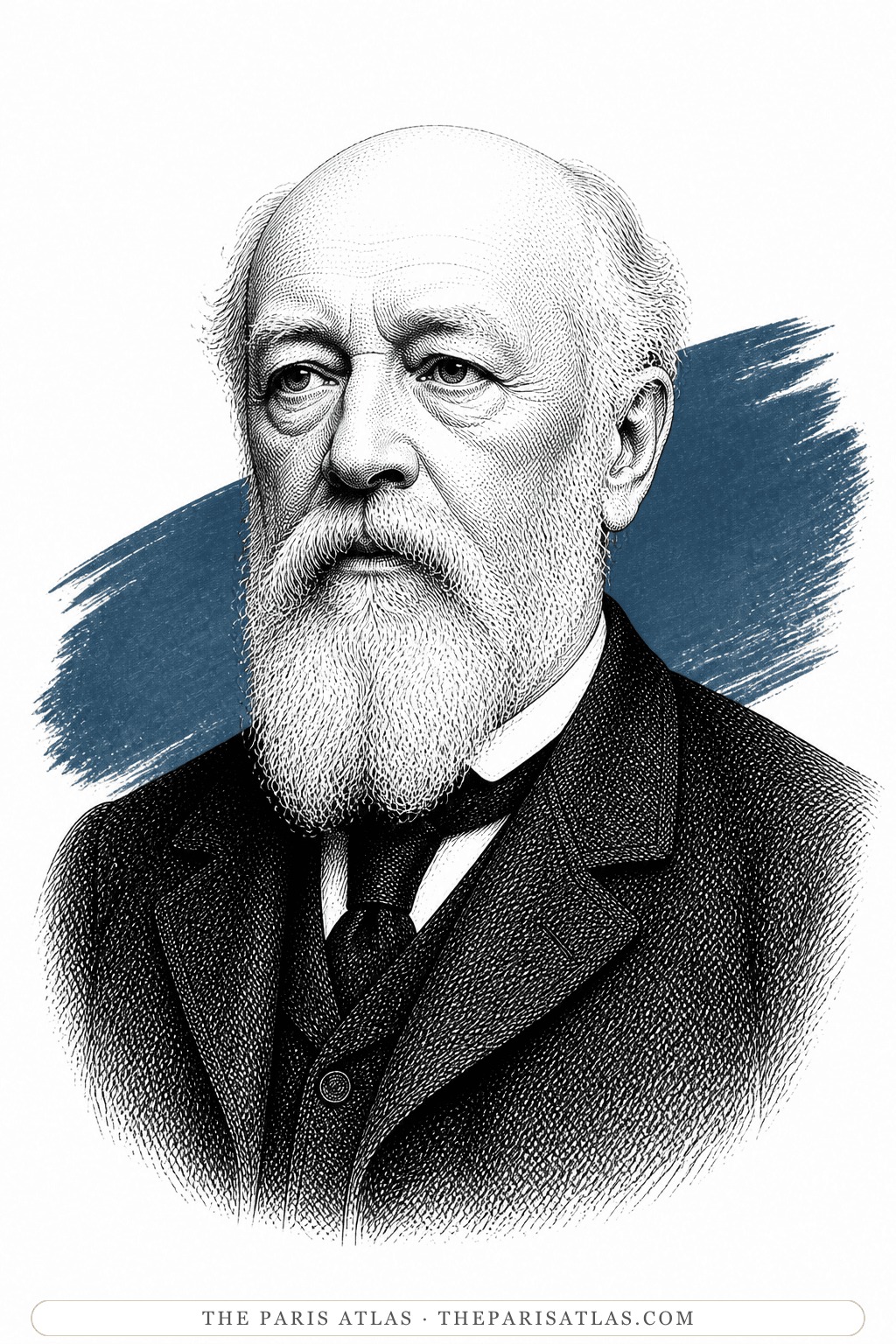
Illustrated portrait of Gustave Eiffel

Gustave Eiffel

  • Engineer
  • Industrialist

Collaborated with · 1879–1886

Bartholdi designed the Statue of Liberty; Eiffel designed what holds it up. After Eugène Viollet-le-Duc died in 1879, Eiffel took over the statue's engineering and replaced the proposed masonry-and-sand interior with an iron framework carrying the copper skin, so the surface can move with wind and temperature instead of behaving as a rigid block. The two roles are distinct: Eiffel engineered the structure and did not shape the figure.
Alexandre-Gustave Eiffel; Eugène Viollet-le-Duc; The Construction of the Statue of Liberty

Frédéric Auguste Bartholdi’s Places

The cataloged places connected to Frédéric Auguste Bartholdi — through the books, and through the documented record.

Places you can enter today appear first, followed by addresses to see from outside and sites that have vanished.

Questions about Frédéric Auguste Bartholdi

Who designed the Statue of Liberty?

Frédéric Auguste Bartholdi, a French sculptor born in Colmar in 1834. He conceived the figure, called Liberty Enlightening the World, and promoted the project for roughly fifteen years. Gustave Eiffel engineered the iron framework inside it, and the American architect Richard Morris Hunt designed the pedestal, so the finished monument is the work of several hands.

Where was the Statue of Liberty built?

In Paris, at the workshops of Gaget, Gauthier & Cie at 25 rue de Chazelles, in the 17th arrondissement. The statue rose above the surrounding rooftops there between 1881 and 1884, and the photographer Albert Fernique recorded it among the workshop buildings. It was then dismantled, crated, and shipped to New York on the French vessel Isère, which arrived on 17 June 1885.

What else did Bartholdi make besides the Statue of Liberty?

The Lion of Belfort, a sandstone animal about twenty-two meters long, finished by 1880 beneath the citadel of Belfort. A smaller copper version stands in the Place Denfert-Rochereau in Paris. He also made the fountain in Lyon's Place des Terreaux in 1892, and the Fountain of Light and Water now in Washington. Colmar holds his monument to General Rapp and his Bruat Fountain. He also made the Champollion monument at the Collège de France and the equestrian Vercingétorix in Clermont-Ferrand.

Was the Statue of Liberty originally designed for Egypt?

No. Bartholdi proposed a colossal lighthouse for the entrance to the Suez Canal in the late 1860s, a draped Egyptian woman holding a light aloft, and Khedive Isma'il Pasha did not accept it. That design was never built and was not moved to New York. The National Park Service treats it as a stage in Bartholdi's thinking about monumental figures, not as the same statue.

How tall is the Statue of Liberty?

Bartholdi's figure rises approximately forty-six meters from heel to torch. Measured with the pedestal and foundation, the whole monument reaches about ninety-three meters. The two numbers are often confused, and the difference is the pedestal Richard Morris Hunt designed.

Where is Bartholdi buried?

In Montparnasse Cemetery in Paris. He died in the city on 4 October 1904, aged seventy. His widow, Jeanne-Émilie, gave the family house in Colmar and his collections to the town in 1907, and the Musée Bartholdi opened there in 1922.

Sourced claims

Every connection the graph holds for Frédéric, with the evidence behind it.

Buried at · 1904

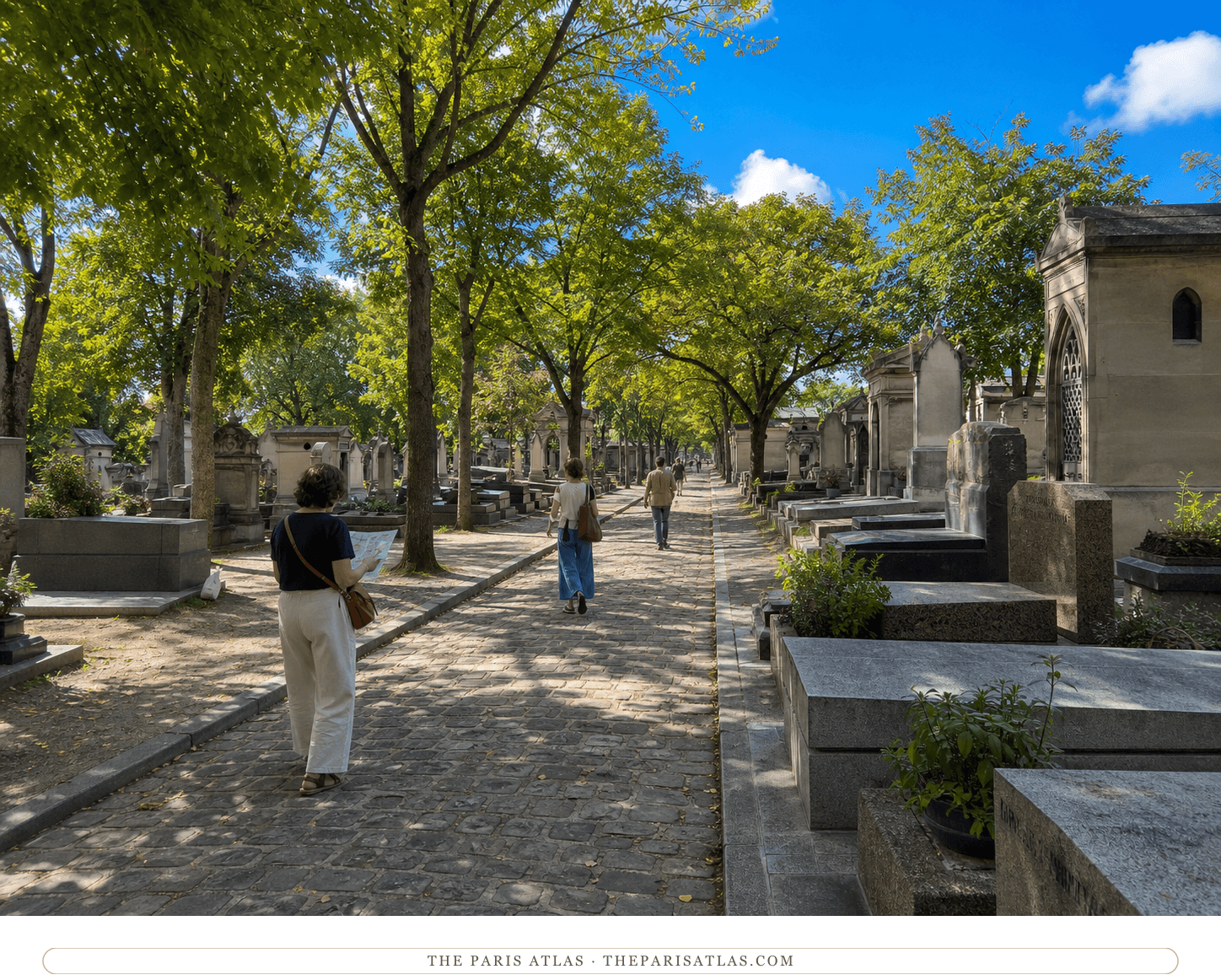
Montparnasse Cemetery

Bartholdi died in Paris on 4 October 1904, aged seventy, and was buried in Montparnasse Cemetery, in the district where his later studio at 82 rue d'Assas stood.

Biographie; Bartholdi — artist entry, 1895 Salon catalogue (Base Salons)

Collaborated with · 1879–1886

Gustave Eiffel

Bartholdi designed the Statue of Liberty; Eiffel designed what holds it up. After Eugène Viollet-le-Duc died in 1879, Eiffel took over the statue's engineering and replaced the proposed masonry-and-sand interior with an iron framework carrying the copper skin, so the surface can move with wind and temperature instead of behaving as a rigid block. The two roles are distinct: Eiffel engineered the structure and did not shape the figure.

Alexandre-Gustave Eiffel; Eugène Viollet-le-Duc; The Construction of the Statue of Liberty

References

References

The sources below include biographies, scholarly essays, interviews, and primary materials that informed this page. They reflect both the historical record and ongoing critical conversations about Frédéric Auguste Bartholdi and their work.

  1. 1Biographie

    Website
    Musée Bartholdi, Colmar
    Used for

    Web source consulted for documented facts and historical context presented on the Frédéric Auguste Bartholdi page.

    View source
  2. 2Repères chronologiques

    Website
    Musée Bartholdi, Colmar
    Used for

    Web source consulted for documented facts and historical context presented on the Frédéric Auguste Bartholdi page.

    View source
  3. 3Frédéric-Auguste Bartholdi

    Website
    National Park Service
    Used for

    Web source consulted for documented facts and historical context presented on the Frédéric Auguste Bartholdi page.

    View source
  4. 4Liberty Island: A Chronology

    Website
    National Park Service
    Used for

    Web source consulted for documented facts and historical context presented on the Frédéric Auguste Bartholdi page.

    View source
  5. 5Frédéric Auguste Bartholdi (1834–1904)

    Website
    Musée protestant
    Used for

    Web source consulted for documented facts and historical context presented on the Frédéric Auguste Bartholdi page.

    View source
  1. 6Auguste Bartholdi, Father of the Statue of Liberty

    Website
    Office de tourisme de Colmar
    Used for

    Web source consulted for documented facts and historical context presented on the Frédéric Auguste Bartholdi page.

    View source
  2. 7The Construction of the Statue of Liberty

    Website
    Musée des Arts et Métiers / Google Arts & Culture
    Used for

    Web source consulted for documented facts and historical context presented on the Frédéric Auguste Bartholdi page.

    View source
  3. 8Statue of Liberty Facts

    Website
    National Park Service
    Used for

    Web source consulted for documented facts and historical context presented on the Frédéric Auguste Bartholdi page.

    View source
  4. 9Liberté — collection record

    Website
    Musée d’Orsay
    Used for

    Web source consulted for documented facts and historical context presented on the Frédéric Auguste Bartholdi page.

    View source
  5. 10Le Lion de Belfort — À nos grands hommes

    Website
    Musée d’Orsay
    Used for

    Web source consulted for documented facts and historical context presented on the Frédéric Auguste Bartholdi page.

    View source
i
Why these sources are here

These references anchor the page in the documented record and in the scholarly conversations around Frédéric Auguste Bartholdi. Every claim on this page traces back to one or more of the works listed here.

Explore more resources