Realization
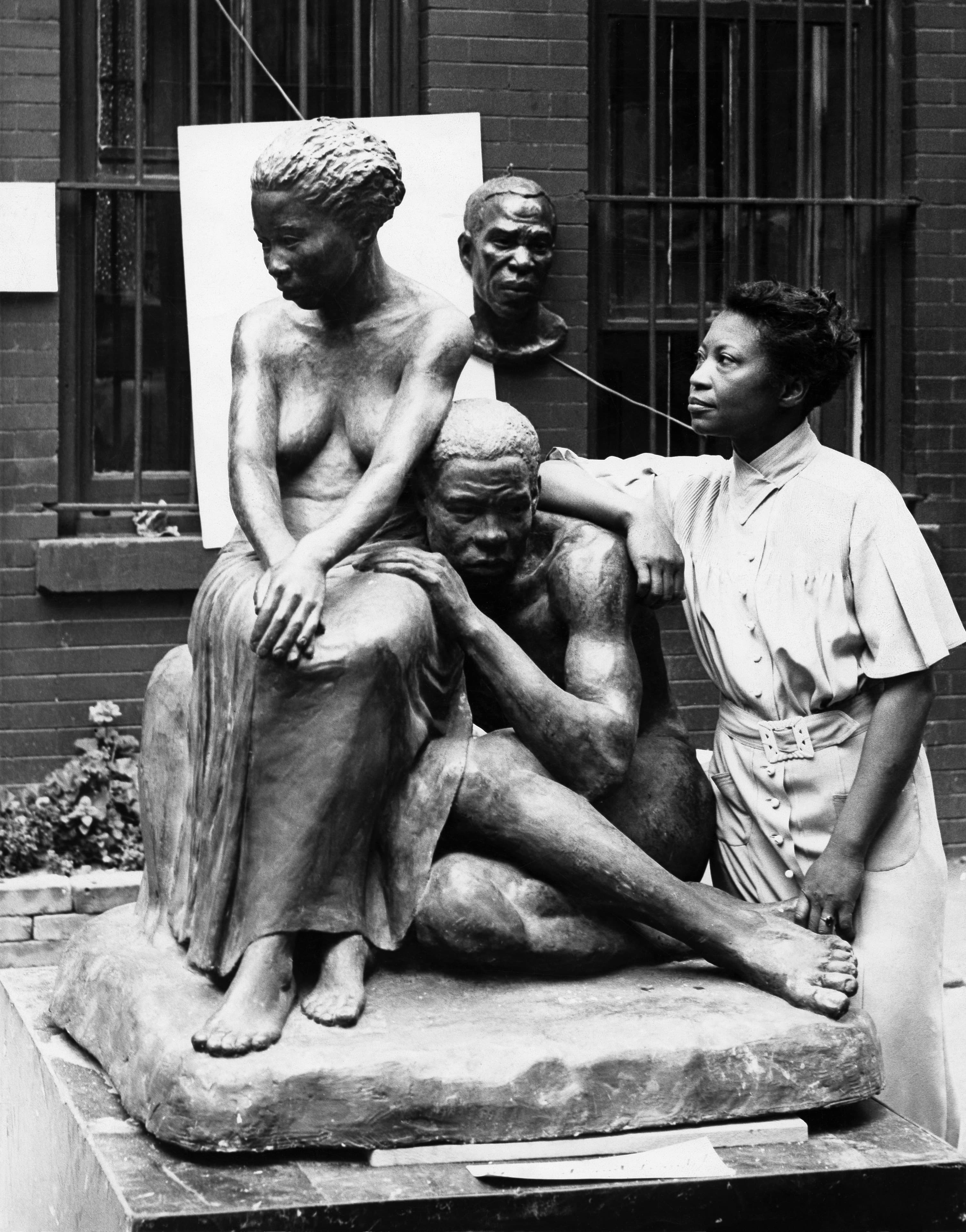
Two figures sit on a rough slab: a woman upright with her hands folded over her knee, and a man below her with his legs stretched out and one arm hooked across her lap. Augusta Savage modelled the group around 1938 under the Works Progress Administration's Federal Art Project. No institution records the object today. What survives is a photograph taken in Harlem by Andrew Herman for the Federal Art Project's Photographic Division, with Augusta Savage standing beside the group.
- c. 1938
- Modelled group, never cast; no institution catalogues the object or records its material
About Augusta Savage
What the photograph shows
A woman sits high on the right-hand side of a rough slab, bare to the waist, a long skirt falling over her legs and her bare feet flat on the stone. Her head is bowed and turned down to her left. Her hands rest one over the other on her forward knee.
Below and in front of her a man sits on the slab with his legs stretched out to the right, one arm hooked over her knee and the other braced behind him. His head is dropped forward and turned towards the camera, the brow furrowed. Neither figure looks at the other.
The base is not a plinth but a slab shaped like a low outcrop of rock, its edges left irregular. In the photograph the group sits outdoors on a low platform against a brick wall, and Augusta Savage stands at the right with her left forearm resting on the man's shoulder. The seated man's head reaches roughly to her chest.
The Federal Art Project
By 1938 Augusta Savage was the first director of the Harlem Community Art Center, a Works Progress Administration institution, and was making her own sculpture under the same federal programme. The Federal Art Project ran a Photographic Division whose job was to document what its artists produced.
Andrew Herman was one of its photographers. The print of Realization is in the Federal Art Project, Photographic Division collection at the Archives of American Art, and its back carries the working details in stamp and handwriting: Art Service Project; 137 E. 57th Street, New York City; Location: 137th St. and Edgecombe Ave.; Date: 6/10; Negative No. 1060I; Photographer: Herman.
That location is a Harlem street corner, a few blocks from where she taught. The photograph is a record made by a government programme of work made under the same programme, which is why it can be reproduced freely today.
What happened to the sculpture
No museum catalogues Realization. Searches of the Smithsonian's collections, of the Art Institute of Chicago, of the Cleveland Museum of Art and of Wikidata return the photograph and nothing else, and no institution states a medium, a size or a location for the object.
The pattern is familiar in Augusta Savage's work. She modelled in clay and plaster because casting in bronze cost more than she could raise, and an uncast sculpture survives only as long as someone stores it. Much of what she made is gone or untraced, and the whereabouts of a great many of her works are simply not known.
What can be said is narrow and should stay narrow. A group called Realization existed in Harlem in 1938, Andrew Herman photographed it for the Federal Art Project, and no later record of the object has surfaced.
The other work in the frame
The photograph catches more than one sculpture. Behind the group, propped against a white board and set on a socle, stands a separate portrait bust of an older man with a lined face and a bare head, cut off at the chest.
The bust is not identified on the print, and no institution has matched it to a titled work. It is recorded here as what it is — an unnamed sculpture visible in the background of a photograph, not an attribution.
Close reading
Reading the work, detail by detail
Andrew Herman photographed the group outdoors in Harlem for the Federal Art Project, in flat daylight against a brick wall. Read the two figures first — the seated woman, her folded hands, the man below her — then the artist standing beside her own work, and last the things the camera caught behind it.
1.The woman's head
Her head is bowed and turned down and away, so the face is seen from above and in three-quarter view. The hair is the roughest passage in the whole group, cut in short deep gouges, against a body worked smooth. She is looking at nothing in the sculpture.
2.The folded hands
Both hands rest on the forward knee, one laid over the other, the fingers loose rather than clasped. It is the stillest thing in the group, and it sits directly above the man's straining arm. The skirt beneath is modelled in a few broad vertical folds.
3.The man's head
His head is pushed forward off the neck and tipped down, and it is the only face in the group turned towards the viewer. The brow is scored with horizontal furrows and the eyes are cut deep into shadow. Where hers is bowed, his is braced.
4.The outstretched leg and foot
One leg runs the full width of the base and ends in a bare foot with every toe modelled. The base is not a plinth but a slab shaped like a low outcrop of rock, its edge left uneven all the way round. The leg reaches almost to that edge.
5.Augusta Savage beside the group
Augusta Savage stands at the right of her own sculpture with her left forearm laid on the seated man's shoulder and her right hand on the base. Her head is turned away from the lens. She is in a light print dress with a buckled belt, and the seated man's head reaches roughly to her chest, which is the only indication of the group's scale in the photograph.
6.The bust behind the group
A second sculpture stands behind the group: a portrait bust of an older man, bare-headed, cut off at the chest, raised on a socle. It is not identified on the print and no institution has matched it to a titled work. The white board propped behind it is a photographer's backdrop, and the brick wall and barred window belong to the Harlem street corner where the picture was taken.
Timeline
1937
Augusta Savage becomes the first director of the Harlem Community Art Center, funded by the Works Progress Administration.
c. 1938
Models Realization under the Works Progress Administration's Federal Art Project.
1938
Andrew Herman photographs the group for the Federal Art Project's Photographic Division at 137th Street and Edgecombe Avenue in Harlem, negative number 1060I.
after 1938
No further record of the object appears. No museum catalogues it, and its whereabouts are unknown.
Where to see it
A viewing location has not yet been listed for this work.
Frequently asked questions
Where is Augusta Savage's Realization?
Unknown. No museum catalogues the object and no institution states a medium, a size or a location for it. The sculpture is known from photographs taken for the Works Progress Administration's Federal Art Project in 1938, and nothing later has surfaced.
What does Realization show?
Two seated figures on a rough slab. A woman sits upright with her head bowed and her hands folded over her knee; a man sits below her with his legs stretched out, one arm hooked across her lap and his head dropped forward. Neither figure looks at the other.
Who photographed Realization?
Andrew Herman, working for the Federal Art Project's Photographic Division. The print is in that collection at the Archives of American Art, and its back records the location as 137th Street and Edgecombe Avenue in Harlem and the negative number as 1060I.
Why is Augusta Savage standing in the photograph?
Because the Federal Art Project photographed its artists with their work as a record of what the programme produced. She stands at the right of the group with her left forearm resting on the seated man's shoulder, looking away from the camera.
Was Realization ever cast in bronze?
No cast is recorded. Augusta Savage worked in clay and plaster through most of her career because bronze casting cost more than she could raise, and an uncast sculpture lasts only as long as someone stores it.
How does Realization connect to her Paris years?
Through the training. Augusta Savage studied at the Académie de la Grande Chaumière in Paris from 1929, working in the studio of Félix Benneteau-Desgrois and with Charles Despiau, and exhibited at the Salon d'Automne in 1930. Realization is a full-scale figure group made seven years after she came home with that schooling.
More by Augusta Savage
If you like Augusta Savage
Explore sculptors from the same movements and circles.
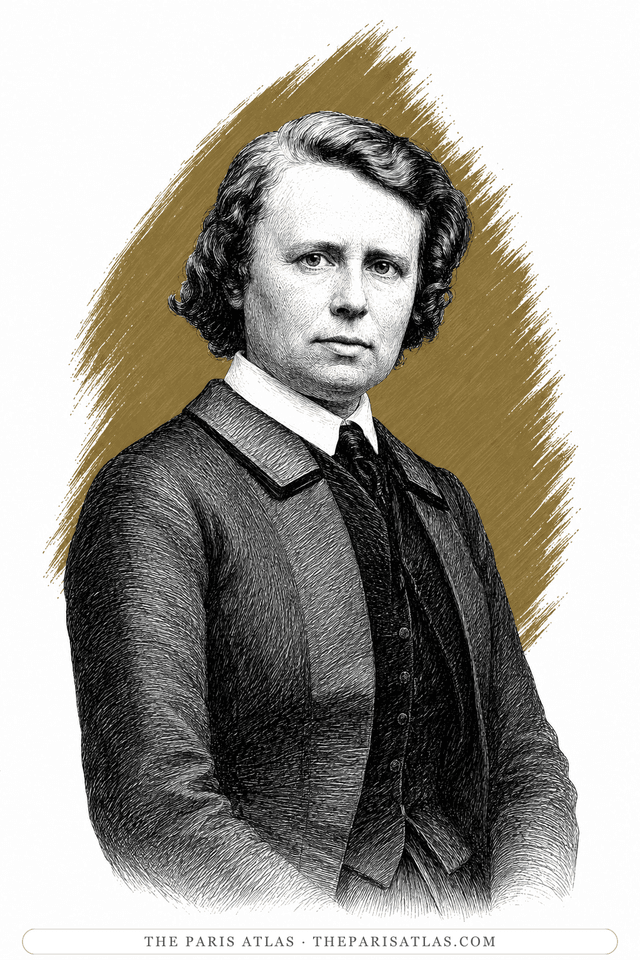
Rosa Bonheur
At the horse markets of Paris and in her studio beside the forest of Fontainebleau, Rosa Bonheur gave animals the presence of great portrait subjects. The success of The Horse Fair helped her build a life shaped by her work, financial independence, and the women she loved.
View artist
Arman
French-American artist, lifelong friend of Yves Klein, and a founder of New Realism.
View artist
Jean Arp
Strasbourg-born sculptor and poet — Hans in German, Jean in French, both all his life — who co-founded Dada at the Cabaret Voltaire in 1916, composed collages by dropping torn paper 'according to the laws of chance', and settled at Meudon outside Paris in a house his wife Sophie Taeuber-Arp designed.
View artist
References
The sources below include collection records, catalogues, scholarly research, and primary materials that informed this page. They document Realization, its making, and its place in cultural history.


1File: Archives of American Art — Augusta Savage — 2371 CROPPED — Andrew Herman's Federal Art Project photograph of Realization
WebsiteWikimedia Commons, 1938Used forThe file page for the photograph published here, carrying Andrew Herman's credit, the Archives of American Art collection line, the verso identification with the Harlem location and negative number, and the public-domain status of a Works Progress Administration work.
2Augusta Savage — artist biography
WebsiteSmithsonian American Art MuseumUsed forThe Smithsonian American Art Museum's life of the artist, for the Harlem Community Art Center directorship and the working conditions behind the uncast plasters.
3Black Women Artists: Augusta Savage
WebsiteNew York Public LibraryUsed forThe New York Public Library's account of her career, for the teaching years in Harlem.
 View source
4Augusta Savage — Biography
WebsiteWomen of Rosenwald: Curating Social Justice through the ArtsUsed forThe Women of Rosenwald Fellowship exhibit, for the Paris study of 1929 to 1931 and the Salon acceptances that precede this work.
5Augusta Savage: Renaissance Woman
WebsiteCummer Museum of Art & GardensUsed forThe Cummer Museum of Art and Gardens on the touring exhibition Augusta Savage: Renaissance Woman, for the scale of the losses in her surviving body of work.
These references provide the documented foundation for this work's history and interpretation. Claim-level citations remain attached to the specific claims they support.
 Explore more resources