Musician and Dancer
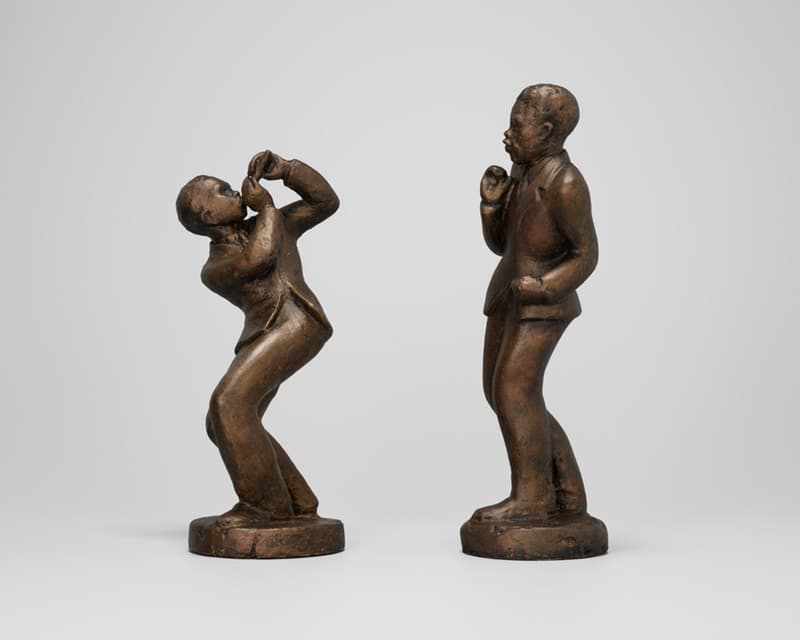
Two small figures in jackets and trousers, each on a round base, painted a bronze brown. One leans far back with his head thrown up and both hands at his mouth; the other stands nearly upright, head turned towards him, one fist raised to the chest. Augusta Savage modelled them in plaster around 1939, and both survive. The Art Institute of Chicago bought them at auction in 2021 and catalogues them together as 2021.29a-b.
- c. 1939
- Painted plaster
- Art Institute of ChicagoChicago, United States
About Augusta Savage
Two figures, one exchange
The two figures are catalogued as one object in two parts. The Art Institute of Chicago gives the musician as 34.3 centimetres high and the dancer as 39.4, both 15.2 centimetres across at the base, in painted plaster. Neither is much longer than a forearm.
The museum reads them as a call and an answer. The musician twists at the waist and throws his shoulders and head back; the dancer leans off his own vertical axis with his arms bent in close, which the museum describes as full of kinetic energy. Set facing each other, the two poses complete a single movement.
Both wear an ordinary jacket and trousers rather than anything symbolic, and both stand on a plain round pad of plaster. Augusta Savage was working in Harlem in the late 1930s, and the museum's account places the subject there: everyday people in her own neighbourhood.
What the museum's photograph shows, and does not
The Art Institute of Chicago's own photograph is taken side-on, with both figures in profile against a plain grey ground. It records two things the catalogue entry does not.
The first is an inscription. A line of incised cursive script runs across the front edge of the musician's round base, clearly visible in the museum's image. The catalogue record leaves the inscriptions field empty.
The second is an absence. The museum's description has the musician lifting a wind instrument high in the air; in the photograph his hands close on each other at his lips, one above the other, and the grey background shows through the gap between them. No instrument reads in that view. The photograph shows one angle under one light, and it cannot settle whether an instrument is modelled and hidden or was never there.
How the two sculptures reached Chicago
The Art Institute of Chicago's provenance is short. William Struna of Washington, District of Columbia, and Shepherdstown, West Virginia, owned both figures by about 1975. They were sold as lot 1 at the Black Art Auction in Indianapolis on 6 February 2021, and the museum bought them there.
They entered the collection that year as 2021.29a-b, through the Roger and J. Peter McCormick Endowment Fund, in the department of Arts of the Americas. The museum lists them as not on view.
Sixty years had passed between the modelling and the acquisition, and the trail before 1975 is blank. For an artist whose work was mostly uncast and mostly lost, two documented sculptures arriving intact in a major collection are the exception.
Close reading
Reading the work, detail by detail
The Art Institute of Chicago photographed the two figures side-on, both figures in profile, against a plain pale grey ground with no shadow. Read the musician first — the backward lean, the head, the hands at the mouth — then cross the gap to the dancer, and finish on the bases.
1.The musician's head
The head is thrown back until the throat is fully exposed and the chin points upward. The face is barely detailed at this scale — a brow, a nose, a slot for the mouth — and the hair is a rough textured skin over the skull. The Art Institute of Chicago describes the musician as twisting at the waist and throwing back his shoulders and head.
2.The hands at the mouth
Two hands, stacked one above the other, the fingers of both curled inward as though closing on a narrow pipe. In this view the grey background shows through the gap between them and no instrument is modelled there. The Art Institute of Chicago's description says he lifts a wind instrument high in the air; one photograph from one angle cannot settle whether it is hidden or absent.
3.The backward lean
The whole body is a single curve. The waist bends back, the knees push forward and the rear leg braces. He wears an ordinary jacket with a lapel and ordinary trousers, which is the point: the figure is a man in the street clothes of 1939, not an allegory.
4.The dancer's head
The dancer's head is turned towards the musician and his lips are parted. The ear is modelled in more detail than any feature on the other figure. The Art Institute of Chicago gives the dancer as 39.4 centimetres and the musician as 34.3, so the taller of the two in any photograph is this one.
5.The dancer's hands
Two hands at two heights: one closed into a fist at the chest, one open and dropped to the hip. The arms stay bent in close to the body rather than reaching out, which is what the Art Institute of Chicago means by an axis leaned off rather than abandoned. Nothing is held in either hand.
6.The bases, and the script on one of them
Two round pads of plaster, both worn at the rim where the paint has chipped away to a paler body. A line of shallow cursive script runs across the front of the musician's base, cut rather than written. The Art Institute of Chicago's published record leaves its inscriptions field empty.
Timeline
1929–1931
Augusta Savage studies in Paris at the Académie de la Grande Chaumière on a Julius Rosenwald Fellowship, and exhibits at the Salon d'Automne in 1930.
1937
Becomes the first director of the Harlem Community Art Center, where she is working when the two figures are modelled.
c. 1939
Models the two figures in plaster and paints them a bronze brown.
c. 1975
William Struna of Washington, District of Columbia, and Shepherdstown, West Virginia, owns both figures.
2021
Sold as lot 1 at the Black Art Auction in Indianapolis on 6 February and bought by the Art Institute of Chicago as 2021.29a-b.
Where to see it
Art Institute of Chicago
111 South Michigan Avenue, Chicago, IL 60603, United States
The Art Institute of Chicago lists both figures as not on view, and marks the object as not open access.
Plan your visit on the museum’s official website (opens in a new tab)Frequently asked questions
Where is Musician and Dancer by Augusta Savage?
At the Art Institute of Chicago, accession number 2021.29a-b, in the department of Arts of the Americas. The museum lists both figures as not on view, so check the object record before travelling. Both figures survive; neither was destroyed.
What are the two figures doing?
The Art Institute of Chicago reads them as a musical partnership. The musician twists at the waist and throws his head and shoulders back with his hands at his mouth; the dancer leans off his vertical axis with his arms bent close to his body, one fist raised to the chest.
What are they made of?
Painted plaster. Augusta Savage could rarely afford bronze casting, and the brown paint on both figures is doing the work bronze would have done. The Art Institute of Chicago states the medium as painted plaster.
How big are they?
Small. The musician is 34.3 centimetres high and the dancer 39.4, each 15.2 centimetres across the base. The taller of the two in any photograph is therefore the dancer.
Is the musician holding an instrument?
The Art Institute of Chicago's description says he lifts a wind instrument high in the air. In the museum's own photograph his two hands meet at his lips and the background shows through the gap between them, so no instrument can be seen from that angle. A single photograph cannot settle the question.
How did the Art Institute of Chicago acquire them?
By purchase at auction. Both figures belonged to William Struna of Washington, District of Columbia, and Shepherdstown, West Virginia, by about 1975, and was sold as lot 1 at the Black Art Auction in Indianapolis on 6 February 2021. The museum bought them there through the Roger and J. Peter McCormick Endowment Fund.
More by Augusta Savage
If you like Augusta Savage
Explore sculptors from the same movements and circles.
Rosa Bonheur
At the horse markets of Paris and in her studio beside the forest of Fontainebleau, Rosa Bonheur gave animals the presence of great portrait subjects. The success of The Horse Fair helped her build a life shaped by her work, financial independence, and the women she loved.
View artist
Arman
French-American artist, lifelong friend of Yves Klein, and a founder of New Realism.
View artist
Jean Arp
Strasbourg-born sculptor and poet — Hans in German, Jean in French, both all his life — who co-founded Dada at the Cabaret Voltaire in 1916, composed collages by dropping torn paper 'according to the laws of chance', and settled at Meudon outside Paris in a house his wife Sophie Taeuber-Arp designed.
View artist
References
The sources below include collection records, catalogues, scholarly research, and primary materials that informed this page. They document Musician and Dancer, its making, and its place in cultural history.


1Augusta Savage, Musician and Dancer (c. 1939) — object record, 2021.29a-b
WebsiteArt Institute of ChicagoUsed forThe museum's object record: title, date, medium, dimensions, credit line, accession number, department, provenance and its reading of the two poses.
2Art Institute of Chicago public API — artwork 260420 and its IIIF image service
WebsiteArt Institute of ChicagoUsed forThe museum's published collection data, which marks the object as not public domain, leaves the inscriptions field empty, and caps the IIIF image service at 843 pixels.
3Augusta Savage — artist biography
WebsiteSmithsonian American Art MuseumUsed forThe Smithsonian American Art Museum's life of the artist, for the Harlem years and the reasons her work stayed in plaster.
4Augusta Savage — Biography
WebsiteWomen of Rosenwald: Curating Social Justice through the ArtsUsed forThe Women of Rosenwald Fellowship exhibit, for the Paris study of 1929 to 1931 and the Salon d'Automne acceptance of 1930.
These references provide the documented foundation for this work's history and interpretation. Claim-level citations remain attached to the specific claims they support.
 Explore more resources