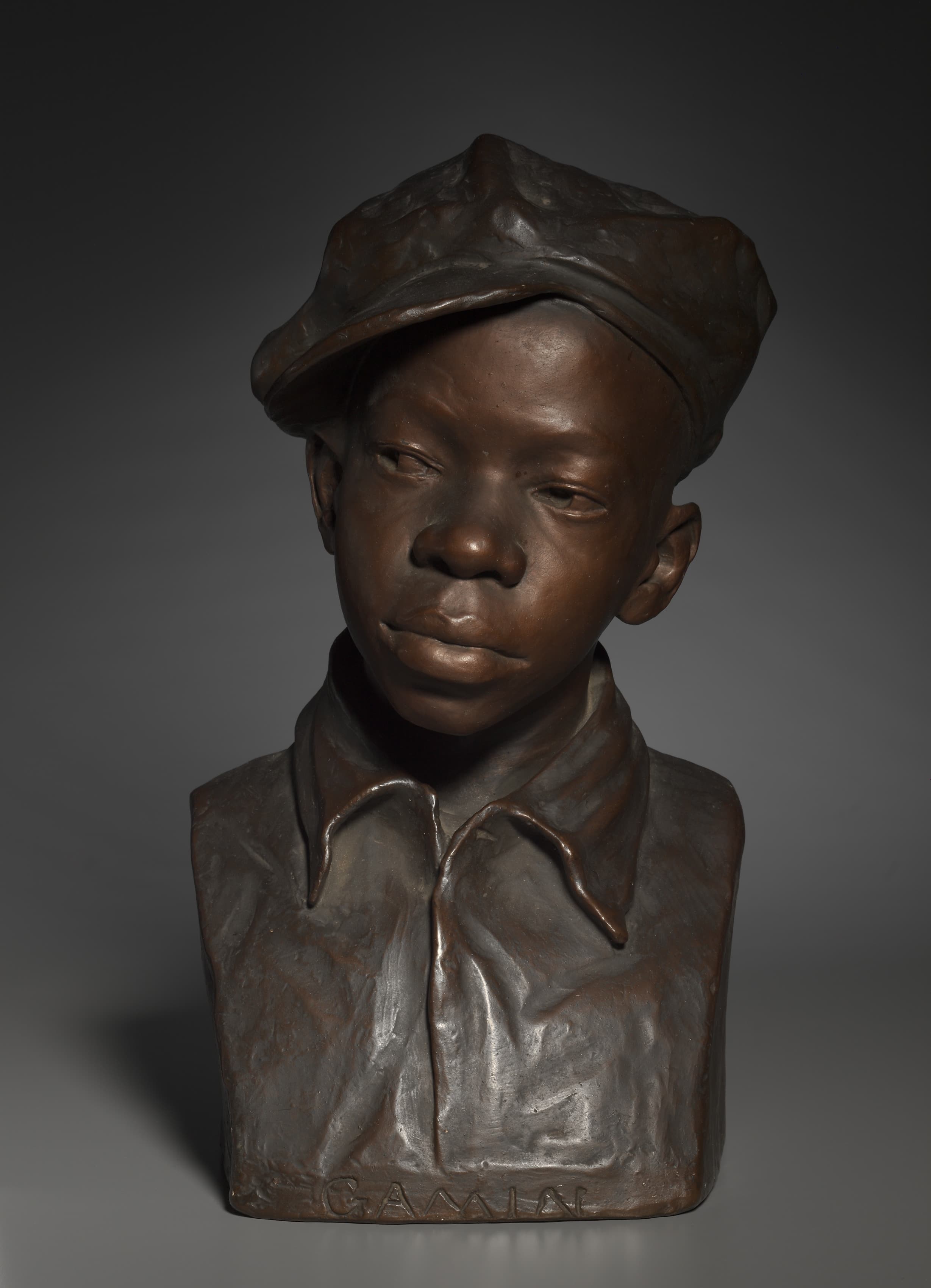
Gamin
A boy in a soft flat cap and an open-collared shirt, modelled from the chest up and painted a warm coppery brown so that plaster would read as bronze. The sitter was Augusta Savage's nephew Ellis Ford, who was living with her in Harlem after a hurricane damaged the family's house in Florida. The sculpture survives. The Cleveland Museum of Art holds the life-size hand-painted plaster as 2003.40, and the Smithsonian American Art Museum holds a smaller painted plaster as 1988.57.
- c. 1929
- Hand-painted plaster
- Cleveland Museum of ArtCleveland, United States
About Augusta Savage

What the sculpture is
The bust stops at the chest and takes in the head, the neck, the shoulders and the top of a shirt. The boy wears a soft cap with a peak, its crown collapsed to one side and its brim lifted clear of the brow. His shirt is open at the throat, with two long pointed collar tips falling across the chest.
The Cleveland Museum of Art gives the material as hand-painted plaster and the size as 44.5 by 24.2 by 20.4 centimetres, which is roughly life size for a head and shoulders. The museum records the word GAMIN cut across the bottom front of the base and the name Savage signed on the right side.
Plaster was not a preference. Augusta Savage could rarely afford to have a finished sculpture cast in bronze, so she painted the plaster dark and glossy instead. The colour on the Cleveland bust is doing exactly that job.
Ellis Ford
The Smithsonian American Art Museum identifies the sitter as Ellis Ford, Augusta Savage's nephew, who modelled for her in 1929 while staying in her Harlem apartment after a hurricane displaced his family in Florida. The museum notes that the figure was long taken for a generic street child rather than a portrait of a particular boy.
The Cleveland Museum of Art says the same thing in its own words: the image was long thought to be a generic figure, and recent research shows that it depicts her nephew. The museum reads the warmth of the characterisation as a consequence of that relationship.
The title is French. A gamin is a child who lives on the street, and the Smithsonian American Art Museum glosses it that way on its own object record.
Two versions, two sizes
The Cleveland Museum of Art calls its cast unique and probably the oldest surviving example of the subject, and notes that several small versions were also produced. Its hand-painted plaster stands 44.5 centimetres high and hangs in gallery 226B, American Modern.
The Smithsonian American Art Museum's version is much smaller: 22.9 by 14.7 by 11.2 centimetres, painted plaster, accession 1988.57, given by Benjamin and Olya Margolin. Anyone who has seen a photograph of one and then met the other in a gallery is meeting a different object.
The two records disagree about where the sculpture was first reproduced. The Cleveland Museum of Art's publication history lists the cover of Opportunity: Journal of Negro Life for June 1929. The Smithsonian American Art Museum says it appeared on the cover of The Crisis in 1929. Both are institutional statements, and they are not the same magazine.
What the sculpture paid for
In the spring of 1923 Augusta Savage had applied to a summer programme at the Fontainebleau School of Fine Arts in France. She was accepted, and the American selection committee withdrew the place when it learned that she was Black. She made the refusal public rather than absorb it.
Gamin changed the arithmetic. The bust brought her a Julius Rosenwald Fellowship in 1929, and the fellowship, topped up by the Urban League, a Carnegie grant and money from friends, paid her passage to Paris at the age of thirty-seven.
In Paris she enrolled at the Académie de la Grande Chaumière, worked in the studio of Félix Benneteau-Desgrois, and also studied with Charles Despiau. Her sculpture was accepted at the Salon d'Automne in 1930 and at the Salon de Printemps in 1931. France had shut the door in 1923; a portrait of a boy in a cap opened it.
Close reading
Reading the work, detail by detail
The photograph takes the bust from the front and a little to the left, lit from the upper right against a grey studio ground. Read it from the cap down: the crumpled crown, the brim clear of the brow, the half-lidded eyes, the closed mouth, the open collar, and the title cut into the base.
1.The crown of the cap
One cap, and the modelling in it is deliberately rough. The crown is pinched up into a ridge and left with every tool mark showing, so the plaster reads as worn cloth rather than as a smooth cast form. Nothing above the brow is idealised.
2.The brim lifted off the brow
The peak is pushed back and up, leaving the whole forehead clear. A cap worn that way is a cap worn by someone who has stopped adjusting it. The bright line along the brim's edge is the only hard highlight in the upper half of the photograph.
3.The eyes
Both eyes are open and neither is wide. Augusta Savage cut the upper lids as hard ledges and left the eyeballs plain, with no drilled pupil, so the gaze reads as level rather than searching. The head is turned a few degrees to the boy's left and tipped slightly down.
4.The mouth
The mouth is closed and unsmiling. The lower lip carries the brightest highlight on the face, which is what draws the eye there before anything else. The Cleveland Museum of Art reads the whole characterisation as warm; the expression itself gives nothing away.
5.The open collar
Two collar points, both unbuttoned, both modelled as thick raised ridges rather than as thin cloth. The gap between them opens straight onto the throat. Below, the shirt is handled in broad soft creases, and the paint there is duller than on the face, which is the clearest evidence in the photograph that the surface is painted plaster and not bronze.
6.The title cut into the base
Five letters, incised rather than applied, running the width of the base's front edge. Each is drawn with a single narrow groove, the A without a crossbar and the final N sloping away at the right. The Cleveland Museum of Art records the inscription as GAMIN titled across the bottom front, with the name Savage signed on the right side, out of this view.
Timeline
1923
Accepted for the summer programme at the Fontainebleau School of Fine Arts, then rejected by the American selection committee on learning she is Black. Augusta Savage makes the refusal public.
1929
Models her nephew Ellis Ford in Harlem, where he is staying after a hurricane damages the family house in Florida.
1929
Reproduced on the cover of Opportunity: Journal of Negro Life for June, according to the Cleveland Museum of Art's publication history. The Smithsonian American Art Museum instead names the cover of The Crisis.
1929
The bust helps win her a Julius Rosenwald Fellowship, and she sails for Paris at thirty-seven.
1988
A smaller painted plaster enters the Smithsonian American Art Museum as 1988.57, the gift of Benjamin and Olya Margolin.
2003
The Cleveland Museum of Art buys the life-size hand-painted plaster from the J. H. Wade Fund as 2003.40.
Where to see it
Cleveland Museum of Art
11150 East Boulevard, Cleveland, OH 44106, United States
The Cleveland Museum of Art records the life-size plaster in gallery 226B, American Modern. A smaller painted plaster is at the Smithsonian American Art Museum as 1988.57.
Plan your visit on the museum’s official website (opens in a new tab)Frequently asked questions
Where is Gamin by Augusta Savage?
In two museums, in two sizes. The Cleveland Museum of Art holds the life-size hand-painted plaster as 2003.40, on view in gallery 226B, American Modern. The Smithsonian American Art Museum holds a smaller painted plaster as 1988.57. The sculpture survives; it was never destroyed.
Who is the boy in Gamin?
Ellis Ford, Augusta Savage's nephew. The Smithsonian American Art Museum records that he sat for her in 1929 while living in her Harlem apartment, his family having been displaced by a hurricane in Florida. The Cleveland Museum of Art notes that the bust was long mistaken for a generic figure.
What is Gamin made of?
Plaster, painted by hand. Augusta Savage could seldom afford bronze casting, so she painted plaster a dark coppery brown to imitate it. The Cleveland Museum of Art states the material as hand-painted plaster; the Smithsonian American Art Museum states it as painted plaster.
How big is Gamin?
That depends which one. The Cleveland Museum of Art's cast measures 44.5 by 24.2 by 20.4 centimetres, about seventeen and a half inches high. The Smithsonian American Art Museum's measures 22.9 by 14.7 by 11.2 centimetres, about nine inches.
What does the word gamin mean?
It is French for a child who lives on the street, and the Smithsonian American Art Museum glosses the title that way. The cap the boy wears was the ordinary headgear of newspaper sellers and other working children in the 1920s.
Why does Gamin matter to Augusta Savage's Paris years?
Because it paid for them. The bust helped win her a Julius Rosenwald Fellowship in 1929, which took her to the Académie de la Grande Chaumière in Paris at the age of thirty-seven. Six years earlier the Fontainebleau School of Fine Arts had withdrawn her place because she was Black.
More by Augusta Savage
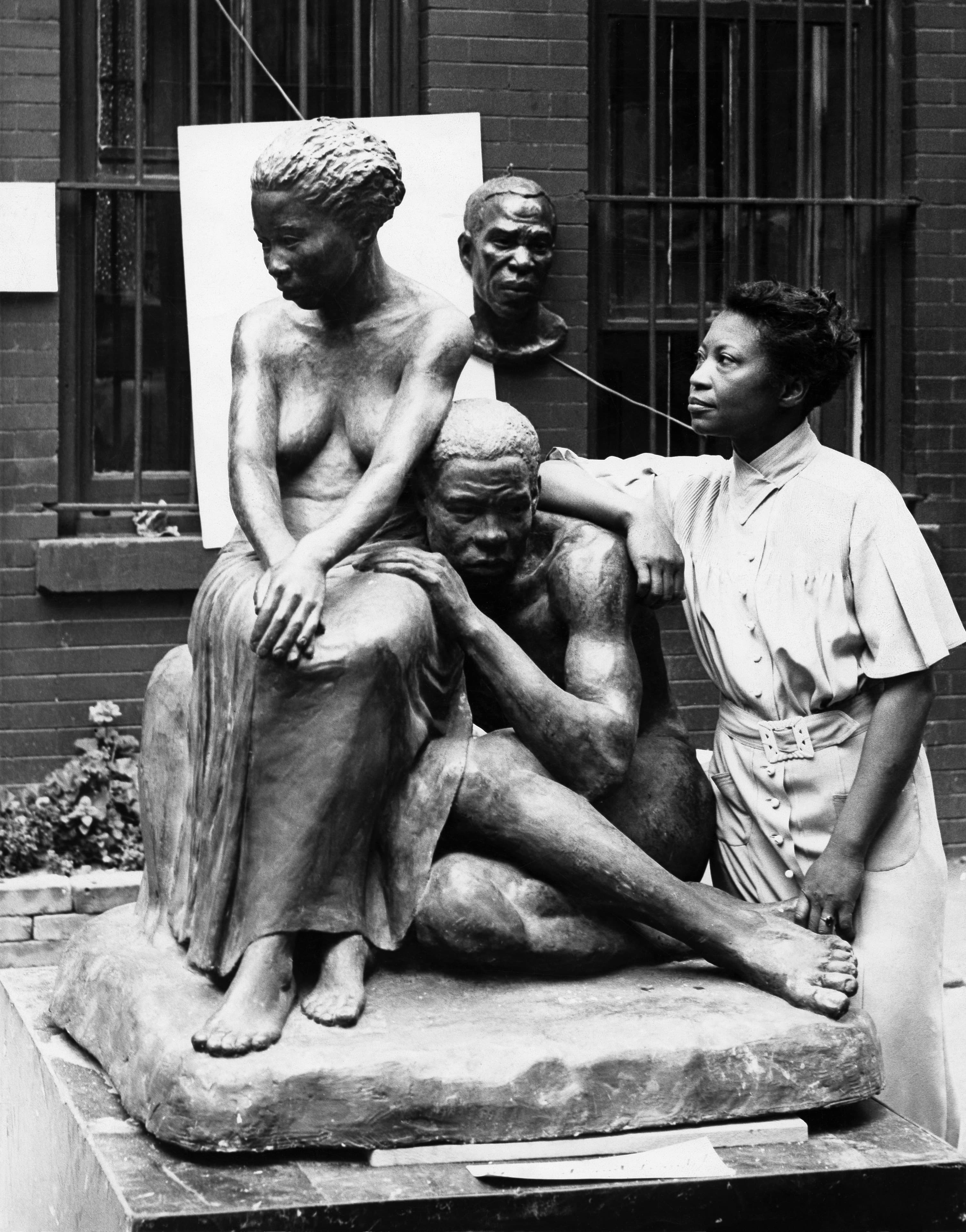
If you like Augusta Savage
Explore sculptors from the same movements and circles.
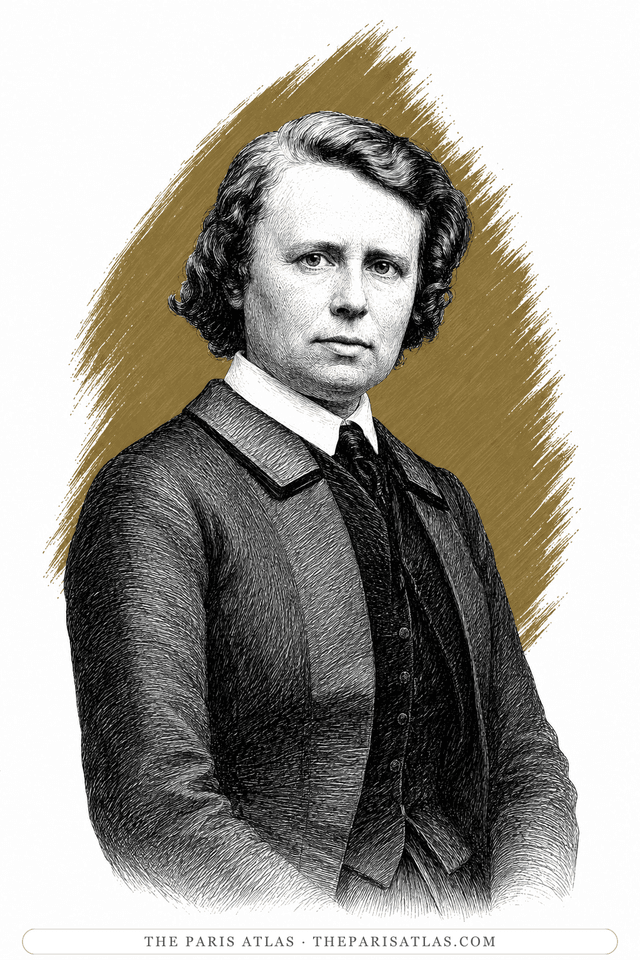
Rosa Bonheur
At the horse markets of Paris and in her studio beside the forest of Fontainebleau, Rosa Bonheur gave animals the presence of great portrait subjects. The success of The Horse Fair helped her build a life shaped by her work, financial independence, and the women she loved.
View artist
Arman
French-American artist, lifelong friend of Yves Klein, and a founder of New Realism.
View artist
Jean Arp
Strasbourg-born sculptor and poet — Hans in German, Jean in French, both all his life — who co-founded Dada at the Cabaret Voltaire in 1916, composed collages by dropping torn paper 'according to the laws of chance', and settled at Meudon outside Paris in a house his wife Sophie Taeuber-Arp designed.
View artist
References
The sources below include collection records, catalogues, scholarly research, and primary materials that informed this page. They document Gamin, its making, and its place in cultural history.


1Gamin
WebsiteCleveland Museum of ArtUsed forThe Cleveland Museum of Art's object record: title, date, medium, dimensions, inscriptions, credit line, accession number, gallery, publication history and the statement that the work may be copied and distributed without permission.
2Gamin
WebsiteSmithsonian American Art MuseumUsed forThe Smithsonian American Art Museum's object record for the smaller painted plaster, which names Ellis Ford as the sitter and glosses the French title.
3File: Augusta Savage — Gamin — 2003.40 — Cleveland Museum of Art
WebsiteWikimedia CommonsUsed forThe Wikimedia Commons file page for the museum's CC0 photograph, which is the reproduction published here.
 View source
4Augusta Savage — artist biography
WebsiteSmithsonian American Art MuseumUsed forThe museum's life of the artist, for the Rosenwald Fellowship and the years in Paris.
5Augusta Savage — Biography
WebsiteWomen of Rosenwald: Curating Social Justice through the ArtsUsed forThe Women of Rosenwald Fellowship exhibit, for the 1923 refusal, the Paris arrival at thirty-seven, and the Salon d'Automne and Salon de Printemps acceptances.
These references provide the documented foundation for this work's history and interpretation. Claim-level citations remain attached to the specific claims they support.
 Explore more resources