Lift Every Voice and Sing
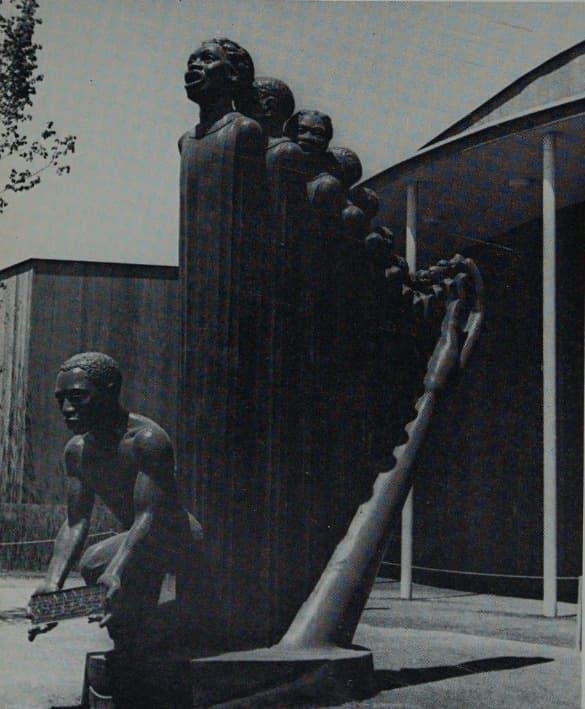
Twelve singing children stand in descending height, their bodies forming the strings of a harp, with a huge forearm and open hand as the soundboard and a kneeling young man holding a bar of music at the front. Augusta Savage made it in plaster for the 1939 New York World's Fair, sixteen feet high. It no longer exists. She could not pay to have it cast in bronze or moved and stored, and the sculpture was destroyed when the fair closed, so only photographs, postcards and small metal souvenir copies survive.
- 1939
- Plaster, never cast
About Augusta Savage
What the sculpture showed
A row of children in choir robes rose in graduated heights, mouths open, arms held behind their backs. Their bodies were drawn out into near-cylinders so that the row read as the strings of a harp. Behind and beneath them a long forearm reached up out of an oval base, its open hand curling over the smallest heads to close the instrument's frame.
In front, a young man knelt on one knee with both arms held out, carrying a flat slab ruled with staves — music given a physical weight. The National Museum of African American History and Culture describes the arrangement from its own souvenir copy. Twelve singing child figures stand in descending height, arranged behind a kneeling male figure. A large outstretched forearm and hand extend from the oval base to cradle them.
The finished work stood about sixteen feet high. The material was plaster.
The commission and the song
Augusta Savage was one of very few Black artists to receive a professional commission from the fair's Board of Design, and the brief was to represent the contribution of Black Americans to music. She answered it with the hymn written by James Weldon Johnson and J. Rosamond Johnson in 1900, Lift Every Voice and Sing, which by 1939 was widely sung as the Black national anthem.
The sculpture took the song's title. Almost everyone at the fair called it The Harp instead, and the nickname has stuck to it ever since.
The National Museum of African American History and Culture records that the sculpture stood in the courtyard of the Pavilion of Contemporary Art. It was among the most photographed things at the fair. Small metal souvenir copies and postcards of it were sold on the grounds.
How it was lost
Plaster was a stage, not a destination. A monumental sculpture is modelled in plaster and then cast in bronze, and the casting is what makes it permanent. Augusta Savage had no money for the casting, and no institution offered any.
The National Museum of African American History and Culture states the outcome plainly. Augusta Savage did not have funds to have the work cast in bronze, or to move and store it. Like the fair's other temporary installations, the sculpture was destroyed when it closed. The fair's second season ended in October 1940.
What survives is a photographic record, a set of postcards, and the souvenir copies. The museum holds one of those copies as 2015.274 — cast metal, 27.5 by 10.2 by 26 centimetres, inscribed on the oval base with the words Augusta Savage and Worlds Fair 1939. New-York Historical holds another as 2019.90. A sixteen-foot sculpture now exists mainly as an object that fits on a shelf.
What the reproduction actually is
No cast was ever made, so every image of the work is a photograph taken between the spring of 1939 and the close of the fair. The photograph published here is one of them, reproduced from a printed page rather than from a negative.
It appeared on page 150 of Cedric Dover's American Negro Art, published by the New York Graphic Society in 1960, where the photograph is credited to Carl Van Vechten. The copyright on that publication was never renewed, which is why the plate can be shown here at all.
The National Museum of African American History and Culture holds two further 1939 photographs of the sculpture, gelatin silver prints measuring seven by five inches, as 2010.66.112 and 2010.66.113, the gift of Jackie Bryant Smith. Both carry the museum's statement of no known copyright restrictions.
Close reading
Reading the work, detail by detail
The photograph is taken outdoors at the 1939 New York World's Fair, from the left front, in hard daylight. Read it as the instrument it imitates: the tallest singer, the descending heads that form the strings, the hand that closes the frame, the forearm that carries it down, and the kneeling man at the front.
1.The tallest singer
The figure at the top of the row is the only one whose mouth is fully open in this view. The head is lifted and turned a little to its left, and the throat is drawn long. Below it the body is not modelled as a body at all but as a long fluted column, which is how a person becomes a string.
2.The heads that descend
Seven heads can be counted from this angle; the National Museum of African American History and Culture's description of the souvenir copy says twelve children in all, so five are hidden behind the front rank. Each is smaller than the one before it, and the smallest are barely faces. The row falls in a smooth curve rather than a straight line.
3.The hand at the top of the arm
One hand, four fingers and a thumb, scaled far larger than the children it reaches over. The fingertips curl down onto the smallest heads and stop there, closing the frame of the instrument. Behind it stands the flank of the fair pavilion, not sky.
4.The forearm as the soundboard
The arm is the whole right-hand edge of the sculpture, and it does the work a harp's soundboard does. It tapers from the wrist down to the base and carries no detail at all — no veins, no muscle, no elbow. A narrow white pavilion column stands directly behind it in this view, which is how the fairground keeps intruding on the photograph.
5.The kneeling man
One figure is separate from the row and in front of it, kneeling on a low block with one knee raised. His head is in profile, turned away from the singers. Where every other body in the sculpture has been flattened into a string, his is modelled fully — shoulder, back, ribs, arms.
6.The bar of music in his hands
A flat plaque, held in both hands and pushed out past the base into open air. Parallel grooves run its length, which is a stave rendered as a solid object. The National Museum of African American History and Culture's description of the souvenir copy puts the kneeling male figure at the front of the sculpture; what he is offering is the music itself.
Timeline
1900
James Weldon Johnson writes the words and J. Rosamond Johnson the music of Lift Every Voice and Sing.
1937
Augusta Savage becomes the first director of the Harlem Community Art Center, the job that occupies her when the commission arrives.
1939
The sixteen-foot plaster goes on view at the New York World's Fair, in the courtyard of the Pavilion of Contemporary Art. Metal souvenir copies and postcards are sold on the grounds.
1940
The fair closes. With no money to cast, move or store it, Augusta Savage loses the sculpture; it is destroyed with the other temporary installations.
1960
A photograph of the sculpture, credited to Carl Van Vechten, is printed on page 150 of Cedric Dover's American Negro Art. The copyright is never renewed.
2010
Two 1939 photographs of the sculpture enter the National Museum of African American History and Culture as 2010.66.112 and 2010.66.113, the gift of Jackie Bryant Smith.
2015
A cast metal souvenir copy enters the same museum as 2015.274, the gift of the Blount, Holloway and Edgerton families.
Where to see it
No collection — the sculpture was destroyed when the 1939 New York World's Fair closed
A public viewing address has not yet been confirmed for this holding.
The link goes to the cast metal souvenir copy at the National Museum of African American History and Culture, 2015.274, which is the nearest thing to the object that can still be seen. New-York Historical holds another souvenir copy as 2019.90.
Frequently asked questions
Where is Augusta Savage's The Harp now?
Nowhere. The sculpture was destroyed when the 1939 New York World's Fair closed. It was made of plaster, Augusta Savage could not pay to have it cast in bronze or moved and stored, and it went the way of the fair's other temporary installations. Photographs, postcards and small metal souvenir copies are what remain.
What did Lift Every Voice and Sing show?
A harp made of people. Twelve children in choir robes stood in descending height, their bodies forming the strings, while a huge forearm and open hand rose from the oval base as the soundboard. A young man knelt at the front holding a flat slab of ruled music in both hands.
Why is it called The Harp?
Because that is what fairgoers called it. Augusta Savage titled the work Lift Every Voice and Sing, after the hymn by James Weldon Johnson and J. Rosamond Johnson, but the shape of the thing named itself and the nickname stuck.
How big was the sculpture?
About sixteen feet high, roughly 4.9 metres. The metal souvenir copy at the National Museum of African American History and Culture is 27.5 centimetres tall, about one-eighteenth of that.
Can you still see a copy of The Harp?
Only the souvenirs sold at the fair. The National Museum of African American History and Culture holds one as 2015.274, cast in metal and inscribed Augusta Savage and Worlds Fair 1939 on the oval base. New-York Historical holds another as 2019.90. They are reductions made for sale, not casts of the sculpture.
Why was it never cast in bronze?
Money. Augusta Savage worked in clay and plaster for most of her life because bronze casting was beyond what she could pay for, and the fair commission did not cover it. The National Museum of African American History and Culture states directly that she had no funds either to cast the work or to move and store it.
More by Augusta Savage
If you like Augusta Savage
Explore sculptors from the same movements and circles.
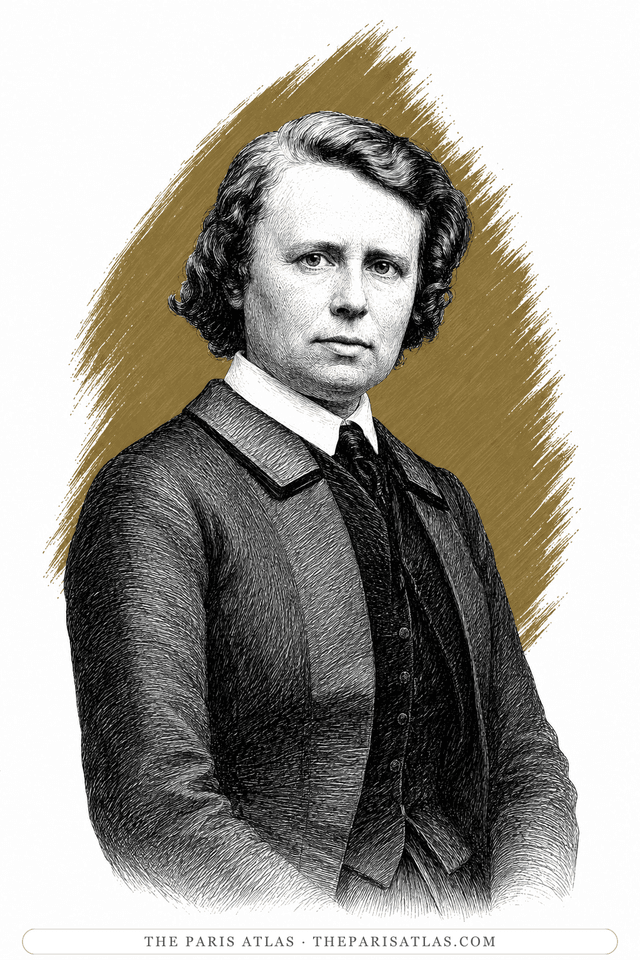
Rosa Bonheur
At the horse markets of Paris and in her studio beside the forest of Fontainebleau, Rosa Bonheur gave animals the presence of great portrait subjects. The success of The Horse Fair helped her build a life shaped by her work, financial independence, and the women she loved.
View artist
Arman
French-American artist, lifelong friend of Yves Klein, and a founder of New Realism.
View artist
Jean Arp
Strasbourg-born sculptor and poet — Hans in German, Jean in French, both all his life — who co-founded Dada at the Cabaret Voltaire in 1916, composed collages by dropping torn paper 'according to the laws of chance', and settled at Meudon outside Paris in a house his wife Sophie Taeuber-Arp designed.
View artist
References
The sources below include collection records, catalogues, scholarly research, and primary materials that informed this page. They document Lift Every Voice and Sing, its making, and its place in cultural history.


1Augusta Savage, Lift Every Voice and Sing (The Harp), cast metal souvenir replica (c. 1939) — object record, 2015.274
WebsiteNational Museum of African American History and CultureUsed forThe museum's record of the cast metal souvenir copy: date, medium, dimensions, credit line, the inscriptions on the oval base, and its description of the twelve children, the kneeling figure and the forearm.
2Photograph of Augusta Savage's sculpture, Lift Every Voice and Sing (The Harp), 1939 — object record, 2010.66.112
WebsiteNational Museum of African American History and CultureUsed forOne of two 1939 photographs of the sculpture at the museum, whose record states the sixteen-foot height, the sale of souvenir copies and postcards, and the destruction of the work at the close of the fair.
3File: Lift Every Voice and Sing (sculpture) Augusta Savage — the plate from American Negro Art, 1960
WebsiteWikimedia CommonsUsed forThe file page for the reproduction published here, recording its source in the 1960 book and the unrenewed copyright.
_Augusta_Savage.png) View source
View source
4American Negro Art
NonfictionNew York Graphic Society, 1960Used forThe book the plate comes from, where the photograph is credited to Carl Van Vechten.
5Oh Freedom! Augusta Savage
WebsiteSmithsonian American Art MuseumUsed forThe Smithsonian American Art Museum's account, which states that the work was not cast in bronze and was later destroyed.
These references provide the documented foundation for this work's history and interpretation. Claim-level citations remain attached to the specific claims they support.
 Explore more resources