Nude Torso
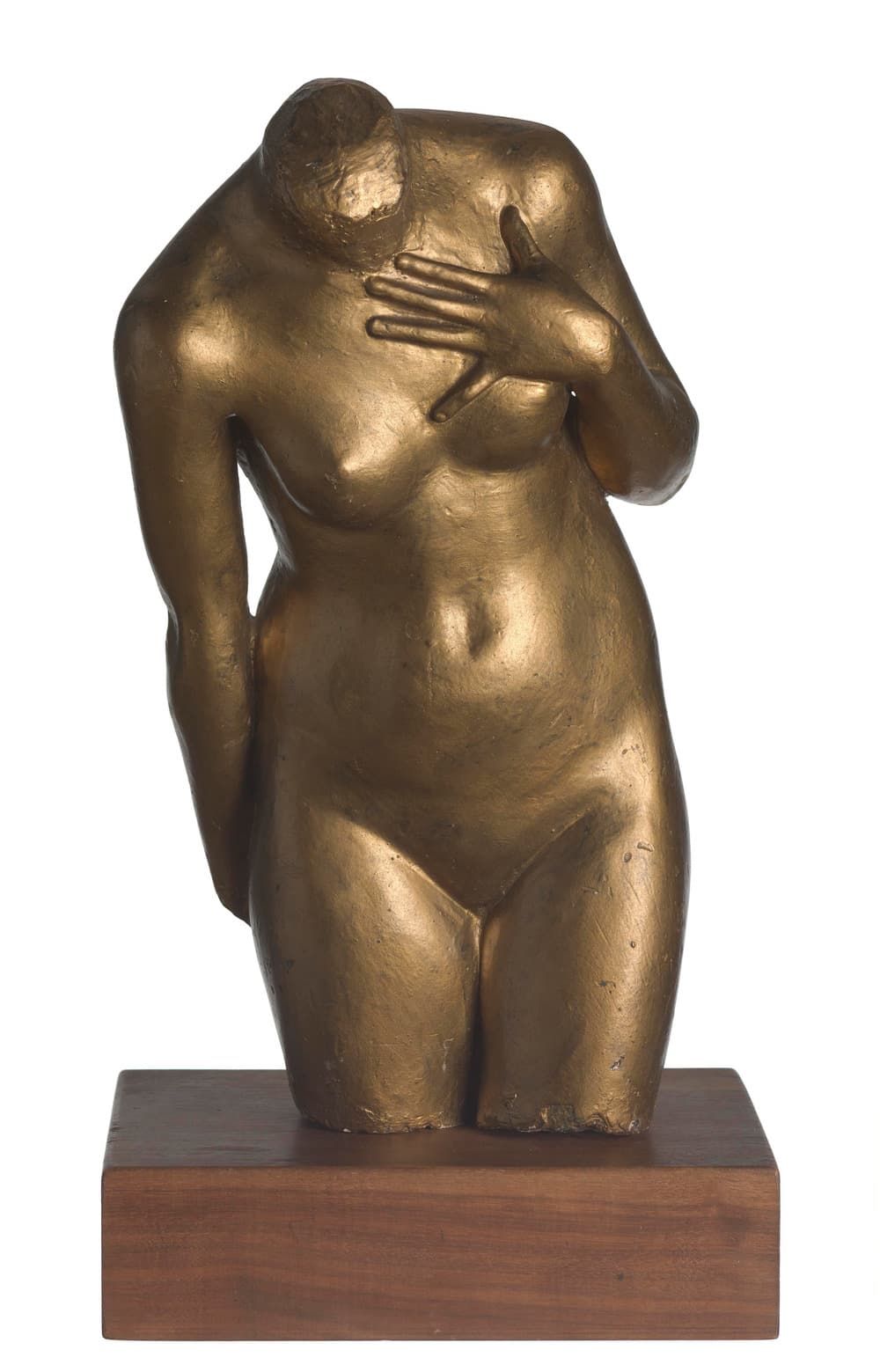
A woman's torso in plaster, painted dark gold, cut at the neck, at both arms and across the thighs. One hand lies flat on the chest with the fingers spread; the other arm falls straight at the side. Augusta Savage modelled it in Harlem after coming back from two years at the Académie de la Grande Chaumière in Paris, taking her former student Edythe Williams Scott as the model. The sculpture survives, at the National Museum of African American History and Culture as 2014.233.2.
- c. 1931–1935
- Paint on plaster with wood
- National Museum of African American History and CultureWashington, United States
About Augusta Savage
What the sculpture is
The figure stops four times: at the neck, at the top of one arm, above the wrist of the other, and across both thighs. What is left is 41.3 centimetres high, about the length of a forearm, and sits on a block of dark wood.
The National Museum of African American History and Culture gives the material as paint on plaster with wood, and describes the body as dark gold. It reads the pose as a slight bend forward and to the figure's right, with the left hand placed above the breast, palm flat and fingers spread, and the right arm held straight and a little behind the body.
Plaster again. Augusta Savage had learned in Paris from sculptors working in bronze and stone, and came home in 1931 to a country in the Depression where she could afford neither. The gold paint is standing in for a metal she could not buy.
Edythe Williams Scott
The museum names the model as Edythe Williams Scott, an artist and educator who had been a student of Augusta Savage's. The relationship matters to the object: this is not an anonymous studio nude but a portrait of a particular woman by her former teacher.
The museum's own record spells the name two ways. The structured subject field gives Edythe Williams Scott; the wall caption on the same page gives Edyth Williams Scott. The spelling used here follows the catalogue field.
What Paris left in it
The museum's caption is unusually direct about the sequence: Augusta Savage sculpted Nude Torso, in academic realist style, after returning from studies at the Académie de la Grande Chaumière in Paris.
She had reached Paris in 1929 on a Julius Rosenwald Fellowship, at thirty-seven, six years after the Fontainebleau School of Fine Arts withdrew her place on learning she was Black. In Paris she lived in Montparnasse, worked in the studio of Félix Benneteau-Desgrois, studied with Charles Despiau, and had sculpture accepted at the Salon d'Automne in 1930 and the Salon de Printemps in 1931.
The training shows in the handling. The anatomy is observed rather than stylised, and the surface is smoothed down rather than left rough. The fragment is a French convention: a torso cut off at neck, arms and thighs descends through Auguste Rodin from antique sculpture. The museum places the work in Harlem all the same. It was made there, of a Harlem sitter, by a Harlem teacher.
In the collection
The National Museum of African American History and Culture catalogues the sculpture as 2014.233.2, in the collection of the museum, classified under Visual Arts and filed to the Harlem Renaissance.
Its rights position is not open. The museum records the object's restrictions as unknown with restrictions possible, and states that rights assessment and proper usage are the responsibility of the user. The museum returns no image of the object through the Smithsonian's open-access programme.
One description in the record does not match the object. The museum calls the base a square block of dark wood, while its own measurements give the base as 25.4 by 19.7 centimetres, and the photograph shows a rectangle wider than it is deep.
Close reading
Reading the work, detail by detail
The museum photographed the sculpture from the front, lit evenly, against a white ground with a dark wooden plinth beneath it. Read the four cuts that define the object — neck, one arm, the other arm, the thighs — then the hand on the chest, and last the surface itself.
1.The cut at the neck
The figure stops at the base of the neck in a clean oval face, tilted back so the cut is visible from the front. Nothing is broken: the edge is even all the way round. Inside the oval the gold paint has worn through to a paler plaster, the largest area of loss anywhere on the sculpture.
2.The hand laid on the chest
One hand, palm flat, fingers apart, laid across the chest above the breast. Each finger is modelled separately and the gaps between them are cut right through to the body beneath. The National Museum of African American History and Culture describes it as the left hand placed above the breast, palm flat and fingers spread.
3.The cut on the raised arm
The arm that carries the hand to the chest is severed just below the elbow and finished as a rounded stub. That is the second of the sculpture's four deliberate terminations. The elbow itself is the widest point of the whole silhouette.
4.The arm at the side
The other arm hangs straight down and slightly behind the body, and ends in a flat cut above the wrist. It is pressed close enough to the flank that the two forms nearly merge. The museum records the right arm as held straight and slightly to the rear of the right side.
5.The cut across the thighs
The last cut runs straight across both thighs, a little below the hip. Here the edge is rough and chipped rather than smooth, and bare plaster shows along the rim. The torso sits directly on the wood with no fixing visible.
6.The wooden plinth
The block is wood, not plaster, and the grain runs horizontally across its front face. Its top is wider than it is deep — the museum's own measurements give 25.4 by 19.7 centimetres — so the description of a square block in the same record does not match the object. It adds 6.7 centimetres to the height.
Timeline
1929
Augusta Savage reaches Paris at thirty-seven on a Julius Rosenwald Fellowship and enrols at the Académie de la Grande Chaumière.
1930
Has sculpture accepted at the Salon d'Automne in Paris.
1931
Has sculpture accepted at the Salon de Printemps, then returns to the United States.
c. 1931–1935
Models Nude Torso in Harlem, taking her former student Edythe Williams Scott as the model.
2014
The sculpture enters the National Museum of African American History and Culture as 2014.233.2.
Where to see it
National Museum of African American History and Culture
Washington, United States
A public viewing address has not yet been confirmed for this holding.
The museum records the object's rights as unknown with restrictions possible, and offers no open-access image of it.
Frequently asked questions
Where is Nude Torso by Augusta Savage?
At the National Museum of African American History and Culture in Washington, accession number 2014.233.2. The sculpture survives. The museum classifies it under Visual Arts and files it to the Harlem Renaissance.
Who was the model for Nude Torso?
Edythe Williams Scott, an artist and educator who had been a student of Augusta Savage's. The museum names her in the object record. The same record spells the first name Edyth in its wall caption and Edythe in its catalogue field.
What is Nude Torso made of?
Plaster, painted dark gold, on a block of dark wood. The National Museum of African American History and Culture states the medium as paint on plaster with wood. Augusta Savage worked in plaster because bronze casting cost more than she could raise.
How big is Nude Torso?
The figure is 41.3 by 22.9 by 22.9 centimetres, about sixteen inches high. Its wooden base adds 6.7 centimetres of height and measures 25.4 by 19.7 centimetres, so it is a rectangle rather than the square the museum's description calls it.
How does Nude Torso relate to Augusta Savage's time in Paris?
It came straight out of it. The National Museum of African American History and Culture states that she sculpted the work, in academic realist style, after returning from her studies at the Académie de la Grande Chaumière. She had studied there from 1929 on a Julius Rosenwald Fellowship and exhibited at the Salon d'Automne in 1930.
Why is the figure cut off at the neck and arms?
Because it was made that way. The fragment — a torso ending deliberately at neck, arms and thighs — is a French academic convention descending through Auguste Rodin from antique sculpture, and it is one of the things Augusta Savage brought home from Paris. Nothing is broken or missing.
More by Augusta Savage
If you like Augusta Savage
Explore sculptors from the same movements and circles.
Rosa Bonheur
At the horse markets of Paris and in her studio beside the forest of Fontainebleau, Rosa Bonheur gave animals the presence of great portrait subjects. The success of The Horse Fair helped her build a life shaped by her work, financial independence, and the women she loved.
View artist
Arman
French-American artist, lifelong friend of Yves Klein, and a founder of New Realism.
View artist
Jean Arp
Strasbourg-born sculptor and poet — Hans in German, Jean in French, both all his life — who co-founded Dada at the Cabaret Voltaire in 1916, composed collages by dropping torn paper 'according to the laws of chance', and settled at Meudon outside Paris in a house his wife Sophie Taeuber-Arp designed.
View artist
References
The sources below include collection records, catalogues, scholarly research, and primary materials that informed this page. They document Nude Torso, its making, and its place in cultural history.


1Augusta Savage, Nude Torso (c. 1931–1935) — object record, 2014.233.2
WebsiteNational Museum of African American History and CultureUsed forThe museum's object record: title, date, medium, dimensions, credit line, accession number, place made, the sitter's name, the description of the pose, and the statement that the work follows her Paris study.
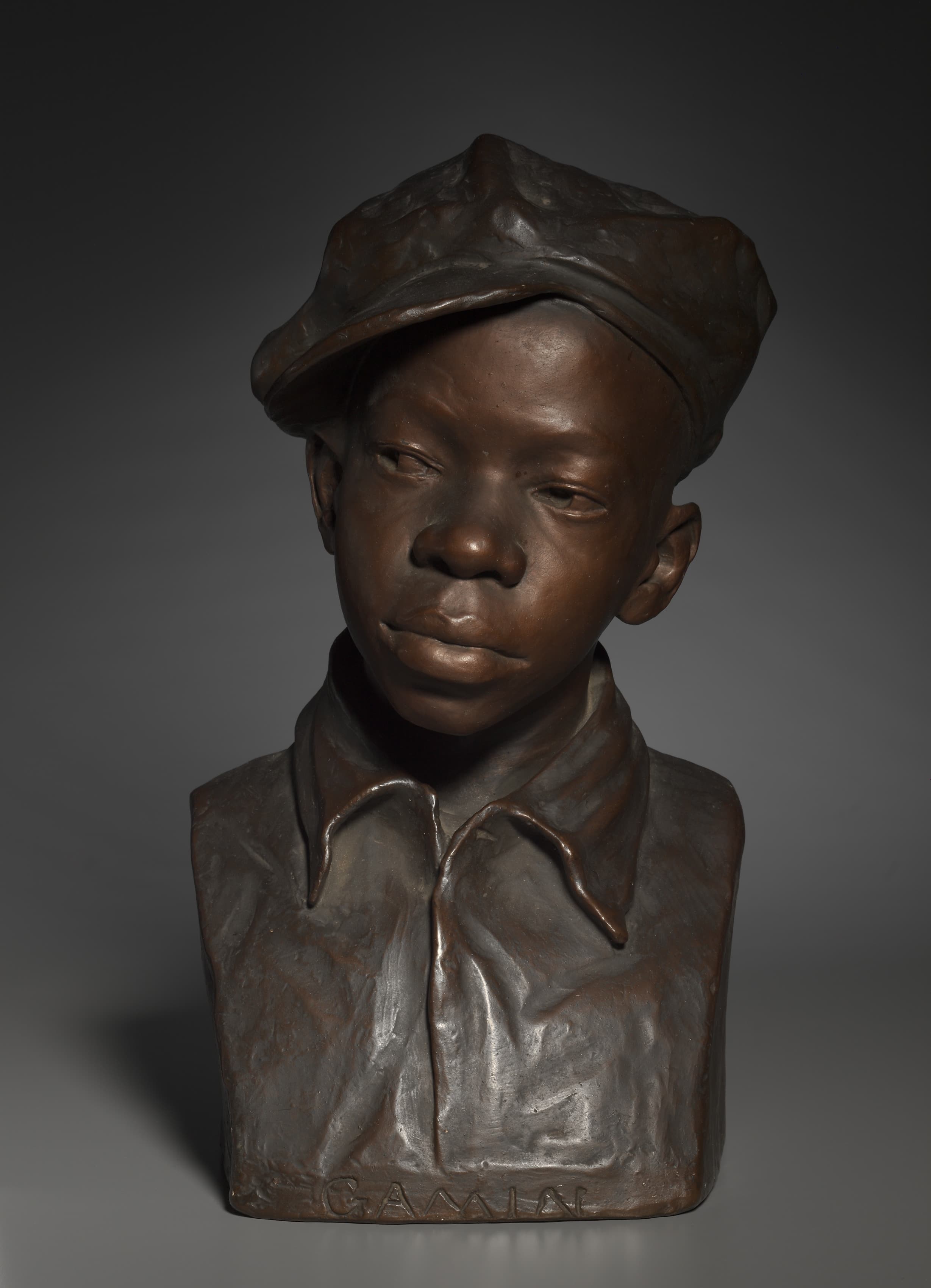
2Augusta Savage, Head of a Young Black Man (c. 1931–1935) — object record, 2024.70.1
WebsiteNational Museum of African American History and CultureUsed forA second painted plaster of the same years in the same museum, for the material and the signature she used on it.
3Augusta Savage — Biography
WebsiteWomen of Rosenwald: Curating Social Justice through the ArtsUsed forThe Women of Rosenwald Fellowship exhibit, for the 1923 refusal, the fellowship at thirty-seven, and the Salon d'Automne and Salon de Printemps acceptances of 1930 and 1931.
4Augusta Savage — artist biography
WebsiteSmithsonian American Art MuseumUsed forThe Smithsonian American Art Museum's life of the artist, for the Paris years and the reasons her sculpture stayed in plaster.
5Savage, Augusta (1892–1962)
WebsiteWomen in World History: A Biographical EncyclopediaUsed forA reference life of the artist, for the Montparnasse address, Félix Benneteau-Desgrois and Charles Despiau.
These references provide the documented foundation for this work's history and interpretation. Claim-level citations remain attached to the specific claims they support.
 Explore more resources