The Door
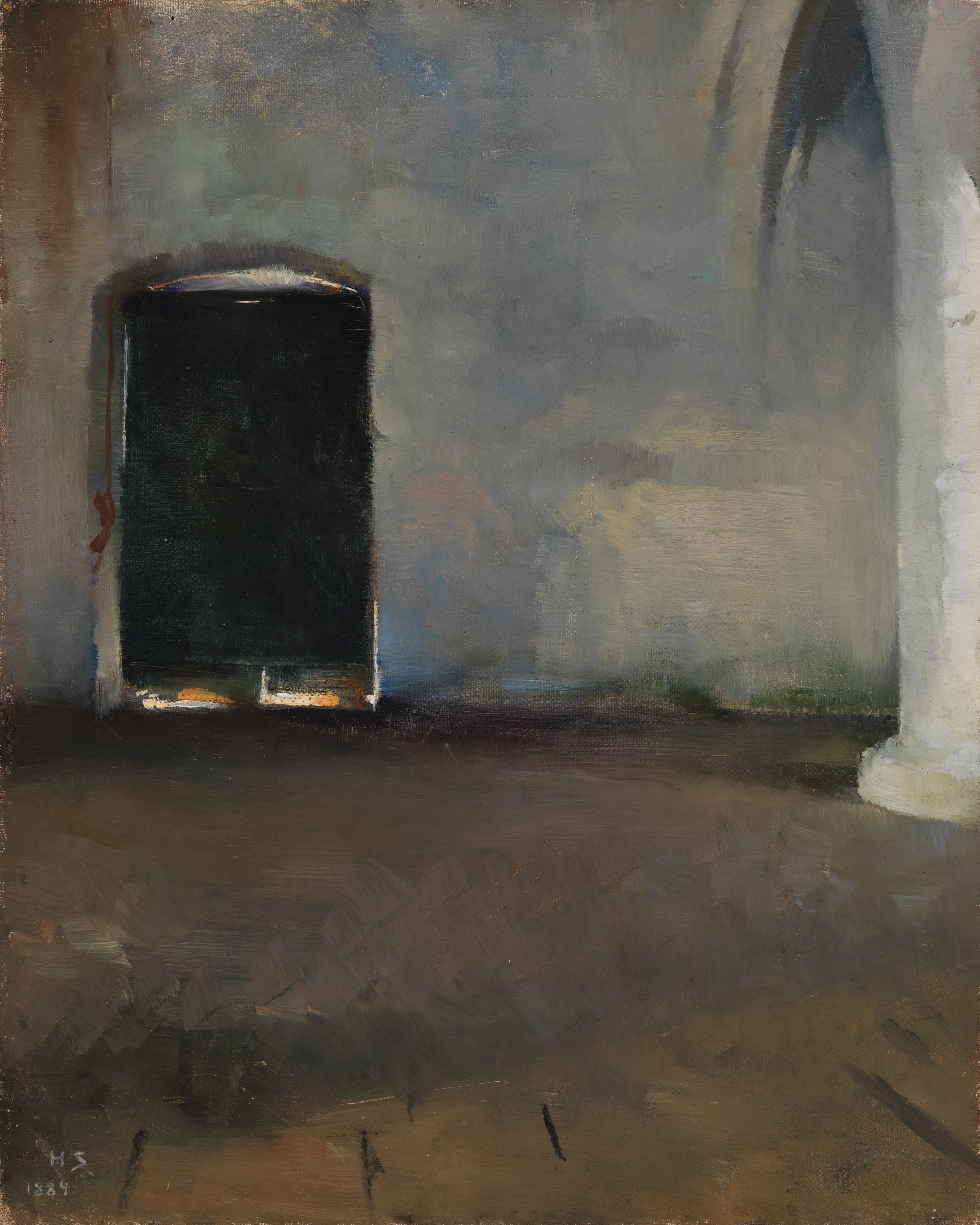
A closed door, painted almost black, stands in a pale gray wall, with light leaking in a thin line along its top and in two patches at its foot. Helene Schjerfbeck painted it in 1884 in the Trémalo chapel outside Pont-Aven, in Brittany, on her second stay in the village. It is one of a small group of pictures from those months that have no figures and no story, and it is at the Ateneum Art Museum in Helsinki.
- 1884
- Oil on canvas
- Ateneum Art Museum, Finnish National GalleryHelsinki, Finland
About Helene Schjerfbeck
What the painting shows
The door fills the left half of the picture: a tall dark green rectangle, nearly black, with a slightly arched top. Along that top edge a thin strip of white light shows where the door does not meet its frame. At the foot, two patches of orange and yellow mark light coming under it, and a thin white line runs up the right-hand jamb. A red-brown cord hangs down the left jamb, with a knot partway down.
The wall around the door is pale gray-blue, brushed thinly enough for the canvas weave to show through, with patches of pink and green-brown where it is stained. At the right edge a white pillar rises from a flared base, and a gray rib of the vault springs from it in the top corner. The floor is brown, laid in broad diagonal strokes, with three or four thin dark marks near the bottom edge.
The canvas is 40.5 by 32.5 centimeters, about sixteen by thirteen inches. Schjerfbeck signed it with her initials, HS, and the date 1884 in the lower left corner. The Finnish National Gallery's record places the scene in the Chapelle de Trémalo at Pont-Aven, and its Finnish and Swedish titles add a second description, Old Monastery Hall.
Pont-Aven, 1883 to 1884
Schjerfbeck first went to Brittany in the summer of 1881, to the fishing port of Concarneau, with the Austrian painter Marianne Preindlsberger, her friend from the Académie Colarossi in Paris. In July 1883 she went back with Preindlsberger and the Finnish painter Maria Wiik. This time the three women based themselves at Pont-Aven, an inland village already full of French, British and American painters, and Schjerfbeck stayed until the spring of 1884.
Pont-Aven is now tied to the name of Paul Gauguin, who first arrived there in 1886. Schjerfbeck's stay came two years before his, when the village was a busy painters' colony but not yet the home of a school. The Trémalo chapel where she set up her easel holds the seventeenth-century wooden crucifix that Gauguin painted in 1889 in The Yellow Christ, now at the Buffalo AKG Art Museum.
The work she brought back from those months was of two kinds. Funeral Procession in Brittany, a large Naturalist canvas of an old man kneeling in front of a procession, went to the Paris Salon of 1884 under the title Un enterrement, Finistère. Alongside it she painted a group of small pictures with no people in them at all: Street in Pont-Aven, Shadow on the Wall, Clothes Drying and The Door.
Marja Lahelma, in her 2023 biography for the Finnish National Gallery, describes these small pictures as having no narrative, no figures and hardly a subject, built instead from composition and the painted surface. Most of them were not shown in Finland for decades, and Schjerfbeck said that even her closest colleagues did not understand them.
A picture with the subject taken out
Nothing happens in The Door. Nobody stands in the hall and nothing is about to happen. The only event is daylight finding the gaps around a shut door. The Metropolitan Museum of Art's 2026 essay on Schjerfbeck by Patricia G. Berman calls this painting and Clothes Drying quietly subversive: pictures of places without people that still carry the marks of use.
Lahelma singles it out from the whole of the 1880s. Even Schjerfbeck's early work, she writes, had highly original qualities that set her apart from her peers, and The Door is an incredibly bold work in its extremely simplified approach. In the same passage she notes that Schjerfbeck never completely abandoned the Naturalist principle of staying true to what she saw, even as her later work pared everything down.
From the studio to the Ateneum
The painting stayed out of public view for more than thirty years. The Finnish National Gallery's exhibition history for it begins with Gösta Stenman's Schjerfbeck exhibition at his gallery at Erottajankatu 7 in Helsinki, from 12 September to 1 October 1917. That show, her first solo exhibition, covered her work from 1879 to 1917.
It was shown at Liljevalchs in Stockholm in 1934 and at the Helsinki Kunsthalle in 1936. The Finnish National Gallery bought it on 3 December 1965, and its inventory number is A IV 3680.
Since then it has traveled widely. It toured the United States with Women Artists in Paris, 1850–1900, shown in Denver, Louisville and at the Clark Art Institute in 2017 and 2018. It went to the Royal Academy of Arts in London in 2019 and to the Ateneum's own Schjerfbeck exhibition that winter. The Ateneum showed it again in Gothic Modern in 2024 to 2025, and it hung in Seeing Silence at the Metropolitan Museum of Art in New York from December 2025 to April 2026.
Where it is
The Ateneum Art Museum in Helsinki, part of the Finnish National Gallery, inventory number A IV 3680. The museum's online record does not say whether the painting is currently on view, so check before traveling to see it.
The Finnish National Gallery releases its photographs of works whose copyright has expired under the CC0 licence, and its record for The Door carries the museum's photograph on those terms. The image can be copied and reused, including commercially, without permission.
Close reading
Reading the work, detail by detail
The picture is small, 40.5 by 32.5 centimeters, and most of it is thin paint. Close views show where the light gets in around the shut door, the cord beside it, and how little Schjerfbeck put on the wall and the floor.
1.Light along the top of the door
The door's top edge is a shallow arch, and a thin strip of white paint runs along it where the door falls short of its frame. One small bright dab sits just below the strip. The door itself is dark green over black, laid on thinly enough for the weave of the canvas to show through.
2.Two patches of light at the foot
Under the door two patches of orange and yellow mark where daylight gets in, one at the left and one at the right, each with a smear of white beside it. A thin white line runs up the right-hand jamb. These few strokes are the brightest paint in the picture.
3.A cord down the left jamb
A red-brown cord hangs down the left side of the door, with a knot or loop about a third of the way down. Beside it a pale blue-white line marks the edge of the jamb. Schjerfbeck gives no hint of what the cord is for.
4.The white pillar and the rib of the vault
A white pillar stands at the right edge, its shaft painted in a few vertical strokes of white and gray. From its top a gray rib curves up and out of the picture. Together with the arched door, these are the only signs that the room is a vaulted building.
5.Thin paint on a stained wall
The wall is brushed in pale gray-blue so thinly that the canvas texture reads through it. Patches of pink and green-brown sit in the gray, and a faint vertical line runs down the middle of this passage. At the bottom a darker band marks where wall meets floor.
6.Diagonal strokes, dark marks and the initials HS
The floor is laid in broad diagonal strokes of brown and gray. In the corner Schjerfbeck put her initials, HS, and the date, 1884, in pale gray paint. To the right of them one of several thin dark marks scratches up from the bottom edge, and a strip of bare brown canvas shows at the left.
Timeline
1883
In July Schjerfbeck arrives at Pont-Aven with Marianne Preindlsberger and Maria Wiik, and stays until the following spring.
1884
Paints The Door in the Trémalo chapel and signs it HS 1884.
1917
First recorded showing, at Gösta Stenman's Schjerfbeck exhibition in Helsinki, 12 September to 1 October.
1965
Bought by the Finnish National Gallery on 3 December. Inventory number A IV 3680.
2019
Shown at the Royal Academy of Arts in London, then at the Ateneum's Through My Travels I Found Myself.
2025–26
Shown in Seeing Silence: The Paintings of Helene Schjerfbeck at the Metropolitan Museum of Art, New York.
Where to see it
Ateneum Art Museum, Finnish National Gallery
Helsinki, Finland
A public viewing address has not yet been confirmed for this holding.
The museum's online record does not state whether the painting is currently on view.
Frequently asked questions
Where is Helene Schjerfbeck's The Door?
The Ateneum Art Museum in Helsinki, part of the Finnish National Gallery, inventory number A IV 3680. The museum bought it in 1965. Its online record does not say whether it is currently on view.
Where was The Door painted?
In the Chapelle de Trémalo, a chapel outside the village of Pont-Aven in Brittany, according to the Finnish National Gallery's record. Schjerfbeck was living at Pont-Aven from July 1883 to the spring of 1884, on her second stay in Brittany, and the painting is dated 1884.
What does The Door show?
A closed door, painted nearly black, in a pale gray wall inside a vaulted building. Light shows in a thin line along the door's arched top and in two orange patches under it. A red-brown cord hangs beside the door, a white pillar stands at the right edge, and the brown floor fills the lower part of the canvas. There are no people.
Why is The Door considered important?
Because of how little is in it. Marja Lahelma's 2023 biography for the Finnish National Gallery calls it an incredibly bold work for its extremely simplified approach, made when the Naturalism of the Paris Salon still expected a subject. The Metropolitan Museum of Art's 2026 essay calls it quietly subversive. The simplification of Schjerfbeck's late portraits was still decades away.
How big is The Door?
40.5 by 32.5 centimeters, about sixteen by thirteen inches. It is oil on canvas.
Was The Door exhibited in Schjerfbeck's lifetime?
Not for a long time. The Finnish National Gallery's exhibition history for it begins in 1917, at Gösta Stenman's Schjerfbeck exhibition in Helsinki, thirty-three years after it was painted. It was then shown in Stockholm in 1934 and Helsinki in 1936.
Can I reuse the image of The Door?
Yes. Helene Schjerfbeck died in January 1946, so the painting is out of copyright, and the Finnish National Gallery releases its photograph of it under CC0, which allows any use without permission.
More by Helene Schjerfbeck
If you like Helene Schjerfbeck
Explore painters from the same movements and circles.
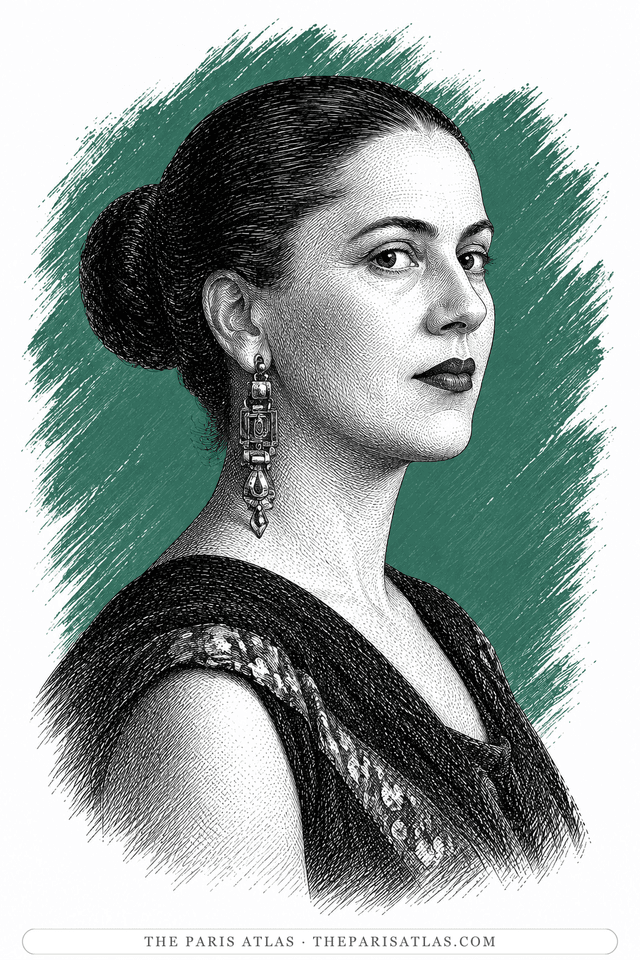
Tarsila do Amaral
Brazilian painter who spent the 1920s moving between São Paulo and Paris, studied Cubism under André Lhote, Albert Gleizes and Fernand Léger, and used what she learned to paint Brazilian towns, railways, plants and bodies. Her 1928 painting Abaporu prompted the manifesto that gave the Anthropophagic movement its name.
View artist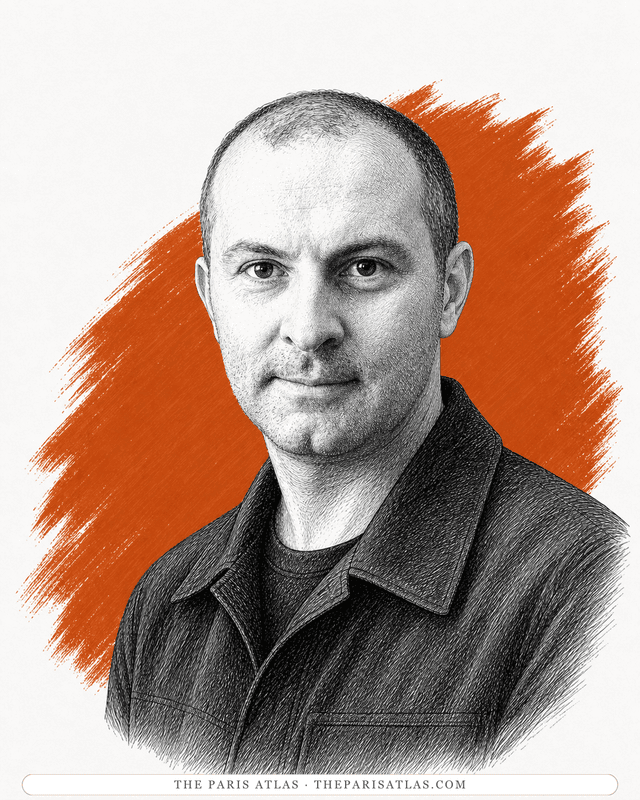
Arman
French-American artist, lifelong friend of Yves Klein, and a founder of New Realism.
View artist
Jean Arp
Strasbourg-born sculptor and poet — Hans in German, Jean in French, both all his life — who co-founded Dada at the Cabaret Voltaire in 1916, composed collages by dropping torn paper 'according to the laws of chance', and settled at Meudon outside Paris in a house his wife Sophie Taeuber-Arp designed.
View artist
References
The sources below include collection records, catalogues, scholarly research, and primary materials that informed this page. They document The Door, its making, and its place in cultural history.

1The Door (Helene Schjerfbeck, 1884) — Finnish National Gallery collection record
WebsiteFinnish National GalleryUsed forWeb source consulted for documented facts and historical context presented on the The Door page.
2Helene Schjerfbeck: An Artist's Life — screen PDF
BiographyFinnish National Gallery / Ateneum Art Museum, 2023Used forBiographical evidence used to verify chronology, relationships, and historical context connected to The Door.
3Helene Schjerfbeck's Portraiture
WebsiteThe Metropolitan Museum of Art, 2026Used forWeb source consulted for documented facts and historical context presented on the The Door page.
4Important Years — Helene Schjerfbeck Chronology
WebsiteHelene Schjerfbeck SocietyUsed forWeb source consulted for documented facts and historical context presented on the The Door page.
5The Convalescent and Under the Yoke Released into the Public Domain
WebsiteAteneum Art Museum, Finnish National GalleryUsed forWeb source consulted for documented facts and historical context presented on the The Door page.
6Le Christ jaune (The Yellow Christ), Paul Gauguin
WebsiteBuffalo AKG Art MuseumUsed forWeb source consulted for documented facts and historical context presented on the The Door page.
These references provide the documented foundation for this work's history and interpretation. Claim-level citations remain attached to the specific claims they support.
 Explore more resources