The Convalescent
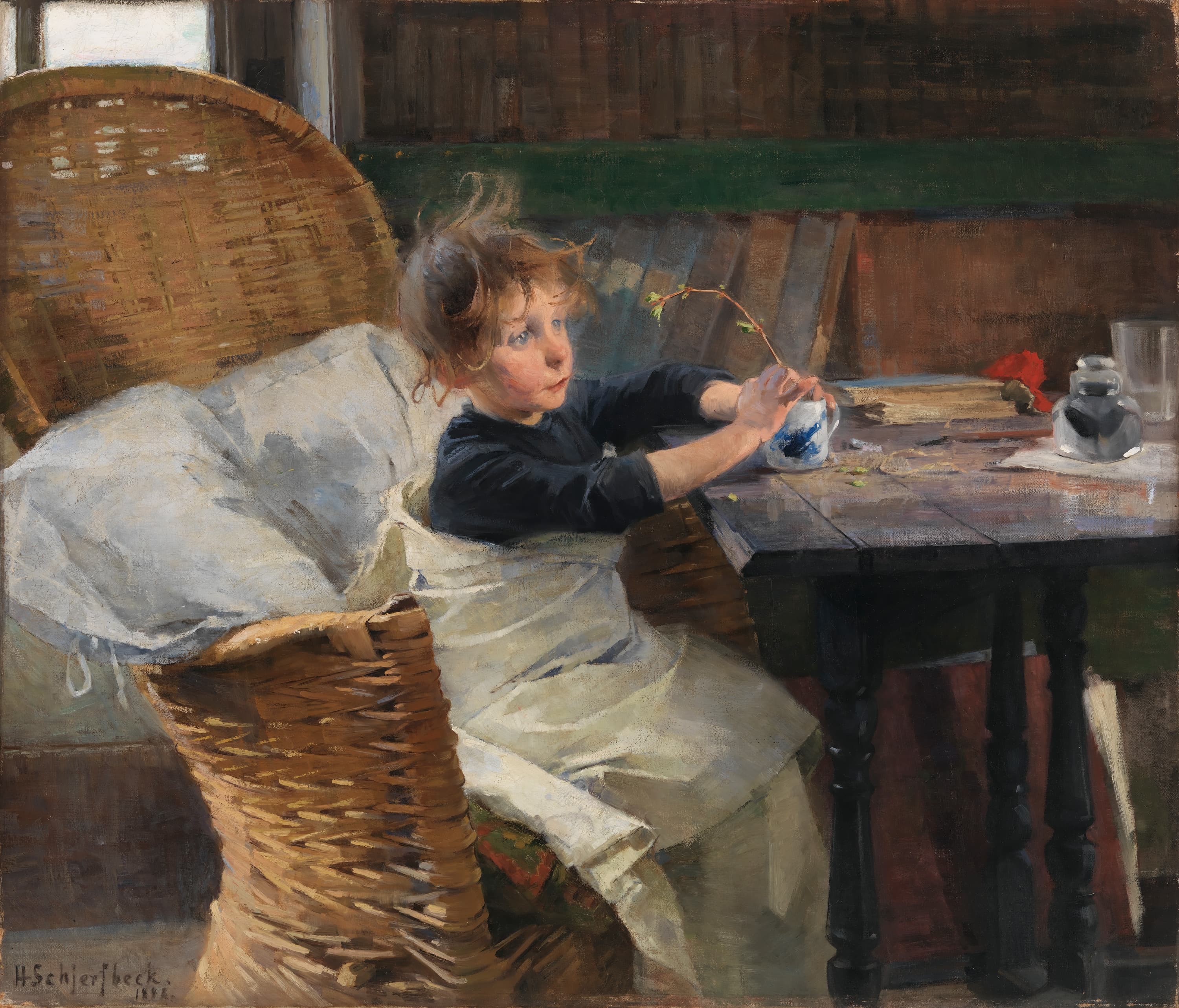
A small girl with tousled hair sits wrapped in a white blanket in a high-backed rattan chair, holding a twig with a few green buds in a cup on the table beside her. Helene Schjerfbeck painted it at St Ives in Cornwall in 1888 and sent it to the Paris Salon that spring under the title Première verdure, First Greenery. The Finnish Art Society bought it the same year, and it is at the Ateneum Art Museum in Helsinki.
- 1888
- Oil on canvas
- Ateneum Art Museum, Finnish National GalleryHelsinki, Finland
About Helene Schjerfbeck
What the painting shows
The girl sits sideways in a tall chair of woven cane, propped on a white pillow, with a white blanket over her lap and a dark blue top on her arms. Her hair stands up in tufts of brown and red-gold, her cheeks are flushed, and her mouth is slightly open. She is looking at the twig she holds upright in a small blue-and-white cup, its tip bent over with a few green buds and leaves.
The table in front of her is dark wood on turned legs. On it lie a bright red cloth, a worn brown book, a dark ink bottle on a sheet of white paper, a plain glass tumbler and a few loose green leaves. Behind her a brown wooden wall carries a green band and a shelf of leaning books or folders, and a window in the top left corner lets in pale light. Under the blanket a cushion patterned in red and green shows on the seat.
The canvas is 92 by 107 centimeters, about three feet by three and a half. Schjerfbeck signed it H Schjerfbeck and dated it 1888 in the lower left corner. The Finnish National Gallery's record lists the Ateneum as its current location.
St Ives, 1887 to 1888
Schjerfbeck went to St Ives, the fishing town in Cornwall, in 1887 at the urging of her friend Marianne Stokes. Stokes was the Austrian painter she had known in Paris as Marianne Preindlsberger, now married to the English painter Adrian Scott Stokes and settled in the town. Schjerfbeck stayed through the winter, and the town's children became her main subjects. Their fathers were at sea and their mothers busy in the fishing trade, so the children were easy to hire as models.
The Finnish National Gallery describes the sitter as a lively girl of about six whose exasperated teacher was only too glad to give her leave to sit for artists. Marja Lahelma's 2023 biography for the museum adds that the same child, in the same rattan chair, appears in Marianne Stokes's painting The Red Dress of 1888.
A sick child was a common subject in the 1880s. Lahelma sets Schjerfbeck's picture beside two Norwegian ones, Christian Krohg's Sick Girl, whose child holds a withering rose, and Edvard Munch's The Sick Child of 1885 to 1886. Where those children seem close to death, Schjerfbeck's holds a sprig with new leaves, and the museum's own text calls the painting a picture of recovery and the return of vitality.
The Salon of 1888 and the World's Fair of 1889
Schjerfbeck sent the painting to the Paris Salon of 1888, held at the Palais des Champs-Élysées, under the French title Première verdure, First Greenery. Lahelma quotes a critic in the Journal des Artistes of 15 July 1888 who called it a little gem and one of the most personal and captivating works at the Salon, and was surprised it had not won a medal.
In Finland the reception was cooler. The picture was shown at the Finnish Art Society's autumn exhibition in the Ateneum from 20 October to 2 December 1888, where reviewers praised the subject and the technique but found the painting too modern to follow. To conservative critics, Lahelma writes, its technical brilliance looked like a dangerous taste for art for its own sake.
The Finnish Art Society bought it anyway, in 1888, and the following year it went into the Finnish section of the Exposition Universelle in Paris. Lahelma records that it was counted among the works barely worth sending, and that it came back with a bronze medal. By 1894 it had been reproduced as A Convalescent in Finland in the Nineteenth Century, the illustrated English-language volume edited by Leo Mechelin and printed in Helsingfors.
Why the painting matters
It is the best-known painting of Schjerfbeck's early career. Lahelma opens her biography with it as a work etched into the nation's consciousness, and the Metropolitan Museum of Art's 2026 essay by Patricia G. Berman calls it the most ambitious picture she made at St Ives. Berman singles out the raised little finger with which the girl probes the twig and the cup.
The Finnish art historian Riitta Konttinen treats it as a transitional work, the point where Schjerfbeck begins to move away from the Naturalism of her twenties toward the more inward pictures of the 1890s. Lahelma is more cautious, finding the effect closer to allegory than mystery, but agrees that the girl's distracted, dishevelled presence has a psychological pull.
Where it is
The Ateneum Art Museum in Helsinki, part of the Finnish National Gallery, inventory number A I 223. The museum's online record gives the Ateneum as the painting's current location, which points to its being on view, but check before traveling to see it.
In February 2017 the Finnish National Gallery announced that it would release its images of The Convalescent and of Eero Järnefelt's Under the Yoke under the CC0 licence. The release was part of a policy of freeing the images of works whose copyright has expired. The photograph here is the museum's own, released on those terms, and can be copied and reused, including commercially, without permission.
The painting has traveled often since 1992, when it went to the Phillips Collection in Washington. It was in Hamburg, The Hague and Paris in 2007 and 2008, in Japan in 2015 and 2016, and at the Royal Academy of Arts in London in 2019. From December 2025 to April 2026 it hung in Seeing Silence at the Metropolitan Museum of Art in New York.
Close reading
Reading the work, detail by detail
The canvas is 92 by 107 centimeters, large for a picture of one child. Close views show the twig she is holding, the rattan chair that Marianne Stokes painted the same year, the objects on the table, and the signature and date in the corner.
1.The girl's face turned to the twig
The girl's hair sticks up in tufts of brown and red-gold, lit from the window behind her. Her eyes are blue-gray and her cheeks flushed, and her mouth is slightly open. She looks at the twig, not at the painter.
2.The twig in the cup
A thin twig rises from a small blue-and-white cup and bends over toward the girl, with a few green buds and leaves at its tip. She holds the cup with both hands and steadies the twig with her fingers. A few loose green leaves lie on the table beside it.
3.The rattan chair
The chair's back is a tall oval of woven cane, painted strand by strand in ochre and brown with white where the light strikes. A window fills the top corner with pale light. Marja Lahelma notes that the same chair appears in Marianne Stokes's The Red Dress, painted at St Ives the same year.
4.What is on the table
Beyond the cup the table carries a bright red cloth, a worn brown book, a dark glass ink bottle standing on a sheet of white paper, and a plain tumbler. They are painted quickly and read as a working table rather than a sickroom. The museum's keywords for the picture list the ink bottle, the pen and the bookcase behind.
5.The white blanket over the chair
The white blanket is painted in broad planes of gray-white with a few sharp creases. Where it lifts at the bottom, a cushion patterned in red and green shows on the seat. The woven front of the chair beside it is picked out strand by strand.
6.Signed and dated 1888
In the lower left corner Schjerfbeck signed in full, H Schjerfbeck, followed by a full stop, and put the date 1888 beneath. The letters sit on a warm brown ground where the floor meets the chair leg. This is the year the picture went to the Paris Salon.
Timeline
1887
Schjerfbeck arrives at St Ives in Cornwall at Marianne Stokes's invitation and stays through the winter.
1888
Paints The Convalescent and shows it at the Paris Salon as Première verdure. The Finnish Art Society buys it and shows it at the Ateneum in the autumn.
1889
Wins a bronze medal in the Finnish section of the Exposition Universelle in Paris.
1894
Reproduced as A Convalescent in Finland in the Nineteenth Century, edited by Leo Mechelin.
2017
The Finnish National Gallery releases its image of the painting under CC0 on 8 February.
2025–26
Shown in Seeing Silence: The Paintings of Helene Schjerfbeck at the Metropolitan Museum of Art, New York.
Where to see it
Ateneum Art Museum, Finnish National Gallery
Helsinki, Finland
A public viewing address has not yet been confirmed for this holding.
The museum's online record gives the Ateneum as the painting's current location; confirm it is on view before traveling.
Frequently asked questions
Where is Helene Schjerfbeck's The Convalescent?
The Ateneum Art Museum in Helsinki, part of the Finnish National Gallery, inventory number A I 223. The Finnish Art Society bought it in 1888, the year it was painted, and the museum's record gives the Ateneum as its current location.
Who is the girl in The Convalescent?
A child from St Ives in Cornwall, about six years old according to the Finnish National Gallery, whose teacher was glad to let her sit for artists. Her name is not recorded. The same girl, in the same rattan chair, appears in Marianne Stokes's painting The Red Dress of 1888.
What does the twig in The Convalescent mean?
It is a sprig with its first green buds, which is why Schjerfbeck showed the painting at the Paris Salon of 1888 as Première verdure, First Greenery. Marja Lahelma reads it as a sign of hope and sets it against the withering rose in Christian Krohg's Sick Girl. The museum describes the painting as being about recovery rather than illness.
How was The Convalescent received?
Well in Paris, where a critic in the Journal des Artistes called it a little gem, and coolly in Finland, where reviewers at the Ateneum's autumn exhibition of 1888 found it too modern. The Finnish Art Society bought it regardless, and it won a bronze medal at the Paris World's Fair of 1889.
How big is The Convalescent?
92 by 107 centimeters, roughly three feet by three and a half. It is oil on canvas, signed and dated 1888 at the lower left.
Can I reuse the image of The Convalescent?
Yes. Helene Schjerfbeck died in January 1946, so the painting is out of copyright, and in February 2017 the Finnish National Gallery released its photograph of it under CC0, which allows any use without permission.
More by Helene Schjerfbeck
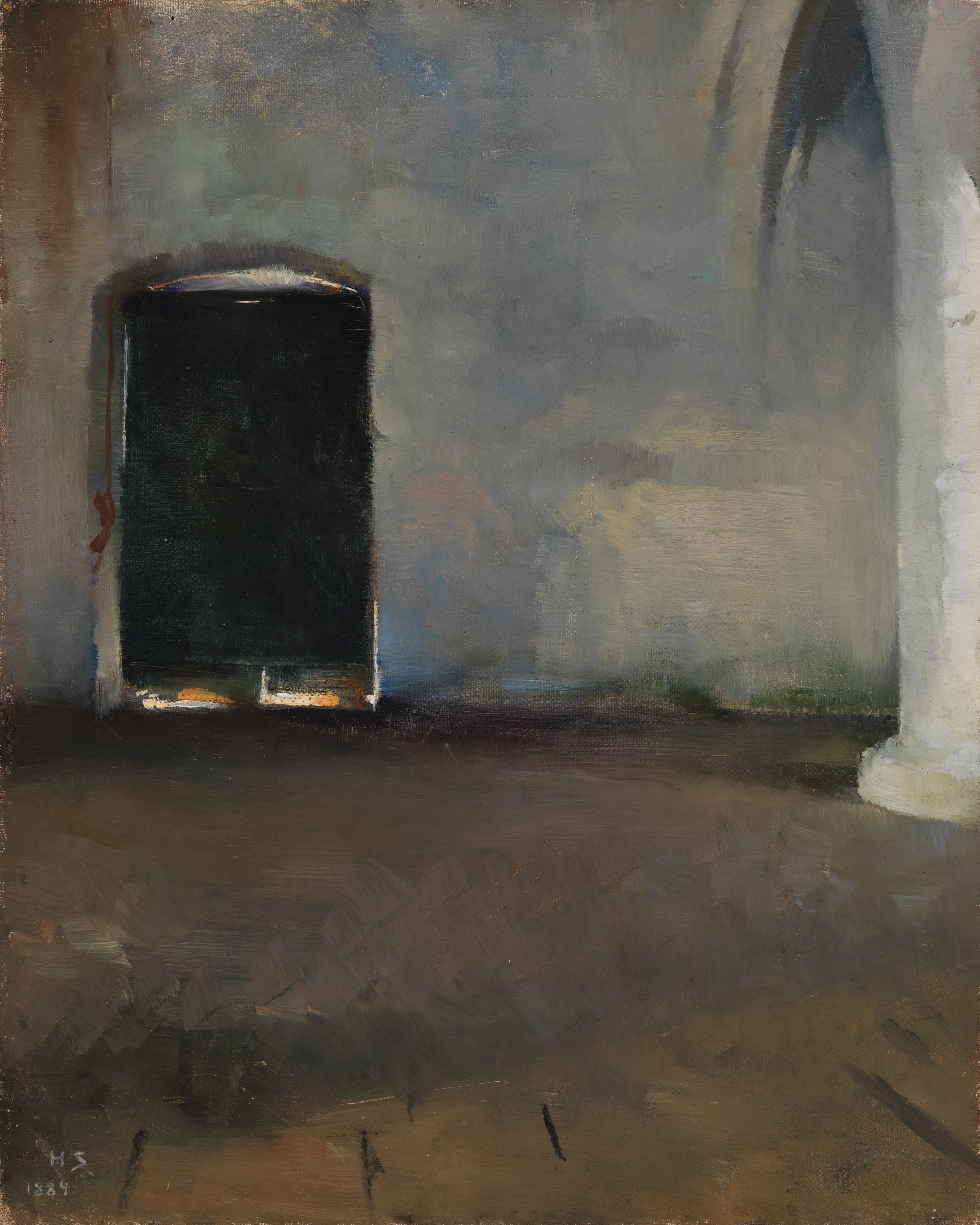
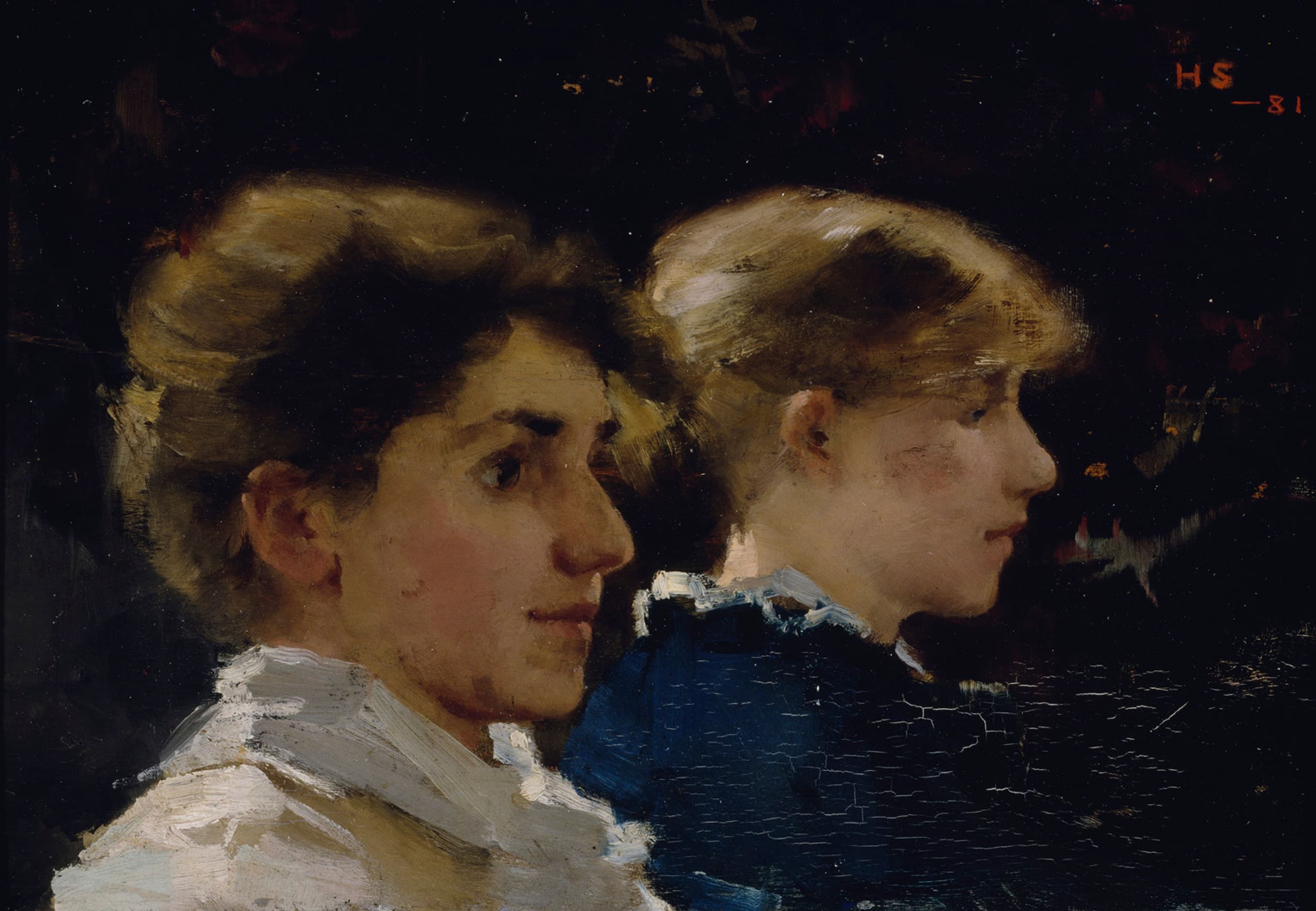
If you like Helene Schjerfbeck
Explore painters from the same movements and circles.
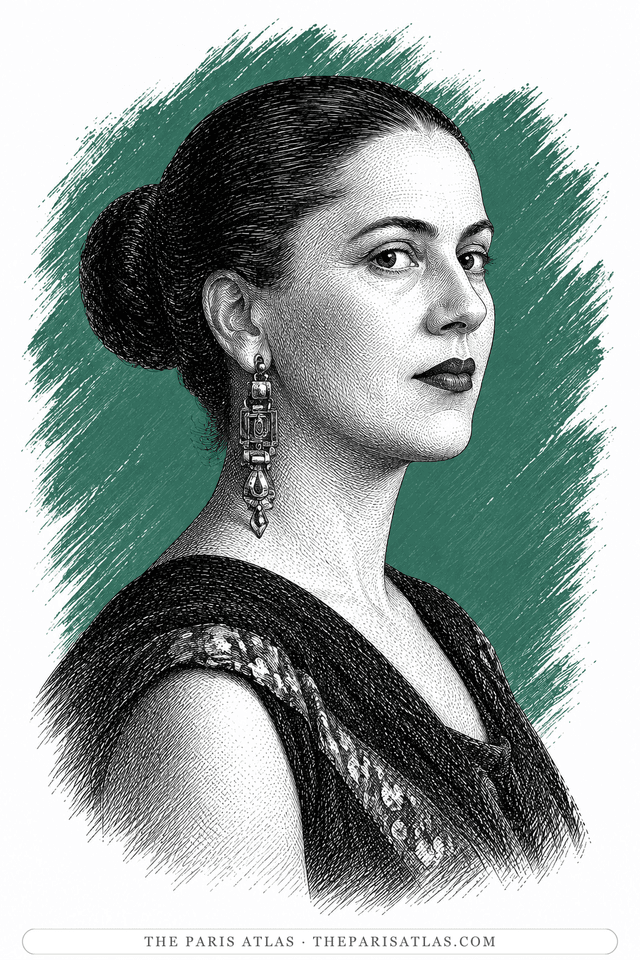
Tarsila do Amaral
Brazilian painter who spent the 1920s moving between São Paulo and Paris, studied Cubism under André Lhote, Albert Gleizes and Fernand Léger, and used what she learned to paint Brazilian towns, railways, plants and bodies. Her 1928 painting Abaporu prompted the manifesto that gave the Anthropophagic movement its name.
View artist
Arman
French-American artist, lifelong friend of Yves Klein, and a founder of New Realism.
View artist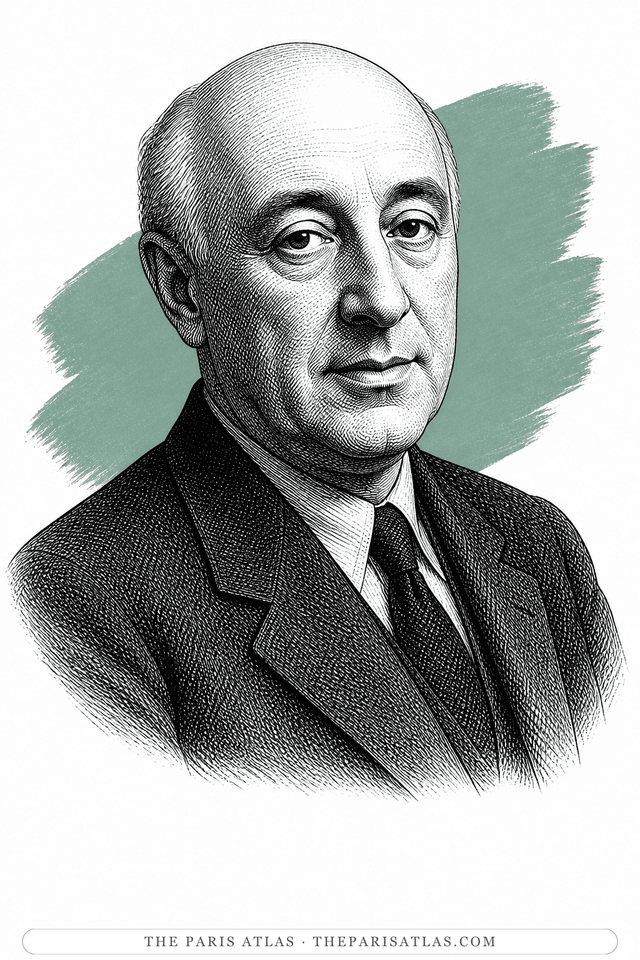
Jean Arp
Strasbourg-born sculptor and poet — Hans in German, Jean in French, both all his life — who co-founded Dada at the Cabaret Voltaire in 1916, composed collages by dropping torn paper 'according to the laws of chance', and settled at Meudon outside Paris in a house his wife Sophie Taeuber-Arp designed.
View artist
References
The sources below include collection records, catalogues, scholarly research, and primary materials that informed this page. They document The Convalescent, its making, and its place in cultural history.


1The Convalescent (Helene Schjerfbeck, 1888) — Finnish National Gallery collection record
WebsiteFinnish National GalleryUsed forWeb source consulted for documented facts and historical context presented on the The Convalescent page.
2Helene Schjerfbeck: An Artist's Life — screen PDF
BiographyFinnish National Gallery / Ateneum Art Museum, 2023Used forBiographical evidence used to verify chronology, relationships, and historical context connected to The Convalescent.
3Helene Schjerfbeck (1862–1946): The Convalescent / Toipilas / Konvalescenten — Finnish National Gallery on Flickr
WebsiteFinnish National GalleryUsed forWeb source consulted for documented facts and historical context presented on the The Convalescent page.
4The Convalescent and Under the Yoke Released into the Public Domain
WebsiteAteneum Art Museum, Finnish National GalleryUsed forWeb source consulted for documented facts and historical context presented on the The Convalescent page.
5Helene Schjerfbeck's Portraiture
WebsiteThe Metropolitan Museum of Art, 2026Used forWeb source consulted for documented facts and historical context presented on the The Convalescent page.
6Important Years — Helene Schjerfbeck Chronology
WebsiteHelene Schjerfbeck SocietyUsed forWeb source consulted for documented facts and historical context presented on the The Convalescent page.

7Finland in the Nineteenth Century, by Finnish Authors, Illustrated by Finnish Artists
NonfictionPrinted by F. Tilgmann, Helsingfors, 1894Used forPublished analysis and historical context used in preparing the The Convalescent page.
These references provide the documented foundation for this work's history and interpretation. Claim-level citations remain attached to the specific claims they support.
 Explore more resources