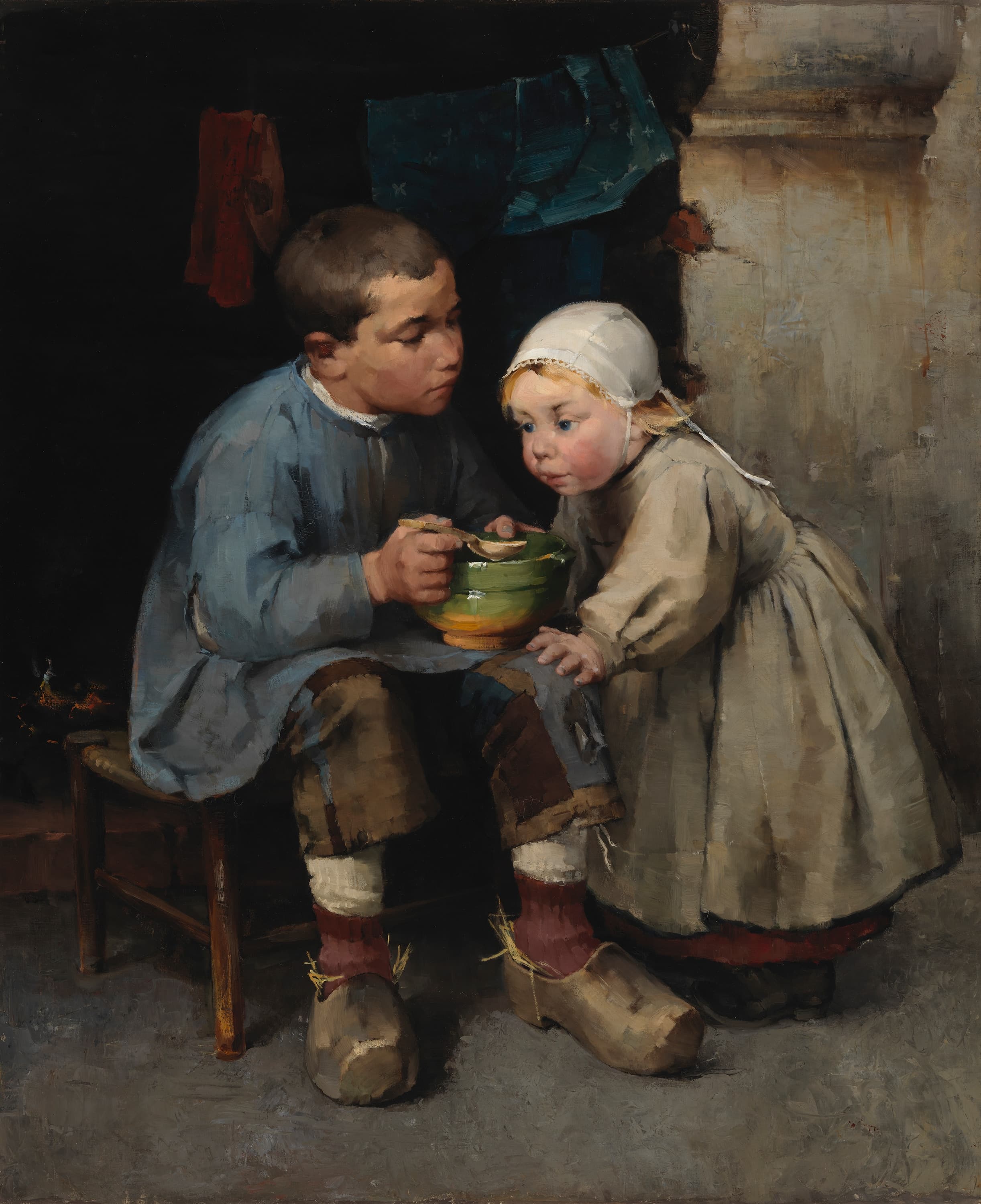
A Boy Feeding his Little Sister
A boy in a blue smock sits on a low stool and spoons food from a green bowl for a small girl in a white cap who leans against his knee. Helene Schjerfbeck painted the two children at Concarneau in Brittany in the summer of 1881, at nineteen, as her first large picture in the French Naturalist manner. It went to Helsinki that autumn, where critics called it ugly, and it is now at the Ateneum Art Museum.
- 1881
- Oil on canvas
- Ateneum Art Museum, Finnish National GalleryHelsinki, Finland
About Helene Schjerfbeck
What the painting shows
The boy sits on a low wooden stool with the bowl in his lap, a wooden spoon in his right hand and his eyes on what he is doing. He wears a pale blue smock over brown trousers patched at both knees, white cloth wound round his shins, dark red socks, and wooden clogs stuffed with straw that pokes out at the heels. The girl stands at his knee in a close white cap tied under her chin, a gray-beige dress with a red hem and dark shoes, her hands on his leg and her eyes on the spoon.
The bowl is glazed green with an orange-yellow foot. Behind the children the room is dark. A small fire glows at the far left, a red garment hangs on the wall above the boy's head, and a blue cloth printed with small white marks hangs from a line above them both. At the right a pale plastered wall with a molded top takes the light. The floor is gray, painted in broad strokes.
The canvas is 115 by 94.5 centimeters, about forty-five by thirty-seven inches, which makes the children close to life size. Marja Lahelma, in her 2023 biography for the Finnish National Gallery, describes the picture as painted with broad brushstrokes in a restricted palette of greenish-gray and brown.
Concarneau, summer 1881
Schjerfbeck arrived in Paris in late 1880, at eighteen, on a travel grant from the Finnish Senate, and moved to the Académie Colarossi in 1881. That summer she and the Austrian painter Marianne Preindlsberger, her closest friend at the academy, left for Concarneau, a fishing port on the south coast of Brittany, and stayed from July to September.
She had a commission to fill. Fredrik Cygnaeus, a professor and art collector in Helsinki, had asked her for a painting for his collection. Cygnaeus died in February 1881 and left the collection to the Finnish state, but its new curator, Berndt Otto Schauman, kept the offer open. Schauman wanted a Finnish subject. Schjerfbeck, in Brittany, could not imagine painting anything but Breton ones.
Lahelma writes that Schjerfbeck was struck by the men and women in traditional dress and wooden clogs, but chose to paint her models in everyday clothes rather than the costumes other visitors preferred. The two children here wear worn and patched things, and the boy's straw-stuffed clogs are the one emblem of Brittany in the picture.
Naturalism, and the reaction in Finland
The painting has the marks of the rustic Naturalism of Jules Bastien-Lepage, the French painter Schjerfbeck's generation admired, whose pictures of country children had startled Salon audiences with their plainness. Lahelma reads it as unidealized. She finds nothing picturesque or sentimental in its poverty, and something touching in the boy's care for his sister, with the size of the canvas giving the scene weight.
It was the first major painting in the French Naturalist style that Schjerfbeck sent home. In Finland it met harsh criticism and accusations of deliberate ugliness, a charge made against the other women who studied with her in Paris too. Schauman decided it was not suitable for the collection he managed and took a smaller, more conventional painting of a Breton girl instead.
Within a few years, Lahelma adds, the same unpolished way of painting country people was taken up by Akseli Gallen-Kallela and Eero Järnefelt, who folded it into a national style of Finnish art. Schjerfbeck met Bastien-Lepage himself on her second stay in Brittany, introduced by the American painter Alexander Harrison, and remembered him saying that her paintings had fine things alongside fierce things.
From the Art Society's exhibition to the Ateneum
The painting was shown in Helsinki in the autumn of 1881, at the Finnish Art Society's exhibition that opened on 13 October in the new public library building. The Finnish National Gallery's record dates its acquisition, as a donation, to the same year, and gives it the inventory number A I 222.
It was shown again at the Finnish Art Exhibition of 1885 in Helsinki and at the Artists' Guild exhibition in Turku in 1888. Since then it has traveled to Moscow in 1979 and to the Musée de Pont-Aven in 1990. In 2007 and 2008 it went to Hamburg, The Hague and Paris, and then to the National Gallery of Ireland in Dublin. It toured four museums in Japan in 2015 and 2016, and it hung in the Ateneum's own Schjerfbeck exhibition in 2019 to 2020.
Where it is
The Ateneum Art Museum in Helsinki, part of the Finnish National Gallery, inventory number A I 222. The museum's online record does not say whether the painting is currently on view, so check before traveling to see it.
The Finnish National Gallery releases its photographs of works whose copyright has expired under the CC0 licence, and its record for this painting carries the museum's photograph on those terms. The image can be copied and reused, including commercially, without permission.
Close reading
Reading the work, detail by detail
The canvas is 115 by 94.5 centimeters, so the children are close to life size. Close views show the two faces, the bowl and spoon, the straw in the clogs, the patches on the trousers, the printed cloth on the line, and the fire at the edge of the room.
1.One face looking down, one looking up
The boy's face is tanned and finished smoothly, his eyes lowered on the bowl and his cropped brown hair painted in flat strokes. The girl's is rounder and pinker, with blue eyes fixed on the spoon and blonde hair escaping a close white cap edged with lace. Neither child looks out of the picture.
2.The green bowl and the wooden spoon
The bowl is glazed green over an orange-yellow foot, with a pale rim where the light catches it. The boy holds it in his lap and lifts a wooden spoon from it with his right hand. The girl's two hands rest on his knee below, painted with the same care as the faces.
3.Clogs stuffed with straw
The boy's clogs are pale wood, and yellow straw pokes out of both at the heel, above dark red socks and white cloth wound round the shins. Marja Lahelma points to the straw-stuffed clogs as the one emblem of Brittany Schjerfbeck allowed into the picture. A leg of the stool stands at the left.
4.Patches on both knees
Both knees of the trousers carry large patches in a lighter brown, sewn on with the seams showing. Above them the blue smock ends in a rough edge. Lahelma describes the children's clothes as worn and patched, and the picture as neither picturesque nor sentimental about it.
5.A printed cloth on the line
A dark blue cloth printed with small white crosses hangs from a line across the top of the canvas, folded over itself. It is painted with a few dragged strokes over the black of the room. To its left a red garment hangs on the wall.
6.A fire at the edge, and the stool
At the far left a few flecks of orange and red mark a fire burning low in the dark. Below it the boy's stool, plain wood with turned legs and a flat seat, comes forward into the light. The boy's blue smock falls over its edge.
Timeline
1880
Schjerfbeck arrives in Paris in late November on a Finnish Senate travel grant.
1881
Spends July to September at Concarneau with Marianne Preindlsberger and paints the picture there.
1881
Shown at the Finnish Art Society's exhibition in Helsinki from 13 October and acquired for the Society's collection as a donation. Inventory number A I 222.
1885
Shown at the Finnish Art Exhibition in Helsinki.
1888
Shown at the Artists' Guild exhibition in Turku.
2019
Shown in Through My Travels I Found Myself at the Ateneum, Helsinki.
Where to see it
Ateneum Art Museum, Finnish National Gallery
Helsinki, Finland
A public viewing address has not yet been confirmed for this holding.
The museum's online record does not state whether the painting is currently on view.
Frequently asked questions
Where is Helene Schjerfbeck's A Boy Feeding his Little Sister?
The Ateneum Art Museum in Helsinki, part of the Finnish National Gallery, inventory number A I 222. The museum's record dates its acquisition to 1881, the year it was painted, as a donation. The online record does not say whether it is currently on view.
Where was A Boy Feeding his Little Sister painted?
At Concarneau, a fishing port in Brittany, where Schjerfbeck spent July to September 1881 with her friend Marianne Preindlsberger. It was her first summer in Brittany and her first large painting in the French Naturalist manner. She was nineteen.
Who are the children in the painting?
Two Breton children from Concarneau whose names are not recorded. Marja Lahelma's 2023 biography notes that Schjerfbeck painted her models in their everyday clothes, worn and patched, rather than in the regional costume other visiting painters favored. The boy's straw-stuffed wooden clogs are the only Breton emblem in the picture.
How was A Boy Feeding his Little Sister received?
Badly, in Finland. Lahelma records harsh criticism and accusations of deliberate ugliness when it was shown in Helsinki in 1881. It had been meant for the collection of Fredrik Cygnaeus, but its curator Berndt Otto Schauman judged it unsuitable and chose a smaller, more conventional Breton picture instead.
How big is A Boy Feeding his Little Sister?
115 by 94.5 centimeters, about forty-five by thirty-seven inches. It is oil on canvas.
Can I reuse the image of this painting?
Yes. Helene Schjerfbeck died in January 1946, so the painting is out of copyright, and the Finnish National Gallery releases its photograph of it under CC0, which allows any use without permission.
More by Helene Schjerfbeck
If you like Helene Schjerfbeck
Explore painters from the same movements and circles.
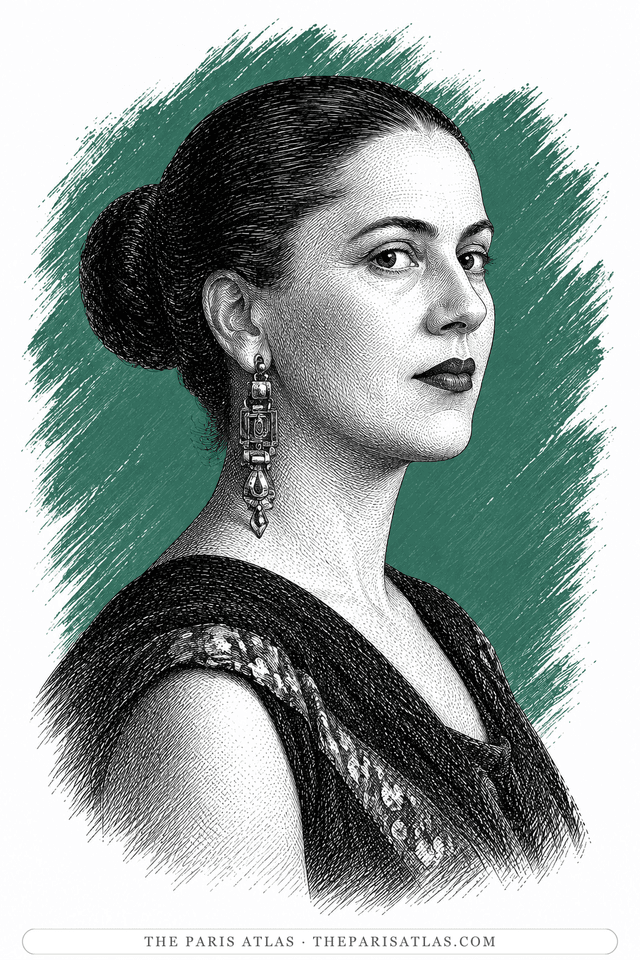
Tarsila do Amaral
Brazilian painter who spent the 1920s moving between São Paulo and Paris, studied Cubism under André Lhote, Albert Gleizes and Fernand Léger, and used what she learned to paint Brazilian towns, railways, plants and bodies. Her 1928 painting Abaporu prompted the manifesto that gave the Anthropophagic movement its name.
View artist
Arman
French-American artist, lifelong friend of Yves Klein, and a founder of New Realism.
View artist
Jean Arp
Strasbourg-born sculptor and poet — Hans in German, Jean in French, both all his life — who co-founded Dada at the Cabaret Voltaire in 1916, composed collages by dropping torn paper 'according to the laws of chance', and settled at Meudon outside Paris in a house his wife Sophie Taeuber-Arp designed.
View artist
References
The sources below include collection records, catalogues, scholarly research, and primary materials that informed this page. They document A Boy Feeding his Little Sister, its making, and its place in cultural history.

1A Boy Feeding his Little Sister (Helene Schjerfbeck, 1881) — Finnish National Gallery collection record
WebsiteFinnish National GalleryUsed forWeb source consulted for documented facts and historical context presented on the A Boy Feeding his Little Sister page.
2Helene Schjerfbeck: An Artist's Life — screen PDF
BiographyFinnish National Gallery / Ateneum Art Museum, 2023Used forBiographical evidence used to verify chronology, relationships, and historical context connected to A Boy Feeding his Little Sister.
3Important Years — Helene Schjerfbeck Chronology
WebsiteHelene Schjerfbeck SocietyUsed forWeb source consulted for documented facts and historical context presented on the A Boy Feeding his Little Sister page.
4The Convalescent and Under the Yoke Released into the Public Domain
WebsiteAteneum Art Museum, Finnish National GalleryUsed forWeb source consulted for documented facts and historical context presented on the A Boy Feeding his Little Sister page.
These references provide the documented foundation for this work's history and interpretation. Claim-level citations remain attached to the specific claims they support.
 Explore more resources