The Paris AtlasCharting the artists, works, and places worth returning to.
  • Sculptor
· French · 1855–1933

François Pompon

French sculptor whose Polar Bear, shown as a life-size plaster in 1922, made his name at sixty-seven after decades carving in other artists' studios.

Details

Lived
1855–1933
Born
1855-05-09
Birthplace
Saulieu, Burgundy, France
Died
1933-05-06
Place of death
Paris, France
Nationality
French
Roles
Sculptor

About François Pompon

Overview

François Pompon (9 May 1855–6 May 1933) was a French sculptor whose simplified representations of animals helped transform animal sculpture in the early twentieth century. Best known for Ours blanc (Polar Bear), he developed a distinctive approach based on flowing contours, compact volumes, and smooth surfaces, reducing anatomical detail without losing the characteristic movement or bearing of his subjects. His animals range from domestic hens and pigeons to panthers, deer, and hippopotamuses. Rather than presenting them as illustrations of stories or occasions for elaborate displays of fur, feathers, and musculature, he treated them as independent sculptural subjects.[1]

Pompon’s recognition came unusually late. For decades he earned his living carving for more celebrated sculptors, including Auguste Rodin and Camille Claudel, while developing his own work in limited time and often difficult circumstances. He was sixty-seven when the monumental plaster version of Polar Bear attracted widespread attention at the Salon d’Automne in 1922. His subsequent reputation can obscure the long formation behind that apparent breakthrough: the celebrated animal sculptor had previously worked as a funerary stonecutter, architectural ornament maker, portraitist, and highly respected studio assistant.[2]

Connection to Paris

Although born in Burgundy, François Pompon spent most of his working life in Paris, where he moved in 1875 and continued his artistic training before working for sculptors including Auguste Rodin and Camille Claudel.[2][3] His home and studio on the rue Campagne-Première in Montparnasse provided a base for his independent work. The menagerie at the Jardin des Plantes became an important place of observation, allowing him to study the postures and movements of living animals.[4][5] Paris was also the setting for his decisive breakthrough: at the Salon d’Automne in 1922, his monumental plaster Ours blanc (Polar Bear) brought him widespread recognition at the age of sixty-seven.[6] The stone version was presented at the Musée du Luxembourg in 1929 and later entered the Musée d’Orsay collection, while his Hippopotame, developed from observations at the Jardin des Plantes, was preserved by the Muséum national d’Histoire naturelle. These connections link the places where he studied and sculpted animals with the Parisian institutions that exhibited and preserved his work.[7][8]

Birth, Family, and Early Training in Burgundy

Pompon was born in Saulieu, a town in Burgundy, on 9 May 1855. He had a twin brother, Hector, and grew up in a family supported by skilled manual work: his father was a carpenter and cabinetmaker, and his mother was a seamstress. His introduction to making objects came through his father’s trade, before formal artistic education became possible. This practical background preceded an entire career in which craftsmanship and artistic invention remained closely connected. Long before he became known for simplifying animal bodies into apparently effortless forms, he had learned the demands of working resistant materials with precision.[3]

In 1870, at about fifteen, Pompon went to Dijon, where he worked for a maker of funerary monuments while attending evening classes at the École des Beaux-Arts. His studies included architecture, engraving, and sculpture; among his teachers were Célestin Nanteuil and François Dameron. Employment supplied his livelihood, while classes offered the possibility of becoming more than a commercial stoneworker. His ability received early acknowledgment when he won a municipal sculpture prize in 1874. The arrangement of paid work by day and personal artistic development outside working hours anticipated the pattern that would govern much of his adult life.[3]

An early indication of his interest in animals survives in Lucane (Stag Beetle), dated 1874. The subject is particularly striking in retrospect: one of the earliest works associated with a sculptor later celebrated for monumental mammals was a small insect. Nevertheless, his development was not a straightforward progression from childhood animal studies to the mature Polar Bear. Human figures and portraits would occupy him extensively before animals became the principal focus of his independent sculpture.[9]

Paris, Marriage, and the Beginnings of an Independent Career

Pompon moved to Paris in 1875. He continued supporting himself through stoneworking and pursued further evening instruction at the school commonly known as the Petite École, subsequently associated with the École nationale des arts décoratifs. His teachers included Aimé Millet and the animal sculptor Pierre Louis Rouillard. Rouillard was especially important to his future development because he introduced him to the menagerie at the Jardin des Plantes, where living animals could be studied repeatedly rather than reconstructed from illustrations or conventional artistic formulas.[3]

He first exhibited at the Salon in 1879, although the work that brought his early figurative ambitions more substantial notice was Cosette, presented in 1888. Inspired by the child heroine of Victor Hugo’s Les Misérables, the sculpture belongs to a very different artistic world from the quiet, simplified animals of his maturity. Its literary subject and emotional associations connected it to nineteenth-century sculpture concerned with suffering, sympathy, and recognizable narrative. Pompon did not begin as an opponent of that tradition; he worked within it before gradually finding another direction.[3]

In 1882 he married Berthe, a seamstress. The couple had no children. Their life became associated with the rue Campagne-Première in Montparnasse, where Pompon maintained the home and studio that would remain central to his career. The working environment was durable rather than glamorous: even after success, the studio retained its importance as the place where models, tools, and years of accumulated experiments surrounded him. Photographs taken after his death later provided the basis for reconstructions of this space.[4]

Portraits and the Human Figure

The predominance of animals in Pompon’s later reputation can make his earlier figurative work seem incidental, but it was a substantial part of his formation. He portrayed members of his family and people in his immediate surroundings, producing works whose significance depended on personal identity rather than zoological type. These sculptures demonstrate that his eventual concentration on animals was a choice made by an experienced figure sculptor, not a specialization adopted because he lacked other training.[5]

One particularly intimate example is Maman, dated by the Musée d’Orsay to between 1892 and 1900. The small plaster represents his mother, Claudine Blandin, kneeling at a prayer desk. Its domestic title and private devotional subject offer a different view of an artist usually encountered through bears and birds. The work also preserves the importance of family memory within his sculpture: alongside professional commissions and exhibition pieces, he made images of people whose significance came from his own life.[10]

Working for Rodin, Claudel, and Other Sculptors

Pompon’s professional life depended for many years on employment as a praticien: a skilled sculptor who translated another artist’s models into finished material, particularly marble. This was demanding interpretive work, requiring a command of proportion, surfaces, and the relationship between a model and its enlarged realization. His employers included Jean Dampt, Antonin Mercié, Alexandre Falguière, Rodin, Claudel, and René de Saint-Marceaux. His position illustrates an important distinction in sculpture between the artist credited with a conception and the specialists whose technical expertise helped bring it into physical existence.[2]

He entered Rodin’s studio in 1890 and became its chief assistant in 1893. The appointment indicates the confidence placed in his abilities, but it also helps explain why his own reputation developed slowly. Pompon was already an accomplished professional when much of his labor remained attached to another sculptor’s name. He also carved for Camille Claudel, placing him within one of the most significant and productive artistic circles of the period. His later independence therefore emerged from close involvement with contemporary sculpture, rather than from isolation from it.[6]

By the mid-1890s, Pompon had begun the long association with René de Saint-Marceaux that continued until the First World War. This relationship also helped bring him into contact with the Normandy countryside. Time spent around Cuy-Saint-Fiacre provided opportunities to observe farm animals, complementing the exotic species available in Paris. Cattle and poultry were not secondary subjects awaiting replacement by more impressive creatures; they became important participants in his investigation of posture, balance, and movement.[11]

The Turn Toward Animal Sculpture

During the opening years of the twentieth century, Pompon increasingly concentrated on animals and on the simplification of sculptural form. Around 1905, this approach became decisive. He reduced distracting surface information, smoothed transitions between parts of the body, and sought a more concentrated relationship between the animal’s overall shape and its characteristic movement. The change was both a choice of subject and a reconsideration of what a sculpture needed to communicate.[9]

The transition was gradual rather than absolute. In 1912 he returned to the human figure with L’Été (Summer), a work associated with the quieter, more classically oriented ambitions of the circle known as the Bande à Schnegg. This group included sculptors seeking greater serenity and structural clarity after the expressive intensity associated with Rodin. Pompon’s mature animals developed within this wider rethinking of sculpture, even though his preferred subjects distinguished him from colleagues primarily concerned with the human body.[3]

Artistic Influences: Egypt, Japan, and Modern Sculpture

Ancient Egyptian art was an important point of reference. Pompon admired its treatment of animals and its ability to establish a powerful presence through controlled silhouettes and simplified forms. Japanese and other East Asian art also contributed to his interest in economy of expression. These influences did not lead him to abandon observation of living creatures. Instead, they offered precedents for making an image recognizable and convincing without reproducing every visible detail.[9]

A modest surviving drawing makes this interest unusually tangible. The Musée d’Orsay catalogues a sheet titled Motifs égyptiens (Egyptian Motifs), drawn in graphite on the back of an envelope. The other side carries a bird sketch and an address to Pompon. The conjunction is revealing: the study of historical art and the observation of animals occupied the same small, ordinary working surface. His sources were not confined to formal academic exercises or grand statements of artistic allegiance; they also entered the improvised materials of everyday studio practice.[12]

Pompon’s simplified forms invite comparison with Aristide Maillol and Constantin Brancusi, but his work remained distinctly figurative. He generally preserved an animal’s recognizable anatomy and bearing rather than converting it into geometric construction. The Musée d’Orsay places him within a modern classical tradition that offered an alternative to Cubist fragmentation. His modernity lay in concentrating form, not in dismantling the subject into separate planes.[7]

Working Methods: Observation, Modeling, and Reduction

Pompon developed a practical means of working directly from animals: a portable modeling bench that allowed him to make clay studies outdoors. He observed domestic creatures in the countryside and visited the Jardin des Plantes for wild and exotic species. The animal did not have to remain motionless for him to find a subject. Walking, turning, standing, or shifting weight supplied information that a fixed anatomical specimen could not provide. He then continued revising the studies in his studio.[5]

Surviving models show how small these investigations could be. A plaster sketch of a hen, dated 1912 and preserved in the Musée d’Orsay’s collection, measures only 6.2 centimeters in height. Such objects help explain the distance between an initial observation and a finished exhibition sculpture. A study could record a compact pose or bodily relationship without resolving every surface; further versions could then test the same subject at different scales and degrees of finish. The apparent simplicity of the mature work depended on this sustained process of experiment.[13]

His practice also involved different materials and collaborators. Plaster preserved models, stone provided a pale and continuous surface, and bronze introduced the effects of casting and patination. The Valsuani foundry produced bronze versions of his animals using the lost-wax process. An Ours blanc catalogued by the Musée d’Orsay as 1927, for example, is a small black-patinated bronze rather than a white stone monument. Its existence is a useful reminder that Polar Bear names a sculptural conception developed through multiple objects, not just the single large version familiar from museum photographs.[14]

War, Bereavement, and Early Recognition

The First World War intensified Pompon’s financial difficulties. Saint-Marceaux died in 1915, removing an important source of professional support, while Berthe’s paralysis restricted the couple’s life. In 1916 Pompon took employment at the Paris department store La Samaritaine. His ability as a sculptor had not yet produced lasting financial security, and practical necessities continued to interrupt his independent work. Berthe died in 1921, before his greatest public success.[4]

Recognition nevertheless began to gather before the celebrated exhibition of 1922. The dealer and founder Adrien Hébrard supported his work, and Pompon had a solo exhibition at Hébrard’s gallery in 1919. Collectors including Jacques Zoubaloff also became interested. That same year, the acquisition of his stone Tourterelle (Turtledove) brought a small animal sculpture into the French national collections. These developments complicate the familiar story of an entirely unknown artist suddenly discovered at sixty-seven: the breakthrough was dramatic, but it followed a period of growing support.[15]

*Polar Bear* and the Breakthrough of 1922

Friends and supporters encouraged Pompon to enlarge his work. Among them were the painter René Demeurisse, the critic Robert Rey, and the sculptor Antoine Bourdelle. Their advice mattered because much of his previous animal sculpture had been modest in size. Enlargement gave his simplified forms a different authority, allowing them to command a public exhibition space rather than remain objects examined at close range. The life-size plaster Ours blanc shown at the Salon d’Automne in 1922 established his reputation.[5]

The sculpture’s effect depends on the relationship between mass and movement. The bear advances on substantial legs, its head carried forward and its body organized into broad, continuous forms. Details of fur and claws do not interrupt the surface. Yet the animal does not become inert: the placement of the limbs and the changing contours of the body suggest the transfer of weight through a walking stride. The work is neither an anatomical demonstration nor a theatrical encounter with a threatening beast. Its subject is the animal’s physical presence.[6]

The famous stone version now at the Musée d’Orsay followed several years later. A state commission was secured in 1927 with help from the journalist Louise Weiss, who approached Édouard Herriot; David Weill supplied the stone. Pompon’s assistant Jean-Joachim Supéry executed the carving at Malakoff, and the sculpture was delivered on 16 February 1929. Measuring 163 centimeters high and 251 centimeters long, it was presented at the Musée du Luxembourg that month. The former assistant who had spent years realizing other sculptors’ models was now employing a specialist to realize his own.[7]

Fame, Friendships, and the Final Decade

Success brought commissions, exhibitions, and a wider audience. The writer Colette admired Polar Bear, responding particularly to its unusual proportions and the character of its head and paws. Pompon’s reputation expanded without a corresponding abandonment of his working habits. The museum in Saulieu records his advice after success: “shut yourself in your studio and work.” His late career remained productive rather than becoming simply a period of repeating the sculpture that had made him famous.[5]

He also participated in the collective promotion of animal art. He founded the Salon des animaliers contemporains in 1927 and, in the early 1930s, helped establish Les Douze, an association that included Jane Poupelet, Paul Jouve, and Georges Guyot. His friendships and professional affiliations placed him within a developing community rather than the isolated category of an eccentric sculptor of animals. Joseph Bernard was another close friend, sharing the broader search for clarity and concentrated form that characterized several sculptors working beyond Rodin’s example.[6]

Important Works Beyond *Polar Bear*

*Pintade* — *Guinea Fowl*

Developed around 1910–1912, Pintade demonstrates the importance of birds to Pompon’s mature sculpture. The large body, relatively small head, and slender supporting legs create a structure in which contrasting proportions become more important than an exhaustive description of plumage. The bronze catalogued by the Musée d’Orsay retains selected details, including indications of wings and feet, while establishing the body as a broad, coherent volume. It shows that simplification was not necessarily the removal of every descriptive feature, but the deliberate selection of those that contributed to the whole.[16]

*Tourterelle* — *Turtledove*

The stone Tourterelle acquired in 1919 represents the quieter end of Pompon’s range. At approximately twenty-three centimeters high, it achieves its effect on a domestic rather than monumental scale. Its pale lithographic stone and compact proportions make it an instructive companion to the later large bear: the preference for a unified body and restrained surface did not depend on enormous dimensions. Its early acquisition also gives it an important place in the history of his recognition, preceding the event through which his career is usually remembered.[17]

Cattle: *Fleur d’Amour* and *Taureau*

Pompon continued to find subjects among familiar farm animals after his success with exotic species. Vache “Fleur d’Amour”, represented by a plaster dated 1927 in the Musée d’Orsay’s collection, belongs to this continuing interest in cattle. The affectionate title gives the work a specificity that distinguishes it from a purely generic study of bovine anatomy. Near the end of his life, a commission for the City of Paris produced Taureau (Bull), one of his final major works. A posthumous replica in Saulieu further connected this late achievement with his birthplace.[18]

*Grand Cerf* — *Large Stag*

Grand Cerf, developed in the late 1920s, offers a different structural problem from the compact bear or guinea fowl. The legs, upright neck, and branching antlers create an extended silhouette in which open space becomes important. Pompon preserves the animal’s alert bearing while simplifying the surfaces of its body. The Musée d’Orsay holds a plaster dated 1929, while bronze versions realize the composition on a monumental scale. In these larger casts, the antlers extend the sculpture upward without overwhelming the comparatively restrained treatment of the body.[19]

*Grande Panthère Noire* — *Large Black Panther*

The Large Black Panther, represented in the Gunma Museum of Art’s collection by a bronze dated 1930–1931, emphasizes horizontal movement. Its low, forward-reaching head, elongated torso, and trailing tail contrast with the upright structure of the stag. The dark surface binds the animal into a continuous moving body, while the placement of its paws gives the stride a measured rhythm. Compared with the bear’s weighty progress, the panther presents a more compressed and supple movement. The comparison shows how Pompon adjusted his formal vocabulary to different animals rather than imposing a single bodily formula on every subject.[11]

*Hippopotame* — *Hippopotamus*

The monumental plaster Hippopotame, dated 1931 and preserved by the Muséum national d’Histoire naturelle, grew from Pompon’s observations of an animal in the Jardin des Plantes menagerie. He worked from drawings through clay models and successive revisions. At 2.75 meters long, the final plaster makes the animal’s breadth and weight unavoidable, but its widely opened mouth also introduces an immediately recognizable behavior: it appears to be yawning. Rather than needing a detailed narrative, the sculpture derives character from this familiar action. It is among the clearest demonstrations of Pompon’s ability to unite simplified form with a specific observation of animal life.[8]

Death and Burial

Pompon died in Paris on 6 May 1933, aged seventy-seven, three days before his seventy-eighth birthday. Biographical accounts describe his death as following prostate surgery at the Saint-Jean-de-Dieu clinic in the rue Oudinot. He had outlived Berthe and left no children. His death brought to an end a little more than a decade of widespread recognition following a much longer period of professional labor and private artistic development.[1][4]

He was buried in Saulieu on 10 May. His grave, shared with Berthe near the church of Saint-Saturnin, is marked by his bronze Condor. The bird gives the burial place a direct connection to the work through which he became known. The return to Saulieu closes the geographical course of a life spent largely between his Burgundian origins, Parisian studios, and periods of observation in the countryside.[4]

The Bequest and the Preservation of His Studio

Pompon made arrangements for his work to pass to the French state in a will dated 5 June 1929. The bequest was formally accepted after his death in 1933. The Muséum national d’Histoire naturelle was selected to receive the collection, but the amount of material exceeded the available exhibition space, and works were distributed among several museums. This was not a simple lifetime donation of his entire studio to Dijon: the institutional history involved a posthumous bequest, subsequent allocations, and later transfers.[10]

Between 1934 and 1939, the Muséum maintained a Pompon display in its botanical gallery that included a reconstruction of the rue Campagne-Première studio. The large Hippopotamus occupied a prominent position within it. Studio material was subsequently transferred to Dijon in 1948, while Saulieu maintained its own museum devoted in substantial part to the sculptor. These collections preserved models and intermediate states as well as finished works, making it possible to study the development behind his polished surfaces.[8]

His studio also acquired an international afterlife. The Gunma Museum of Art in Tatebayashi, Japan, holds sculptures and archival material associated with Pompon and has reconstructed his working environment using photographs, original furnishings and equipment, and other supporting objects. Letters, tools, molds, notebooks, and photographs extend the record beyond the finished animals. They preserve the practical circumstances of an artist whose public image might otherwise be reduced to the apparent ease of a handful of famous forms.[20]

Legacy and Place in Art History

Pompon helped establish that animal sculpture could participate in the central formal questions of modern art rather than remain primarily a descriptive or decorative specialty. His subjects remained accessible and recognizable, but their construction involved decisions about proportion, rhythm, weight, and surface comparable to those pursued by sculptors of the human figure. His achievement was not the invention of animal sculpture, but a substantial change in how an animal could be represented and what that representation could demand from the viewer.[21]

The popularity of his bronzes has also made the distinction between lifetime and posthumous production important. The Gunma Museum documents that Pompon expressed opposition to casting after his death, although posthumous casts were subsequently produced, including some authorized by the French state. Consequently, the date of a model, the date of a particular cast, and the circumstances of its manufacture are separate parts of a work’s history. A bronze carrying Pompon’s name is not necessarily an object whose production he personally supervised.[21]

The retrospective François Pompon (1855–1933), le retour du lisse, presented at the Musée d’Orsay in 1994–1995, placed renewed emphasis on his broader development. Its title—“the return of the smooth”—identified a central feature of his achievement, but smoothness alone does not explain the work. The surfaces matter because they bring attention to the relationship between the parts of a living body. Pompon’s finest sculptures remain persuasive not simply because detail has disappeared, but because posture, movement, and the particular character of an animal survive that reduction.[9]

Life events

  1. 1855

    Born at Saulieu. Born on 9 May in Saulieu, Burgundy, with a twin brother, Hector. His father was a carpenter and cabinetmaker, his mother a seamstress.

  2. 1870

    Dijon, and evening classes. At about fifteen he goes to Dijon to work for a maker of funerary monuments, attending the École des Beaux-Arts in the evenings. He wins a municipal sculpture prize in 1874.

  3. 1875

    Moves to Paris. Continues stoneworking by day and studies at the Petite École by night. His teacher Pierre Louis Rouillard introduces him to the menagerie at the Jardin des Plantes.

  4. 1888

    Cosette. His sculpture of Victor Hugo's child heroine brings his early figurative work its first substantial notice.

  5. 1890

    Enters Rodin's studio. Becomes its chief assistant in 1893. He also carves for Camille Claudel, Antonin Mercié, Alexandre Falguière and René de Saint-Marceaux.

  6. 1905

    The turn to simplified form. He begins concentrating on animals and on smoothing transitions between the parts of a body, seeking the relationship between overall shape and characteristic movement.

  7. 1916

    La Samaritaine. With Saint-Marceaux dead and Berthe paralysed, he takes employment at the Paris department store. Berthe dies in 1921, before his success.

  8. 1919

    First signs of recognition. A solo exhibition at Adrien Hébrard's gallery, and the acquisition of his stone Tourterelle for the French national collections.

  9. 1922

    The Polar Bear at the Salon d'Automne. The life-size plaster Ours blanc establishes his reputation. He is sixty-seven.

  10. 1927

    The state commission. A commission for a stone version is secured with help from the journalist Louise Weiss. He founds the Salon des animaliers contemporains the same year.

  11. 1929

    The stone bear delivered. Carved at Malakoff by his assistant Jean-Joachim Supéry, delivered on 16 February and shown at the Musée du Luxembourg. He signs his will on 5 June, leaving his work to the French state.

  12. 1933

    Death in Paris. Dies on 6 May, three days before his seventy-eighth birthday, after prostate surgery. Buried at Saulieu on 10 May beside Berthe, under his bronze Condor.

  13. 1994

    Le retour du lisse. The Musée d'Orsay retrospective reassesses his whole development rather than the bear alone.

Selected works

Cataloged from the holding institutions' records. Reproductions appear only where the rights are verified.

Sculptures

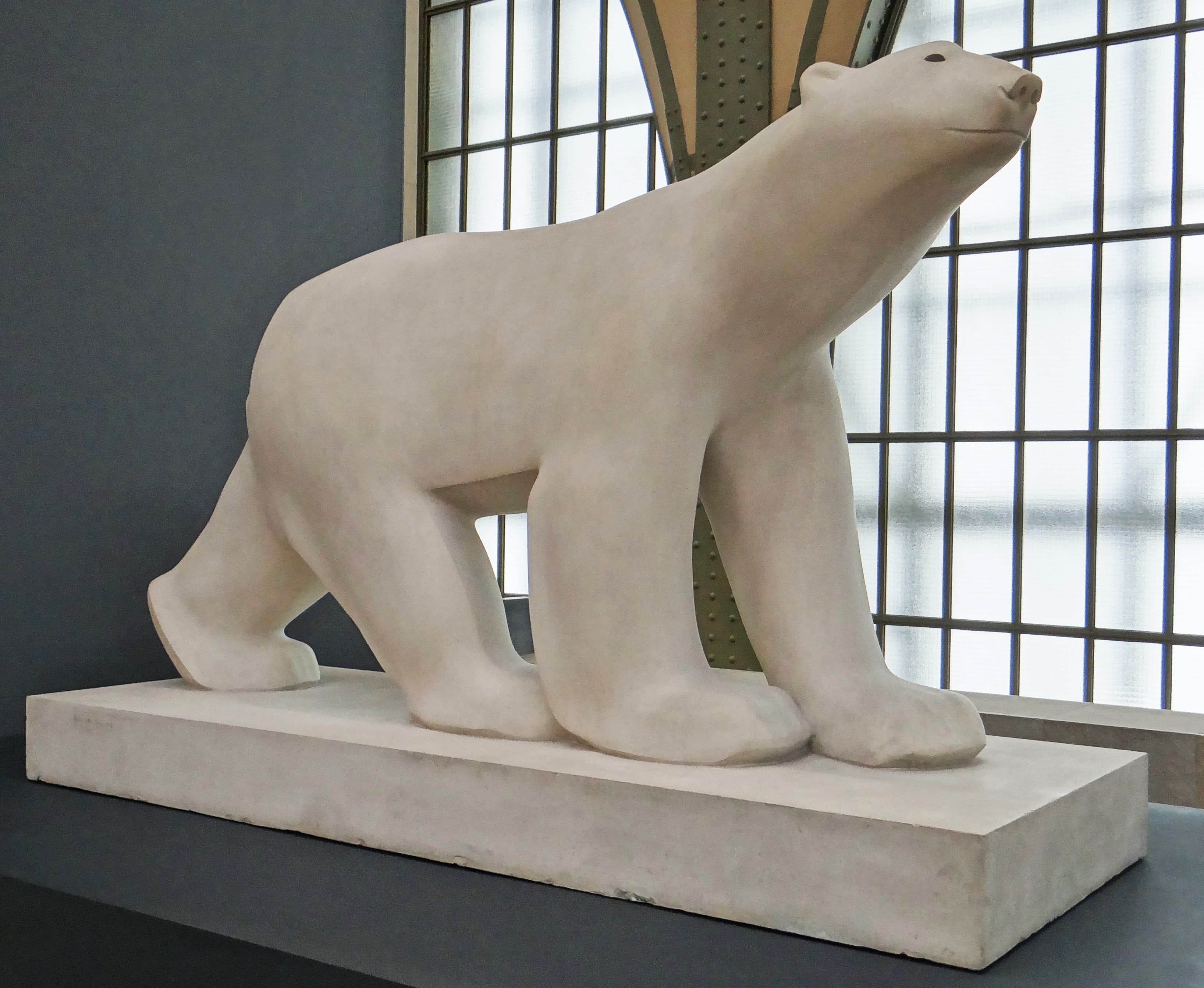
A large pale stone polar bear in profile on a plain rectangular plinth, walking with its head raised and turned slightly up. The surface carries no fur or claws: the back is one unbroken curve, the paws are rounded blocks, and the eye and mouth are shallow incised marks.

Artwork reproduction

Sculpture · Art Deco

Polar Bear

life-size plaster first exhibited 1922; Musée d'Orsay version executed 1928–29 · Pierre de Lens limestone (Musée d'Orsay version); other versions in marble, bronze, plaster and porcelain

François Pompon's Polar Bear is a walking bear with the fur, claws and muscle detail taken out, so that light runs across a continuous pale surface. He showed it as a life-size plaster at the 1922 Salon d'Automne, at sixty-seven, and it made his name after decades spent carving in other sculptors' studios. The monumental limestone version in the Musée d'Orsay was commissioned by the French state and carved in 1928–29.

Musée d'Orsay

François Pompon, Polar Bear, life-size plaster first exhibited 1922; Musée d'Orsay version executed 1928–29. Musée d'Orsay.

Movements

The artistic and literary currents this life ran through.

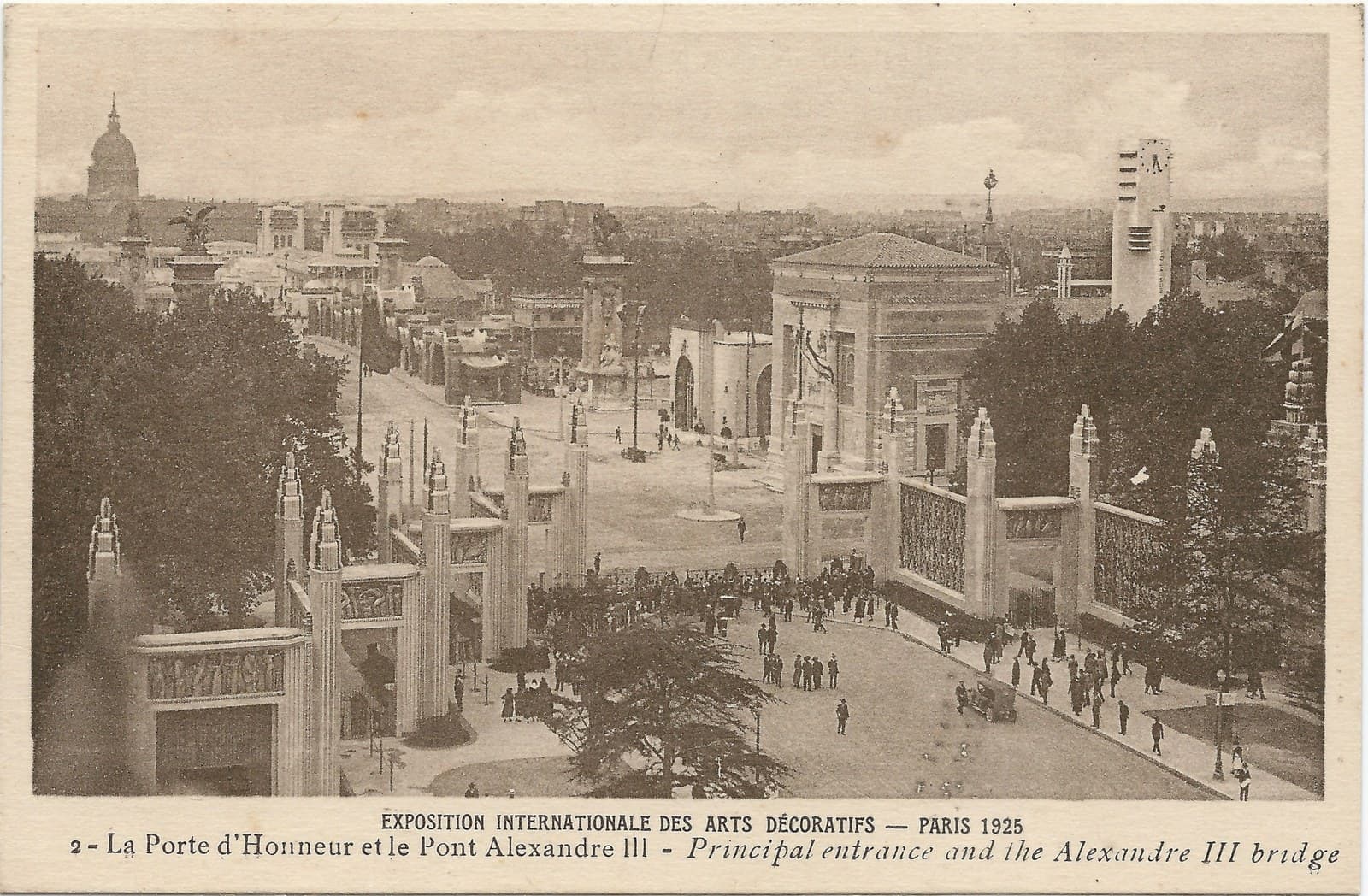
Aerial view of the 1925 Paris decorative arts exhibition: tall square pylons flanking the Porte d'Honneur entrance, crowds on the paths below, pavilions and a clock tower spreading toward the Invalides dome

Art & design movement · circa 1910–1939

Art Deco

Pompon's simplified animals entered the Art Deco decorative world through the people who bought and placed them. His friend Émile-Jacques Ruhlmann put the Polar Bear in his room settings at the 1925 Paris decorative-arts exhibition, and the Metropolitan Museum of Art acquired its marble version in 1930 from Galerie Edgar Brandt, where sculpture was shown alongside furniture, glass and ceramics.

François Pompon, Polar Bear — collection record; Le musee Francois Pompon

Questions about François Pompon

What is François Pompon best known for?

Ours blanc, or Polar Bear, a walking bear with the fur, claws and muscle detail taken out. He showed it as a life-size plaster at the 1922 Salon d'Automne. The monumental stone version is in the Musée d'Orsay in Paris.

Why did Pompon become famous so late?

He was sixty-seven in 1922. For decades his living came from work as a praticien, carving other sculptors' models into marble — for Rodin, whose chief assistant he became in 1893, and for Camille Claudel, Antonin Mercié, Alexandre Falguière and René de Saint-Marceaux. The labour was skilled and it was attached to other people's names.

How did Pompon study animals?

From life, mostly at the menagerie in the Jardin des Plantes in Paris and among farm animals in Normandy. He made a portable modelling bench that let him work in clay outdoors, walking alongside an enclosure rather than relying on a single fixed view.

Why do his animals have no fur or feathers?

He removed the detail after studying the animal closely, not instead of studying it. The Musée d'Orsay stresses that he preferred rounded, continuous forms and resisted turning a body into a geometric scheme. What survives the reduction is posture, weight and the particular bearing of the creature.

Is every bronze signed Pompon one he made?

No. The Gunma Museum of Art records that he opposed casting after his death, and posthumous casts were produced anyway, some authorised by the French state. The date of the model, the date of the cast and the circumstances of manufacture are three separate facts about any given bronze.

Where can I see Pompon's work?

The Musée d'Orsay in Paris holds the monumental stone Polar Bear, along with plasters and bronzes. The Muséum national d'Histoire naturelle has the 2.75-metre Hippopotame. The Musée François-Pompon in Saulieu and the museums of Dijon hold studio material, and the Gunma Museum of Art in Tatebayashi, Japan, has reconstructed his studio.

Connections and Sources

François Pompon’s connections to people, places, and works, with the sources behind each one.

Associated with · 1922–1933

Art Deco

Pompon's simplified animals entered the Art Deco decorative world through the people who bought and placed them. His friend Émile-Jacques Ruhlmann put the Polar Bear in his room settings at the 1925 Paris decorative-arts exhibition, and the Metropolitan Museum of Art acquired its marble version in 1930 from Galerie Edgar Brandt, where sculpture was shown alongside furniture, glass and ceramics.

François Pompon, Polar Bear — collection record; Le musee Francois Pompon

References

References

The sources below include biographies, scholarly essays, interviews, and primary materials that informed this page. They reflect both the historical record and ongoing critical conversations about François Pompon and their work.

  1. 1abPompon, Francois (1855-1933) - biographical record

    Website
    Institut national d'histoire de l'art, AGORHA
    Used for

    The INHA's biographical record: born Saulieu 9 May 1855, died Paris 6 May 1933, with the archival resources attached to him.

    View source
  2. 2abcFrancois Pompon - artist record

    Website
    Musee d'Orsay
    Used for

    The holding museum's artist record: his Dijon training, the sculptors he carved for, and his late recognition after 1922.

    View source
  3. 3abcdefFrancois Pompon (1855-1933) - artist biography

    Website
    Galerie Malaquais
    Used for

    Family background, the twin brother Hector, the apprenticeship to a funerary stoneworker, the evening classes, Cosette, and the Bande a Schnegg.

    View source
  4. 4abcdeFrancois Pompon

    Website
    Wikipedia (French)
    Used for

    Biographical detail on his marriage to Berthe, her paralysis and death in 1921, his 1916 employment at La Samaritaine, and the burial at Saulieu under his bronze Condor.

    View source
  5. 5abcdeLe musee Francois Pompon

    Website
    Municipalite de Saulieu
    Used for

    The museum in his birthplace: the portable modelling bench, his observation of animals in the countryside and at the Jardin des Plantes, and the friends who urged him to work larger.

    View source
  6. 6abcdLe mouvement en sculpture avec L'ours blanc de Pompon

    Website
    Grand Palais
    Used for

    How the Polar Bear carries movement through mass rather than detail, and his Egyptian and Japanese points of reference.

    View source
  7. 7abcFrançois Pompon, Ours blanc — collection record

    Website
    Musée d'Orsay
    Used for

    The monumental stone version: the 1927 state commission, the 1928-29 execution in pierre de Lens, Jean-Joachim Supery's carving, and the 163 by 251 centimetre dimensions.

    View source
  8. 8abcHippopotame de Francois Pompon

    Website
    Museum national d'Histoire naturelle
    Used for

    The 2.75-metre plaster hippopotamus of 1931, worked up from the Jardin des Plantes menagerie, and the 1934-39 studio display in the botanical gallery.

    View source
  9. 9abcdFrancois Pompon (1855-1933), le retour du lisse - exhibition record

    Website
    Musee d'Orsay
    Used for

    The 1994-95 retrospective: the 1874 Lucane, the admiration for Egyptian animal sculpture, and the decisive turn to simplified form around 1905.

    View source
  10. 10abMaman - Francois Pompon, collection record

    Website
    Musee d'Orsay
    Used for

    The small plaster of his mother at a prayer desk, and the 1929 will under which his work passed to the French state.

    View source
  11. 11abAbout Francois Pompon

    Website
    Gunma Museum of Art, Tatebayashi
    Used for

    The Japanese museum's account of his development, the Normandy cattle and poultry, and the Large Black Panther of 1930-31.

    View source
  1. 12Motifs egyptiens - Francois Pompon, collection record

    Website
    Musee du Louvre
    Used for

    The graphite sheet of Egyptian motifs drawn on the back of an envelope, with a bird sketch on the reverse.

    View source
  2. 13Poule - Francois Pompon, collection record

    Website
    Musee d'Orsay
    Used for

    The 6.2-centimetre plaster hen of 1912, evidence of how small his working studies could be.

    View source
  3. 14Ours blanc (bronze, 1927) - Francois Pompon, collection record

    Website
    Musee d'Orsay
    Used for

    The small black-patinated bronze of 1927, cast by Valsuani, showing that Polar Bear names a conception realised in several objects.

    View source
  4. 15Francois Pompon - artist biography

    Website
    Sladmore Gallery
    Used for

    Adrien Hebrard's dealership, the 1919 solo exhibition, the collector Jacques Zoubaloff, and the animal-art association Les Douze.

    View source
  5. 16Pintade - Francois Pompon, collection record

    Website
    Musee d'Orsay
    Used for

    The guinea fowl of about 1910-12, where selected details survive inside a single broad volume.

    View source
  6. 17Tourterelle - Francois Pompon, collection record

    Website
    Musee d'Orsay
    Used for

    The stone turtledove acquired for the national collections in 1919, three years before the Salon d'Automne.

    View source
  7. 18Vache “Fleur d'Amour” - Francois Pompon, collection record

    Website
    Musee d'Orsay
    Used for

    The 1927 plaster cow, evidence that farm animals held his attention after the exotic species made his name.

    View source
  8. 19Grand cerf - Francois Pompon, collection record

    Website
    Musee d'Orsay
    Used for

    The 1929 plaster stag, whose antlers and open silhouette set a different structural problem from the compact bear.

    View source
  9. 20The sculptor's studio - Pompon's reconstructed atelier

    Website
    Gunma Museum of Art, Tatebayashi
    Used for

    The reconstruction of his rue Campagne-Premiere studio from photographs, furnishings, tools, moulds and notebooks.

    View source
  10. 21abThe Pompon collection, and the casting history

    Website
    Gunma Museum of Art, Tatebayashi
    Used for

    The casting history, including Pompon's stated opposition to posthumous casts and the ones produced anyway.

    View source
  11. 22François Pompon: 1855–1933

    Exhibition catalogue
    Gallimard, Electa and Réunion des musées nationaux, Paris, 1994
    Used for

    The scholarly catalogue behind the 1994 retrospective, cited throughout the Musee d'Orsay's own collection records.

    View source
i
Why these sources are here

These references anchor the page in the documented record and in the scholarly conversations around François Pompon. Every claim on this page traces back to one or more of the works listed here.

Explore more resources