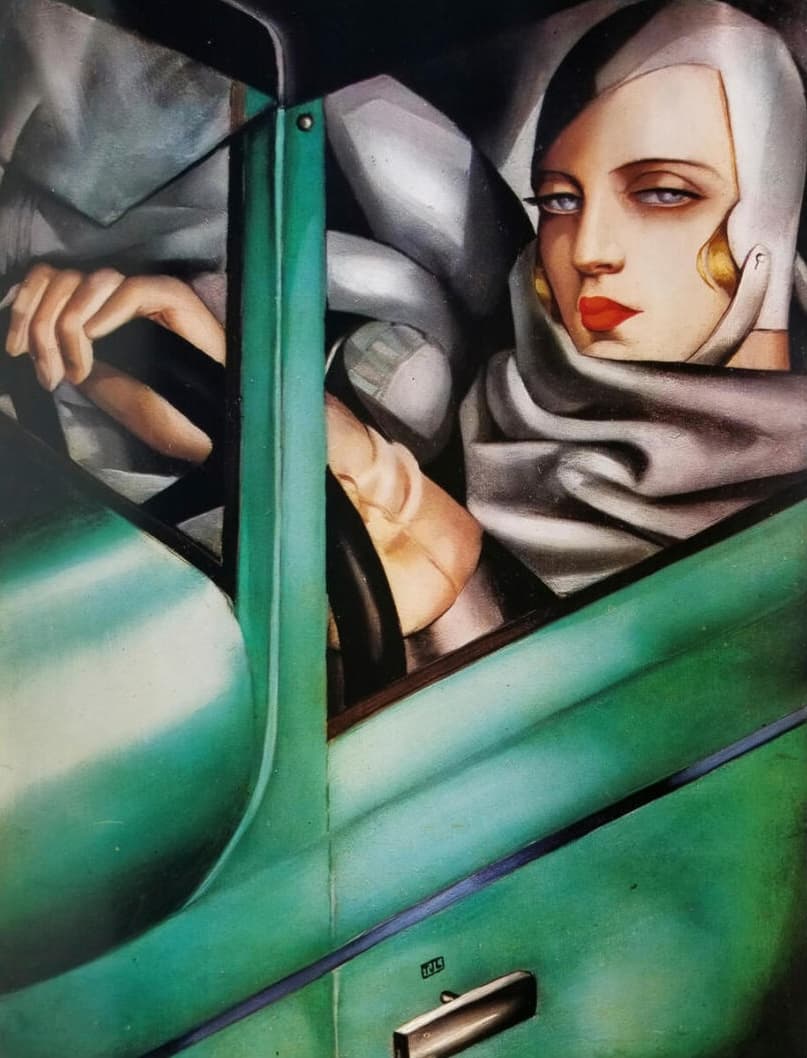
Tamara de Lempicka painted this self-portrait in 1929 for the German magazine Die Dame. She shows herself at the wheel of a green Bugatti in a motoring cap, gloves and pale scarf, the forms polished and sharply modelled. She did not own the car: she drove a yellow Renault. At 35 by 27 centimetres the panel is much smaller than its reputation suggests, and it remains in a private collection.
Tamara in a Green Bugatti is a self-portrait in which Tamara de Lempicka presents herself through the fashionable imagery of driving. Created for the German magazine Die Dame, it combines portrait painting with commercial illustration and carefully constructed public identity. The subject is both the artist herself and a particular conception of the modern woman.[1]
Composition and Appearance
Lempicka appears close to the viewer, wearing a fitted motoring cap, gloves, and a pale scarf. Her red lips interrupt the restrained colors around her face, while the green automobile supplies a strong contrast. The forms are sharply modeled and polished, giving both the figure and the machine a sculptural presence. Her expression is controlled rather than conversational, reinforcing the image's air of self-possession.[1]
The combination of geometry and physical solidity belongs to Lempicka's broader artistic approach. Her work brought together lessons from Cubism with an interest in Renaissance painting, classical traditions, and artists such as Ingres. Contemporary fashion and theatrical presentation also informed her imagery. These influences allowed her to create figures that seemed simultaneously modern and deliberately removed from ordinary, casual observation.[2]
The Bugatti She Did Not Own
The famous automobile was an element of artistic self-fashioning: Lempicka actually drove a yellow Renault, not the green Bugatti shown in the painting. The substitution made the portrait an aspirational image rather than a literal account of her possessions.[1]
A frequently repeated story claims that a publisher noticed her driving in Monte Carlo and commissioned the portrait after being struck by her appearance. The account has the appeal of a chance discovery, but it is difficult to accept uncritically: Lempicka had already worked for Die Dame. The story fits the glamorous identity she cultivated better than it establishes a secure history of the commission.[1]
The Modern Woman and the Automobile
The painting belongs to a period in which images of female independence were being negotiated through fashion, work, leisure, and consumer culture. Art historian Paula J. Birnbaum examines the portrait as part of Lempicka's engagement with the modern woman and the commercialization of her image. The automobile offers an especially effective setting because it connects personal mobility with industrial modernity and expensive consumption.[3]
The portrait can consequently be read as more than a straightforward declaration of liberation. Its independence is highly styled and associated with privilege. At the same time, Lempicka is not merely a model chosen by someone else to embody that ideal: she is the artist constructing the image. This relationship between self-representation and a commercially desirable identity is one of the work's enduring tensions.[3]
Paris and Artistic Reinvention
Lempicka's interwar career developed within the cosmopolitan artistic environment of Paris, where her distinctive portraits found an audience. Her paintings combined fashionable subjects with an approach that did not require viewers to choose between recognizable figures and modern formal experimentation. The resulting style could function in exhibitions, private collections, and the visual culture surrounding fashion and celebrity.[2]
Reputation and Collection
The small scale of the original is worth emphasizing: at 35 × 27 centimeters, it is far smaller than its monumental reputation might suggest. Its private ownership also distinguishes it from paintings that can be associated with a permanent public gallery. The Fine Arts Museums of San Francisco's artwork information identifies it as belonging to a private collection; the availability of museum-authorized reproductions does not mean that institution owns the original.[4]
A 1972 exhibition at the Galerie du Luxembourg helped renew interest in Lempicka's work. That rediscovery contributed to the later prominence of her interwar paintings as images of Art Deco sophistication. The Green Bugatti portrait remains particularly effective because its artistic language and its subject reinforce one another: a meticulously fashioned modern identity is presented through an equally controlled painting style.[2]
Close reading
Reading the work, detail by detail
The painting is small, 35 by 27 centimetres, and almost all of it is car. The details show the few places Lempicka lets skin and fabric interrupt the metal, and how little of the vehicle she actually describes.
1.The look, which is sideways
She is not looking at the viewer. The eyes are turned to the side under heavy lids, which is what gives the portrait its reputation for coldness. The face is modelled in smooth planes with no visible brushwork.
2.The red mouth
The lips are the one hot colour above the bodywork, set against grey leather, grey scarf and pale skin. A gold earring picks the warmth up again just beside it.
3.The motoring helmet
A close leather helmet covers the hair entirely and a strap runs down past the cheek. It is working motoring kit rather than a hat, and it removes the one feature a 1929 fashion portrait would normally use.
4.The hand on the wheel
The hand lies over the wheel rather than gripping it. The fingers are smooth cylinders with no knuckles described, modelled like the sheet metal around them.
5.The scarf, painted like metal
The scarf is wound in thick folds, and each fold is given a hard edge and a flat highlight. It is painted the same way as the car's panels, which is what makes the figure and the machine look made of one substance.
6.The car is mostly one green shape
Below the window line there is almost no detail: a door, a wing, a chrome handle and a long highlight. Lempicka gives the car nothing a mechanic would recognise, which is consistent with the fact that she did not own one.
Where to see it
A viewing location has not yet been listed for this work.
Frequently asked questions
Did Tamara de Lempicka own a green Bugatti?
No. She drove a yellow Renault. The green Bugatti in the painting is an invention, which makes the portrait an aspirational image rather than a record of what she owned.
Why did Lempicka paint this self-portrait?
It was made for the German magazine Die Dame. The painting therefore sits between portraiture and commercial illustration, and its subject is both Lempicka herself and a particular idea of the modern woman.
Is the story about Monte Carlo true?
It is hard to accept as it stands. The story says a publisher saw her driving in Monte Carlo and commissioned the portrait on the spot. Lempicka had already worked for Die Dame, so the tale fits the glamorous identity she cultivated better than it establishes how the commission actually happened.
How big is Tamara in a Green Bugatti?
35 by 27 centimetres, oil on panel. It is much smaller than its reputation suggests.
Where is the painting now?
In a private collection. Museum-authorised reproductions are sold, but that does not mean a museum owns the original.
In the atlas
What the graph records about this work — every claim carries its citation.
The self-portrait is the painting most often used to picture Art Deco: polished forms, fashion and the imagery of speed, made for a magazine rather than a gallery. Lempicka painted herself in a car she did not own.
— Self-Portrait (Tamara in a Green Bugatti) — Tamara Łempicka; My Portrait (Tamara in the Green Bugatti), 1929 — Art on Demand record; Tamara de Lempicka — exhibition
The painting is a self-portrait: Lempicka painted herself at the wheel for the German magazine Die Dame in 1929. The car is not hers — she drove a yellow Renault.
— Self-Portrait (Tamara in a Green Bugatti) — Tamara Łempicka; My Portrait (Tamara in the Green Bugatti), 1929 — Art on Demand record
If you like Tamara de Lempicka
Explore painters from the same movements and circles.
Georges Braque
The Le Havre house-painter's son who invented Cubism in Montmartre with the Spanish painter Pablo Picasso between 1908 and 1914 — the quieter half of the most consequential partnership in modern art — and who invented papier collé, the pasted-paper picture, in September 1912. He was given a French state funeral in 1963.
French poster designer whose advertisements for railways, liners and aperitifs — Nord Express, Dubonnet, Normandie — reduced their subjects to a few commanding shapes.
Painter between Impressionism and everything after — shown in the independents' exhibitions, emulated by the Cubists, and present at the Orangerie through 15 works in the Walter-Guillaume collection.
The sources below include collection records, catalogues, scholarly research, and primary materials that informed this page. They document Self-Portrait (Tamara in a Green Bugatti), its making, and its place in cultural history.
1abcdSelf-Portrait (Tamara in a Green Bugatti) — Tamara Łempicka
Website
Culture.pl
Used for
The commission for Die Dame, the yellow Renault Lempicka actually drove, and the frequently repeated Monte Carlo story about how the portrait came about.
4↑My Portrait (Tamara in the Green Bugatti), 1929 — Art on Demand record
Website
Fine Arts Museums of San Francisco
Used for
Artwork information giving the medium, the 35 by 27 cm dimensions, the 1929 date, and the private-collection status. Also cataloged there as My Portrait (Tamara in the Green Bugatti).
These references provide the documented foundation for this work's history and interpretation. Claim-level citations remain attached to the specific claims they support.



 View source