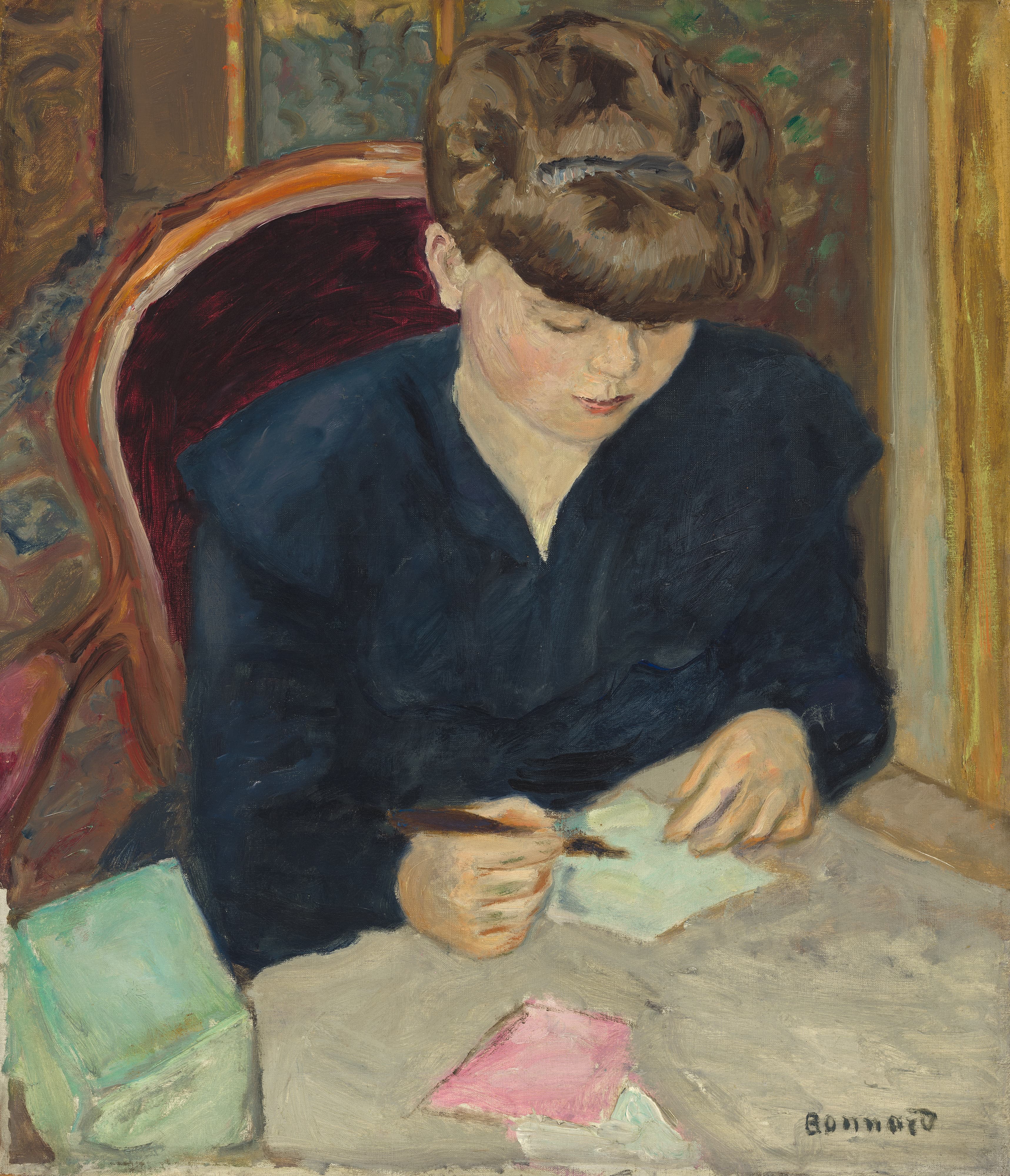
The Letter
A young woman bends over a sheet of pale blue-green paper with a pen in her right hand. Pierre Bonnard painted her from slightly above, in a dark blue dress, at a warm grey table, with the curved frame and crimson back of a chair behind her. Bernheim-Jeune bought the canvas from him in Paris in 1906 and sold it to the collector Alexandre Natanson. It reached the National Gallery of Art in Washington in 1963 with the bequest of Chester Dale.
- c. 1906
- Oil on canvas
- National Gallery of ArtWashington, D.C., United States
About Pierre Bonnard

What the painting shows
The woman fills most of the canvas and is cut off at the waist by the table. Her head is bowed far enough that the crown of her hair reads before the face, and the features come down to a lowered eyelid, a nose and a reddened mouth. The hair is piled in heavy brown masses with a grey-blue comb set into it.
Her right hand holds a dark penholder with the nib on the paper, and a small dark mark has already been made. Her left hand lies flat beside the sheet, fingers spread, keeping it still. The sheet is not white but pale blue-green, the coolest note in the picture.
The dress is one mass of dark blue across the middle of the canvas, with a narrow white edge at the throat. Against it the tabletop reads as a warm grey and the paper as green.
Two more things lie on the table. A block of pale mint green at the lower left is a closed book or a pad, set at an angle so that its top and its front edge both show. A pink rectangle sits at the bottom centre, either an envelope or a second sheet.
Behind her at the left is the curved wooden frame of a chair with dark crimson upholstery. The rest of the background is a mottled brown-green field flecked with small green dashes, a strip of gilt at the upper left, and a band of ochre down the right side.
The sitter is not named
The National Gallery of Art publishes no curatorial text for the painting, and its records carry no name beyond the artist's. Its accessibility description goes no further than a woman who looks down and writes on a piece of paper.
Marthe de Méligny had been Pierre Bonnard's companion since 1893 and sat for him more often than anyone else, which makes her the obvious guess. The museum does not make that identification, and no other museum record consulted here does either.
What the canvas does record is an ordinary act caught mid-stroke. Bonnard painted people reading, eating, dressing and writing rather than posing, and the bowed head here withholds the face that a portrait would have delivered.
Twenty-three years in Paris
The provenance the National Gallery of Art publishes begins in the studio. Bernheim-Jeune acquired the painting from Pierre Bonnard in 1906, the year the firm opened new premises at 25 boulevard de la Madeleine, and sold it to Alexandre Natanson.
Alexandre Natanson was one of the brothers behind La Revue blanche, the magazine that carried the Nabis through the 1890s and for which Bonnard made his 1894 poster. The picture therefore went from the painter to a dealer to a patron who already belonged to his own circle.
It came up at the Hôtel Drouot in Paris on 16 May 1929 as lot 88 in Natanson's sale. The Galerie Étienne Bignou bought it there for Chester Dale, and it left France. Dale's bequest brought it to Washington in 1963, where it carries the accession number 1963.10.86.
From New York it went back out on loan. It hung in Renoir and His Tradition at the Museum of French Art in 1931, and in a loan exhibition of Pierre Bonnard and Édouard Vuillard at the Art Institute of Chicago in 1938 and 1939. From 1943 to 1951 it sat on long deposit at the Philadelphia Museum of Art with the rest of the Dale paintings.
Painted from drawings
Bonnard did not work from a sitter in front of him. He made small pencil notes and painted later from those and from memory, a method the Museum of Modern Art sets out in its account of his drawings.
The consequence shows in the hands more than anywhere else. They are the most closely observed passage in the picture, while the face they belong to is given away almost nothing, and the background stays a flat patterned field.
Close reading
Reading the work, detail by detail
A bowed head withholds the face and the hands do all the work. The crops follow the pen to the paper, find the comb in the piled hair, and pick out the things left on the table.
1.The pen in one hand, the page held by the other
Her right hand grips a dark penholder with the nib down, and a small dark mark has already been made on the paper. Her left hand lies flat beside the sheet, fingers spread, keeping it still.
2.A comb set into the piled hair
The head is bowed far enough that the crown of the hair arrives before the face. A grey-blue comb is set horizontally into the piled brown mass, and of the features only a lowered eyelid, a nose and a reddened mouth are given.
3.A mint-green block at the near corner
A block of pale mint green sits at the lower left, angled so that both its top face and its front edge show. It reads as a closed book or a pad, and it is the largest cool shape in the picture after the writing paper.
4.A pink rectangle at the bottom edge
A pink rectangle lies flat on the table at the bottom centre, with a paler sheet just under it. An envelope is the obvious reading, though nothing in the painting settles it.
5.The chair behind her shoulder
A curved wooden frame catches a cream and orange highlight and encloses dark crimson upholstery. It is the one saturated warm note set against the dark blue mass of her dress.
6.Green dashes in the background
The wall behind her is a mottled brown-green field flecked with small green dashes, which reads as patterned fabric or paper rather than as depth. A pale vertical band and a strip of gilt close it off at the right.
7.Signed on the tabletop
The signature sits on the bare tabletop at the lower right, in dark paint over warm grey. The National Gallery of Art records the inscription at exactly that position and the canvas carries no date.
Timeline
c. 1906
Painted; Bernheim-Jeune buys it from Pierre Bonnard in Paris and sells it to Alexandre Natanson.
1929
Sold at the Hôtel Drouot, Paris, on 16 May as lot 88 in Natanson's sale; bought by the Galerie Étienne Bignou for Chester Dale.
1931
Shown in New York in Renoir and His Tradition at the Museum of French Art, as number 23.
1938–39
Lent to the Art Institute of Chicago for a loan exhibition of paintings and prints by Pierre Bonnard and Édouard Vuillard, as number 7.
1943–51
On deposit at the Philadelphia Museum of Art with the Chester Dale paintings.
1963
Enters the National Gallery of Art with the Chester Dale bequest; accession 1963.10.86.
Where to see it
National Gallery of Art
Washington, D.C., United States
A public viewing address has not yet been confirmed for this holding.
The museum's record gives the East Building ground level, Gallery E103. Displays rotate, so check the collection page before traveling to see it.
Frequently asked questions
Where is The Letter by Bonnard?
The National Gallery of Art in Washington, accession number 1963.10.86, in the Chester Dale Collection. The museum's record marks it on view on the East Building ground level, in Gallery E103.
Who is the woman writing in The Letter?
The National Gallery of Art does not say. It publishes no curatorial text for the painting and records no sitter. Marthe de Méligny, Pierre Bonnard's companion from 1893 and his most frequent model, is the obvious candidate, but no museum record consulted here names her.
How big is The Letter?
55 by 47.5 centimeters, or 21 5/8 by 18 11/16 inches. Framed, the National Gallery of Art gives 78.4 by 70.1 by 4.4 centimeters.
What is she writing on?
A single sheet laid flat on the table, painted a pale blue-green rather than white. Her right hand holds the penholder with the nib down; her left hand keeps the sheet in place. A pink rectangle at the bottom edge may be an envelope.
Why is the date given as about 1906?
The canvas is signed but not dated, so the National Gallery of Art prints it as c. 1906. The year is anchored by the provenance instead: the museum records Bernheim-Jeune acquiring the painting from Pierre Bonnard in 1906.
Who owned The Letter before it reached Washington?
Bernheim-Jeune in Paris from 1906, then Alexandre Natanson of La Revue blanche, then the Galerie Étienne Bignou, which bought it at the Hôtel Drouot in 1929 for the American collector Chester Dale. Dale left it to the National Gallery of Art in 1963.
More by Pierre Bonnard
If you like Pierre Bonnard
Explore painters from the same movements and circles.
Paul Gauguin
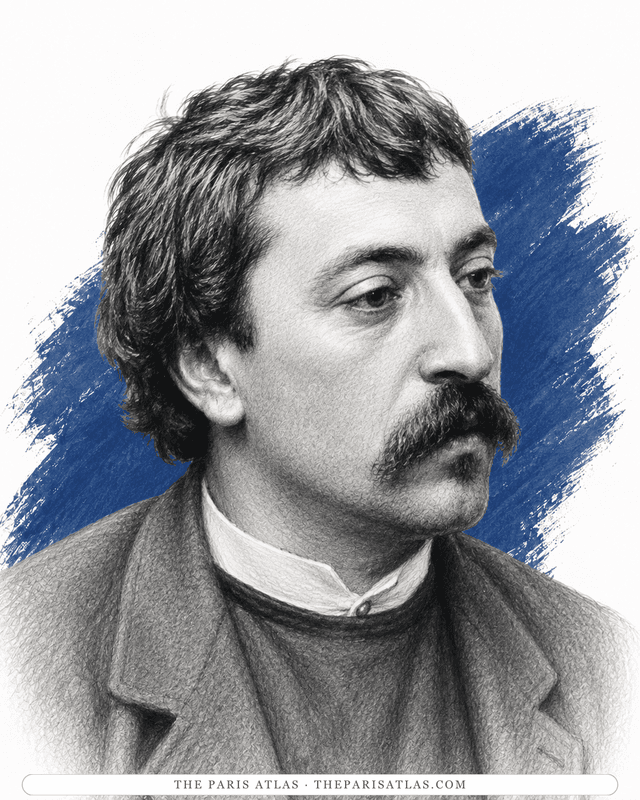
Stockbroker turned painter who came into art through Camille Pissarro, showed with the Impressionists, and left Europe for Polynesia.
View artist
Gustave Moreau
Painter of jewelled myths — Salome, Oedipus, floating severed heads — who lived nearly his whole life in one Paris house, taught Henri Matisse and Georges Rouault at the Beaux-Arts, and turned the house into a museum before he died so the state would have to keep everything.
View artist
Edvard Munch
Norwegian painter of The Scream, who arrived in Paris in 1889 on a state scholarship to learn academic drawing from an anti-Impressionist professor, lost his father that November, and spent a bleak winter in the riverside suburb of Saint-Cloud writing down the vow that redirected his art — paint the moments when people are most alive, not the furniture around them.
View artist
References
The sources below include collection records, catalogues, scholarly research, and primary materials that informed this page. They document The Letter, its making, and its place in cultural history.


1The Letter
Official recordNational Gallery of ArtUsed forOfficial record used to verify names, dates, institutional details, or other factual information on this page.
2National Gallery of Art open data: objects and published images
ArchiveNational Gallery of ArtUsed forArchival evidence used to document the historical record connected to The Letter.

3Misia, Queen of Paris
WebsiteMusée d'OrsayUsed forWeb source consulted for documented facts and historical context presented on the The Letter page.
4Bonnard's drawings and memory
WebsiteMuseum of Modern ArtUsed forWeb source consulted for documented facts and historical context presented on the The Letter page.
5Pierre Bonnard — biography and chronology
WebsiteMusée BonnardUsed forWeb source consulted for documented facts and historical context presented on the The Letter page.
6Pierre Bonnard (1867–1947)
WebsiteMusée d'OrsayUsed forWeb source consulted for documented facts and historical context presented on the The Letter page.
These references provide the documented foundation for this work's history and interpretation. Claim-level citations remain attached to the specific claims they support.
 Explore more resources