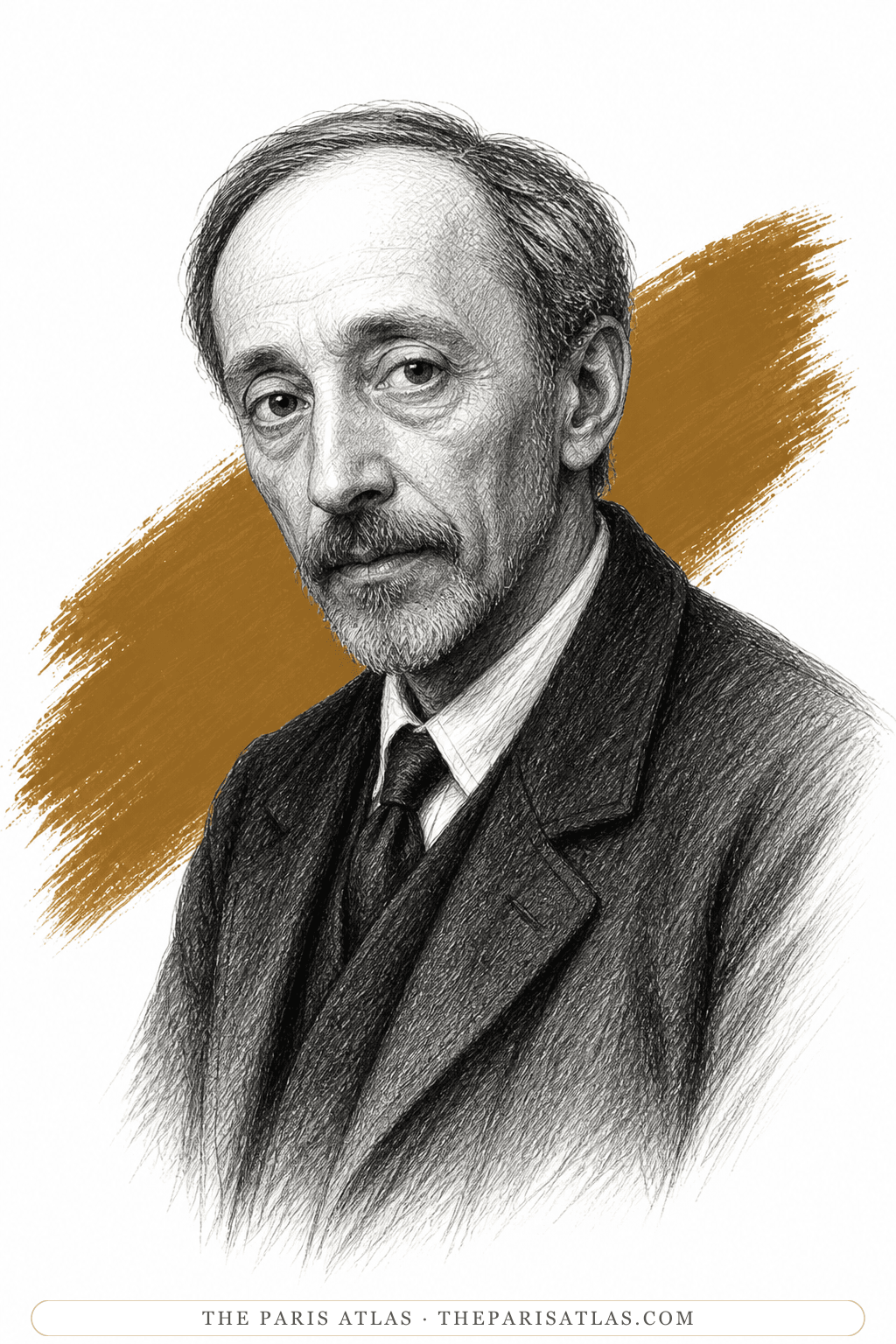

Depicts · 1924
Ambroise Vollard
The Petit Palais names the sitter in its own title and description, placing Ambroise Vollard on a chair with a small cat on his knees in a room crowded with pictures.
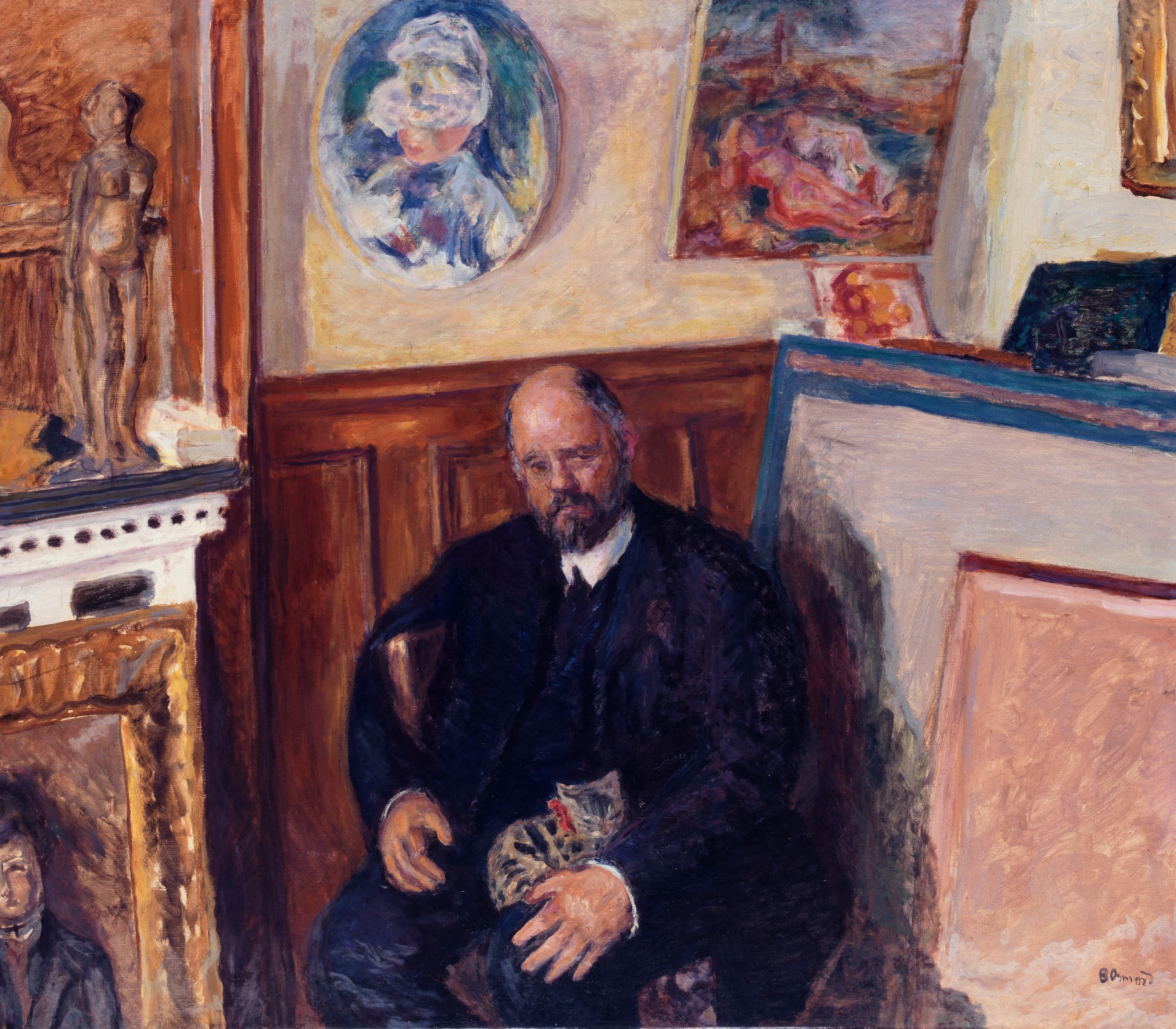
Ambroise Vollard sits in the middle of a room crowded with pictures, a small tabby cat on his lap. Pierre Bonnard painted the Paris dealer bald, bearded and hunched, his eyes lowered, in a dark suit that goes almost black against the woodwork behind him. The Petit Palais says the cat was a device Bonnard thought up to stop his sitter falling asleep. Vollard's heirs gave the canvas to the City of Paris in 1950.
Vollard sits a little left of centre and fills the lower middle of a canvas that is wider than it is tall. His head is bald on top with dark hair at the temples, and he wears a dark beard and moustache. The Petit Palais describes the pose as a stooped back, the head slightly bowed and one drooping eye, betraying a sleepiness that everyone who knew him remarked on.
The cat sits on his lap, grey-brown and dark-striped, with a bright red mark at its throat. His right hand hangs loose beside his knee, fingers curled, a white cuff showing at the wrist. His left hand rests across the cat's hindquarters, broad and heavy, with the same white cuff.
Everything he wears is dark. The suit reads almost black against the brown wainscot behind him, and a white collar and dark tie are the only breaks in it. Above the wainscot the wall turns cream and yellow.
Three large canvases crowd in from the right, turned at angles and showing mostly blank surfaces: a teal stretcher edge, a broad grey-lilac face, and a salmon-pink one across the lower corner. Pierre Bonnard signed the painting on that pink surface, at the lower right.
The Petit Palais identifies two of them. At the extreme lower left, propped against a chimneypiece, is Paul Cézanne's portrait of Alfred Hauge; only a pale face, a white collar and one shoulder clear the edge of the canvas. On the back wall to the right of Vollard's head are Pierre-Auguste Renoir's reclining women, a loose tangle of salmon-pink figures in a landscape.
The rest go unnamed. An oval canvas hangs high and left of centre, holding a child in a broad white bonnet against blue-green leaves. A small still life of orange fruit sits below the Renoir, and a fragment of heavy gilt frame shows in the top right corner.
At the far left a pale nude statuette stands on a ledge. Below it runs a white chimneypiece edged with black dots, and below that the carved gilt frame the Cézanne leans against.
The stock is the setting and the sitter's trade at once. Vollard is boxed in by what he sold, and the one thing in the room that is neither a picture nor a frame is the cat.
The Petit Palais says Maurice Denis introduced Pierre Bonnard to Ambroise Vollard in 1893. Bonnard was in his mid-twenties and had been with the Nabis for five years.
The Art Institute of Chicago records that Vollard mounted large Nabis exhibitions in 1897 and again in 1898, and that Bonnard was his favourite of that group and the only one whose work he collected for himself.
The partnership produced books. Vollard published Paul Verlaine's Parallèlement in 1900 with lithographs by Bonnard, then Daphnis et Chloé in 1902, both printed in Paris by Auguste Clot. They put image and type on the same page in a way that had not been done before.
Vollard's business ran from the rue Laffitte. The Musée d'Orsay records him opening at number 37 in September 1893 and taking larger premises at number 6 in May 1896. It calls that second address the centre of gravity of the Paris art scene until the First World War. By about 1924 he had moved again, to the rue de Martignac in the Faubourg Saint-Germain.
Vollard kept the portrait. He died in July 1939 after a road accident, and eleven years later his heirs gave the canvas to the City of Paris. Paris Musées records the acquisition as a manual gift of 1950 from Ambroise Vollard's ayants droit, under the inventory number PPP3052.
The Petit Palais holds a second portrait of the same man by another painter. Paul Cézanne's Portrait d'Ambroise Vollard of 1899 came as a bequest from Vollard himself in February 1945, and the museum links the two records. Its label notes that Cézanne needed 115 morning sittings, in a studio near the Montmartre cemetery.
Pierre Bonnard painted Ambroise Vollard more than once. The Petit Palais says several portraits exist and that this one stands out for its large format.
Close reading
Bonnard put his dealer in the middle of his own stock. The crops take the sitter's face and hands, the cat that was there to keep him awake, and the pictures the Petit Palais can name on the walls around him.
1.A bowed head and a drooping eye
The crown is bald, the temples dark, the beard and moustache dark. The eyes are lowered under heavy lids, which is the sleepiness the Petit Palais describes as a stooped back, a bowed head and one drooping eye.
2.The cat, and what each hand is doing
The cat is a grey-brown tabby with dark stripes and a bright red mark at its throat. One hand hangs loose beside the knee with the fingers curled; the other rests broad and heavy across the cat. Both wrists show a white cuff.
3.An oval canvas above the panelling
An oval canvas hangs high and left of centre, holding a child in a broad white bonnet with a pink face beneath it, against blue-green leaves. The Petit Palais does not name this one among the pictures it identifies.
4.Renoir's reclining women on the back wall
The Petit Palais identifies the picture on the back wall as Pierre-Auguste Renoir's reclining women. Bonnard gives it as a loose tangle of salmon-pink figures against blue and ochre, with a small still life of orange fruit hanging below.
5.The Cézanne in the corner
The Petit Palais places Paul Cézanne's portrait of Alfred Hauge here, propped against a chimneypiece. Only a pale face, a white collar and one shoulder clear the edge of the canvas, alongside the lit edge of a heavy gilt frame.
6.Signed on the pink canvas
One of the stacked canvases turns its salmon-pink face to the viewer across the lower right corner, and Bonnard signed the painting on it. Paris Musées records the signature at the lower right and no date beside it.
7.A nude statuette on the ledge
A small pale standing nude stands on a ledge at the far left, above the chimneypiece, with a white object lying beside it. It is the only sculpture in a room otherwise filled with framed and stretched pictures.
1893
Maurice Denis introduces Pierre Bonnard to Ambroise Vollard; Vollard opens at 37 rue Laffitte in September.
1896
Vollard moves to larger premises at 6 rue Laffitte in May.
1900
Vollard publishes Paul Verlaine's Parallèlement with lithographs by Bonnard.
1902
Vollard publishes Daphnis et Chloé, illustrated by Bonnard and printed by Auguste Clot.
c. 1924
Bonnard paints the portrait, signing it at the lower right on the face of a pink canvas.
1939
Ambroise Vollard dies in July after a road accident.
1945
The Petit Palais receives Paul Cézanne's 1899 portrait of Vollard as a bequest from Vollard, in February.
1950
Vollard's heirs give the Bonnard portrait to the City of Paris; inventory PPP3052.
2007
Shown at the Musée d'Orsay in De Cézanne à Picasso, chefs-d'œuvre de la galerie Vollard.
Petit Palais, musée des Beaux-Arts de la Ville de Paris
Paris, France
A public viewing address has not yet been confirmed for this holding.
The museum's record marks the painting on display in the Rez-de-Jardin, Salle 09, the salle Concorde. Displays rotate, so check the collection page before traveling to see it.
The Petit Palais, musée des Beaux-Arts de la Ville de Paris, inventory number PPP3052. The museum's record marks it on display in the Rez-de-Jardin, Salle 09, the salle Concorde.
The Petit Palais says the cat was a trick Pierre Bonnard thought up to keep his sitter from falling asleep too easily during the sittings. The museum's own description of Ambroise Vollard's pose names a stooped back, a bowed head and a drooping eye.
A Paris dealer and publisher, born in 1866 and killed in a road accident in 1939. He gave Paul Cézanne his first solo exhibition, ran his business from the rue Laffitte, and published the illustrated books Pierre Bonnard made with him from 1900.
The Petit Palais names two: Paul Cézanne's portrait of Alfred Hauge, propped against a chimneypiece at the lower left, and Pierre-Auguste Renoir's reclining women on the back wall. The oval of a child in a bonnet, the small still life of orange fruit and the blank stacked canvases are not identified.
96.5 by 111 centimeters, so it is wider than it is tall. Framed, Paris Musées gives 115.4 by 130.5 by 5.5 centimeters. The museum publishes metric measurements only.
Yes. Paris Musées releases the image under Creative Commons Zero through its Open Content programme, credited to CC0 Paris Musées / Petit Palais, musée des Beaux-Arts de la Ville de Paris. Attribution is invited rather than required.
Depicts · 1924
The Petit Palais names the sitter in its own title and description, placing Ambroise Vollard on a chair with a small cat on his knees in a room crowded with pictures.
Explore painters from the same movements and circles.
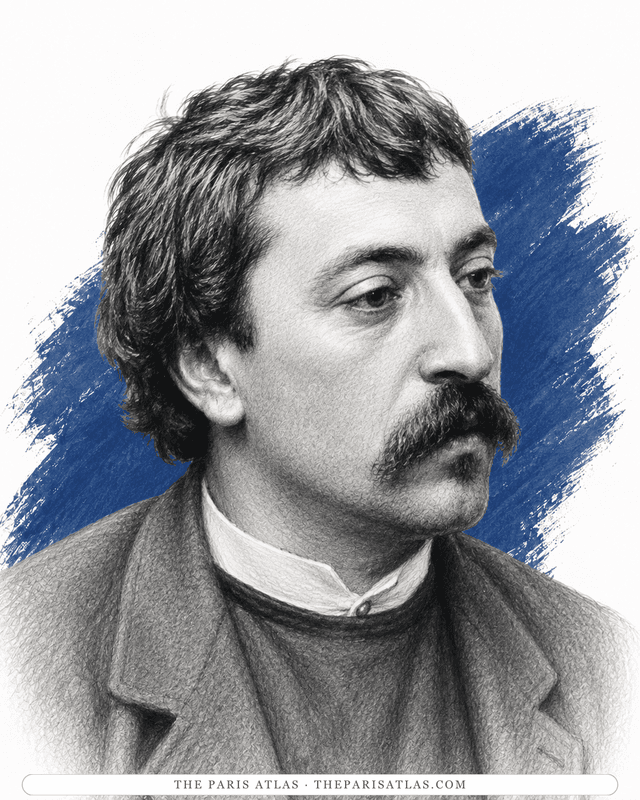
Stockbroker turned painter who came into art through Camille Pissarro, showed with the Impressionists, and left Europe for Polynesia.
View artist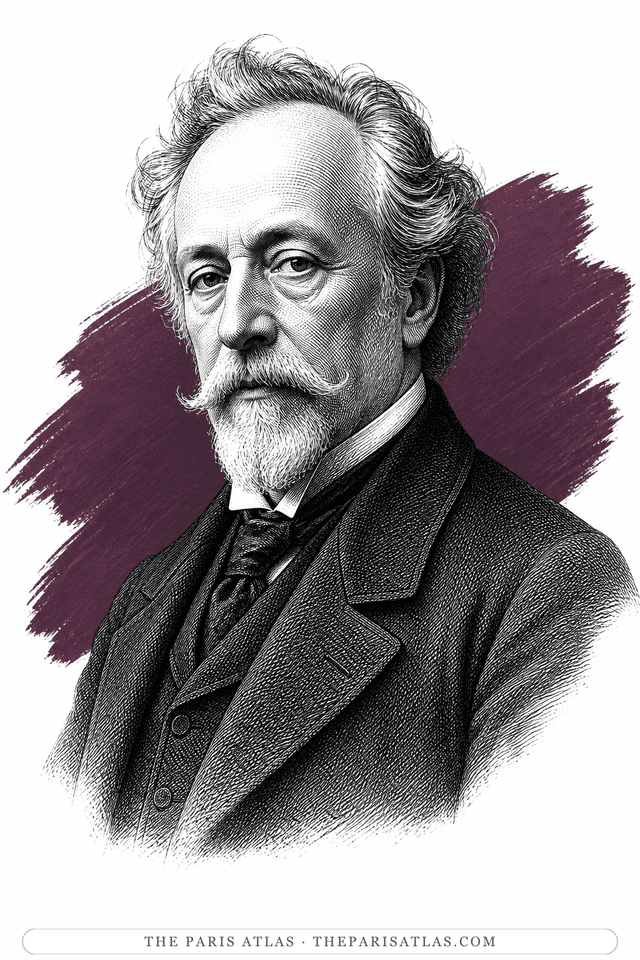
Painter of jewelled myths — Salome, Oedipus, floating severed heads — who lived nearly his whole life in one Paris house, taught Henri Matisse and Georges Rouault at the Beaux-Arts, and turned the house into a museum before he died so the state would have to keep everything.
View artist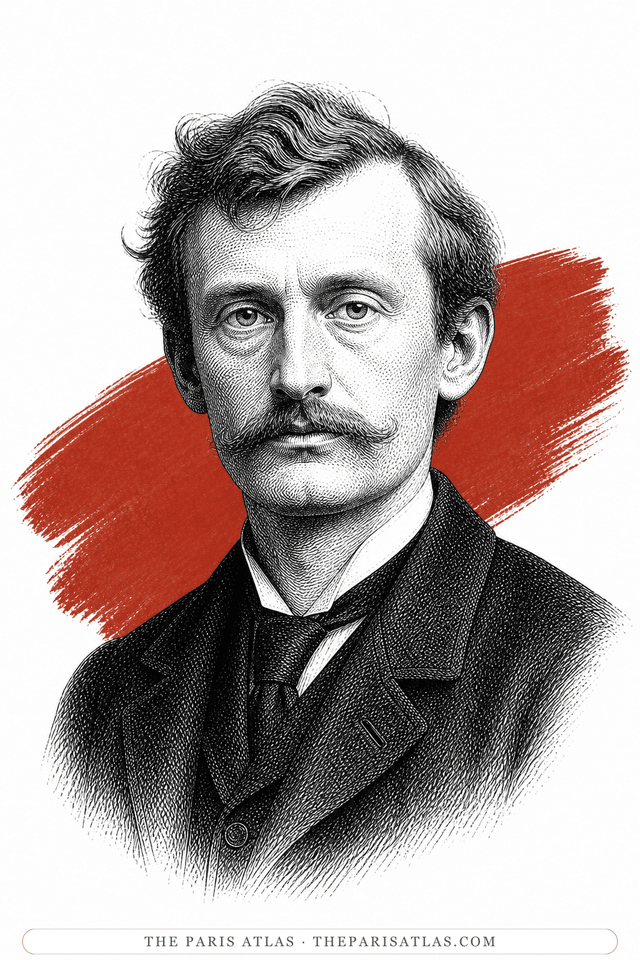
Norwegian painter of The Scream, who arrived in Paris in 1889 on a state scholarship to learn academic drawing from an anti-Impressionist professor, lost his father that November, and spent a bleak winter in the riverside suburb of Saint-Cloud writing down the vow that redirected his art — paint the moments when people are most alive, not the furniture around them.
View artistThe sources below include collection records, catalogues, scholarly research, and primary materials that informed this page. They document Portrait of Ambroise Vollard with a Cat, its making, and its place in cultural history.


Official record used to verify names, dates, institutional details, or other factual information on this page.
Official record used to verify names, dates, institutional details, or other factual information on this page.

Web source consulted for documented facts and historical context presented on the Portrait of Ambroise Vollard with a Cat page.
Web source consulted for documented facts and historical context presented on the Portrait of Ambroise Vollard with a Cat page.
Official record used to verify names, dates, institutional details, or other factual information on this page.
Official record used to verify names, dates, institutional details, or other factual information on this page.
Web source consulted for documented facts and historical context presented on the Portrait of Ambroise Vollard with a Cat page.
These references provide the documented foundation for this work's history and interpretation. Claim-level citations remain attached to the specific claims they support.
 Explore more resources