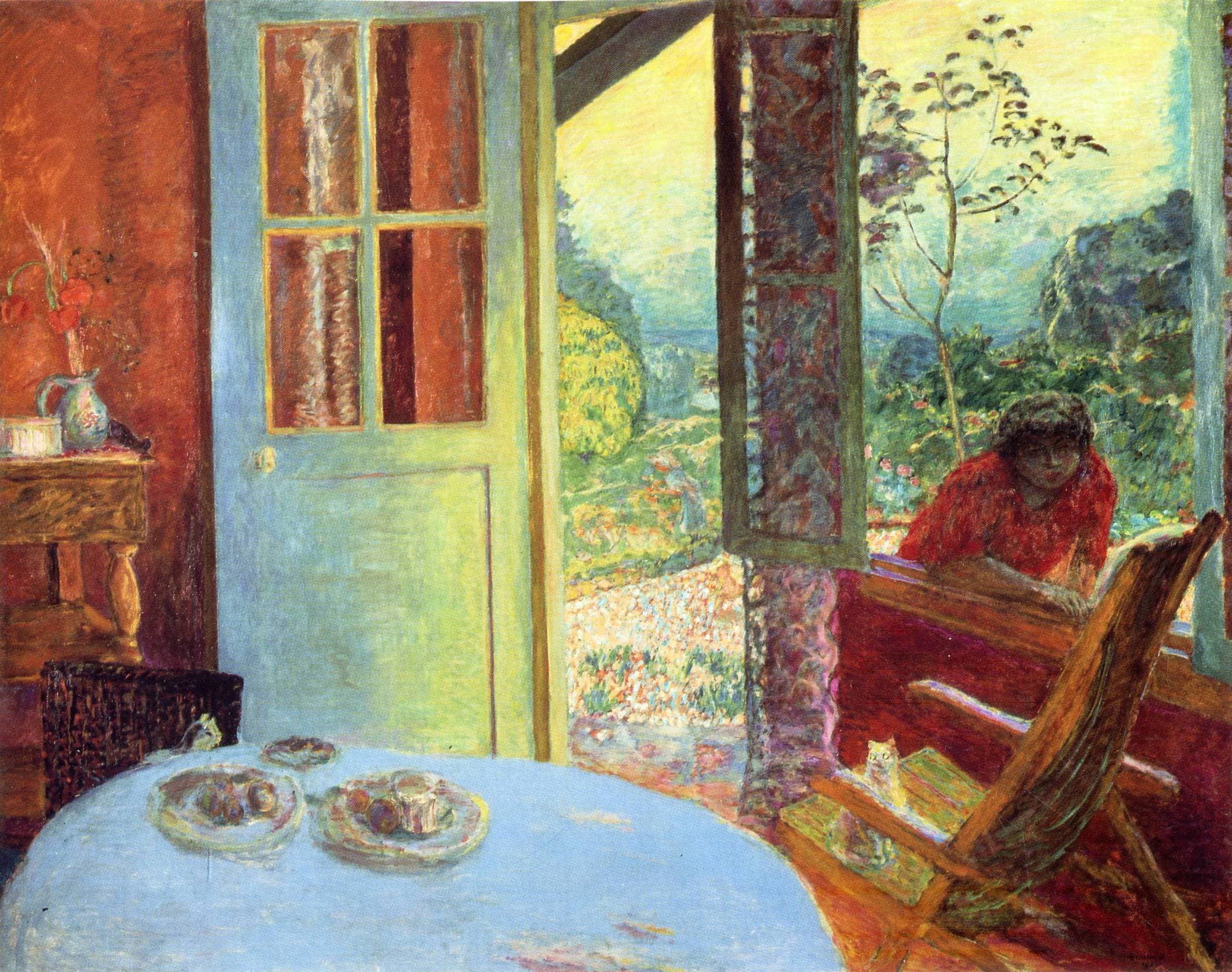
Dining Room in the Country
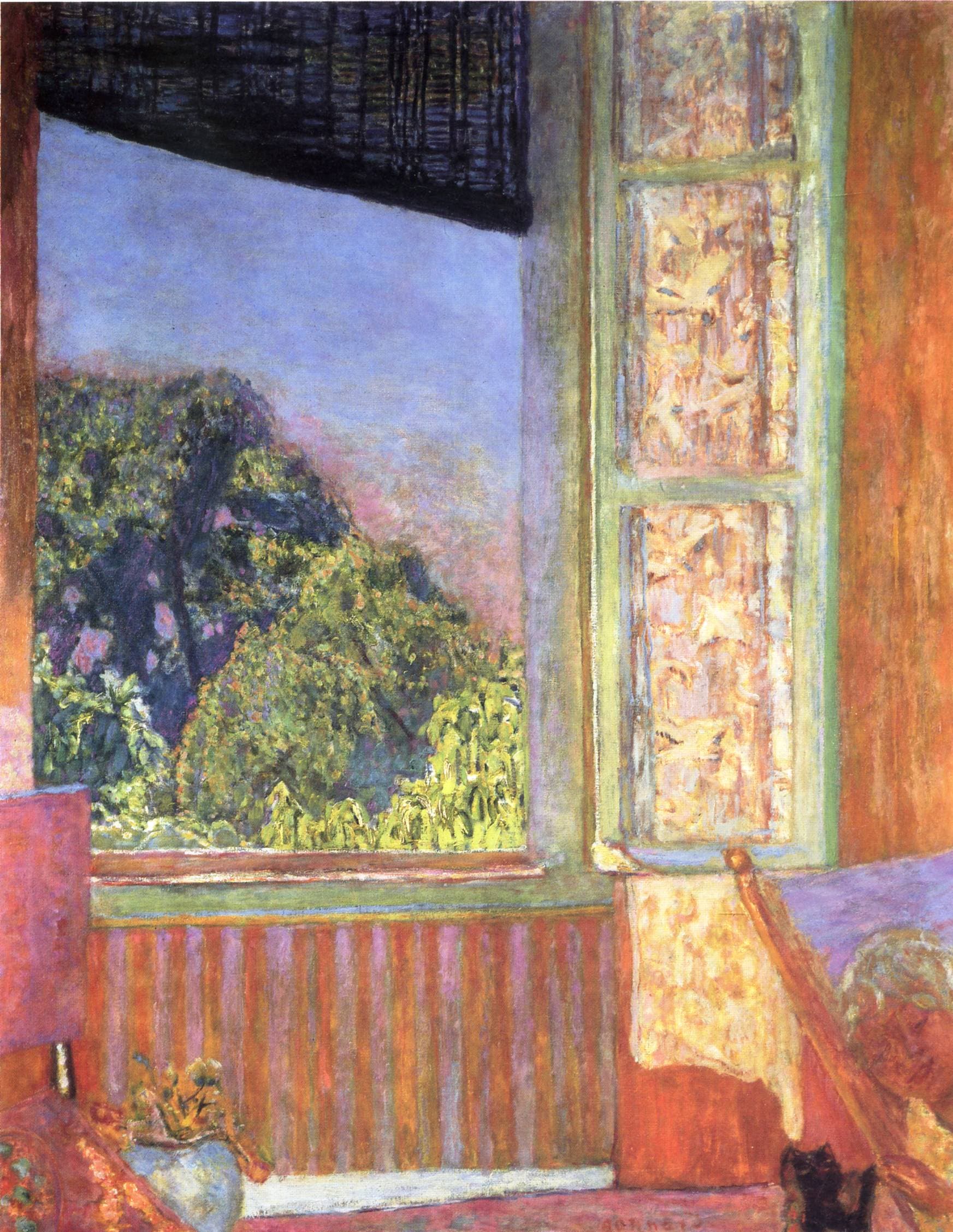
A round table under a pale blue cloth fills the front of a country dining room, and an open door and window let the garden straight in. Pierre Bonnard painted the room at Ma Roulotte, the house above the Seine at Vernonnet he had bought the year before. Marthe de Méligny leans in at the windowsill on the right in a red blouse, and a ginger cat sits on a slatted seat below her. The canvas is just over two meters wide and belongs to the Minneapolis Institute of Art.
- 1913
- Oil on canvas
- Minneapolis Institute of ArtMinneapolis, United States
About Pierre Bonnard
What the painting shows
The room is split down the middle by a tall opening. On the left a glazed door stands flat to the wall, blue-gray at the top and yellow-green where the light reaches it. Its four panes hold the red of the room behind them rather than the green of the garden. To the right of the door the garden fills the gap: a gravel terrace, a bed of flowers, dark green trees, a bare young sapling, and the hills of the Seine valley beyond. A small figure in pale blue stands among the flowers on the bank. Pierre Bonnard gave the walls and floor the same red-orange, so the inside of the room reads as one warm block against the cool light outdoors.
The table is laid but nobody is eating. Two shallow dishes hold fruit, and a pale cylindrical pot stands among the fruit in the right-hand one. A third and smaller dish sits behind them carrying something dark brown, and the cloth takes reflected color from everything around it. At the left edge a wooden sideboard carries a pale blue-green jug holding red flowers, a small white box beside it, and a dark vessel lying on its side.
Two cats are easy to miss. A pale one shows only its head, at the right-hand edge of the dark wicker piece at the lower left, just above the tablecloth. A ginger cat sits upright on a green-painted slatted seat at the right. Behind that cat a wooden chair with a broad curved back cuts across the corner of the picture, seen from behind.
Marthe de Méligny is outside the room, leaning forward onto the wooden rail at the window with one bare forearm along it. She was Pierre Bonnard's companion and his most frequent model, and they had been together for about twenty years when he painted this. The Minneapolis Institute of Art identifies her as the figure at the window and calls her the artist's wife, a description that runs ahead of the 1925 marriage.
The house at Vernonnet
Bonnard bought a house on a hillside above the Seine at Vernonnet in 1912 and called it Ma Roulotte, meaning my caravan. The dining room opened onto a terrace over the river, and that opening is as much the subject here as the furniture is. He painted the same room, terrace and valley repeatedly over the following years.
Claude Monet lived close by at Giverny, and Bonnard went to see him after the move. The two gardens were nothing alike: Monet built Giverny into a highly organized environment, while Bonnard let the ground at Vernonnet grow as it wanted. That difference shows here in the unclipped look of the terrace and the bank beyond it, where a dense flower bed runs straight into rough grass.
Painted away from the room
Bonnard did not set up an easel in front of the scene. He made rapid pencil notes in pocket diaries, sometimes over months, and then built the painting from those notes and from memory in a separate room. The Museum of Modern Art's account of his working method describes the drawings as the record he painted from, rather than as preparation for a sitting.
Three of those working drawings are in the same collection as the painting. The Minneapolis Institute of Art holds all three under the title Study for Dining Room in the Country, graphite on paper, given by Antoine Terrasse in 2006. That lets the finished canvas be read against the notes it came from.
The habit had a practical consequence for the color. Nothing here is matched to a light that was actually falling at a particular hour, so the red walls can run hotter and the garden cooler than any single moment would allow.
From Bernheim-Jeune to Minneapolis
Bonnard sold the painting to the Paris dealers Bernheim-Jeune on 7 November 1913, the year he finished it. The museum's provenance then follows it through the gallery and into the private collection of Gaston Bernheim de Villers, one of the brothers who ran it, where it stayed until the early 1950s.
The New York dealer Sam Salz bought it next, and the Minneapolis Institute of Art acquired it from him on 23 November 1954 through the John R. Van Derlip Fund. It carries the accession number 54.15 and hangs among the museum's European highlights of 1800 to the 1960s.
Close reading
Reading the work, detail by detail
Bonnard hangs a warm red room next to a cool green garden and then hides things on both sides of the join. The crops find the two cats, the figure out on the bank, and the objects on the table that are easy to miscount.
1.Marthe de Méligny leans in from outside
She is outside the room, resting her weight forward on the wooden rail, one bare forearm along it and her eyes lowered. The Minneapolis Institute of Art names her as Marthe de Méligny. No hat, and only the one forearm bare.
2.A ginger cat on the green slats
The cat sits upright and face-on, on a green-painted slatted seat. Behind it the broad curved back of a wooden chair cuts across the corner, seen from behind. Nothing about that chair shows that it folds.
3.The second cat is only a head
The other cat gives away a head and nothing else. It appears at the right-hand edge of the dark wicker piece, level with the top of the tablecloth, which makes two animals in the room rather than one.
4.Three dishes, and the pot among the fruit
Two shallow dishes hold fruit. A pale cylindrical pot stands among the fruit in the right-hand dish, not on its own, and a third smaller dish sits behind them carrying something dark brown.
5.The jug is the vase
One pale blue-green jug holds the red flowers; there is no separate white jug standing next to a vase. A small white box sits to its left and a dark vessel lies on its side to its right.
6.Someone is out on the bank
A small figure in pale blue, with a reddish head, stands among the flowers on the bank beyond the doorway. It is the second person in the painting and the easiest thing in it to walk past.
7.Four panes holding red, not green
The door is flat to the wall, its pane rectangles unforeshortened, so it is not ajar. Each of the four panes carries the deep red of the room behind it rather than the green of the garden, and the right side of the door turns yellow-green in the light.
Timeline
1912
Bonnard buys Ma Roulotte, a house above the Seine at Vernonnet, near Vernon.
1913
Paints Dining Room in the Country, signing and dating it lower right.
1913
Sells the painting to Bernheim-Jeune, Paris, on 7 November.
1953–54
Passes from the collection of Gaston Bernheim de Villers to the New York dealer Sam Salz.
1954
Bought by the Minneapolis Institute of Art on 23 November through the John R. Van Derlip Fund, accession 54.15.
2006
The same museum receives three graphite drawings catalogued as Study for Dining Room in the Country, the gift of Antoine Terrasse.
Where to see it
Minneapolis Institute of Art
Minneapolis, United States
A public viewing address has not yet been confirmed for this holding.
The museum's record gives Gallery 355. Displays rotate, so check the collection page before traveling to see it.
Frequently asked questions
Where is Dining Room in the Country?
The Minneapolis Institute of Art, accession number 54.15, bought with the John R. Van Derlip Fund. The museum files it under European Art and gives its gallery as 355.
What room does Dining Room in the Country show?
The dining room of Ma Roulotte, the house Pierre Bonnard bought at Vernonnet on the Seine in 1912. The door and window open onto a terrace above the river and the hills of the Seine valley.
Who is the woman at the window?
The Minneapolis Institute of Art identifies her as Marthe de Méligny, Bonnard's partner and his most frequent model. She leans on the sill from the terrace outside; the two had been together since 1893 and married in 1925.
How big is Dining Room in the Country?
The canvas measures 164.5 by 205.7 centimeters, a little over two meters wide. The table in front fills about the bottom quarter of the canvas and some two-thirds of its width.
Did Bonnard paint it in the room?
No. He worked from pencil notes and memory in a separate room, a method the Museum of Modern Art describes in its account of his drawings. Three related drawings are in Minneapolis as well, catalogued as Study for Dining Room in the Country.
How many cats are in the painting?
Two. A pale one shows only its head beside the dark wicker piece at the lower left, and a ginger one sits upright on a green-painted slatted seat under the window on the right.
More by Pierre Bonnard
If you like Pierre Bonnard
Explore painters from the same movements and circles.
Paul Gauguin
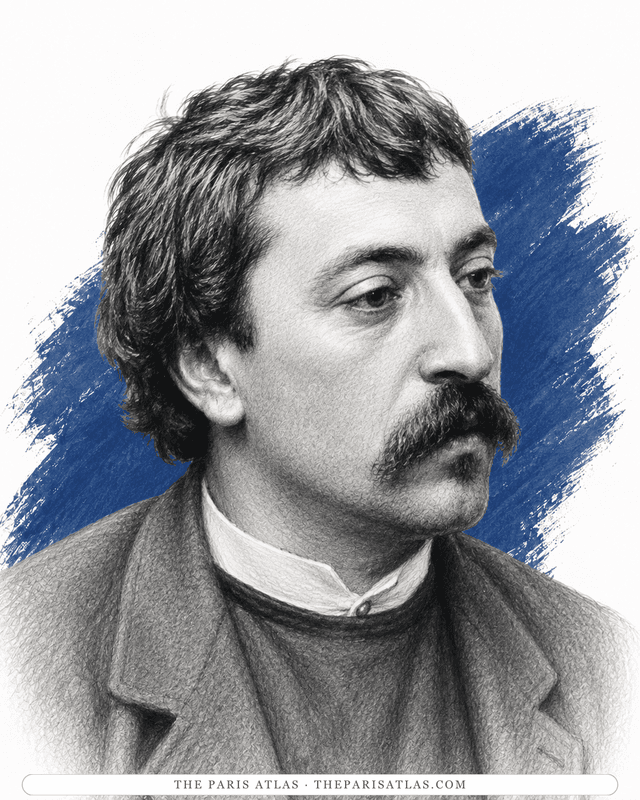
Stockbroker turned painter who came into art through Camille Pissarro, showed with the Impressionists, and left Europe for Polynesia.
View artist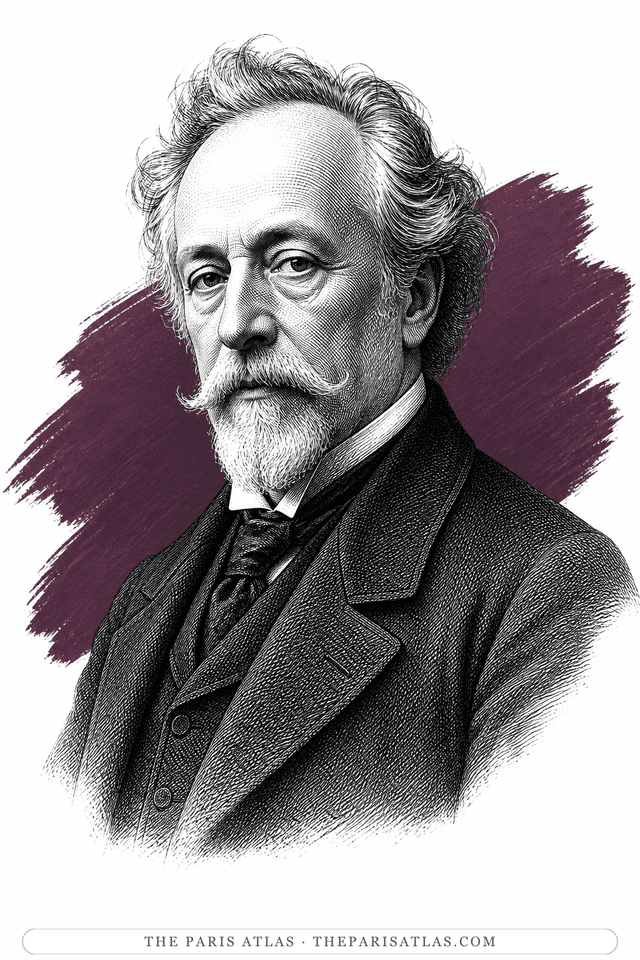
Gustave Moreau
Painter of jewelled myths — Salome, Oedipus, floating severed heads — who lived nearly his whole life in one Paris house, taught Henri Matisse and Georges Rouault at the Beaux-Arts, and turned the house into a museum before he died so the state would have to keep everything.
View artist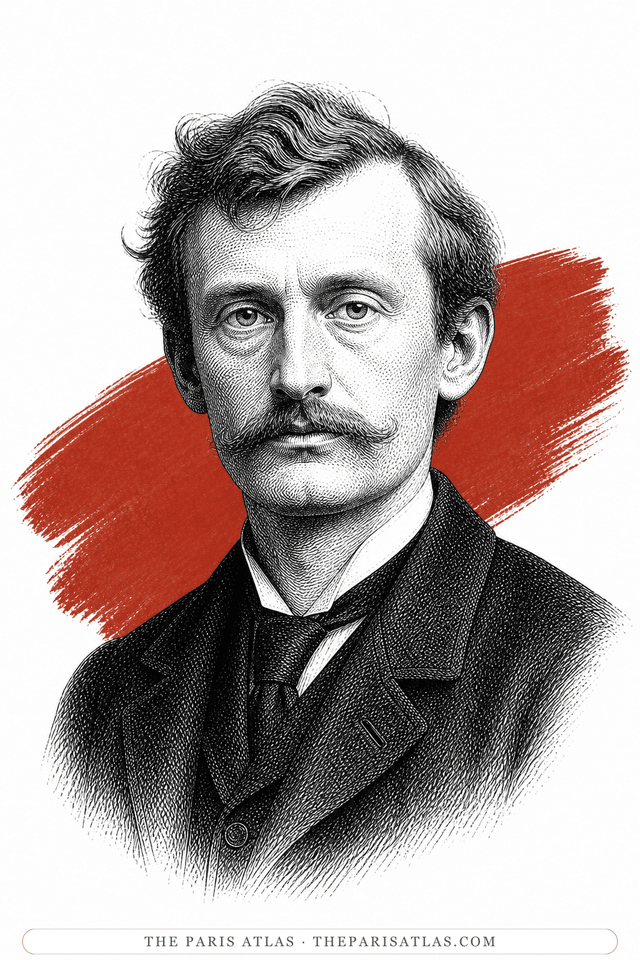
Edvard Munch
Norwegian painter of The Scream, who arrived in Paris in 1889 on a state scholarship to learn academic drawing from an anti-Impressionist professor, lost his father that November, and spent a bleak winter in the riverside suburb of Saint-Cloud writing down the vow that redirected his art — paint the moments when people are most alive, not the furniture around them.
View artist
References
The sources below include collection records, catalogues, scholarly research, and primary materials that informed this page. They document Dining Room in the Country, its making, and its place in cultural history.


1Dining Room in the Country
Official recordMinneapolis Institute of ArtUsed forOfficial record used to verify names, dates, institutional details, or other factual information on this page.
2Study for Dining Room in the Country
Official recordMinneapolis Institute of ArtUsed forOfficial record used to verify names, dates, institutional details, or other factual information on this page.

3Bonnard's drawings and memory
WebsiteMuseum of Modern ArtUsed forWeb source consulted for documented facts and historical context presented on the Dining Room in the Country page.
4Pierre Bonnard — biography and chronology
WebsiteMusée BonnardUsed forWeb source consulted for documented facts and historical context presented on the Dining Room in the Country page.
5Pierre Bonnard: Peindre l'Arcadie
WebsiteMusée d'OrsayUsed forWeb source consulted for documented facts and historical context presented on the Dining Room in the Country page.
These references provide the documented foundation for this work's history and interpretation. Claim-level citations remain attached to the specific claims they support.
 Explore more resources