
The Vagabond
The novel Colette drew from the same music-hall years, its narrator a touring performer.
Read our take
by Colette
The music hall seen from behind — the tired, precarious, intimate world of performers, by a writer who had lived it.
Music-Hall Sidelights is a collection of short pieces Colette published in 1913, drawn from her own years touring the music halls. Its French title, L'Envers du music-hall, means the reverse or wrong side of the music hall — the view from backstage rather than from the seats. The sketches follow performers through trains, dressing rooms, shabby hotels, rehearsals, and physical strain, and their subject is work: the labor, fatigue, and stubborn camaraderie behind the spectacle. It is one of the foundational books of Colette's short prose. (What's inside is described below.)
Colette spent several years on the music-hall stage after leaving her first marriage, and this book is the record of that world seen from the inside. The title says it plainly: this is the underside of the entertainment, the part the paying audience never sees. She writes about the performers — named figures like Gonsalez, Dolly, Ida, Bastienne, and Gitanette — as workers, and the book's tenderness is for their tiredness, their small economies, and the odd intimacies of people thrown together on tour.
What keeps the sketches from sentimentality is Colette's exactness about the body at work: the cold dressing rooms, the strained muscles, the makeup and the waiting. The 'innocence' of this world, as she presents it, is not moral purity but the vulnerable candor of people whose living depends on their physical effort. The book gathers twenty-six pieces, most of them new when it appeared.
Music-Hall Sidelights belongs with The Vagabond, the novel Colette drew from the same years, and it stands as one of the early books in which her short prose found its subject and its manner. In English it was published together with Mitsou, translated by Anne-Marie Callimachi.
There is no continuous story. The book collects short pieces — sketches, scenes, and portraits — about the backstage life of the music hall: performers on tour, in dressing rooms and cheap hotels, at rehearsal and between shows. Colette draws on her own years on the stage, and the sketches follow named performers through the ordinary labor and fatigue behind the spectacle.
The unifying subject is work rather than glamour — the physical effort, precariousness, and camaraderie of people who make their living on stage. The pieces are short and exact, attentive to bodies, rooms, and the texture of touring. Twenty-six pieces make up the collection, most of them previously unpublished.
The quiet sewing scene comes after accounts of injury, damaged clothing and a management unwilling to bear the cost of its performers' work. That order prevents the closing calm from erasing the conditions around it. The women have little space or time of their own, yet become absorbed in tasks whose pace they can briefly determine. Anita's attention shifts from demanding her rights to red embroidery, but her grievance has not been answered. The interval offers a change in how time feels, not a solution to the insecurity that resumes with the show.
Daylight makes the troupe's worn costumes and leftover makeup painfully visible, and the narrator includes her own reflection in the unflattering inspection. The park briefly changes that light into something kinder. Flowers and unfamiliar scents suggest a life beyond the tour, but the pause also exposes how far the performers have become separated from it. Their rush back cannot be explained by the timetable alone: they know they will catch the train. Familiar work promises warmth and activity, and also the relief of having less time to remember or think.
Colette shows the labor and fatigue the audience never sees, written by someone who had done the work herself.
The tenderness is for tiredness and small economies, not glamour — which is what keeps the sketches honest.
One of the early books in which Colette's short form found its subject and its exact, unsentimental manner.
1913
L'Envers du music-hall is published by Flammarion — sketches of the backstage music-hall world.
1957
It appears in English as Music-Hall Sidelights, translated by Anne-Marie Callimachi, together with Mitsou.
2010
Mathieu Amalric's Tournée, drawn from the book, wins the directing prize at Cannes.
The novel Colette drew from the same music-hall years, its narrator a touring performer.
Read our take

The early collection whose music-hall sketches this book expands into a whole world.
Read our takeColette. L'Envers du music-hall was published in 1913, drawn from the years she spent performing in the music halls.
L'Envers du music-hall means the reverse or wrong side of the music hall — the backstage world of performers rather than the show the audience sees.
No. It is a collection of short pieces — sketches, scenes, and portraits of backstage life — without a continuous plot.
Yes. It was translated by Anne-Marie Callimachi and published in 1957 together with Mitsou, in a single volume.
Yes. Mathieu Amalric drew on the book for his film Tournée, which won the directing prize at the Cannes Film Festival in 2010.
Explore authors with a similar voice, perspective, and influence.

The Brooklyn dropout who arrived in Paris broke at thirty-eight and wrote the exuberant, banned books that ended American censorship.
View author
The doctor of the Paris slums who wrote the century's blackest, funniest novel — and changed the sound of French prose.
View author
War correspondent who covered the Spanish Civil War, D-Day, and conflicts across five more decades; Hemingway's third wife, 1940–1945.
View authorThe sources below include the primary text, editions, scholarship, archival materials, and other records that informed this page. They document Music-Hall Sidelights, its publication, and its place in literary history.


The primary text represented by this page, used for descriptions of the work’s contents and for any quoted passages shown here.
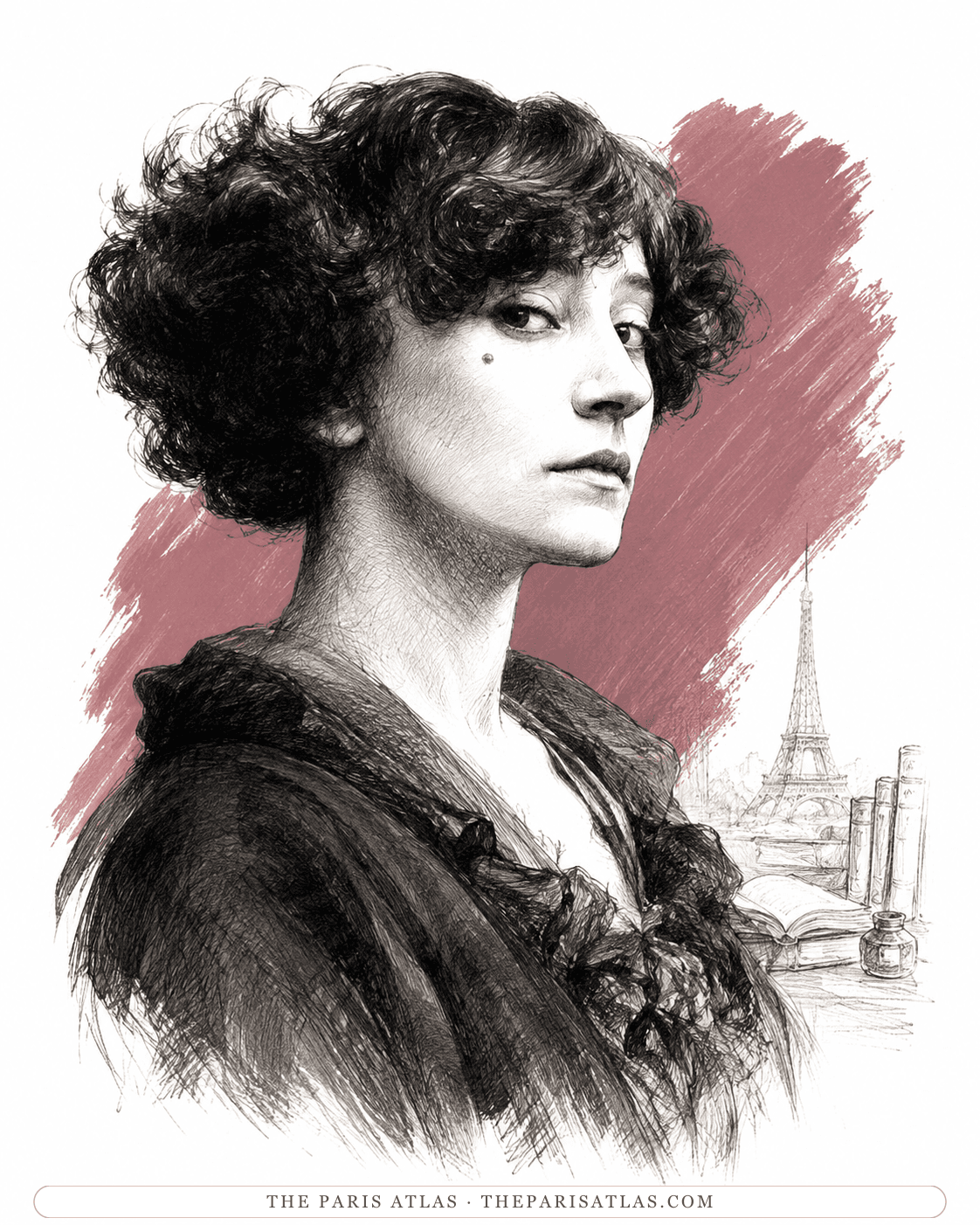
Primary French text of “L’Ouvroir” and “La Halte” in the illustrated Flammarion 1926 edition. Supports the readings of the sewing interval and park stop; no 1913 first-edition or Anne-Marie Callimachi translation collation is claimed. The artwork’s deliberate Colette likeness does not identify her as one of the five named sewing women.
The Société des amis de Colette bibliography verifies the original edition's publisher and publication date.
Used to place Music-Hall Sidelights within Colette's published work and verify its bibliographic context.

Used for independent biographical, archival, or historical context surrounding Colette's career and the period in which Music-Hall Sidelights appeared.
Used to cross-check authorship, chronology, and the work's place in Colette's wider catalogue.
Used to verify Colette's bibliography and place Music-Hall Sidelights within the broader chronology of Colette's career.
The primary text is the baseline reference for every book page. Additional references document publication history, interpretation, and historical context where that evidence is available.
 Explore more resources