
The Blue Lantern
Another of the late Le Fleuron–era books, gathered in the same final phase of Colette's publishing life.
Read our take
by Colette
A late gathering of Colette's short prose — first published not as a standalone book but as a named section of her Complete Works.
At Hand (À portée de la main) is a collection of Colette's late short prose. It is not an ordinary standalone book: it first appeared as a named section within Volume XIV of Colette's Œuvres complètes, the collected edition issued by Le Fleuron in 1950. The pieces are late, occasional prose — on appetite and food, memory, travel, objects, and the provinces of her childhood — rather than fiction. Its texts had an afterlife: nine of them were later selected for the posthumous 1961 volume Découvertes. (What's inside is described below.)
At Hand belongs to the last phase of Colette's publishing life, when her longtime companion and editor Maurice Goudeket was gathering her scattered late prose into collectible, well-made volumes. Rather than a book conceived and sold on its own, this collection took shape as one section of the large collected edition of her works — a distinction worth keeping, because the title can otherwise be mistaken for an ordinary trade book.
The prose itself is characteristic late Colette: short, exact pieces that turn appetite, memory, travel, and small objects into occasions for description and reflection. The recurring note is gourmandise in the widest sense — a relish for food, places, and things — carried by a writer who by now trusted the concrete detail to do the work. Titles later drawn from it, such as 'Moi, je suis gourmande' and 'Le Miracle d'Auray,' point to that mixture of appetite, relic, and regional recollection.
For readers building a full picture of Colette, the collection matters as much for what it is as for what it says: an example of how her final prose reached print — first inside the collected edition, then mined for later selections. Nine of its pieces were carried into the posthumous 1961 anthology Découvertes.
There is no narrative. At Hand is a gathering of late short prose — brief pieces on appetite and food, memory, travel, objects, and the provinces of Colette's childhood. The mode is descriptive and reflective rather than fictional, and the pieces are unified by a sensibility, above all a wide gourmandise, rather than by a plot.
Its bibliographic form is part of what the page records. The collection first appeared as a named section within Volume XIV of Colette's Œuvres complètes (Le Fleuron, 1950), not as a standalone book, and nine of its texts were later selected for the posthumous 1961 anthology Découvertes — among them 'Moi, je suis gourmande,' 'Tentations,' 'Reliques,' 'Le Miracle d'Auray,' and 'Province.'
“Moi, je suis gourmande” makes an extravagant wish out of traveling slowly: a donkey cart would require even more leisure than a horse-drawn carriage. Appetite here means having time to notice, choose and enjoy, not ordering the most elaborate meal. The conversation reaches its climax in bread and fresh butter, whose perfection confounds the listener's expectation of expensive dishes. Colette also distrusts polished gastronomic writing detached from eating. Sensuous language earns its place by returning to an actual taste, while the recurring pressure to hurry threatens both the meal and the attention it deserves.
Read beside the essay on appetite, “Reliques” shows another way that ordinary things acquire depth. A fresh sprig behind a family photograph repeats a childhood gesture without requiring the narrator to profess its original religious meaning. Easter eggs, cakes and a porcelain hen carry habits that outlast their explanations. The recollection of Sido complicates any simple opposition between belief and unbelief: she observes a custom while resisting the priest's approval. At the close, pruning sounds turn the Palais-Royal into remembered provincial gardens. What survives is not merely an object but a practice of responding to it.
One of the late collections that completes the record of Colette's work, including how her final prose was gathered and published.
The page identifies exactly what the collection is — a section of the collected edition, not a standalone book — a point other sources often get wrong.
Short pieces that turn food, objects, and the provinces of childhood into occasions for Colette's late descriptive intelligence.
1950
À portée de la main first appears as a named section within Volume XIV of Colette's Œuvres complètes (Le Fleuron).
1950 — collected again
The expanded Ferenczi edition of En pays connu incorporates À portée de la main alongside other recent short-prose collections.
1961
Nine of its texts are reused in the posthumous anthology Découvertes.
Another of the late Le Fleuron–era books, gathered in the same final phase of Colette's publishing life.
Read our take
The nearby late self-portrait, from the same years of gathering scattered prose into volumes.
Read our take
Colette's other book built from portraits and reflection rather than plot.
Read our takeColette. À portée de la main is a collection of her late short prose, first published as a named section within Volume XIV of her Œuvres complètes in 1950.
No. Its first securely verified appearance is as a section within Colette's collected works (Le Fleuron's Œuvres complètes, Volume XIV, 1950), not as an independent trade book published during her lifetime.
It gathers late, occasional prose — pieces on appetite and food, memory, travel, objects, and the provinces of Colette's childhood — rather than telling a story.
Short descriptive and reflective prose, unified by sensibility rather than plot, in the manner of Colette's late self-portraits and chronicles.
In Volume XIV of Colette's Œuvres complètes (1950), and — for nine of the pieces — in the posthumous anthology Découvertes (1961).
Explore authors with a similar voice, perspective, and influence.

The Brooklyn dropout who arrived in Paris broke at thirty-eight and wrote the exuberant, banned books that ended American censorship.
View author
The doctor of the Paris slums who wrote the century's blackest, funniest novel — and changed the sound of French prose.
View author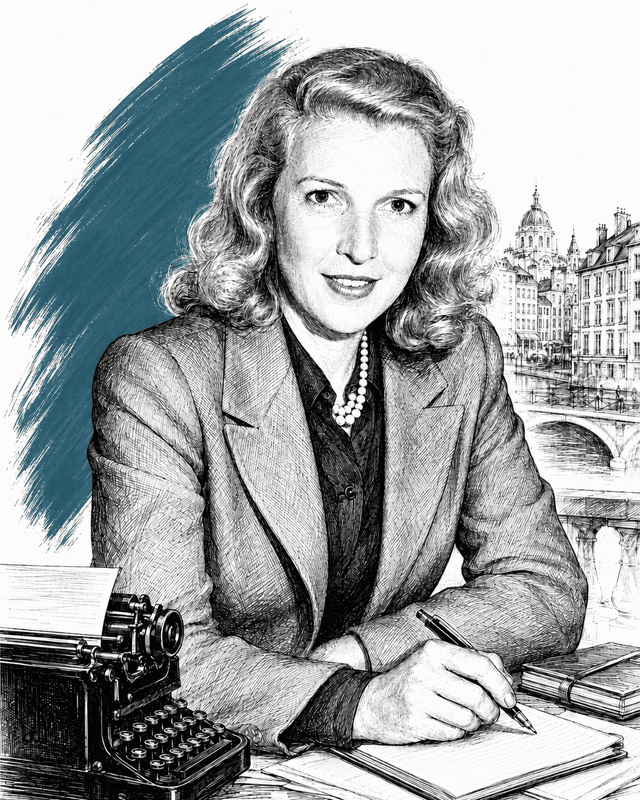
War correspondent who covered the Spanish Civil War, D-Day, and conflicts across five more decades; Hemingway's third wife, 1940–1945.
View authorThe sources below include the primary text, editions, scholarship, archival materials, and other records that informed this page. They document At Hand, its publication, and its place in literary history.


The primary text represented by this page, used for descriptions of the work’s contents and for any quoted passages shown here.
Complete Moi, je suis gourmande, pp. 411–414, and Reliques, pp. 451–455, in the French Le Fleuron 1950 collected text. Read together for appetite's pace and the persistence of everyday ritual; no complete-volume, later anthology or independent biographical collation. The bindery illustration remains symbolic.
The Société des amis de Colette bibliography verifies the original edition's publisher and publication date.
Used to verify At Hand's bibliographic context and its place within Colette's published work.

Used for independent archival, institutional, or historical context surrounding Colette and At Hand.
Used to cross-check chronology, publication history, and the circumstances in which At Hand appeared.
Used for an additional scholarly or biographical perspective on At Hand and Colette's wider career.
Publication and revision history used for the timeline.
The primary text is the baseline reference for every book page. Additional references document publication history, interpretation, and historical context where that evidence is available.
 Explore more resources