

The Evening Star
by Colette
Late reflections written from an immobile chair — memory, the war years, and lost friends, gathered under the evening star.
- 1947
About Colette
The story, briefly
Spoiler-freeThe Evening Star is a late book of Colette's, published in 1947 and first serialized in the magazine Elle in 1945–46. Its French title, L'Étoile Vesper, is the evening star — the planet Venus, watched from her Palais-Royal window in the years when illness kept her still. It is the closest Colette came to autobiography while still refusing to write a straight life: a sequence of arranged fragments that move between the present of the aging writer and the people, places, and losses of her past. (What's inside is described below.)
The story, in more detail
Confined by age and pain, Colette turned her stillness into a vantage. From the window she watches the moon and Venus over the Palais-Royal, and from that fixed point the book ranges widely: back to the newspaper world of the early century, out to the friends she is losing, and into the recent war. She writes about the arrest and internment of her husband, Maurice Goudeket, during the Occupation, and she honors dead friends — the poet Hélène Picard and the traveler Renée Hamon — with the precision of someone keeping accounts.
The book's method is fragmentary but not broken. Reflection, anecdote, portrait, and remembrance sit side by side, held together by the steadiness of the narrating voice rather than by chronology. It is late Colette turning immobility into abundance: the less she can move, the more closely she sees.
Its ending is one of the most quoted in her late work, bringing together the needle and the pen — sewing and writing set side by side as two slow companions carrying her toward the end of the road. It was translated into English as The Evening Star: Recollections by David Le Vay.
What's inside
There is no plot. The book is a sequence of arranged fragments — reflection, anecdote, portrait, and memory — written from the chair and window to which age had largely confined Colette. From the present of the aging writer, watching the evening star over the Palais-Royal, the pieces reach back into her past: the early-century world of newspapers, the friends she is outliving, and the years of the war.
Among its subjects are the wartime arrest and internment of her husband, Maurice Goudeket, and tributes to dead friends such as the poet Hélène Picard and the traveler Renée Hamon. The writing refuses straight autobiography, preferring the fragment to the life story, and it ends by pairing needle and pen — sewing and writing as two slow companions moving toward the end of the road.
Themes and analysis
A fixed point, a moving world
The opening distinguishes the companion's fear that Colette is bored from her own experience of enforced stillness. She waits for spring as though it were a visitor whose return is owed to her, letting seasonal expectation fill the room. The closing section complicates the idea of a fixed viewpoint: children below the window grow so quickly that looking away risks missing a change. Her limited movement does not stop time; it sharpens the contrast between a familiar position and an unstable world. Attention offers activity without cancelling the losses that have made that position necessary.
The needle beside the pen
Needlework promises relief from the demands of writing, but it also repeats the writer's power to remake what she sees. Colette chooses blue foliage and oversized fruit, composing a world in thread rather than merely copying nature. She imagines learning not to write, yet the search for a better word continues inside her. The final image of paired horses therefore holds together two impulses that do not always keep pace: the habit of literary labor and the wish to stop. Needle and pen become negotiating companions, not signs of an effortless retirement from art.
Why we recommend it
Autobiography on her own terms
Colette gets as near to a life story as she ever chose to, while keeping the freedom of the fragment.
Immobility turned into vision
Confined to a chair, she watches more closely, not less — the book's abundance comes from its narrow vantage.
A famous late ending
The closing image of needle and pen, two slow companions on the last road, is among her most quoted.
What this book explores
Bring it to book club
- Colette calls this almost an autobiography, yet refuses to tell her life in order. What does the fragment let her do that a straight account could not?
- From an immobile chair she claims to see more, not less. How does the book turn confinement into a way of looking?
- The final image pairs needle and pen. Why end a writer's memoir on sewing as much as on writing?
Timeline
1945
The book is serialized in the magazine Elle.
1947
L'Étoile Vesper is published as a book by Éditions du Milieu du monde.
1973
It appears in English as The Evening Star: Recollections, translated by David Le Vay.
Book editions
Hardcover
- Hardcover
- 1947
Hardcover
- Hardcover
- 1973
- David Le Vay
Ebook
- Ebook
Reader reviews
Readers may also like

Break of Day
The earlier book in which Colette first made her reflective, first-person late voice.
Read our take
Three… Six… Nine…
The nearby late self-portrait, telling her life through the sequence of her Paris addresses.
Read our takeThe Evening Star: frequently asked questions
Who wrote The Evening Star?
Colette. L'Étoile Vesper was published in 1947, after first appearing in the magazine Elle in 1945–46.
What does the title mean?
L'Étoile Vesper is the evening star — the planet Venus — which Colette watched from her Palais-Royal window in the immobile last years when she wrote the book.
What is the book about?
It is a fragmentary late memoir, moving between the present of the aging writer and her past — the early newspaper world, lost friends, and the war years, including her husband Maurice Goudeket's internment.
Is it a novel?
No. It is a book of arranged fragments — reflection, portrait, and memory — the closest Colette came to autobiography, though she refused to write a continuous life.
Is The Evening Star available in English?
Yes. It was translated by David Le Vay as The Evening Star: Recollections (Bobbs-Merrill and Peter Owen, 1973).
If you like Colette
Explore authors with a similar voice, perspective, and influence.

Henry Miller
The Brooklyn dropout who arrived in Paris broke at thirty-eight and wrote the exuberant, banned books that ended American censorship.
View author
Louis-Ferdinand Céline
The doctor of the Paris slums who wrote the century's blackest, funniest novel — and changed the sound of French prose.
View author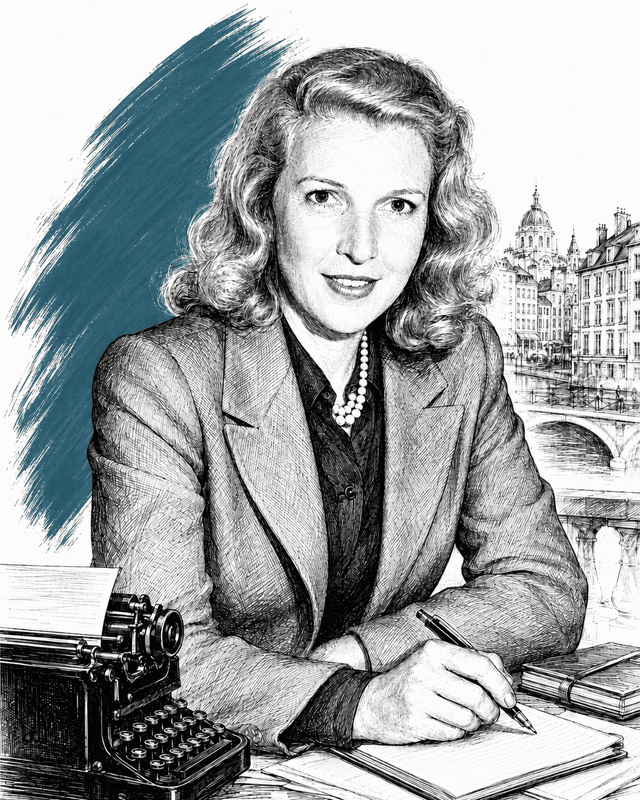
Martha Gellhorn
War correspondent who covered the Spanish Civil War, D-Day, and conflicts across five more decades; Hemingway's third wife, 1940–1945.
View author
References
References
The sources below include the primary text, editions, scholarship, archival materials, and other records that informed this page. They document The Evening Star, its publication, and its place in literary history.

1The Evening Star
NovelColette, 1947Used forThe primary text represented by this page, used for descriptions of the work’s contents and for any quoted passages shown here.
2L’Étoile Vesper — Fayard 1986 text
WebsiteWikisourceUsed forOpening of section I and complete closing section XIII, pp. 175–181, in the French Fayard 1986 transcription. Used for attention, seasonal expectation and needlework/writing; no complete-book reading, first-edition dating claim or comparison with David Le Vay's English translation.
3Colette — bibliography of original editions
WebsiteSociété des amis de ColetteUsed forThe Société des amis de Colette bibliography verifies the original edition's publisher and publication date.
4Société des amis de Colette — Chronology
WebsiteUsed forUsed to place The Evening Star within Colette's published work and verify its bibliographic context.

5Bibliothèque nationale de France — The Worlds of Colette
Exhibition catalogueUsed forUsed for independent biographical, archival, or historical context surrounding Colette's career and the period in which The Evening Star appeared.
6Library of Congress — Colette resource guide
WebsiteUsed forUsed to cross-check authorship, chronology, and the work's place in Colette's wider catalogue.
7Bibliothèque nationale de France — Colette: online resources
WebsiteUsed forUsed to verify Colette's bibliography and place The Evening Star within the broader chronology of Colette's career.
i
Why these sources are here
The primary text is the baseline reference for every book page. Additional references document publication history, interpretation, and historical context where that evidence is available.
 Explore more resources