The Barque of Dante
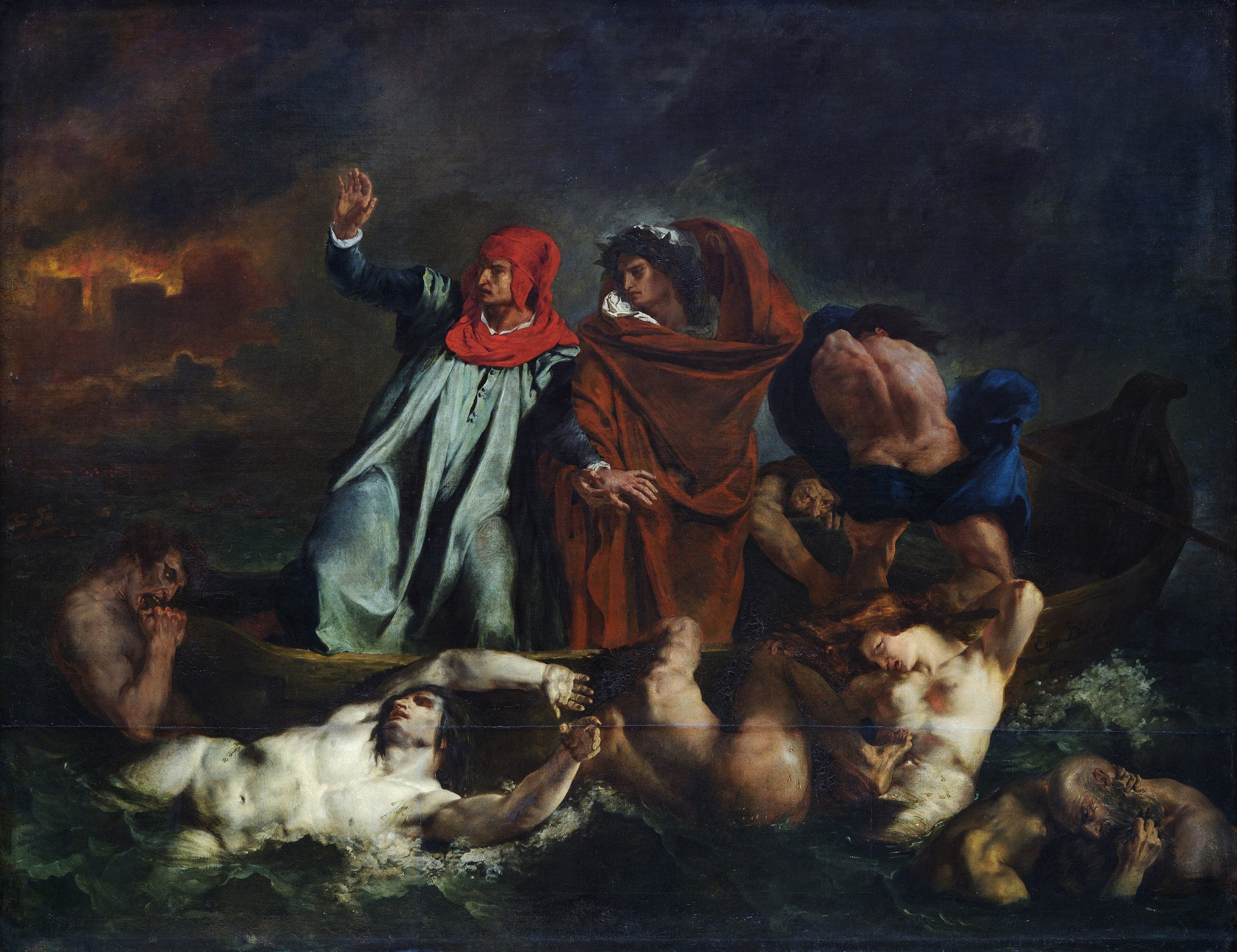
Dante and Virgil cross a dark lake in a small boat while the damned claw at the hull. Eugène Delacroix was twenty-four and had never shown at the Salon before. The state bought it on 16 July 1822 for 2,000 francs, which made his career in a single transaction, and it hung at the Musée du Luxembourg for the rest of his life.
- 1822
- Oil on canvas
About Eugène Delacroix

What the painting shows
Three men stand in a boat. Dante is on the left in a pale blue-white robe and a red hood, one hand raised. Virgil is beside him in a heavy rust-red cloak and a laurel wreath, steady, his hands open and lowered. Behind them a muscular ferryman works at an oar with his back to the viewer.
Around the boat the damned are in the water. One bites the hull. One hangs off the side with his head thrown back. Another reaches up over the gunwale and grips it. They are painted with hard, cold highlights — beads of water on grey skin — and they do most of the work of making the picture frightening. Behind everything, the walls and towers of a city burn in a red haze.
The scene is from canto eight of Dante's Inferno, the crossing of the marsh of Styx towards the city of Dis, where the wrathful fight each other in the mud. The canvas is 189 by 241.5 centimetres, a little over six feet by eight.
A debut that worked
This was the first painting Delacroix showed at the Salon. He was twenty-four. The Direction des Musées Royaux bought it on 16 July 1822 for 2,000 francs, straight out of the exhibition.
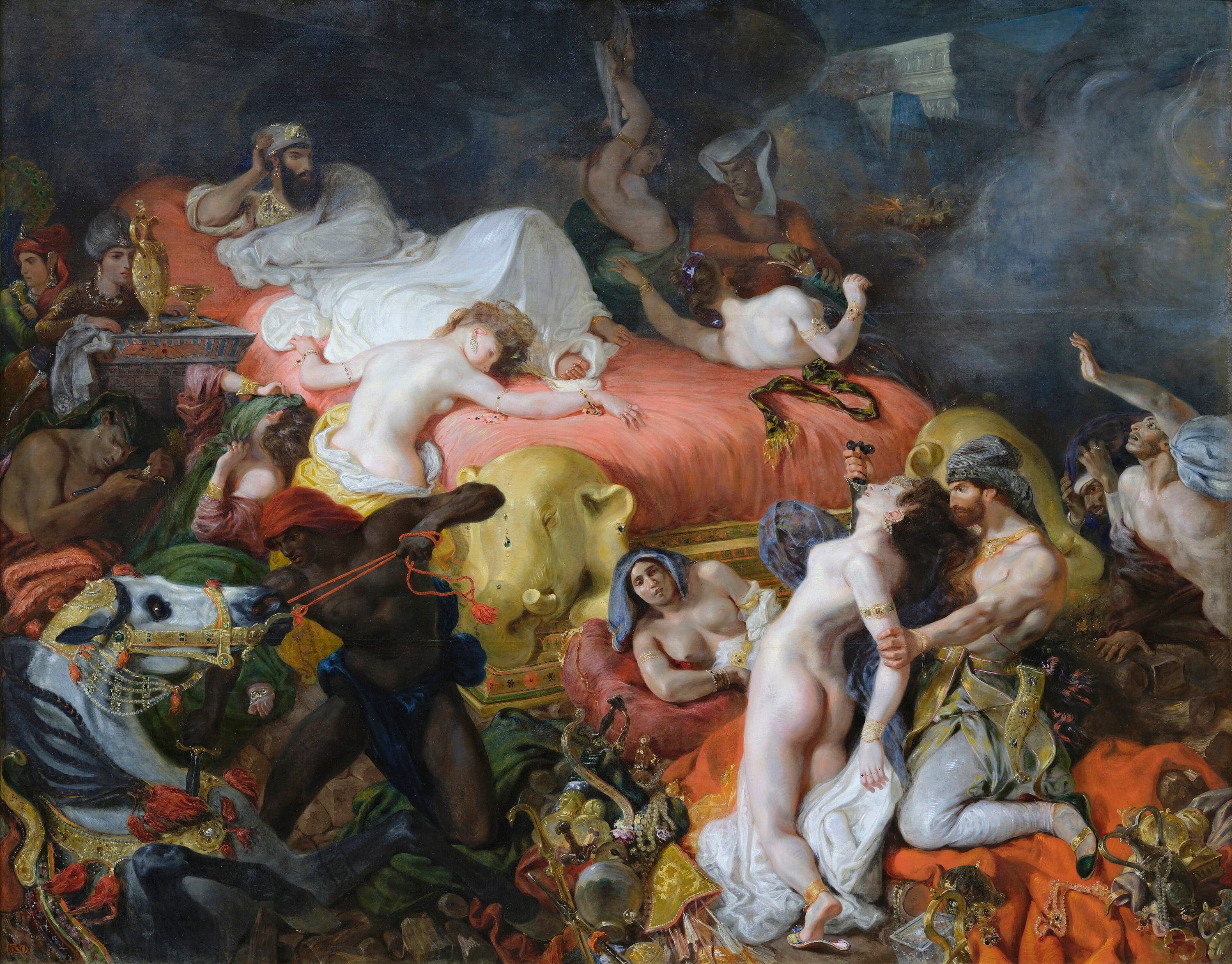
A state purchase at a first Salon is not a normal outcome, and it set up everything that followed — the Massacres de Scio two years later, the Sardanapalus in 1827. The painting went to the Musée du Luxembourg, which was then where the state showed work by living artists, and stayed there for the whole of Delacroix's life. It moved to the Louvre in November 1874, eleven years after his death.
What it owes to Géricault
Delacroix had entered Pierre-Narcisse Guérin's studio in 1815 and met Théodore Géricault there. In 1819 he posed for one of the figures in Géricault's The Raft of the Medusa. That painting was shown at the Salon of the same year, three years before this one.
The debt is visible. Both are large canvases about people in the water around a boat, both are built on a diagonal of straining bodies, and both take a subject the Salon would not have called beautiful. Delacroix was twenty-one when he modelled for Géricault and twenty-four when he painted this. Géricault died in January 1824, aged thirty-two.
Close reading
Reading the work, detail by detail
Delacroix was twenty-four and this was his first Salon painting. Close views show where the effort went: the two poets are painted smoothly and conventionally, while the bodies in the water — which is where the picture actually lives — are handled with a roughness that no jury of 1822 expected.
1.A hand up against what he is seeing
The gesture is not balance and not command. It is the hand of someone putting something away from himself. It sits at the top of the figure group and is the brightest piece of flesh in the upper half of the canvas.
2.Virgil, wreathed and unbothered
The laurel identifies him as the poet. He looks down rather than out, and his hands are open and lowered — the guide who has been here before. The rust-red cloak is the largest single area of colour in the painting and it belongs to him, not to Dante.
3.Phlegyas at the oar, back turned
The ferryman of the Styx is given no face at all. Delacroix paints him as a back and a set of shoulders, and the anatomy is the most confident thing in the picture. He is the only figure doing any work to move the boat.
4.One of the damned gnawing at the boat
Dante's eighth canto puts the wrathful in the marsh, biting each other. Delacroix has one of them set his teeth into the boat itself. The skin is painted with hard cold highlights, like something just pulled out of water, and this passage is the one that made the picture's reputation.
5.Dis burning at the far left
The burning walls are the city of Dis, where the boat is heading. Delacroix gives it perhaps a twentieth of the canvas, in the darkest corner, and the fire is the only warm light in the whole painting apart from the flesh.
6.A body laid back across the waves
The foreground is given over to bodies in the water rather than to the boat. This one lies back with the head almost submerged and the arm flung out. Delacroix had modelled for a drowned figure in Géricault's Raft of the Medusa three years earlier, and the debt shows here more than anywhere else in the canvas.
Timeline
1815
Delacroix enters Pierre-Narcisse Guérin's studio in Paris and meets Théodore Géricault.
1819
Poses for a figure in Géricault's The Raft of the Medusa, shown at the Salon that year.
1822
Paints and shows The Barque of Dante, his first Salon entry. The Direction des Musées Royaux buys it on 16 July for 2,000 francs.
1822–74
Hangs at the Musée du Luxembourg, the state's gallery for living artists, through the rest of Delacroix's life.
1874
Transferred to the Louvre in November; inventoried as INV 3820.
Where to see it
Musée du Louvre, département des Peintures
A public viewing address has not yet been confirmed for this holding.
Frequently asked questions
Where is The Barque of Dante?
The Musée du Louvre in Paris, with the Romantic paintings in the Denon wing. Its inventory number is INV 3820. It hung at the Musée du Luxembourg from 1822 until it came to the Louvre in November 1874.
What scene is The Barque of Dante?
Canto eight of Dante's Inferno. Dante and his guide Virgil are ferried across the marsh of Styx towards the burning city of Dis, and the souls of the wrathful, who fight each other in the water, grab at the boat as it passes.
Who are the figures in The Barque of Dante?
Dante is on the left in a pale blue-white robe with a red hood, one hand raised. Virgil wears the laurel wreath and the heavy rust-red cloak and stands steady beside him. The oarsman with his back turned is Phlegyas, the ferryman of the Styx in Dante's poem. The figures in the water are the damned.
Was The Barque of Dante Delacroix's first painting?
It was his first painting at the Salon, in 1822, when he was twenty-four. It was not his first picture, but it was the one that started his public career — the state bought it within weeks.
How much did the French state pay for The Barque of Dante?
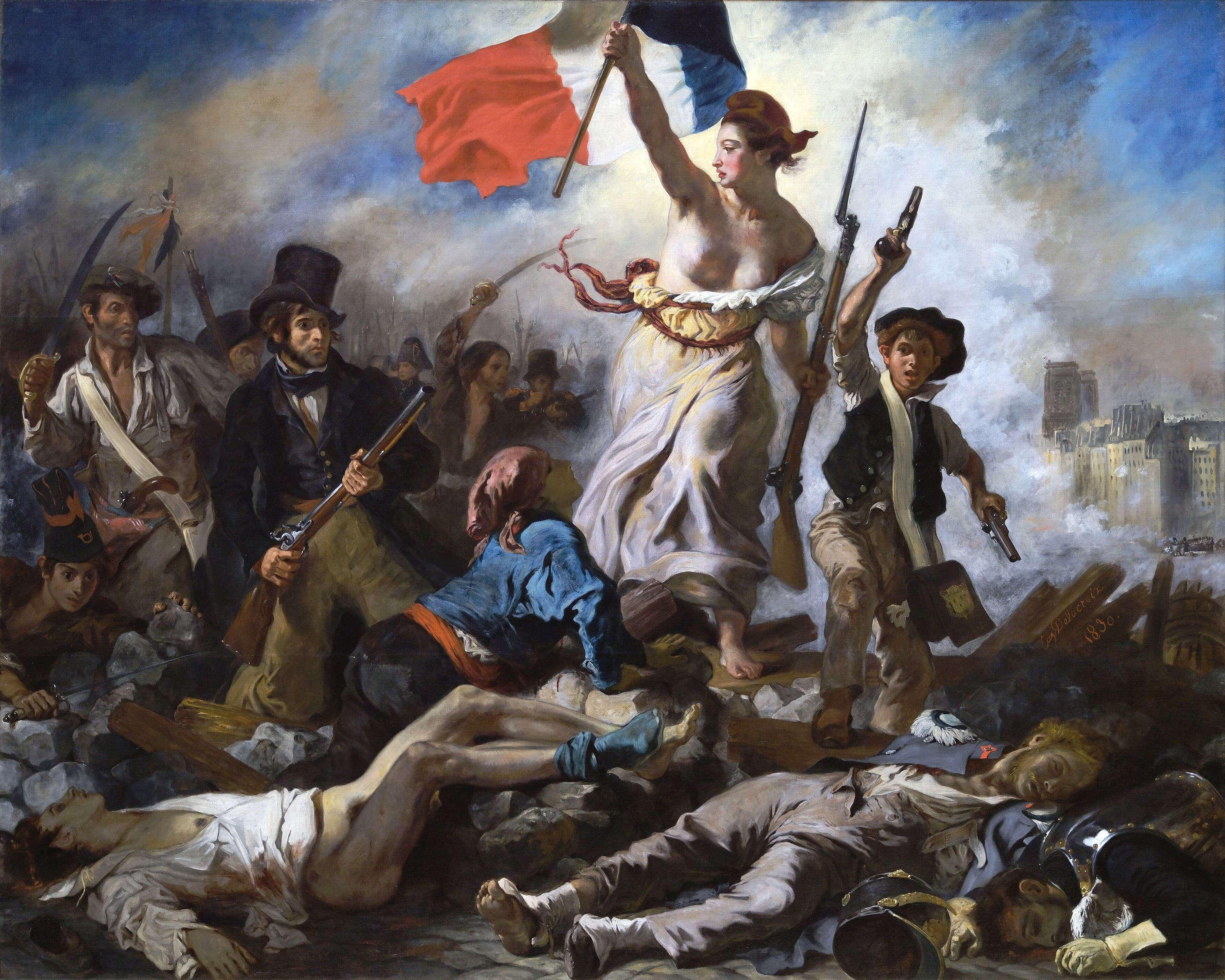
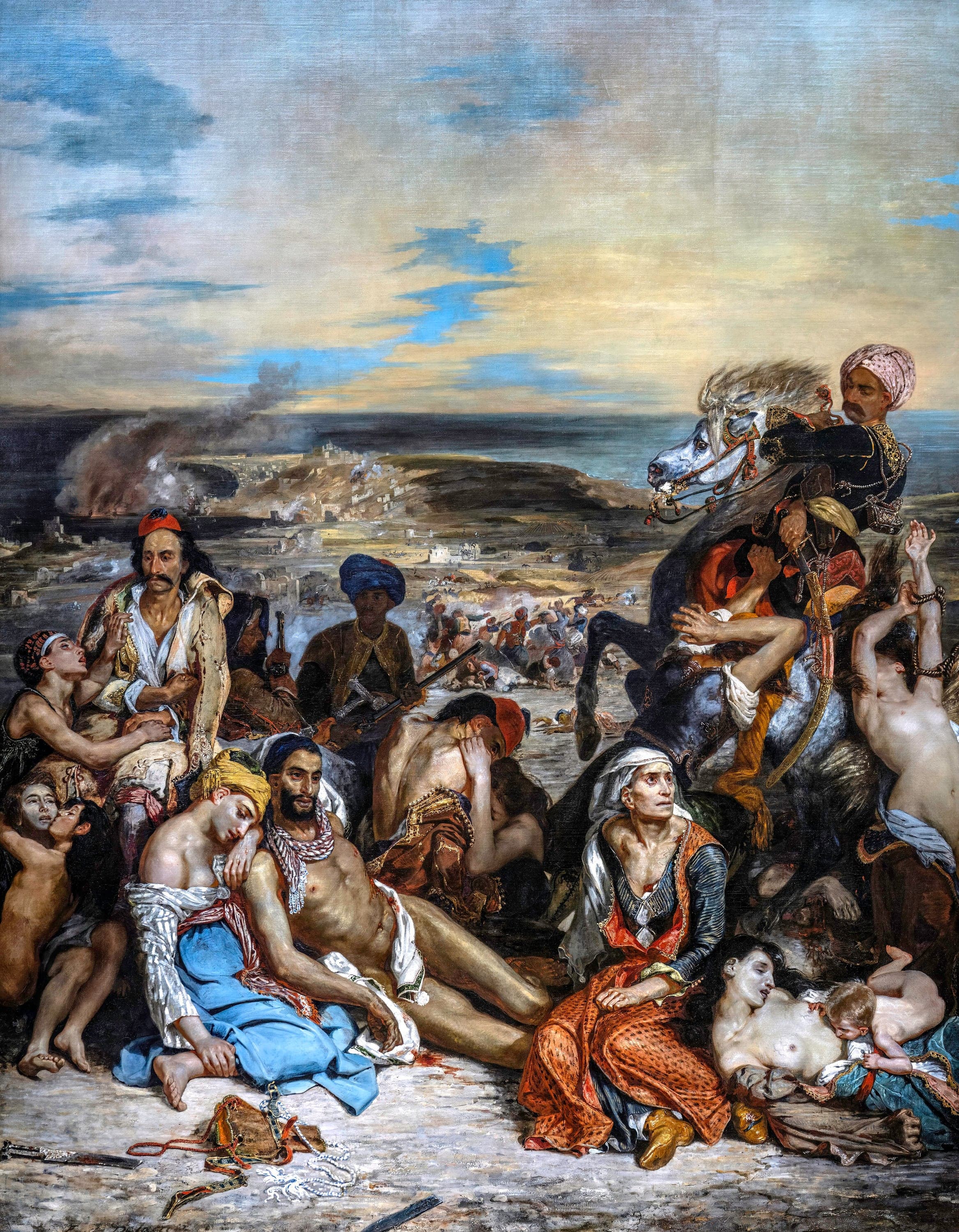
2,000 francs, on 16 July 1822, bought by the Direction des Musées Royaux out of the Salon. For comparison, the state paid 6,000 francs for his Massacres de Scio in 1824 and 3,000 francs for Liberty Leading the People in 1831.
How is The Barque of Dante connected to Géricault?
Delacroix met Théodore Géricault in Guérin's studio in 1815 and modelled for one of the figures in The Raft of the Medusa in 1819. The Barque of Dante takes the same kind of subject — bodies in water around a boat, arranged on a diagonal — and was painted three years after he posed for it.
More by Eugène Delacroix
If you like Eugène Delacroix
Explore painters from the same movements and circles.

Théodore Géricault
French painter who turned the recent Méduse disaster into a monumental modern history painting and a defining work of French Romanticism.
View artist
Tarsila do Amaral
Brazilian painter who spent the 1920s moving between São Paulo and Paris, studied Cubism under André Lhote, Albert Gleizes and Fernand Léger, and used what she learned to paint Brazilian towns, railways, plants and bodies. Her 1928 painting Abaporu prompted the manifesto that gave the Anthropophagic movement its name.
View artist
Arman
French-American artist, lifelong friend of Yves Klein, and a founder of New Realism.
View artist
References
The sources below include collection records, catalogues, scholarly research, and primary materials that informed this page. They document The Barque of Dante, its making, and its place in cultural history.


1La Barque de Dante, Eugene Delacroix
WebsiteMusee du LouvreUsed forWeb source consulted for documented facts and historical context presented on the The Barque of Dante page.
2Biography of Eugène Delacroix
WebsiteMusée national Eugène-Delacroix, 2026Used forWeb source consulted for documented facts and historical context presented on the The Barque of Dante page.
3The Divine Comedy, translated by Henry Wadsworth Longfellow (1867)
WebsiteWikisourceUsed forWeb source consulted for documented facts and historical context presented on the The Barque of Dante page.
4Le radeau de la Méduse (INV 4884)
WebsiteMusée du Louvre, 2026Used forWeb source consulted for documented facts and historical context presented on the The Barque of Dante page.
These references provide the documented foundation for this work's history and interpretation. Claim-level citations remain attached to the specific claims they support.
 Explore more resources