The Paris AtlasCharting the artists, works, and places worth returning to.
  • Painter
· French · 1791–1824

Théodore Géricault

French painter who turned the recent Méduse disaster into a monumental modern history painting and a defining work of French Romanticism.

Details

Lived
1791–1824
Born
26 September 1791
Birthplace
Rouen, France
Died
26 January 1824 · aged 32
Place of death
Paris, France
Nationality
French
Children
Georges-Hippolyte Géricault
Roles
Painter

About Théodore Géricault

Jean-Louis André Théodore Géricault (1791–1824) was a French painter whose eighteen-foot canvas The Raft of the Medusa turned a recent naval scandal into the founding painting of French Romanticism. He worked at scale, painted from posed models and studies of real cadavers, and finished his most famous work at twenty-seven.

He was a passionate horseman as much as a painter, and rode as recklessly as he worked. Two riding accidents in 1822 and 1823 caused a spinal injury that never healed; a tuberculous infection killed him in Paris on 26 January 1824, aged thirty-two. Eugène Delacroix, who had modelled for one of the figures on the Raft as a young man, said the news left him in tears in the street.

A Norman childhood, a Parisian training

Géricault was born in Rouen in 1791 into a prosperous merchant family and moved to Paris as a child. His interest in horses started early — the family had money and stables and the boy rode nearly every day. In 1808 he entered the Paris studio of Carle Vernet, whose speciality was horse painting; in 1810 he moved on to Pierre Guérin's more academically demanding studio, where he shared a room with a young Eugène Delacroix.

Neither Vernet nor Guérin held him for long. Géricault spent more of his training hours in the Louvre copying Rubens, Titian, and Caravaggio directly, and taught himself as much as any master taught him. His first Salon entry in 1812 — Charging Chasseur, an over-life-size portrait of a mounted officer of the Imperial Guard — won a gold medal at twenty-one and announced a painter who did not intend to work at ordinary scale.

Italy, an affair, and the summer he began the Raft

In 1816 Géricault paid for his own trip to Rome and Florence — a private Grand Tour after failing to win the Prix de Rome. In Rome he studied Michelangelo in the Sistine Chapel; the muscular figures on the raft that followed were the direct legacy of that year. He came back to Paris in the autumn of 1817 changed by the trip and privately in trouble: he had begun an affair with Alexandrine-Modeste Caruel, his uncle's twenty-two-year-old wife.

A son, Georges-Hippolyte, was born to Alexandrine in August 1818 and hidden — sent to a village nurse under a false name, and known to his father only through his uncle's household. The scandal shaped the rest of Géricault's life: the affair broke his relationship with his uncle, alienated his father, and drove him into the near-monastic year of work on The Raft of the Medusa. He shaved his head in the autumn of 1818 to keep himself from going out.

The Raft of the Medusa

The French naval frigate Méduse ran aground off the coast of Senegal on 2 July 1816 with an incompetent Bourbon captain at the helm. A hundred and fifty passengers were put onto a makeshift raft cut from the ship's timbers; after thirteen days at sea only fifteen were still alive, and only ten survived the rescue. The scandal — the incompetence of the appointment, the cannibalism on the raft, the government's attempt to bury the story — was still fresh two years later when Géricault began his painting.

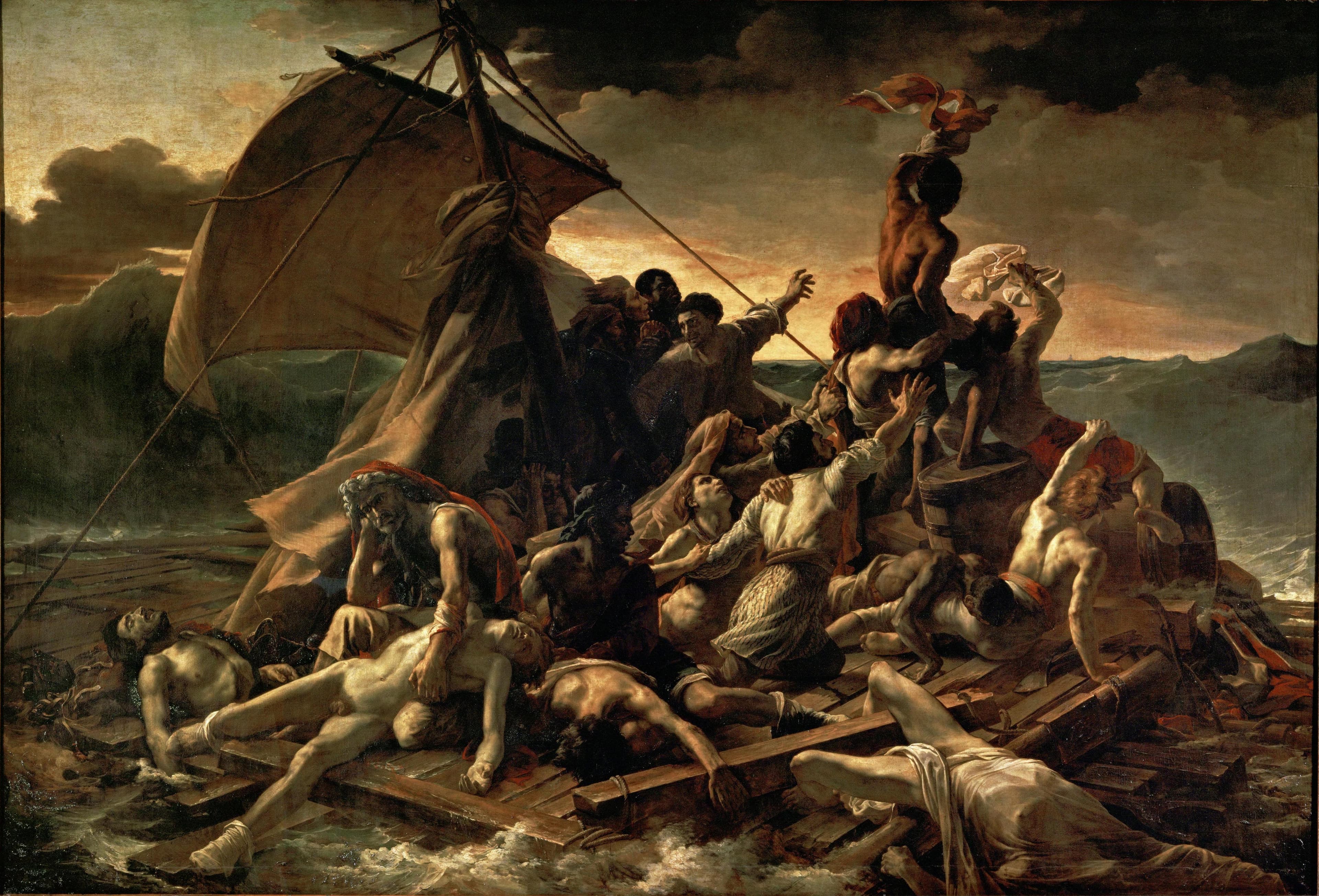
He spent eighteen months on the canvas. He interviewed two of the survivors, Henri Savigny and Alexandre Corréard, and used their book about the ordeal as reference. He commissioned a scale model of the raft from a former Méduse carpenter, borrowed severed limbs from the Beaujon Hospital morgue, and painted body parts drying in his studio to get the tones of dying flesh right. Delacroix modelled for one of the corpses. Géricault settled on the moment the survivors sight the tiny rescue brig Argus in the distance — before they know whether they have been seen.

  • The Raft of the Medusa (1818–19)

    The Louvre canvas — its dimensions, its models, the Salon controversy, and the meaning of the Black figure at the summit of the composition.

England, the mad, and the horses

The Raft was hung poorly at the Salon of 1819. The critics were divided — Charles X's government tried to buy the painting to keep it out of the public eye — and Géricault took it to London in 1820, where it was exhibited at the Egyptian Hall and drew forty thousand paying visitors. He spent two years in England painting horse races, English street scenes, and studies of working horses. He came back to Paris in 1822 exhausted and financially strained.

Between 1821 and 1824 Géricault painted a series of ten portraits of patients at the Salpêtrière and Bicêtre hospitals in Paris, working with the young alienist Dr Étienne-Jean Georget. Five of the paintings survive: portraits of a man diagnosed with military mania, a woman with pathological envy, a compulsive gambler, a kidnapper of children, and a kleptomaniac. They are among the earliest sustained portraits of the mentally ill in Western painting, and they treat their subjects with a seriousness the century's medicine did not usually extend to them.

Two falls and a Père-Lachaise grave

Géricault fell from a horse twice in 1822 and 1823. Both accidents damaged his spine. The tumour that followed became tubercular; he was bedridden through his final year and painted with his easel arranged over his bed. Delacroix visited him in December 1823 and reported that even the smaller studies in the sickroom carried the same charge as the Raft. Géricault died on 26 January 1824. He was thirty-two.

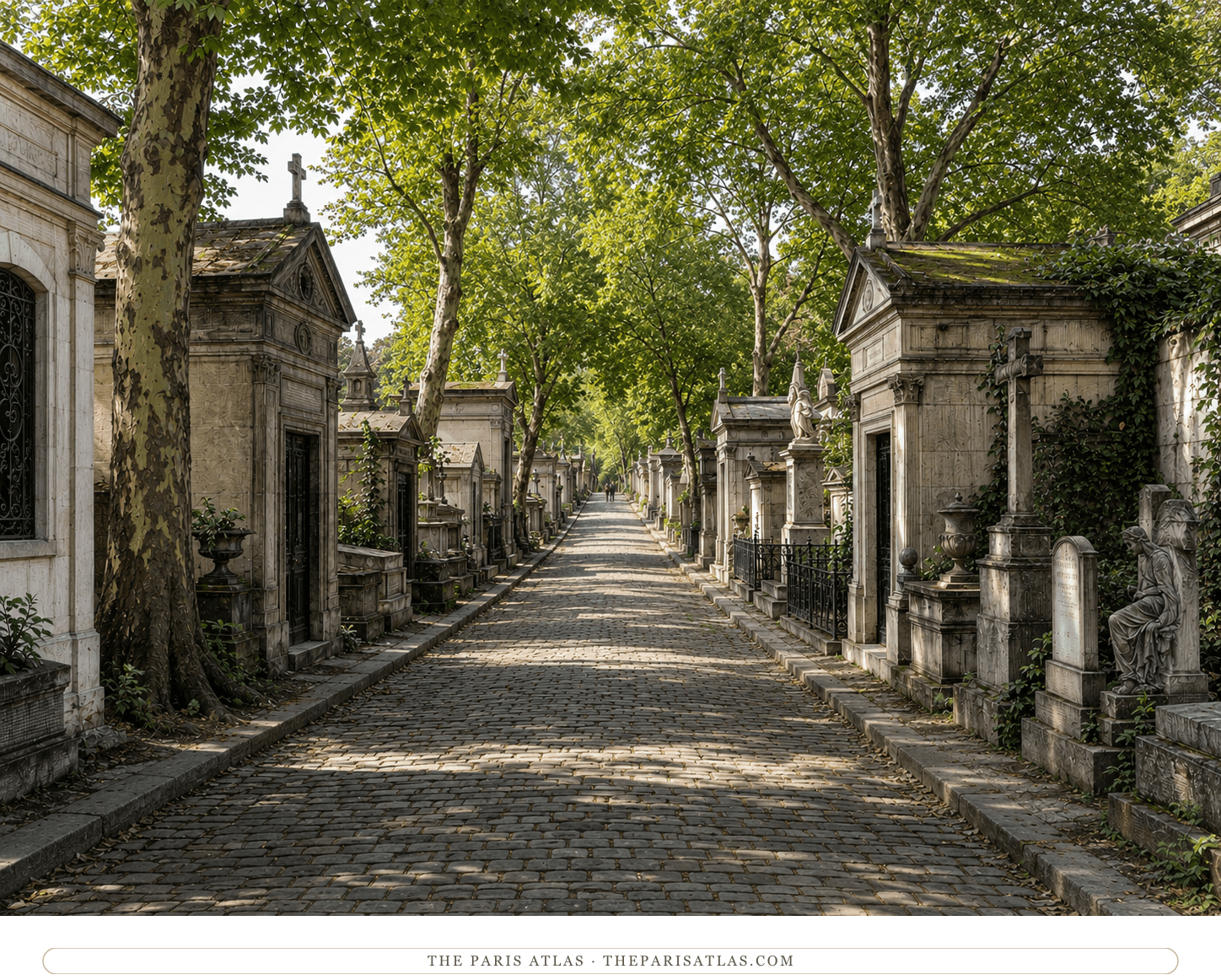
He was buried at Père-Lachaise Cemetery in Division 12. Antoine Étex cast a bronze relief of the Raft into the front of the tomb, the first time in the century a French artist's grave carried the reduction of his own most famous work. Delacroix took up the Romantic argument Géricault had begun — his Death of Sardanapalus (1827) and Liberty Leading the People (1830) both owe their scale and their political nerve directly to the Raft.

Life events

  1. 26 September 1791

    Born in Rouen, Normandy, into a prosperous merchant family.

  2. 1808

    Enters the Paris studio of Carle Vernet, the horse and battle painter.

  3. 1810

    Moves to Pierre Guérin's studio, where he shares a room with the young Eugène Delacroix.

  4. 1812

    Wins a gold medal at his first Salon with Charging Chasseur, the over-life-size portrait of a Napoleonic cavalry officer.

  5. 1816–1817

    Travels to Rome and Florence at his own expense; studies Michelangelo in the Sistine Chapel.

  6. 1818

    Begins an affair with his uncle's wife Alexandrine-Modeste Caruel; their son Georges-Hippolyte is born in August. Starts work on The Raft of the Medusa in Paris.

  7. 1819

    Exhibits The Raft of the Medusa at the Salon; the government fails to buy it and it is hung poorly.

  8. 1820

    Ships the painting to London and exhibits it at the Egyptian Hall for two shillings a visit; forty thousand people pay to see it.

  9. 1821–1824

    Paints ten portraits of Salpêtrière and Bicêtre patients with Dr Étienne-Jean Georget; five survive.

  10. 1822 and 1823

    Falls from a horse twice; a spinal tumour follows and turns tubercular.

  11. 26 January 1824

    Dies in Paris, aged thirty-two. Buried in Division 12 of Père-Lachaise Cemetery under a tomb carrying a bronze relief of the Raft cast by Antoine Étex.

Selected works

Cataloged from the holding institutions' records. Reproductions appear only where the rights are verified.

Paintings

Théodore Géricault's Raft of the Medusa: dead and living shipwreck survivors crowded on a timber raft, rising toward a Black man who waves cloth at a tiny rescue ship on the horizon

Artwork reproduction

Painting · French Romanticism

The Raft of the Medusa

1818–1819 · Oil on canvas

Théodore Géricault made this monumental painting from a recent French naval disaster. It shows the survivors of the Méduse raft trying to signal the distant rescue ship Argus after nearly two weeks at sea.


Musée du Louvre, Paris

Théodore Géricault, The Raft of the Medusa, 1818–1819. Musée du Louvre, Paris. Image: public domain.

Théodore Géricault’s Places

The cataloged places connected to Théodore Géricault — through the books, and through the documented record.

Places you can enter today appear first, followed by addresses to see from outside and sites that have vanished.

Questions about Théodore Géricault

Who was Théodore Géricault?

Théodore Géricault (1791–1824) was a French painter, one of the founders of French Romanticism, best known for The Raft of the Medusa. He worked at monumental scale, painted from posed models and dissected cadavers, and died at thirty-two from a spinal injury caused by two falls from a horse.

What is Théodore Géricault's most famous painting?

The Raft of the Medusa (1818–1819) — an eighteen-foot canvas that turned a recent French naval scandal into the founding painting of French Romanticism. It hangs in the Louvre in Paris.

How did Théodore Géricault die?

Two riding accidents in 1822 and 1823 damaged his spine. The tumour that followed became tubercular, and he died in Paris on 26 January 1824 at thirty-two.

Where is Théodore Géricault buried?

In Division 12 of Père-Lachaise Cemetery in Paris. His tomb carries a bronze relief of The Raft of the Medusa cast by Antoine Étex — the first French artist's grave in the century to reproduce his own most famous work at its front.

What is Théodore Géricault's role in French Romanticism?

He is one of the movement's founders. The Raft of the Medusa broke with the calm, classical history painting of David and his followers by using a recent scandal, a monumental scale, and a modern political charge. Delacroix — Géricault's studio-mate at Guérin's, and a model for one of the figures on the Raft — took the argument forward through Death of Sardanapalus and Liberty Leading the People.

Who did Théodore Géricault paint at the Salpêtrière?

Between 1821 and 1824 he painted ten portraits of patients at the Salpêtrière and Bicêtre hospitals in Paris, working with the young alienist Dr Étienne-Jean Georget. Five survive: portraits of a man diagnosed with military mania, a woman with pathological envy, a compulsive gambler, a kidnapper of children, and a kleptomaniac.

Sourced claims

Every connection the graph holds for Théodore, with the evidence behind it.

Buried at · 1824

Père-Lachaise Cemetery

Buried in Division 12 in January 1824, aged thirty-two, after a series of horse-riding accidents and a spinal infection. His tomb, topped by a bronze relief of the Raft of the Medusa cast by Antoine Étex, is one of the cemetery's most visited artist graves and one of the earliest large monuments erected there to a painter of Romanticism.

Théodore Géricault — Encyclopaedia Britannica; Metropolitan Museum of Art, Romanticism (2004)

Sources and further reading

  • Théodore Géricault — Encyclopaedia Britannica
  • Musée du Louvre, Le Radeau de la Méduse — Une œuvre contre l'esclavage ? (2026)
  • Jean-Baptiste-Henri Savigny and Alexandre Corréard, Naufrage de la frégate La Méduse, faisant partie de l'expédition du Sénégal, en 1816 (1817)
  • Metropolitan Museum of Art, Romanticism (2004)