Paradise Lost — the Doré illustrations
by Gustave Doré
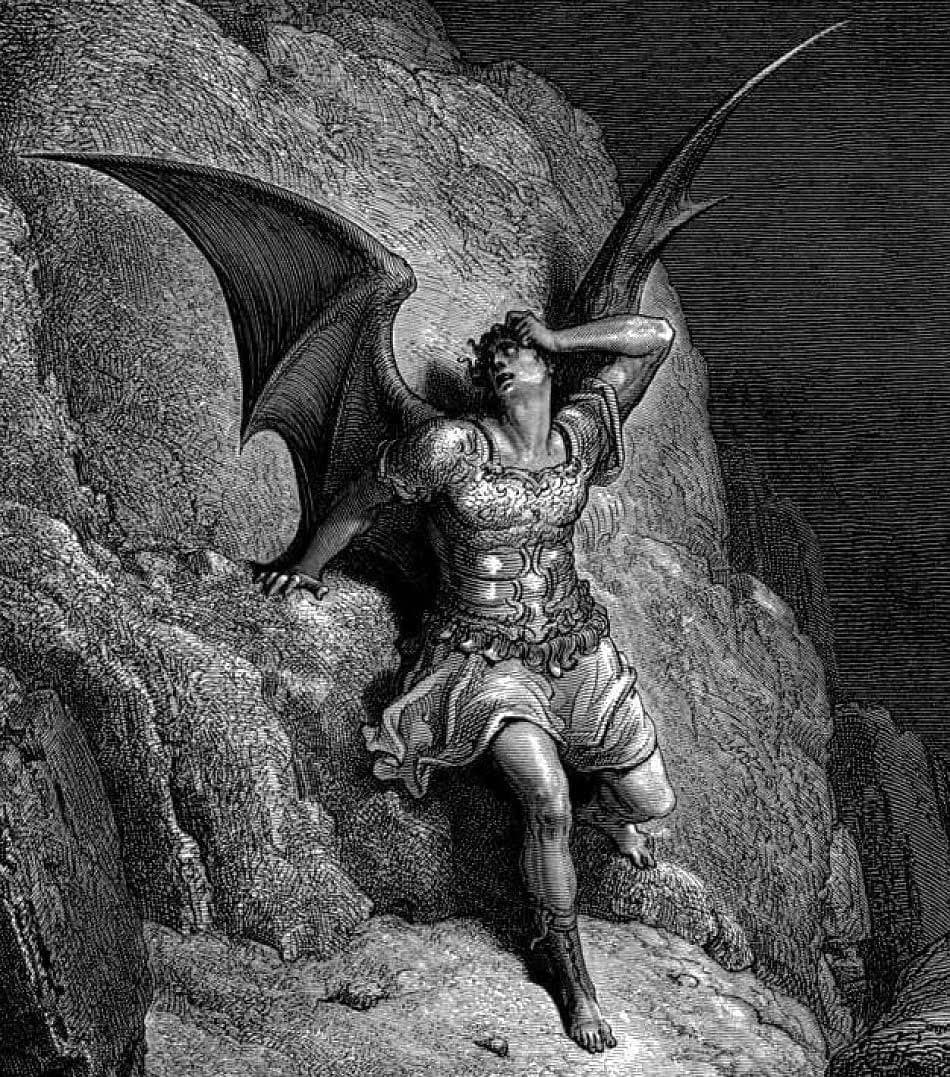
Doré's fifty-plate Paradise Lost, published by Cassell in London in 1866. Its Satan — winged, muscular, falling through cloud and void — became the standard modern image of Lucifer.
- 1866
- Wood engravings after Doré's drawings
About Gustave Doré
Milton for the English market
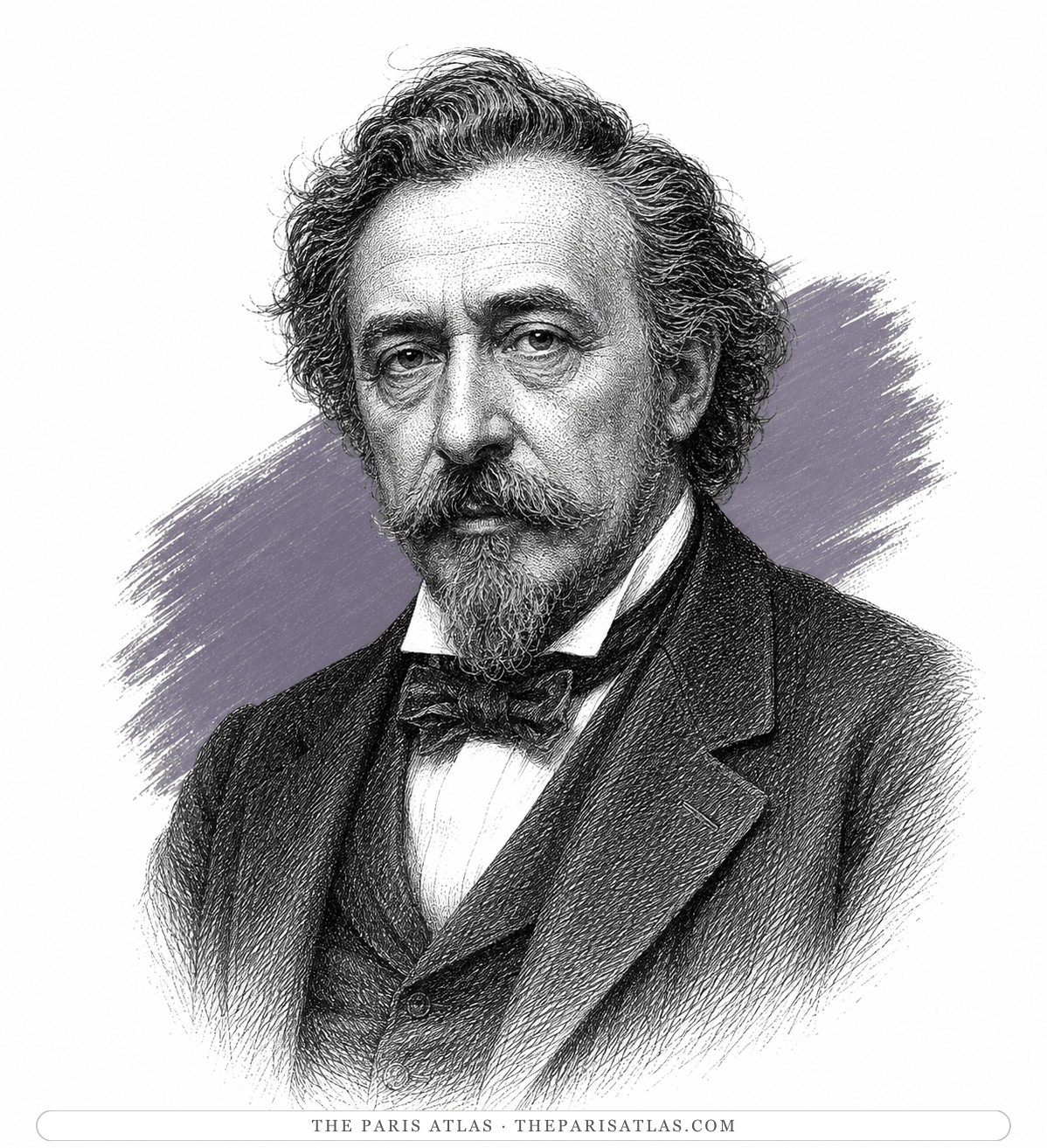
By the mid-1860s Doré's largest audience was English, and Cassell commissioned the national epic: John Milton's Paradise Lost, published in 1866 with fifty full-page plates. It joined the Bible of the same year in the run of great folios, and in Britain it outsold nearly everything else with his name on it.
Milton gave Doré his most congenial subject since Dante: cosmic space. The plates stage the war in heaven, the fall of the rebel angels, the council in Pandemonium and Eden before and after the Fall as events in an immense vertical universe of cloud, light and abyss.
The Satan everyone inherited
The suite's lasting export is its Satan: a heroic, winged, athletic figure — falling head-first with his host, brooding on the burning lake, flying alone through chaos toward the new world. Doré took Milton's ambiguous grandeur literally, and the result displaced the horned medieval devil in popular imagination.
Fantasy illustration, comics and cinema have drawn on these plates ever since; the fallen-angel figure of modern visual culture is, at root, Doré's Milton.
Close reading
Reading the work, detail by detail
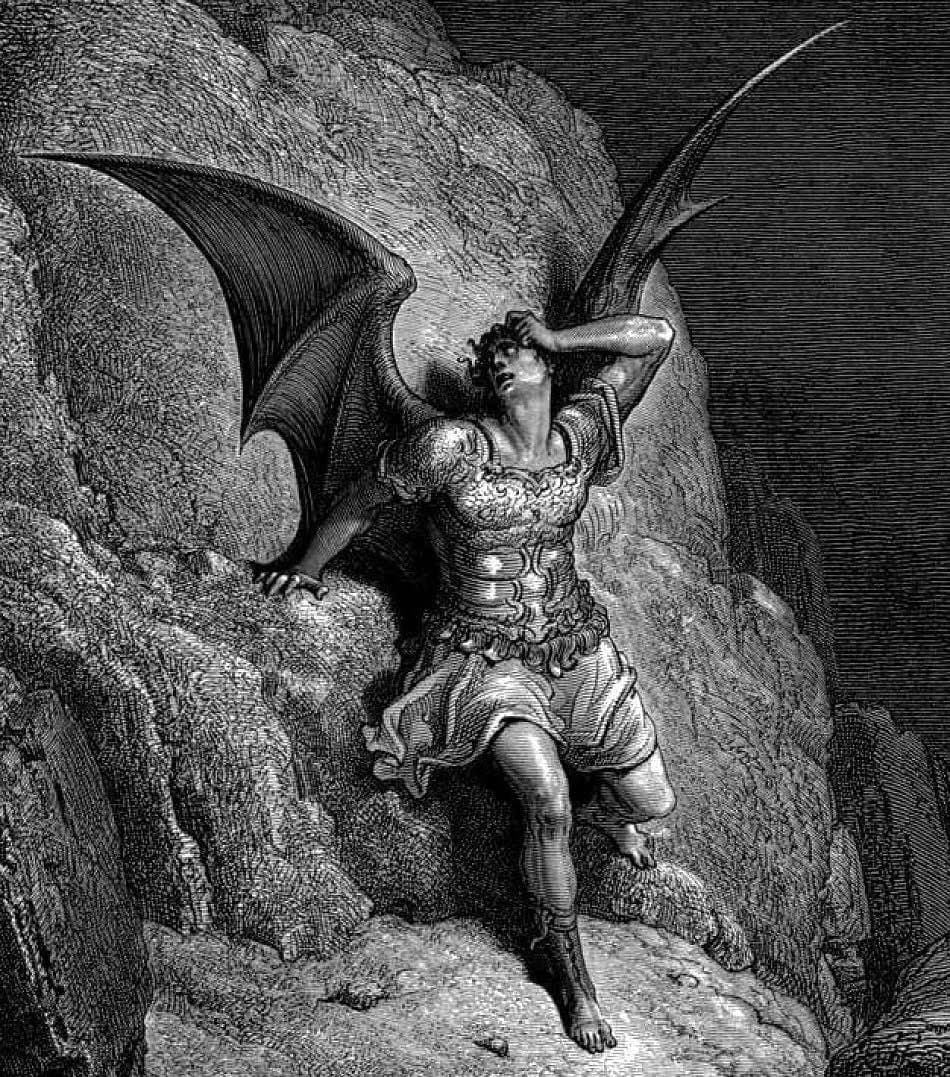
Doré's profile of Satan condenses the suite's enduring visual invention: the fallen angel as monumental, beautiful, and isolated rather than a horned caricature. The details show thought, wing, and abyss supporting that ambiguity.
1.The profile gives rebellion a thinking face
Downturned gaze, compressed mouth, and shadowed brow present inward calculation rather than theatrical rage. Doré gives the antagonist enough psychological gravity to preserve Milton's dangerous grandeur.
2.The wing preserves the scale of what has fallen
Layered feathers fill much of the plate and keep the figure visibly angelic. Fallenness is represented as displaced power, not as the erasure of former magnificence.
3.Empty darkness isolates the figure more than chains could
Sparse rock and deep shadow provide almost no social or geographic foothold. The figure's monumentality therefore reads alongside absolute separation—the rebel made visually alone.
4.The lowered brow makes thought feel heavy
The eyes sit beneath a strongly bent brow, so reflection appears as physical pressure. Doré makes the figure's intelligence visible without presenting it as calm or liberating.
5.The hand holds tension instead of taking action
The fingers draw inward rather than reaching into the surrounding darkness. That contained gesture makes defeat feel temporary and dangerous, as though thought is gathering before another decision.
6.The torso twists between collapse and return
The body is neither fully upright nor fully at rest. Its twist preserves the possibility of movement, which keeps the image from becoming a simple picture of a defeated figure lying still.
Where to see it
A viewing location has not yet been listed for this work.
Frequently asked questions
When did Doré illustrate Paradise Lost?
In 1866, for the London publisher Cassell, with fifty full-page plates. It appeared the same year as his folio Bible and was aimed squarely at the English market, where his books sold best.
How many plates are in Doré's Paradise Lost?
Fifty full-page wood engravings, covering the poem from the fall of the rebel angels to the expulsion from Eden.
What is the most famous image from Doré's Paradise Lost?
The falling and brooding Satans: the plunge of the rebel angels, Satan on the burning lake, and Satan flying through chaos. The heroic winged Lucifer of modern books, games and films descends from these plates.
How do Doré's Milton plates differ from his Dante plates?
The Inferno of 1861 is subterranean — cliffs, pits and ice seen by two small travellers. Paradise Lost is aerial: falls through space, hosts of angels in open sky, light against void. Together they mapped the two halves of the nineteenth-century supernatural imagination.
Where can I see Doré's Paradise Lost illustrations?
The plates are in the public domain: modern reprints, online scans and rare-book libraries all carry them, and the 1866 Cassell folio surfaces regularly on the collectors' market.
More by Gustave Doré
If you like Gustave Doré
Explore painters from the same movements and circles.
Tarsila do Amaral
Brazilian painter who spent the 1920s moving between São Paulo and Paris, studied Cubism under André Lhote, Albert Gleizes and Fernand Léger, and used what she learned to paint Brazilian towns, railways, plants and bodies. Her 1928 painting Abaporu prompted the manifesto that gave the Anthropophagic movement its name.
View artist
Arman
French-American artist, lifelong friend of Yves Klein, and a founder of New Realism.
View artist
Jean Arp
Strasbourg-born sculptor and poet — Hans in German, Jean in French, both all his life — who co-founded Dada at the Cabaret Voltaire in 1916, composed collages by dropping torn paper 'according to the laws of chance', and settled at Meudon outside Paris in a house his wife Sophie Taeuber-Arp designed.
View artist
In images
References
The sources below include collection records, catalogues, scholarly research, and primary materials that informed this page. They document Paradise Lost — the Doré illustrations, its making, and its place in cultural history.


1Gustave Doré
WebsiteWikipediaUsed forWeb source consulted for documented facts and historical context presented on the Paradise Lost — the Doré illustrations page.
2Gustave Doré — Encyclopaedia Britannica
WebsiteEncyclopaedia BritannicaUsed forWeb source consulted for documented facts and historical context presented on the Paradise Lost — the Doré illustrations page.
3La vie de Gustave Doré : une chronologie
WebsiteBnF EssentielsUsed forWeb source consulted for documented facts and historical context presented on the Paradise Lost — the Doré illustrations page.
4Gustave Doré (1832–1883): Master of Imagination — exhibition
WebsiteMusée d'OrsayUsed forWeb source consulted for documented facts and historical context presented on the Paradise Lost — the Doré illustrations page.
These references provide the documented foundation for this work's history and interpretation. Claim-level citations remain attached to the specific claims they support.
 Explore more resources