The Paris AtlasCharting the artists, works, and places worth returning to.
  • Poet
  • Playwright
· English · 1788–1824

Lord Byron

The most famous poet in Europe by the age of twenty-four, and the inventor of the brooding, guilty, magnificent outsider that literature still calls the Byronic hero. He never once set foot in Paris: his travels went around France rather than through it, and no Paris address, publisher or friendship appears anywhere in his record. So the Paris story on this page is the one that happened after his death — the paintings the French artist Eugene Delacroix built out of his poems and hung in the Paris Salon, the state's official annual art exhibition, and a French Romantic generation that took him as its model.

Details

Lived
1788–1824
Born
22 January 1788
Birthplace
London
Birth name
George Gordon Byron
Died
19 April 1824 · aged 36
Place of death
Missolonghi, Greece
Nationality
English
Profession
Poet
Major works
Childe Harold's Pilgrimage, The Giaour, The Corsair, Manfred, Sardanapalus, Don Juan
Married
Anne Isabella Milbanke · 1815–1824; separated 1816
Children
Augusta Ada Byron, later Ada Lovelace, Allegra Byron
Roles
PoetPlaywright
Also known as
George Gordon Byron, 6th Baron Byron · George Gordon Noel Byron

About Lord Byron

George Gordon Byron, sixth Baron Byron, published the first two cantos — the long numbered sections into which the poem is divided — of Childe Harold's Pilgrimage in 1812, and became, more or less overnight, the most talked-about writer in Europe. The poem follows a young Englishman wandering through Portugal, Spain, Albania and Greece, bored with pleasure and sick of himself. Byron was twenty-four, a lord, handsome, lame in one foot, and spectacularly indiscreet; that travelling, disenchanted hero was read as a self-portrait, and the reading has never entirely stopped. Four years later a marital scandal drove him out of England for good, and he spent the rest of his short life abroad — Switzerland, Venice, Ravenna, Pisa, Genoa — before sailing to join the Greek war of independence against the Turkish empire and dying of fever at Missolonghi, in western Greece, in 1824, aged thirty-six.

This atlas is Paris-centred, so the admission belongs up front: Byron never set foot in Paris. The standard biographies follow him almost week by week for fifteen years, and the city does not appear as a residence, a season or a friendship. His first great journey, in 1809, was routed the long way round — Portugal, Spain, Malta, Albania, Greece, Constantinople (now Istanbul) — precisely because France, then ruled by Napoleon and at war with Britain, had closed the ordinary overland route to an English traveller. When he left England for the last time in April 1816 he crossed to Ostend, on the Belgian coast, looked at the battlefield of Waterloo, where a British-led alliance had beaten Napoleon ten months earlier, and went up the Rhine into Switzerland. He never came back, and he never went to Paris.

Since he never came to France, this page follows what France did with him instead — and it did a great deal, all of it after his death. Byron was the foreign writer French Romanticism read hardest. (Romanticism was the movement, roughly 1800 to 1850, that put feeling, individual vision and wild landscape above the calm rules of the previous century.) The clearest surviving evidence of that reading hangs on walls. Eugene Delacroix, the leading painter of French Romanticism, took two of his most violent pictures directly out of Byron's verse — The Combat of the Giaour and Hassan in 1826, from the poem The Giaour (giaour was a Turkish term of abuse for a non-Muslim, and it is what the poem calls its Venetian hero), and The Death of Sardanapalus, shown at the Paris Salon in 1827, from Byron's verse tragedy of that name. The Salon was the French state's official annual exhibition and the only place a painter's reputation could be made; Byron's imagination arrived there before his name did.

Paris is missing from the record, and the absence is the point

It is worth setting out the itinerary, because the absence is so complete that it looks deliberate. In July 1809, aged twenty-one, Byron sailed from Falmouth in Cornwall on a Grand Tour — the long finishing-school journey through Europe that young English gentlemen made to see classical antiquities and acquire polish — that could not take the usual road: Britain had been at war with France almost continuously since 1793, and the route across France to Italy that young Englishmen had taken for a century was shut. So he went by sea — Lisbon, Cadiz, Gibraltar, Malta — and then into territory almost no English tourist had seen, Albania and mainland Greece, and on to Constantinople. He came home in July 1811 by the same maritime back door.

The second departure, in April 1816, was permanent. He crossed from Dover to Ostend in what is now Belgium, drove east through Flanders — the flat farming country of the southern Low Countries — to look at the field of Waterloo, where Napoleon had been beaten the previous June, went up the Rhine and settled for the summer beside Lake Geneva. From there: Venice from 1816, Ravenna from 1819, Pisa in 1821, Genoa in 1822, and Greece from 1823. Every one of those is documented to the street. Paris is not among them, and there is no Paris address, no Paris publisher, no Paris salon in the record at all. It is a strange thing for a European celebrity of the 1810s to have managed, and it is the honest starting point for anything this atlas can say about him.

Fame at twenty-four, exile at twenty-eight

Byron was born in London on 22 January 1788, into a family with a title and no money, and inherited the barony — the rank of baron, the lowest in the English peerage, with a seat in the House of Lords attached — at ten from a great-uncle, along with a half-ruined house, Newstead Abbey in Nottinghamshire. He was born with a deformed foot that made him limp all his life and that he was fiercely sensitive about. The first two cantos of Childe Harold's Pilgrimage, written out of the 1809 journey, appeared in March 1812 and made him famous immediately; Samuel Taylor Coleridge, the poet who had written The Rime of the Ancient Mariner, met him and was struck above all by the beauty of his face.

What followed was five years of very public disorder. Lady Caroline Lamb, a married aristocrat with whom he had a brief and loud affair, produced the sentence he has never escaped — that he was mad, bad and dangerous to know — and went on sending him mementoes long after it ended. In January 1815 he married Anne Isabella Milbanke, an heiress and a serious mathematician; she left him a year later, taking their infant daughter Augusta Ada, and the separation became a public scandal in which it was widely whispered that Byron had been sleeping with his own half-sister, Augusta Leigh. He denied it in public and did not deny it in private. In April 1816 he left England, and he never set foot in it again alive.

The exile years produced the best of the work. On Lake Geneva in June 1816 he rented the Villa Diodati, a house above the lake outside the city of Geneva, and with his personal doctor John Polidori and the party staying nearby — the English poet Percy Bysshe Shelley; Mary Shelley, then still Mary Godwin, who would marry him; and her stepsister Claire Clairmont, with whom Byron had a daughter, Allegra, born the following January — he proposed a ghost-story competition to fill a summer of freakish cold and rain. Mary Shelley's Frankenstein, the novel about a student who assembles a living creature out of dead bodies and then abandons it, came out of that competition. In Venice he began Don Juan, the sixteen-canto comic epic he was still writing when he died: a poem in eight-line stanzas that turns the old Spanish seducer into a young man who is seduced by everyone else, and uses the joke to attack politicians, poets and the Church. Conservative critics called it filthy and impious; Percy Shelley thought nothing like it had ever been written in English.

The Byronic hero, explained

The Byronic hero is a character type Byron assembled across Childe Harold, the short Eastern verse tales — The Giaour, The Corsair, Lara — and the drama Manfred, and it is the single most durable thing he made. The figure is proud, magnetic, contemptuous of ordinary rules, unhappy in a way that reads as depth rather than weakness, and carrying a crime or a grief in his past that the poem never fully names. He is an outcast, usually self-exiled, usually beautiful, and the reader is invited to admire him without approving of him.

Because Byron's own life supplied a public scandal that matched the type exactly, readers across Europe collapsed the two together and treated author and hero as one person. The result is that the Byronic hero was not simply read; it was imitated, in poetry, in dress, in posture, and eventually in every brooding outsider in fiction — starting with Heathcliff, the vengeful foundling at the centre of Emily Bronte's Wuthering Heights of 1847. The type travelled fastest and furthest in France.

Missolonghi, and the memoirs in the fire

Greece had been in revolt since 1821 against the Ottoman Empire, the Turkish empire that had ruled it for nearly four centuries, and Byron — who had first seen the country at twenty-one, on the 1809 journey, and had spent months there — put his money and then himself behind the rising. He sailed from Genoa in July 1823, spent months on the island of Cephalonia weighing which faction to back, sailed at the end of December and landed in the first days of 1824 at Missolonghi, a marshy lagoon town in western Greece. He paid for troops and ships out of his own pocket and tried to hold quarrelling commanders together. He was not a soldier and never fought. In April 1824 he caught a fever, was bled repeatedly by his doctors in the standard treatment of the day, and died on 19 April, aged thirty-six. Greece mourned him as a national figure and still does.

In London, a month later, his friends destroyed his autobiography. Byron had given a manuscript memoir to the poet Thomas Moore, who had sold it to Byron's publisher John Murray; on 17 May 1824, in Murray's drawing room at 50 Albemarle Street, Moore, Murray and Byron's friend John Cam Hobhouse tore up the pages and burned them in the grate, on the reasoning that publication would ruin the reputations of the living and the dead. Nobody now knows what was in it. It is the most famous act of literary destruction in English, and it is the reason the archives that survive — the John Murray papers, now at the National Library of Scotland in Edinburgh, and the Lovelace Byron papers, the family archive descending through his daughter Ada, deposited at the Bodleian Library in Oxford — matter so much. His body came home by sea; Westminster Abbey, the London church where England buries its kings and its great writers, refused to take it, and he was buried in the family vault at Hucknall in Nottinghamshire.

Delacroix reads Byron

The Paris that Byron never visited spent thirty years painting him. Eugene Delacroix (1798–1863) was ten years younger than Byron, and became the standard-bearer of French Romanticism in paint — the argument that a picture should work through colour, motion and feeling rather than through the cool, exact drawing that the classical school, which took ancient Greek and Roman sculpture as its model, demanded. He read English poetry hard, and Byron gave him subjects nobody else was supplying.

In 1826 Delacroix painted The Combat of the Giaour and Hassan, now in the Art Institute of Chicago, straight out of Byron's 1813 poem The Giaour: two horsemen locked together at the moment a Venetian avenges the murder of the woman he loved. The Art Institute's own record names Byron as the source. The following year came the picture that made Delacroix notorious. The Death of Sardanapalus was shown at the Salon of 1827 — the state's official exhibition in Paris, where a painter's career was made or destroyed — and the Musee national Eugene-Delacroix records it as inspired by Byron's tragedy: an Assyrian king reclining on a bed while his women, his horses and his treasure are slaughtered around him at his own order, the whole canvas a red avalanche. The classical critics were appalled, which was the point.

Byron's other gift to French painting was Greece. The war he died in had already reached the Salon: Delacroix showed Scenes from the Massacres at Chios there in 1824, painted from newspaper accounts of Ottoman troops killing and enslaving the population of a Greek island. Byron's death at Missolonghi that same April turned a foreign war into a cause with a martyr attached, and Greek subjects stayed on Paris walls for the rest of the decade.

What France made of him

Beyond the paintings, Byron got into French writing and French music less as a name to quote than as a mood to work in. Hector Berlioz, the French composer, called his 1834 symphony for orchestra and solo viola Harold en Italie — Harold in Italy — after Childe Harold's Pilgrimage, and let the viola wander through the piece as a detached observer in exactly the Byronic manner. Victor Hugo, the young leader of the French Romantic movement in literature, published an essay on Byron's death in 1824 and used it to argue about what the new poetry should be. The standard study of the phenomenon, the French scholar Edmond Esteve's Byron et le romantisme francais of 1907 — Byron and French Romanticism — traces the imported hero through four decades of French verse, drama and fiction.

That is the shape of Byron in this atlas, and it is worth stating plainly rather than dressing up. He is here not as a resident, a visitor or a guest at anybody's table, but as an import: a set of poems that crossed the Channel, got translated, and gave French Romanticism a hero it had not invented and a foreign death it could use. The Salon of 1827 is as close as he ever came to Paris.

Life events

  1. 1788

    Born in London on 22 January, with a deformed right foot; inherits the barony at ten.

    Leslie A. Marchand, Byron: A Biography (1957)

  2. 1809

    Sails from Falmouth in July on a Grand Tour routed around a France at war — Portugal, Spain, Gibraltar, Malta, Albania, Greece, Constantinople.

    Leslie A. Marchand, Byron: A Biography (1957); Fiona MacCarthy, Byron: Life and Legend (2002)

  3. 1812

    The first two cantos of Childe Harold's Pilgrimage make him famous overnight at twenty-four.

    Lord Byron

  4. 1813

    The Giaour — the Eastern verse tale Delacroix would paint from thirteen years later.

    Eugene Delacroix, The Combat of the Giaour and Hassan (1826), collection record 1962.966

  5. 1815

    Marries Anne Isabella Milbanke in January; their daughter Augusta Ada is born in December.

    Lord Byron, 19th-century bad boy

  6. 1816

    The separation becomes a public scandal. He leaves England in April, crossing to Ostend rather than to France, and never returns.

    Lord Byron, 19th-century bad boy; Fiona MacCarthy, Byron: Life and Legend (2002)

  7. 1816

    At the Villa Diodati on Lake Geneva in June he proposes the ghost-story competition that produces Mary Shelley's Frankenstein and, from his own doctor John Polidori, The Vampyre — the story that first put the aristocratic vampire into English fiction.

    Frankenstein

  8. 1819

    Don Juan begins to appear, and goes on appearing until his death — sixteen cantos of comic epic in ottava rima, the eight-line Italian stanza that ends on a rhyming couplet, and unfinished at his death.

    Don Juan

  9. 1821

    Publishes the verse tragedy Sardanapalus, written in Ravenna.

    Leslie A. Marchand, Byron: A Biography (1957)

  10. 1823

    Sails from Genoa in July to join the Greek war of independence against the Ottoman Empire.

    The Romantics

  11. 1824

    Dies of fever at Missolonghi in western Greece on 19 April, aged thirty-six. Westminster Abbey refuses the body; he is buried at Hucknall in Nottinghamshire.

    Lord Byron; Fiona MacCarthy, Byron: Life and Legend (2002)

  12. 1824

    On 17 May his memoirs are torn up and burned in John Murray's drawing room at 50 Albemarle Street, London, by Murray, Thomas Moore and John Cam Hobhouse.

    Fiona MacCarthy, Byron: Life and Legend (2002)

  13. 1826

    Delacroix paints The Combat of the Giaour and Hassan from Byron's poem — the first of the Paris pictures built out of a poet who never saw Paris.

    Eugene Delacroix, The Combat of the Giaour and Hassan (1826), collection record 1962.966

  14. 1827

    The Death of Sardanapalus, taken from Byron's tragedy, is shown at the Paris Salon and scandalises the classical critics.

    Musée national Eugène-Delacroix, Biography of Eugène Delacroix (2026)

People they knew

Documented connections — every one carries its source.

Mary Shelley

  • Author
  • Editor

Met · 1816

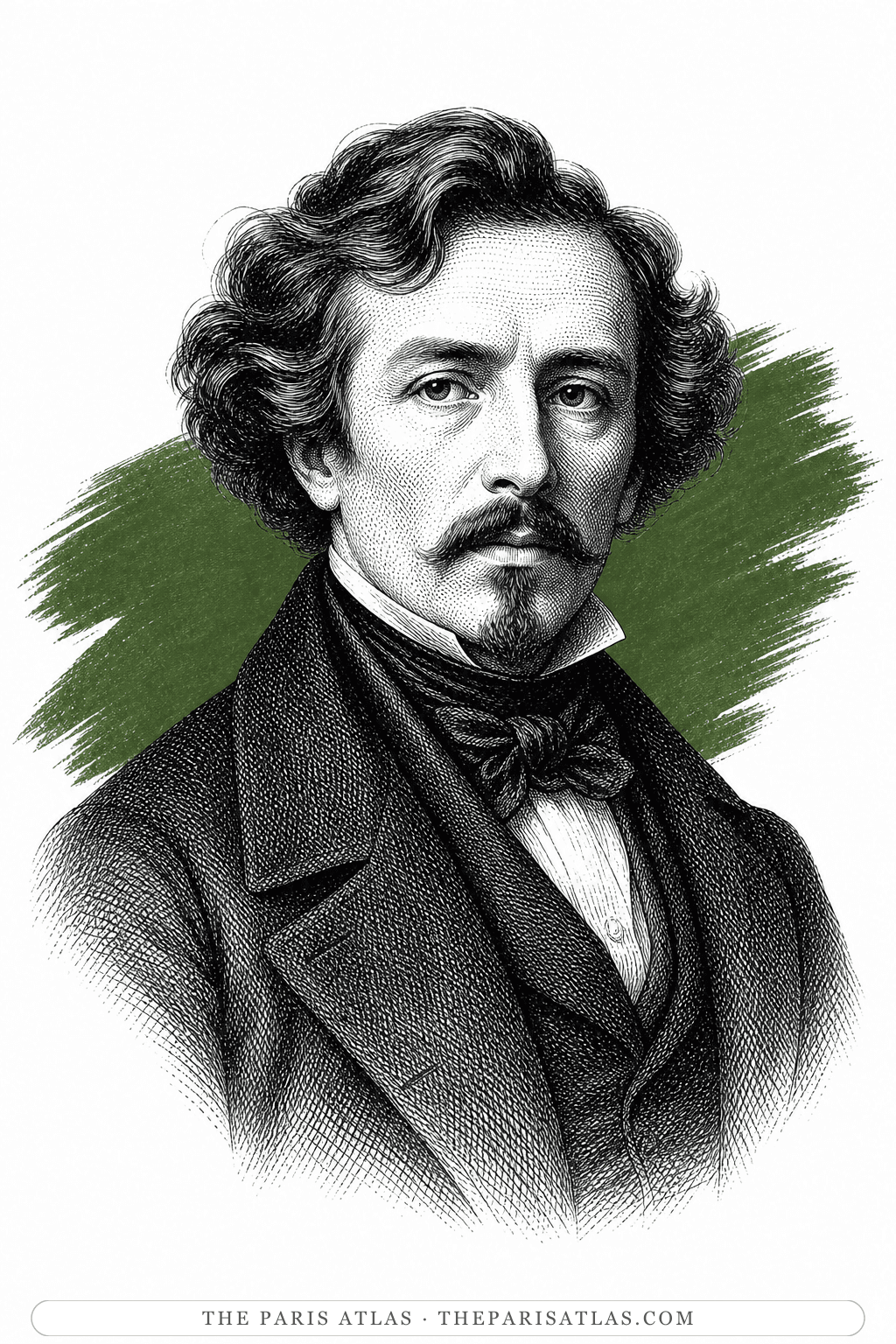
They spent the summer of 1816 as neighbours on Lake Geneva: Byron at the Villa Diodati, the Shelleys and Mary's stepsister Claire Clairmont in a house just below it. Claire had begun an affair with Byron in London and had steered the party there; their daughter Allegra was born the following year. In June, kept indoors by the freakish cold and rain of the year without a summer, Byron proposed that everyone present write a ghost story. Mary Shelley, then eighteen, began Frankenstein, and Byron's physician John Polidori began The Vampyre.
Frankenstein; Miranda Seymour, Mary Shelley (2000)

Who drew from them

Influence running outward — the writers and artists who built on their work.

Eugène Delacroix

Byron's poems gave French Romanticism's leading painter two of his most confrontational pictures. The Combat of the Giaour and Hassan (1826), in the Art Institute of Chicago, comes straight from Byron's 1813 verse tale The Giaour, and the museum's collection record says so. The Death of Sardanapalus, shown at the Paris Salon in 1827, comes from Byron's verse tragedy of 1821, and the Musee national Eugene-Delacroix describes it as inspired by Byron's tragedy. Byron never visited Paris; the Salon is as close as his imagination came.

Musée national Eugène-Delacroix, Biography of Eugène Delacroix (2026); Eugene Delacroix, The Combat of the Giaour and Hassan (1826), collection record 1962.966

Questions about Lord Byron

Did Lord Byron ever visit Paris?

There is no Paris in his record, and this page will not invent one. His 1809-11 Grand Tour was deliberately routed by sea around a France at war — Portugal, Spain, Malta, Albania, Greece, Constantinople. When he left England for good in April 1816 he crossed to Ostend in what is now Belgium, drove through Flanders to Waterloo and went up the Rhine to Switzerland. After that he lived in Venice, Ravenna, Pisa and Genoa before sailing to Greece, where he died. The standard biographies track those years closely and Paris does not appear as a residence, a stop or a friendship.

What is a Byronic hero?

A character type Byron built across Childe Harold's Pilgrimage, the Eastern verse tales — The Giaour, The Corsair, Lara — and the drama Manfred. He is proud, magnetic, contemptuous of ordinary rules, self-exiled, and carrying a guilt or grief the poem never fully explains. The reader is invited to admire him without approving of him. Because Byron's own scandals matched the type so exactly, Europe read the poet and the character as one person, and the figure was copied everywhere — most influentially in France, and eventually in every brooding outsider in fiction, beginning with Heathcliff in Emily Bronte's Wuthering Heights.

Which Delacroix paintings come from Byron?

Two in particular. The Combat of the Giaour and Hassan (1826), in the Art Institute of Chicago, comes from Byron's 1813 poem The Giaour, and the museum's own record says so. The Death of Sardanapalus, shown at the Paris Salon of 1827, comes from Byron's verse tragedy Sardanapalus of 1821; the Musee national Eugene-Delacroix describes it as inspired by Byron. Delacroix was the leading painter of French Romanticism, and the Salon was the state's official annual exhibition in Paris — so Byron's imagination reached the centre of French artistic life without its author ever going there.

Why did Byron leave England in 1816?

Because his marriage collapsed in public. He married Anne Isabella Milbanke in January 1815; she left him in January 1816, taking their newborn daughter, and the separation became a national scandal in which it was openly whispered that he had been sleeping with his half-sister Augusta Leigh. He denied it publicly and not privately. London society turned on him, and in April 1816 he left the country. He never returned alive.

How did Lord Byron die?

Of a fever at Missolonghi, a lagoon town in western Greece, on 19 April 1824, aged thirty-six. He had sailed from Genoa in July 1823 to support the Greek revolt against Ottoman rule, spending his own money on troops and ships and trying to hold rival Greek commanders together; he never fought. When he fell ill his doctors bled him repeatedly, the standard treatment of the period, which almost certainly hastened his death. Greece treated him as a national hero immediately, and still does.

What happened to Byron's memoirs?

They were burned. Byron had given a manuscript autobiography to the poet Thomas Moore, who sold it to the publisher John Murray. On 17 May 1824, a month after Byron's death, Moore, Murray and Byron's friend John Cam Hobhouse tore the pages up and burned them in the fireplace of Murray's drawing room at 50 Albemarle Street in London, on the argument that publication would destroy reputations. No copy survives and nobody knows what was in it.

What is Don Juan about?

It is a comic epic in sixteen cantos, published serially from 1819 until Byron's death and never finished. It takes the old Spanish legend of the great seducer and inverts it: Byron's Juan is an innocent who is seduced by everyone he meets, and the real voice of the poem is the cynical narrator commenting on the action. It is written in ottava rima, an eight-line Italian stanza whose closing couplet lands like a punchline, and Byron used it to attack fellow poets, politicians and the Church. Conservative reviewers called it filthy and impious; Percy Bysshe Shelley thought nothing like it had ever been written in English.

Where are Byron's papers?

Mainly in two archives, both created by the destruction of the memoirs as much as by anything else. The John Murray Archive — the records of the publishing house that printed him, including manuscripts and correspondence — is at the National Library of Scotland in Edinburgh. The Lovelace Byron papers, which descend through his daughter Ada, are deposited at the Bodleian Library in Oxford.

Sourced claims

Every connection the graph holds for Lord, with the evidence behind it.

Influenced · 1826

Eugène Delacroix

Byron's poems gave French Romanticism's leading painter two of his most confrontational pictures. The Combat of the Giaour and Hassan (1826), in the Art Institute of Chicago, comes straight from Byron's 1813 verse tale The Giaour, and the museum's collection record says so. The Death of Sardanapalus, shown at the Paris Salon in 1827, comes from Byron's verse tragedy of 1821, and the Musee national Eugene-Delacroix describes it as inspired by Byron's tragedy. Byron never visited Paris; the Salon is as close as his imagination came.

Musée national Eugène-Delacroix, Biography of Eugène Delacroix (2026); Eugene Delacroix, The Combat of the Giaour and Hassan (1826), collection record 1962.966

Met · 1816

Mary Shelley

They spent the summer of 1816 as neighbours on Lake Geneva: Byron at the Villa Diodati, the Shelleys and Mary's stepsister Claire Clairmont in a house just below it. Claire had begun an affair with Byron in London and had steered the party there; their daughter Allegra was born the following year. In June, kept indoors by the freakish cold and rain of the year without a summer, Byron proposed that everyone present write a ghost story. Mary Shelley, then eighteen, began Frankenstein, and Byron's physician John Polidori began The Vampyre.

Frankenstein; Miranda Seymour, Mary Shelley (2000)

References

References

The sources below include biographies, scholarly essays, interviews, and primary materials that informed this page. They reflect both the historical record and ongoing critical conversations about Lord Byron and their work.

  1. 1Lord Byron

    British Library

    The British Library's summary: the fame after Childe Harold, Don Juan, and the death at Missolonghi in the Greek cause.

    View source
  2. 2Lord Byron, 19th-century bad boy

    British Library

    The British Library on the scandals — Caroline Lamb, the 1816 separation, the rumours about Augusta Leigh.

    View source
  3. 3Don Juan

    British Library

    The British Library on Don Juan: the 1819-24 serial publication, the ottava rima stanza, the satire and the reception.

    View source
  4. 4The Romantics

    British Library

    The British Library on the Romantic generation, its politics, and Byron's support for Greek liberation.

    View source
  5. 5Frankenstein

    British Library

    The British Library on the Villa Diodati ghost-story competition Byron set in June 1816.

    View source
  1. 6Biography of Eugène Delacroix

    Musée national Eugène-Delacroix, 2026

    The Musee national Eugene-Delacroix, which names Byron's tragedy as the source of The Death of Sardanapalus (1827) and dates the Chios picture to the Salon of 1824.

    View source
  2. 7Eugene Delacroix, The Combat of the Giaour and Hassan (1826), collection record 1962.966

    Art Institute of Chicago

    The Art Institute of Chicago's record for The Combat of the Giaour and Hassan (1826), which names Byron's poem The Giaour as its source.

    View source
  3. 8Byron: A Biography

    Alfred A. Knopf, New York, 1957

    The standard scholarly life, used here for the itineraries that contain no Paris.

  4. 9Byron: Life and Legend

    John Murray, London, 2002

    The modern biography, used for the exile, Missolonghi and the burning of the memoirs.

  5. 10Byron et le romantisme francais: essai sur la fortune et l'influence de l'oeuvre de Byron en France de 1812 a 1850

    Hachette, Paris, 1907

    The standard study of Byron's fortune and influence in France from 1812 to 1850 — the source for the Berlioz and Hugo strands of the French afterlife.

i
Why these sources are here

These references anchor the page in the documented record and in the scholarly conversations around Lord Byron. Every claim on this page traces back to one or more of the works listed here.

Explore more resources