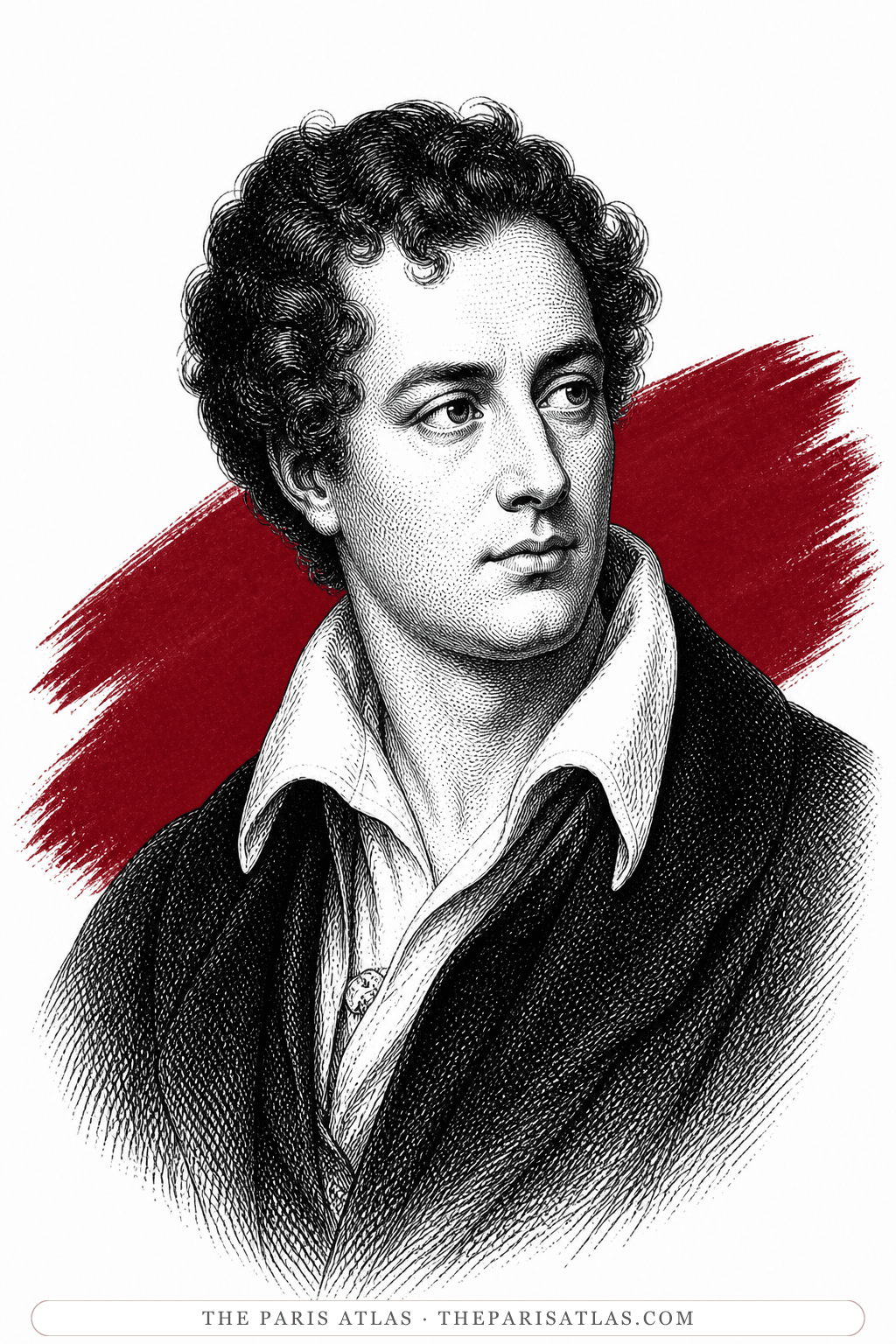
Childe Harold's Pilgrimage
Lord Byron
Childe Harold's Pilgrimage
The poem of the journey that gave Byron the Greek and Turkish settings he used here.
Read our takeThe Giaour
Lord Byron
by Lord Byron
A woman drowned in a sack, a Venetian's revenge and a deathbed confession, told in broken pieces: the Eastern tale that Delacroix painted twice.
The Giaour is a verse tale Lord Byron published in 1813, the year after Childe Harold made him famous. The story is set in Greece under Turkish rule. Leila, a slave in the household of a Turkish lord named Hassan, loves a young Venetian. Hassan has her sewn into a sack and drowned. The Venetian, whom the Turks call the Giaour, ambushes Hassan in a mountain pass and kills him, then spends his last years in a monastery, where he confesses to a monk. Byron tells it in fragments, from several points of view, with gaps the reader has to fill. Giaour was a Turkish insult for a Christian or any non-Muslim.[1][2]
The first edition came out on 5 June 1813 with 685 lines. Byron kept adding passages all summer and autumn. By the seventh edition, at the end of November 1813, the poem had nearly doubled to 1,334 lines. In a letter to his publisher, John Murray, on 26 August, he called it "this snake of a poem, which has been lengthening its rattles every month."[1]
Byron dedicated the poem to the older poet Samuel Rogers. Rogers's The Voyage of Columbus, published the year before, was also told in sudden jumps, and Ernest Hartley Coleridge thought the likeness was more than an accident. What was new was the setting. William Gifford, Murray's literary adviser, called Byron's descriptions of Eastern scenery and customs new and original. Byron had lived in Greece and Turkey, and it showed.[1]
Byron later said the story had some foundation in fact. In Athens in 1810 he had stepped in to save a girl who had been sewn into a sack to be thrown into the sea. His friend John Cam Hobhouse said the girl was loved by Byron's Turkish servant, not by Byron. In his journal Byron wrote that the feelings of that moment were icy even to recollect.[1]
The poem opens on the coast near Athens, beside a tomb said to be that of Themistocles, the Athenian general. The narrator describes Greece as a beautiful dead body, lovely but with no soul left in it. Then the story begins, told in the first sections by a Turkish fisherman who sees parts of it happen.[1]
A young Giaour gallops past on a black horse and snatches one glance behind him. The fisherman hates his race but cannot forget his face. Later a group of Hassan's men come down to the shore carrying a heavy sack. They hire the fisherman to row them out, and he watches the sack sink. The reader learns only afterwards that Leila, Hassan's slave, has disappeared from his household.[1]
Hassan sets out through the mountains with twenty armed men to court a new bride. In a narrow pass they are ambushed by a band of robbers. Their leader, dressed as an Albanian, is the Giaour. He kills Hassan in the fight, then stands over the body and says that Leila sleeps beneath the wave and her spirit guided his sword. The narrator curses him: he will become a vampire after death and feed on his own family.[1]
Years later a monk points out a strange brother who has lived in his monastery for six years. The stranger never kneels at prayers and will not name the dark deed that brought him there. On his deathbed the Giaour finally speaks to a friar. He admits no guilt for killing Hassan, only grief for Leila, and says he sees her ghost. He asks to be buried with no name on his grave.
The poem ends with the narrator admitting how little anyone knows: this broken tale was all we knew of her he loved, or him he slew.
Byron calls the poem a fragment, and he means it. The story jumps from one scene to the next with rows of asterisks between them. Different voices take over without warning: the fisherman, a narrator who comments on the action, the Giaour himself and the monk. The poem never shows Leila's death. The reader works it out from a sack, a sinking shape and a sentence the Giaour speaks over Hassan's body.
The Giaour is the first of the proud, guilty loners in Byron's Eastern tales. He has no name in the poem. He feels no remorse for the killing and refuses the comfort of the Church, but he cannot stop grieving. Byron followed the poem with The Bride of Abydos, The Corsair and Lara. John Murray told Byron he sold ten thousand copies of The Corsair on the day it came out in 1814.
After the killing of Hassan, the narrator lays a curse on the Giaour. His body will be torn from its tomb and sent back as a vampire. He will drink the blood of his daughter, sister and wife, and his youngest child will die blessing him as her father. Byron added a prose note saying the vampire superstition was still general in the Levant, the eastern Mediterranean, when he travelled there.
Eugène Delacroix painted the fight between the Giaour and Hassan more than once. His 1826 version is now in the Art Institute of Chicago, whose record names Byron's poem as the source. A second version, painted in 1835, belongs to the Petit Palais in Paris. The Paris picture shows the Giaour on a black horse lunging at Hassan on a white one, while the horses bite and struggle underneath them.
The poem was on sale in Paris in English in Byron's lifetime. Galignani, the English-language bookseller and publisher at 18 rue Vivienne, printed The Giaour in the first volume of its 1819 edition of Byron's works. A French translation, Le Giaour, by J. M. H. Bigeon, was published in Paris in 1828.
Such is the aspect of this shore; 'Tis Greece, but living Greece no more!
Yes, Leila sleeps beneath the wave, But his shall be a redder grave
This broken tale was all we knew Of her he loved, or him he slew.
A sack, a sinking shape, an ambush and a confession. The reader puts the story together from pieces, and the last line admits nobody knows the whole of it.
Eugène Delacroix painted the fight between the Giaour and Hassan in 1826 and again in 1835. The later version hangs in the Petit Palais in Paris.
The curse laid on the Giaour describes a dead man rising from his tomb to drink his family's blood, three years before the ghost-story summer at the Villa Diodati.
The opening lines mourn Greece under Turkish rule as a beautiful corpse. Byron died in the Greek war of independence eleven years later.
1810
In Athens Byron intervenes to save a girl sewn into a sack to be drowned, the incident he later said lay behind the poem.
1813
John Murray publishes The Giaour on 5 June, 685 lines long, dedicated to Samuel Rogers.
1813
Byron keeps enlarging the poem through the summer and autumn. The seventh edition, at the end of November, reaches its final 1,334 lines.
1819
Galignani prints The Giaour in English in Paris, in the first volume of its edition of Byron's works.
1826
Eugène Delacroix paints The Combat of the Giaour and Hassan, now in the Art Institute of Chicago.
1828
A French translation, Le Giaour, by J. M. H. Bigeon, is published in Paris.
1835
Delacroix paints a second version of the fight. The Petit Palais in Paris bought it in 1963.

Childe Harold's Pilgrimage
Lord Byron
The poem of the journey that gave Byron the Greek and Turkish settings he used here.
Read our takeDon Juan
Lord Byron
The Greek island and the harem cantos return to the same world, played for comedy.
Read our takeHebrew Melodies
Lord Byron
Written two years later, with the same taste for Eastern scenes in short lyric form.
Read our takeThe Prisoner of Chillon and Other Poems
Lord Byron
Another poem about a solitary man living with a loss, written three years later in Switzerland.
Read our takeA Turkish insult for a Christian or other non-Muslim. The Art Institute of Chicago's record for Delacroix's painting of the poem defines it that way. In Byron's poem it is the only name the Venetian hero is given.
Leila, a slave in the household of a Turkish lord named Hassan, loves a Venetian. Hassan has her drowned in a sack. The Venetian ambushes Hassan in a mountain pass and kills him, then spends his last years in a monastery. On his deathbed he confesses to a friar.
Byron tells the story in disconnected pieces, with rows of asterisks between them and several different narrators. His advertisement at the front calls them disjointed fragments and sums up the plot the poem never tells straight.
Partly. Byron said it had some foundation in fact. In Athens in 1810 he helped save a girl who was about to be drowned in a sack. His friend John Cam Hobhouse said she was loved by Byron's Turkish servant, not by Byron.
Yes, in a curse. After the killing of Hassan the narrator says the Giaour will rise from his tomb after death as a vampire and drink his family's blood. Byron added a note saying the belief was still common in the eastern Mediterranean.
The Combat of the Giaour and Hassan of 1826, now in the Art Institute of Chicago, and Le Combat du Giaour et du Pacha of 1835, now in the Petit Palais in Paris.
Explore authors with a similar voice, perspective, and influence.
The doctor of the Paris slums who wrote the century's blackest, funniest novel — and changed the sound of French prose.
View author
The Brooklyn dropout who arrived in Paris broke at thirty-eight and wrote the exuberant, banned books that ended American censorship.
View author
American poet and novelist of Los Angeles rooming houses, racetracks and the post office, who quit his job to write when a publisher offered him a hundred dollars a month. He came to Paris once, in September 1978, drank his way through a live television book programme and walked off the set — and French television has been replaying it ever since.
View authorThe sources below include the primary text, editions, scholarship, archival materials, and other records that informed this page. They document The Giaour, its publication, and its place in literary history.


The full poem with Byron's notes and Ernest Hartley Coleridge's introduction and bibliographical note: the dates and line counts of each edition, the Athens incident, the dedication to Rogers and the letter about the snake of a poem. The quotations and line numbers were checked against it.

The Art Institute of Chicago's record for Delacroix's 1826 painting, which names the poem as its source and defines the word giaour.
The Paris Musées record for Delacroix's 1835 version at the Petit Palais, with its description of the two riders and the date of purchase.
Coleridge's bibliography, used for the 1819 Galignani edition printed in Paris and the 1828 French translation.
Catalogue records for the modern reprints, used for the ISBN.
The primary text represented by this page, used for descriptions of the work’s contents and for any quoted passages shown here.
The primary text is the baseline reference for every book page. Additional references document publication history, interpretation, and historical context where that evidence is available.
 Explore more resources